98%
Placed
in 2025






Brainware University transformed me, fostering confidence and capability for conquering the world.
Master of Science in Mathematics is a 2-year postgraduate programme focused on advanced mathematical theory, analytical reasoning, abstract thinking, modelling, statistics, computation, and applied problem-solving. The course is designed for graduates who want deeper academic training in mathematics and want to build careers in education, research, data analytics, finance, actuarial science, statistics, quantitative analysis, technology, and government sectors.
The MSc Mathematics programme at Brainware University helps students strengthen their understanding of pure and applied mathematics while developing logical reasoning, quantitative ability, research orientation, and computational awareness. Applicants will find complete information on this page about MSc Mathematics courses, MSc Maths duration, eligibility, admission process, fees, syllabus outline, career options, internship scope, placement support, and learning benefits.
The applicants will find all MSc Mathematics admission-relevant information on this page, including MSc Mathematics courses overview, MSc Maths admission, syllabus outline, MSc Maths career options, as well as learning benefits. Details concerning the course, MSc Mathematics eligibility, Mathematics career options and MSc Mathematics admission criteria are provided as well.


MSc Mathematics at Brainware University is a 2-year postgraduate programme focused on advanced mathematical concepts, analytical reasoning, real and complex analysis, algebra, differential equations, statistics, mathematical modelling, computation, and applied problem-solving. The programme prepares students for careers in education, research, analytics, finance, actuarial science, data science, and quantitative roles.
| Programme | Master of Science in Mathematics |
|---|---|
| Duration | 2 years |
| Focus Areas | Real Analysis, Complex Analysis, Abstract Algebra, Linear Algebra, Differential Equations, Numerical Methods, Probability, Statistics, Mathematical Modelling, Operations Research, Discrete Mathematics, Computational Mathematics, Financial Mathematics, Data Interpretation, Optimisation, and Research Methods. |
| Salary | Graduates of MSc Mathematics may explore entry-level salary packages commonly ranging from ₹3 LPA to ₹6 LPA, depending on role, analytical skills, computational exposure, internship experience, recruiter profile, and interview performance. Higher growth may be possible in data analytics, quantitative finance, actuarial science, risk analysis, research, teaching, and technology-linked mathematical roles with experience and added certifications. |
| Popular Job Types | Quantitative Risk Analyst, Statistician, Data Analyst, Data Interpreter, Quantitative Developer, Treasury Management Specialist, Econometrician, Demographer, Enumerator, Accountant, Loan Officer, Equity Quantitative Analyst, Interest Rate Trading Strategist, Statistical Programmer, Research Assistant, Teacher, and Academic Professional. |
| Hiring Industries | Education, research institutions, data analytics firms, IT companies, banking and finance, insurance, actuarial services, consulting, government statistical departments, public policy organisations, market research firms, fintech companies, investment firms, healthcare analytics, biotechnology research, and academic institutions. |
| Top Recruiters | MSc Mathematics graduates may find opportunities with educational institutions, research organisations, analytics companies, IT firms, banks, insurance companies, consulting firms, public-sector organisations, statistical agencies, and financial service companies. Recruiter participation may vary by year, student profile, skill level, internship exposure, and placement cycle. |
| Specializations | Pure Mathematics, Applied Mathematics, Statistics, Mathematical Modelling, Operations Research, Computational Mathematics, Financial Mathematics, Data Analytics, Quantitative Methods, Actuarial Foundations, Numerical Analysis, and Research Mathematics. |
| Higher Studies | Graduates can pursue PhD programmes in Mathematics, Applied Mathematics, Statistics, Data Science, Operations Research, Financial Mathematics, Computational Mathematics, Economics, or related interdisciplinary domains. They may also pursue certifications in data science, actuarial science, machine learning, financial modelling, Python, R, MATLAB, SAS, and analytics tools. |
| Benefits | The programme supports advanced mathematical learning through conceptual training, problem-solving practice, research-oriented study, computational exposure, analytical assignments, project work, faculty mentorship, and placement-oriented preparation. It is suitable for students seeking MSc Mathematics, master of science maths, masters in mathematics, or MSc mathematics courses with strong academic depth. |
| Internship and Placement | Students receive exposure to internships, live projects, analytical assignments, industry visits, research work, pre-placement training, interview preparation, and placement assistance. The programme aims to build job-ready skills for analytics, education, research, finance, actuarial services, statistics, and quantitative career pathways. |
| Location | Brainware University, Barasat, Kolkata, West Bengal. |
| Approvals & Recognition | Brainware University is a UGC-recognised university. The MSc Mathematics programme is offered under the university’s academic framework, with curriculum, evaluation, and learning outcomes aligned with postgraduate mathematics education standards. |
MSc Mathematics is a strong postgraduate choice for students who want careers in teaching, research, analytics, finance, statistics, actuarial science, data science, computing, and quantitative decision-making. The programme develops advanced problem-solving ability, abstract reasoning, mathematical modelling, statistical thinking, and analytical precision required across modern academic and industry roles.
Mathematics remains central to artificial intelligence, machine learning, cryptography, risk modelling, economics, engineering, finance, scientific research, and data interpretation. A master’s degree in mathematics helps students move beyond undergraduate concepts and develop deeper theoretical and applied competence.
Key reasons to study MSc Mathematics include:

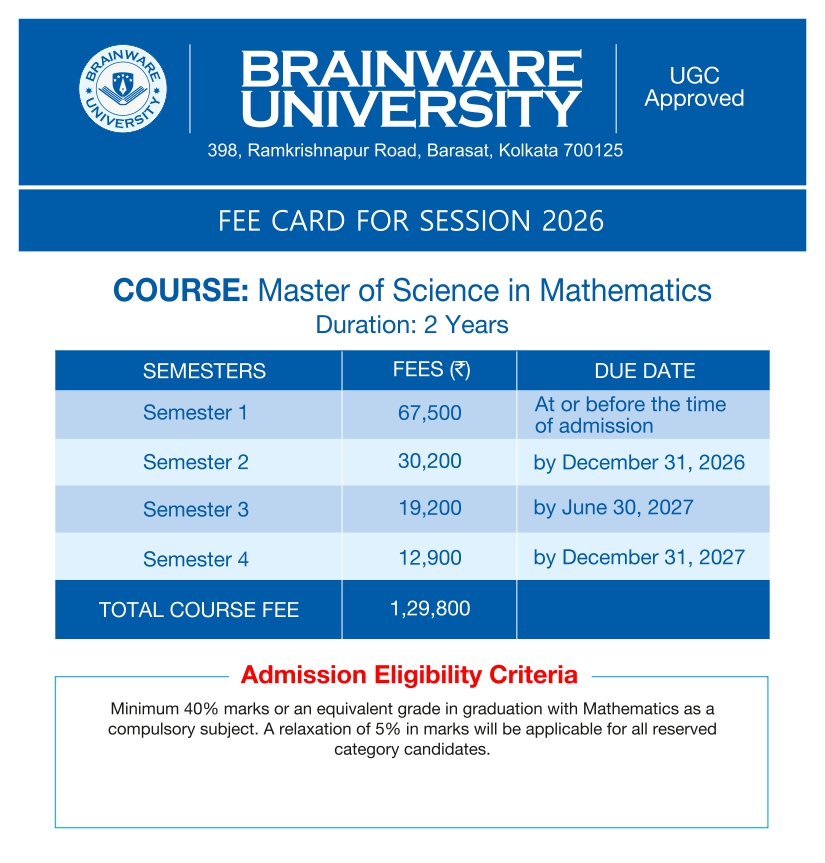
Educational Qualification: Candidates must have completed graduation or an equivalent degree with Mathematics as a compulsory subject from a recognised university or institution.
Minimum Marks: Applicants are required to secure a minimum of 40% marks or an equivalent grade in graduation.
A 5% relaxation in marks is applicable for reserved category candidates, as per government and university norms.
Entrance Examination: Admission to the M.Sc. Mathematics programme at Brainware University is based on performance in the Brainware Entrance Test (BET), which is the university’s official entrance examination for postgraduate programmes.
Concerned about the M.Sc. Mathematics fees? At Brainware University, we offer a rigorous postgraduate education in Mathematics at an affordable cost, ensuring that financial limitations never hold back your academic ambitions. Our M.Sc. Mathematics programme is thoughtfully priced to make advanced mathematical education accessible without compromising on quality.
Designed for graduates passionate about higher mathematics, this programme builds strong analytical and problem-solving skills through in-depth study of areas such as algebra, real and complex analysis, differential equations, and applied mathematics—preparing students for careers in academia, research, analytics, and beyond.
The MSc Mathematics fee structure at Brainware University is designed to support quality postgraduate education in advanced mathematics, applied mathematics, statistics, research methods, computation, and analytical problem-solving. The fee generally covers academic instruction, project work, learning support, research guidance, student development, and placement-oriented preparation as per university norms.
| Semesters | Semester 1 | Semester 2 | Semester 3 | Semester 4 | Semester 5 | Semester 6 | Semester 7 | Semester 8 | Semester 9 | Semester 10 | Total |
|---|---|---|---|---|---|---|---|---|---|---|---|
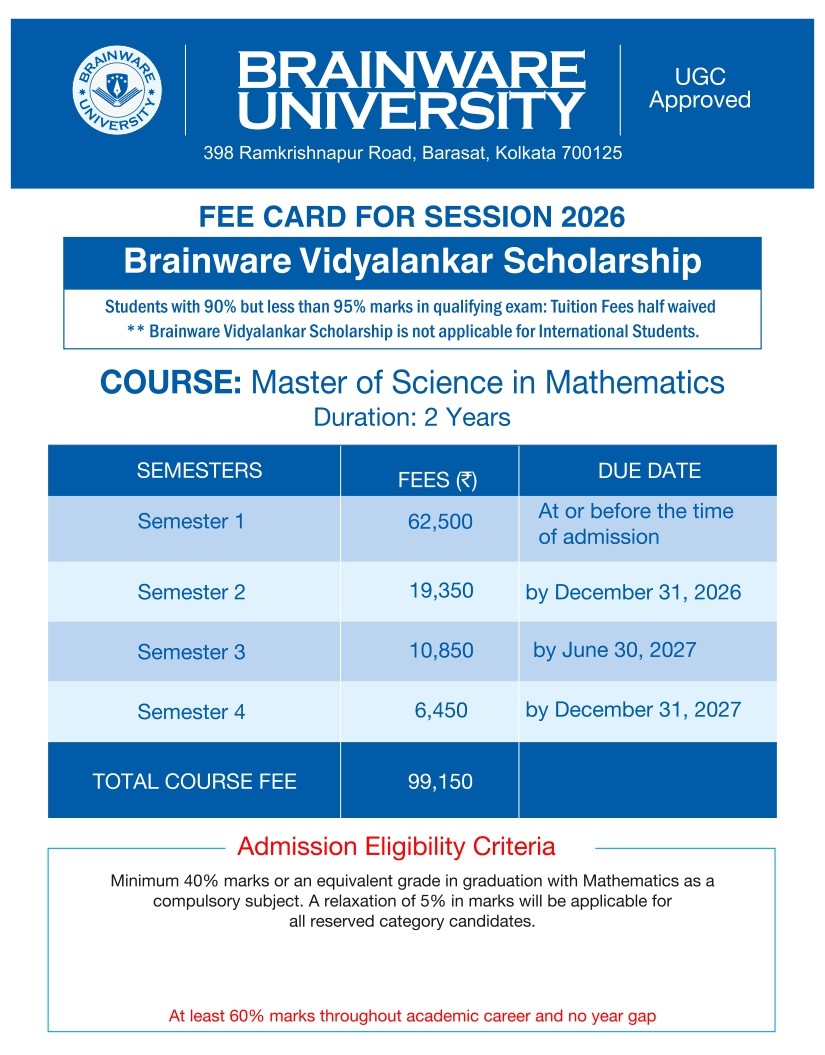
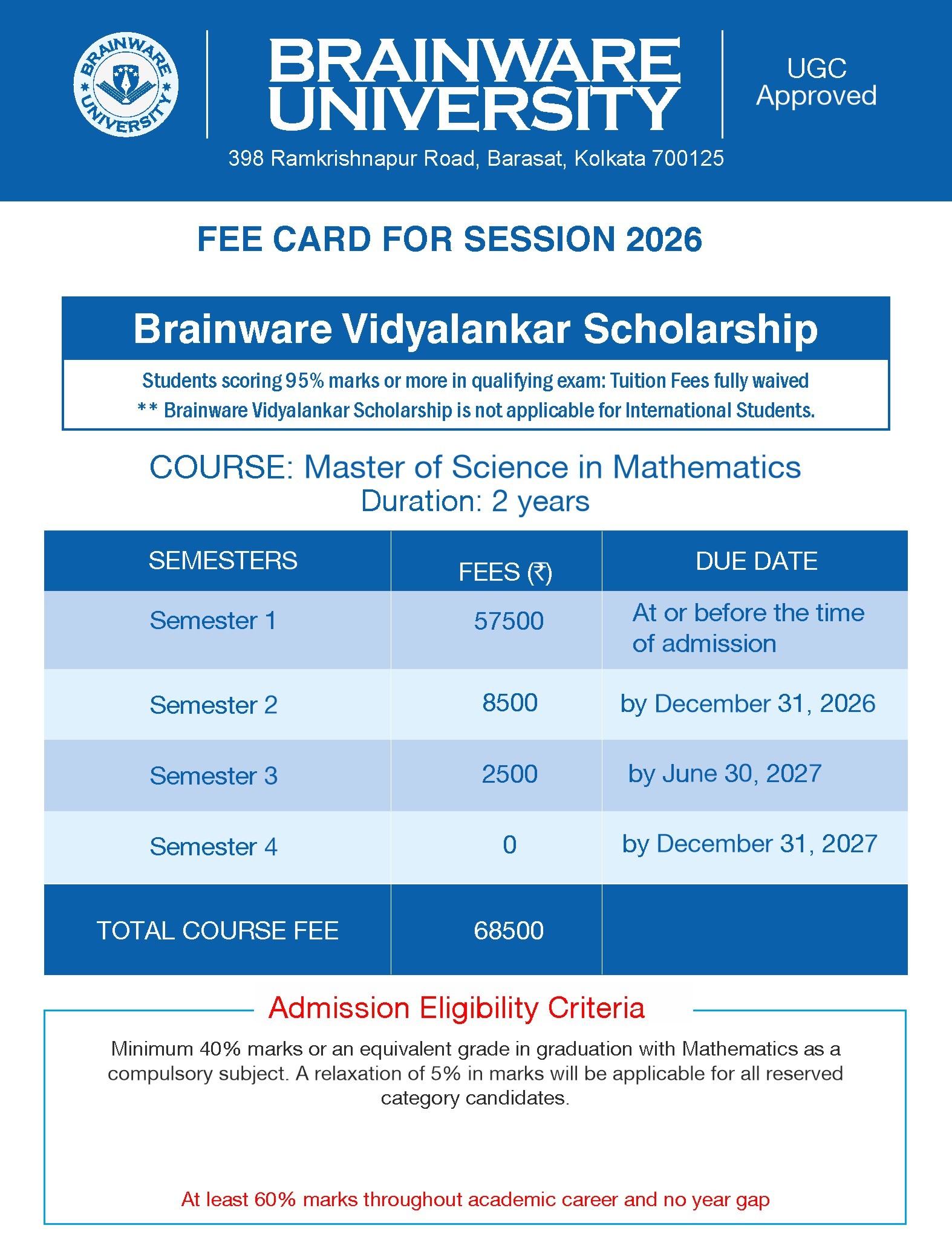
| Fees (INR) | 67500 | 30200 | 19200 | 12900 | 1,29,800 |
**Fees are subject to change, and the application fee of ₹5,000 is non-refundable under any circumstances. Please contact us for further details.
Scholarships(Fees): Brainware University offers merit-based scholarships for top performers and financial aid for deserving students. Scholarships are available for high scorers in entrance exams, board results, and outstanding achievements in innovation or research. Visit our scholarship page for more details.
**Please note that the Brainware Vidyalankar Scholarship is available only to students who passed their qualifying examination in the current admission year. Also, eligibility is strictly restricted to Indian nationals; international students are not eligible to apply.
AI-driven academic and industry innovation has increased the value of advanced mathematics because artificial intelligence, machine learning, cryptography, optimisation, data science, financial modelling, and simulation all depend on mathematical foundations. MSc Mathematics students learn how abstract theory connects with real-world computation, analytics, and technology-led problem solving.
The programme helps students understand how mathematical ideas support modern digital systems. Concepts from linear algebra, probability, statistics, calculus, optimisation, graph theory, and numerical methods are used in AI models, data analysis, algorithm design, risk prediction, scientific computing, and engineering applications.
AI and digital innovation are relevant in areas such as:

The end-to-end AI learning spectrum in MSc Mathematics covers the mathematical path from theory to computation and application. Students learn how mathematical structures, probability models, statistics, optimisation techniques, and numerical methods support AI systems, analytics workflows, and quantitative decision-making.
This learning approach helps students see mathematics as both an abstract discipline and a practical tool for solving complex problems. Strong mathematical thinking is especially important in AI because models must be interpreted, validated, optimised, and evaluated carefully.
Key learning areas include:





Brainware University is a strong choice for MSc Mathematics because the programme combines advanced mathematical theory with applied problem-solving, computational awareness, research orientation, industry skill training, and placement support. The course is designed for students who want academic depth as well as career readiness in mathematics-linked domains.
The programme is suitable for students searching for MSc Mathematics, master of science maths, masters in mathematics, best university for maths, good universities for maths, or MSc Mathematics colleges in West Bengal. It helps students build analytical discipline, logical thinking, research skills, and readiness for modern quantitative careers.
Key academic strengths include:
The best colleges for MSc Mathematics should offer a strong mix of advanced theory, applied mathematics, statistics, computational exposure, research guidance, placement support, and higher-study preparation. Students should compare curriculum quality, faculty experience, research environment, internship support, fee structure, eligibility, and admission process before selecting a college.
Brainware University is a relevant option for students searching for the best university for maths, good universities for maths, best mathematics university, Best College for mathematics, or MSc Mathematics colleges in Kolkata and West Bengal.
When comparing mathematics colleges, students should check:

Alumni of MSc Mathematics can build careers across education, research, data analytics, finance, statistics, banking, insurance, consulting, and technology. Their career journeys show how advanced mathematical training can support both academic progression and industry roles that require logical reasoning, quantitative analysis, modelling, and problem-solving.


Brainware University has earned an AA+ rating in India’s Best Engineering Institutes by Careers360. The recognition reflects the University’s strength in academic quality, faculty, infrastructure, research, and student outcomes, reinforcing its position as a trusted destination for industry-aligned engineering education.

Brainware University has been ranked No. 1 Engineering College under a Private University in West Bengal in the IIRF Rankings 2026. The recognition highlights the University’s strength in engineering education, industry-focused learning, research, emerging technologies, and placement outcomes.

Brainware University has been ranked No. 2 Private University in West Bengal by uniRank 2026, marking another recognition of the University's growing presence in the state's higher education landscape.

Brainware University's inclusion in the Times Higher Education (THE) Impact Rankings 2025 reflects its contribution to the UN Sustainable Development Goals (SDGs) through education, innovation, sustainability, community engagement, and responsible institutional practices.

Brainware University has been recognised as the Best Private University of West Bengal in Infrastructure & Placement at Times Now.in – Leaders of Excellence: East 2026, celebrating its commitment to world-class infrastructure and career-focused education.

Brainware University has been recognised by The Times Group for excellence across Engineering (Placement), Law, and MBA Studies. The honours reflect the University’s multidisciplinary strength and its focus on career-oriented, industry-relevant education.

Brainware University received the ABP Ananda Shiksha Samman 2026 for Excellence in Placement & AI-Integrated Academic Infrastructure, acknowledging its emphasis on placement opportunities alongside technology-enabled academic development.

Brainware University has been honoured with the Zee 24 Ghanta Education Excellence Award 2026 for Best Industry Placement & Academic Infrastructure, continuing its recognition in 2022, 2023, 2024, 2025, and 2026. The University was also recognised in 2017 and 2018 for its job-oriented academic initiatives.

Brainware University received the TV9 Uttaran Academic Excellence Honour for Excellence in Placement & AI-Integrated Academic Infrastructure, highlighting its focus on combining career opportunities with an AI-enabled academic and learning environment.

Brainware University was honoured with the R Bangla Sikkha Gourab Samman 2026, recognising its contribution to higher education and continued pursuit of academic excellence and career-focused learning.

Brainware University was honoured as the Best Private University in West Bengal at the Times Now in Business Excellence Awards (East) 2025, recognising its academic quality, modern infrastructure, industry engagement, and focus on student success.

Brainware University was recognised as the Leading University in Infrastructure, Academics & Placement at the Times Business Awards West Bengal 2025, highlighting its strong campus facilities, academic ecosystem, and placement performance across disciplines.

The MSc Mathematics syllabus is designed to build postgraduate-level expertise in pure mathematics, applied mathematics, statistics, mathematical modelling, analysis, algebra, differential equations, numerical methods, and computational thinking. The curriculum supports both academic depth and applied quantitative problem-solving.
The syllabus prepares students to understand abstract mathematical structures, solve complex problems, analyse data, build models, and apply mathematical methods in research, finance, technology, education, and scientific domains.
The core foundation modules in MSc Mathematics help students develop an advanced understanding of mathematical theory, proof techniques, analytical reasoning, and problem-solving methods. These subjects build the academic base required for research, higher studies, teaching, and quantitative careers.
Core learning areas include:
These foundation areas help students develop rigorous mathematical thinking and advanced conceptual clarity.
The evolving and high-growth areas in MSc Mathematics prepare students for opportunities in data science, AI, finance, actuarial science, cryptography, scientific computing, optimisation, and quantitative research. These areas are becoming increasingly important as industries use mathematical models for prediction, automation, and decision-making.
Advanced learning areas include:
These modules help students build practical readiness for careers in analytics, finance, research, technology, and applied mathematics.
| Semester | Course |
|---|---|
| Semester I | Research Methodology and Ethics |
| Linear Algebra | |
| Real Analysis | |
| General Topology | |
| Elective I: Operations Research, Mathematical Statistics, Financial Mathematics or MOOC | |
| Ordinary and Partial Differential Equations | |
| Numerical Analysis with Computer Programming | |
| Semester II | Abstract Algebra |
| Complex Analysis | |
| Measure Theory and Integration | |
| Functional Analysis | |
| Integral Equations and Calculus of Variations | |
| Elective II: Dynamical Systems, Applied Statistics, Cryptography or MOOC | |
| R Programming and Python | |
| Professional Communication, Collaboration, and Career Skills | |
| Semester III | Fuzzy Logic |
| Differential Geometry | |
| Project | |
| Semester IV | Dissertation |
Please note that the syllabus is subject to modification. Visit our Syllabus page for the elective subject details and updated syllabus.

MSc Mathematics graduates can work in private-sector roles across analytics companies, IT firms, banks, insurance companies, consulting firms, fintech companies, investment organisations, market research firms, education companies, and technology-driven businesses. Career growth depends on analytical ability, computational skills, statistical knowledge, internship exposure, and communication confidence.
Students with strong skills in statistics, modelling, Python, R, MATLAB, data interpretation, financial mathematics, and logical reasoning are better positioned for quantitative industry roles.
MSc Mathematics graduates may explore government and public-sector opportunities in education, research, statistics, banking, public policy, defence research, scientific organisations, census and survey departments, public-sector finance, and competitive examination pathways. These roles often require strong quantitative reasoning, analytical writing, data interpretation, and mathematical knowledge.
Candidates should check official recruitment notifications, eligibility rules, examination patterns, and organisation-specific requirements.
MSc Mathematics career prospects are strong for students who want to work in education, research, data analytics, finance, statistics, actuarial science, technology, public policy, and quantitative decision-making. A Master of Science in Mathematics develops analytical ability, logical reasoning, modelling skill, numerical accuracy, and abstract problem-solving.
| Area of Opportunity | Why It’s in Demand |
|---|---|
| Quantitative Risk Analyst | Financial Stability: Vital for banks to predict potential losses using models such as Value-at-Risk (VaR). They ensure the institution remains stable during market volatility. |
| Enumerators | Data Integrity: High-level mathematicians are needed to lead large-scale surveys, such as national censuses, to ensure sampling accuracy and eliminate statistical bias. |
| Treasury Management Specialist | Liquidity & Hedging: Essential for managing a corporation’s cash flow and using advanced mathematics to hedge against interest rate or currency fluctuations. |
| Demographer | Socio-Economic Planning: Needed by governments to analyse population trends, including birth, death, and migration, to plan future infrastructure and healthcare requirements. |
| Econometrician | Macro-Economic Forecasting: Uses mathematical models to test economic theories and forecast trends such as inflation and GDP growth for policy-making. |
| Quantitative Developer | Algorithm Implementation: Highly demanded in FinTech to translate complex mathematical models into high-performance code using programming languages such as C++ and Python for automated trading. |
| Statistician | Scientific Validation: A core role in clinical trials and public policy that involves designing experiments and ensuring that results are mathematically significant and valid. |
| Accountant | Advanced Auditing: MSc graduates bring a high level of numerical accuracy to complex corporate auditing, forensic accounting, and tax strategy. |
| Data Interpreters | Bridging Data & Strategy: Essential for translating dense statistical outputs into plain-English insights that business executives can use to make decisions. |
| Loan Officer | Credit Risk Logic: Uses predictive modelling to determine the likelihood of borrower default and optimise a bank’s lending portfolio against risk. |
| Equity Quantitative Analyst | Portfolio Alpha: Focuses on identifying undervalued stocks and optimising investment portfolios through mathematical factor models. |
| Data Analyst | Operational Efficiency: Needed across industries to identify patterns in large datasets that can improve customer retention, operational performance, or supply chain logistics. |
| Interest Rate Trading Strategist | Fixed-Income Insight: A specialised role that involves predicting central bank decisions and interest rate movements to trade bonds and derivatives profitably. |
| Statistical Programmer | Clinical & Biotech Research: Crucial for writing technical scripts using SAS or R to process data for drug approval and regulatory compliance. |
The career scope after MSc Mathematics depends on the student’s mathematical foundation, computational skills, project work, internship exposure, communication ability, and career specialisation. Graduates who combine advanced mathematics with statistics, programming, data analysis, finance, or research methods can build stable careers across academic and industry sectors.
The job market for MSc Mathematics graduates is expected to grow steadily from 2025 to 2032 as industries increase their use of analytics, AI, financial modelling, risk management, statistics, optimisation, and quantitative decision-making. Employers will need professionals who can interpret complex data, build models, test assumptions, and solve structured problems.
Mathematics graduates will find growing relevance in data science, finance, insurance, education, research, technology, public policy, and scientific computing. WEF has identified AI, big data, analytical thinking, and technology skills as major areas of future demand, while employment of mathematicians and statisticians is projected to grow faster than the average for all occupations in the United States.
Mathematics career growth will be driven by the expansion of data analytics, AI, financial risk modelling, actuarial services, scientific research, business forecasting, cybersecurity, and quantitative technology. Organisations will need professionals who understand mathematical logic, probability, statistics, optimisation, and modelling.
Major growth drivers include:
The fastest-growing roles for MSc Mathematics graduates will include Data Analyst, Statistician, Quantitative Risk Analyst, Quantitative Developer, Actuarial Analyst, Econometrician, Operations Research Analyst, Financial Modelling Associate, Statistical Programmer, and Mathematics Educator. These roles require quantitative reasoning, modelling ability, data interpretation, and computational skill.
High-growth career roles include:
MSc Mathematics graduates will find opportunities in sectors that depend on quantitative reasoning, forecasting, modelling, data analysis, and problem-solving. Hiring is expected across education, analytics, finance, insurance, IT, research, consulting, and public-sector organisations.
Key hiring industries include:
The most valuable mathematics skills from 2025 to 2032 will include analytical reasoning, statistics, probability, optimisation, mathematical modelling, programming, data interpretation, financial mathematics, numerical methods, and research ability. Employers will prefer candidates who can combine mathematical depth with computational and communication skills.
Important skill areas include:
The growth outlook for MSc Mathematics graduates is positive because mathematics supports many of the fastest-changing career areas, including AI, analytics, finance, cybersecurity, optimisation, research, and education. By 2032, the strongest opportunities will favour students who combine advanced mathematical knowledge with software skills and applied project experience.
Students should focus on building:
The future mathematics job market will reward students who can think abstractly, model real problems, analyse data, and explain results clearly. Employers will seek professionals who combine logic, precision, computational ability, and business or research understanding.
For students choosing a best mathematics university or MSc Mathematics college, the focus should be on curriculum quality, faculty mentorship, research exposure, computational learning, placement support, and higher-study guidance. Brainware University’s MSc Mathematics programme is structured to support these academic and career needs for students aiming at mathematics-linked careers from 2025 onwards.


MSc Mathematics admission 2026 at Brainware University is open to eligible graduates who want advanced postgraduate training in mathematical theory, applied mathematics, statistics, modelling, computation, and analytical reasoning. Applicants should review eligibility, BET requirements, application steps, counselling process, fees, scholarships, and required documents before applying.
Admission Criteria: Admission to MSc Mathematics is based on academic eligibility and university admission norms. Candidates must have completed graduation or an equivalent degree with Mathematics as a compulsory subject from a recognised university or institution. Applicants must meet the required minimum marks, and admission is based on performance in BET, the Brainware Entrance Test, as mentioned in the uploaded course draft.
Application: Candidates can apply online by filling up the enquiry or application form on the Brainware University website. Applicants need to provide their name, course preference, location, phone number, email ID, and academic details. After submission, the admission counselling team will guide them through the next steps.
Entrance Exam: Admission to the MSc Mathematics programme is based on BET, the Brainware Entrance Test conducted by the university for postgraduate admission. Candidates should confirm the current BET schedule, mode, syllabus, and selection requirements with the admission office before applying.
Counselling: After application and eligibility review, shortlisted candidates receive counselling support from the university admission team. Counselling helps students understand the MSc Mathematics course, eligibility, fees, syllabus, scholarship options, placement scope, documents required, and final admission steps.
Direct Admission: Direct admission may be available for eligible candidates as per university norms, seat availability, and admission criteria. Students seeking MSc Mathematics admission, MSc Mathematics direct admission, MSc Math admission, or admission for MSc Mathematics should contact the admission counsellor to confirm eligibility, BET requirements, documents, fee details, and the latest admission procedure.
Please follow the MSc Mathematics admission procedure at Brainware University:

The Department of Mathematics at Brainware University supports academic and applied learning through seminars, workshops, invited lectures, student activities, research-oriented discussions, project work, and interdisciplinary learning opportunities. These activities help students connect mathematical theory with applications in analytics, computation, finance, science, and education.

An MSc in Mathematics is a postgraduate degree program that focuses on advanced mathematical theory, analysis, and applications. It provides students with a deeper understanding of various mathematical disciplines, including algebra, analysis, geometry, probability, statistics, and numerical methods.
Students should choose Brainware University for MSc in Mathematics in 2026 because the programme builds advanced knowledge in pure mathematics, applied mathematics, statistics, computational methods, and analytical problem-solving. With academic guidance, research-oriented learning, a 98% placement rate across courses, 1000+ recruiters, and placement support, Brainware University prepares students for careers in teaching, research, analytics, finance, data science, competitive examinations, and higher studies.
The prerequisites for pursuing an MSc in Mathematics may vary among institutions. Typically, a bachelor's degree in mathematics or a closely related field is required. Some programs may have specific course prerequisites or require a minimum GPA.
An MSc in Mathematics program covers a broad range of subjects, including advanced topics in algebra, analysis, geometry, number theory, probability theory, mathematical modeling, differential equations, numerical methods, and mathematical statistics.
Graduates can pursue careers in academia, finance, insurance, consulting, data analysis, technology, cryptography, engineering, and government agencies. Job roles include mathematician, data analyst, quantitative analyst, risk analyst, and operations researcher.
Some MSc programs may consider applicants from other disciplines who have a strong mathematical background. Additional prerequisite courses may be required. Admission criteria vary, so it is best to check with the institution.
Yes, some institutions offer MSc in Mathematics programs online or through distance learning formats. These programs provide flexibility for students who cannot attend on-campus classes. It is essential to ensure the program is accredited.
Students develop advanced mathematical skills, analytical thinking, problem-solving abilities, logical reasoning, data analysis, programming, mathematical modeling, and critical thinking.
The duration typically ranges from 1 to 2 years, depending on whether it is a full-time or part-time program. Some programs include a research project or thesis component.
M.Sc. in Mathematics is a postgraduate program that focuses on advanced mathematical theories, analytical problem-solving, and applications in science, engineering, and technology.
Brainware University offers industry-relevant coursework, expert faculty, and research opportunities, making it a top choice for M.Sc. Mathematics.
You need a B.Sc. in Mathematics or a related field. Admission may be based on merit or entrance exams.
The curriculum includes Real Analysis, Algebra, Number Theory, Probability & Statistics, Differential Equations, and Mathematical Modeling.
The program is 2 years long, divided into 4 semesters.
Graduates can work as Data Scientists, Statisticians, Mathematicians, Actuaries, Research Analysts, and Educators.
Entry-level salaries start from ₹5-8 LPA, while experienced professionals can earn ₹12-20 LPA in fields like finance, data science, and research.
Top employers include ISRO, DRDO, IBM, TCS, Infosys, Goldman Sachs, and research institutions.
Focus on problem-solving, mathematical reasoning, programming (Python, R), and statistical analysis.
Yes, it offers diverse career opportunities in academia, research, finance, data analytics, and IT industries.
Key skills include logical reasoning, data interpretation, mathematical modeling, and proficiency in computational tools.
Python, MATLAB, R, and C++ are widely used in data science, analytics, and computational mathematics.
Practice logical puzzles, participate in mathematics competitions, and take advanced courses in calculus and algebra.
Certifications in Data Science, Actuarial Science, Machine Learning, and Financial Modeling can enhance job prospects.
Include research projects, computational skills, internships, certifications, and problem-solving expertise.
Mathematics is used in AI, Machine Learning, Cryptography, Quantum Computing, and Financial Analytics.
AI is helping in automating theorem proving, optimizing algorithms, and solving complex mathematical models.
Mathematics plays a key role in statistical analysis, predictive modeling, deep learning, and optimization techniques.
Pursue Ph.D. programs, collaborate on research projects, publish papers, and work with mathematical institutions.
Financial mathematics is in high demand in banking, investment firms, hedge funds, and risk management.