
98%
Placed
in 2025






General Nursing and Midwifery, commonly known as GNM Nursing, is a 3-year diploma programme focused on patient care, medical-surgical nursing, community health, maternal and child health, midwifery, mental health nursing, nutrition, pharmacology, and clinical practice. The programme prepares students for nursing roles in hospitals, clinics, nursing homes, community health centres, maternity facilities, and public health organisations.
The GNM course at Brainware University combines classroom learning with clinical training, patient-care practice, hospital exposure, community health activities, and placement preparation. Applicants will find complete information on this page about GNM course details, duration, fees, eligibility, syllabus, admission, career options, clinical exposure, placement support, and higher-study pathways.
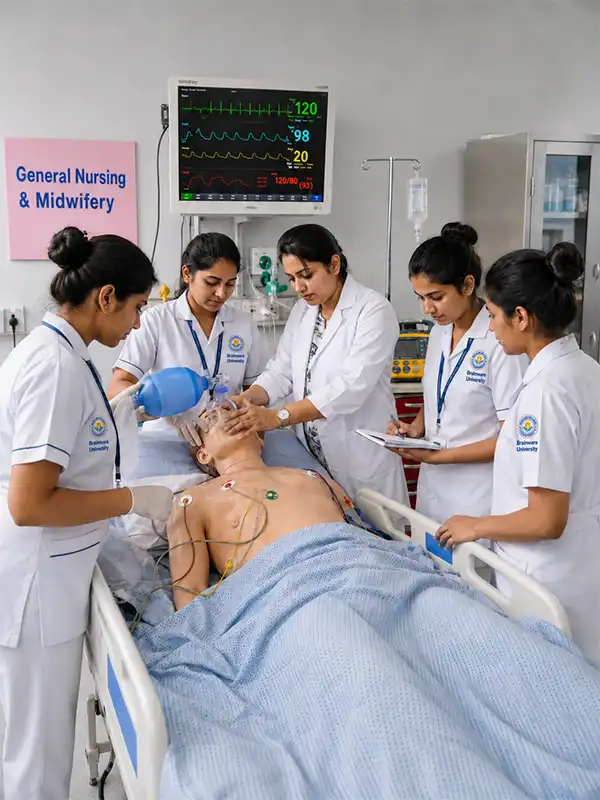

GNM Nursing at Brainware University is a 3-year diploma programme that develops practical skills in patient care, clinical nursing, community health, midwifery, maternal care, child health, emergency support, and healthcare communication. The programme prepares students for entry-level nursing roles and further study in nursing and allied healthcare.
| Focus Areas | Fundamentals of Nursing, Medical-Surgical Nursing, Community Health Nursing, Maternal Health, Midwifery, Child Health Nursing, Mental Health Nursing, Pharmacology, Nutrition, Anatomy and Physiology, Microbiology, Emergency Nursing, Nursing Ethics, Patient Safety, Health Education, and Clinical Practice. |
|---|---|
| Salary | GNM graduates may explore entry-level salary packages commonly ranging from ₹2.5 LPA to ₹4 LPA, depending on clinical skills, registration status, hospital type, location, internship exposure, and interview performance. Career growth may improve with experience, higher qualifications, specialised nursing training, and professional registration. |
| Popular Job Types | Staff Nurse, Ward Nurse, Community Health Nurse, Home Care Nurse, Midwife, Clinical Nurse Assistant, Public Health Nurse, Emergency Care Nurse, Maternity Nurse, Nursing Supervisor, Healthcare Coordinator, Patient Care Executive, and School Health Nurse. |
| Hiring Industries | Hospitals, nursing homes, clinics, maternity centres, community health centres, rehabilitation centres, elder-care organisations, home healthcare companies, public health departments, NGOs, healthcare institutions, medical colleges, wellness centres, and government health programmes. |
| Top Recruiters | GNM graduates may find opportunities with hospitals, nursing homes, healthcare chains, home-care providers, maternity centres, and public health organisations. Recruiters include Apollo Hospitals, KD Hospital, S. L. Raheja Hospital, and Rajiv Gandhi Cancer Institute and Research Centre, subject to current programme-specific recruitment records. |
| Specializations | GNM is a broad foundational nursing programme rather than a formal specialisation course. Students gain exposure to Medical-Surgical Nursing, Community Health Nursing, Child Health Nursing, Mental Health Nursing, Midwifery, Emergency Care, Maternal Care, Geriatric Care, and Public Health Nursing. |
| Higher Studies | Graduates may pursue Post Basic B.Sc Nursing, B.Sc Nursing through an applicable route, specialised nursing certificates, healthcare management, public health, or other nursing and allied health programmes, subject to eligibility and professional regulations. |
| Benefits | The programme develops patient-care ability, clinical discipline, medication awareness, communication, infection-control knowledge, maternal-care skills, community health understanding, and professional ethics. It is suitable for students seeking GNM Nursing, a nursing diploma, General Nursing and Midwifery, or a career in patient care and healthcare services. |
| Internship and Placement | Students receive clinical exposure, hospital-based training, nursing demonstrations, patient-care practice, community health activities, pre-placement preparation, interview support, and placement assistance. Practical training helps students understand ward procedures, patient monitoring, documentation, communication, and professional nursing responsibilities. |
| Location | Brainware University, Barasat, Kolkata, West Bengal. |
| Approvals & Recognition | Brainware University is a UGC-recognised university. The GNM programme is offered under the applicable nursing education framework. Applicants should verify the latest approval and registration status through official university sources, the Indian Nursing Council, and the relevant state nursing council before admission. |
GNM is a suitable nursing diploma for students who want practical careers in patient care, hospital nursing, community health, maternal care, child health, emergency support, and public health. The programme combines nursing theory with clinical practice, helping students develop the competence, discipline, communication, and empathy required in healthcare settings.
Nurses play a central role in patient assessment, medication administration, wound care, recovery support, maternal and newborn care, health education, and coordination with doctors and healthcare teams. GNM also creates a pathway to professional registration and higher nursing education, subject to applicable norms.
Key reasons to study GNM include:

Educational Qualification: Candidates must have passed the 10+2 (Higher Secondary) examination in any discipline from a recognized board and must have passed English as an individual subject.
Minimum Marks: Applicants are required to secure a minimum of 40% marks or an equivalent grade in the qualifying examination. A relaxation of 5% in marks is applicable for candidates belonging to reserved categories, as per university norms.
Age Criteria: Candidates must be between 17 and 35 years of age as on 31st December of the admission year.
Additional Requirement: Only female candidates are eligible to apply for this programme.
Admission Process: Admission to the General Nursing & Midwifery (GNM) programme at Brainware University is conducted according to the university's admission guidelines and eligibility criteria.
Brainware University offers the General Nursing & Midwifery (GNM) programme at an affordable fee structure, helping students build essential skills in patient care, community health, clinical nursing, and midwifery. With practical training, clinical exposure, experienced faculty, and industry-oriented learning, the programme prepares students for rewarding careers in the healthcare sector.
The GNM course fee at Brainware University is designed to support education in nursing fundamentals, medical-surgical care, maternal and child health, community health, midwifery, mental health nursing, pharmacology, and clinical training. The fee generally covers academic instruction, practical learning, clinical exposure, student support, and placement preparation according to university norms.
| Semesters | Semester 1 | Semester 2 | Semester 3 | Semester 4 | Semester 5 | Semester 6 | Semester 7 | Semester 8 | Semester 9 | Semester 10 | Total |
|---|---|---|---|---|---|---|---|---|---|---|---|
| Fees (INR) | 100000 | 101000 | 155000 | 0 | 145000 | 0 | 5,01,000 |
**Fees may be subject to change. Please contact us for details
Students applying for admission to the GNM Nursing programme can avail themselves of merit scholarships based on their performance in the qualifying examination. The scholarship scheme is intended to make professional nursing education more accessible to academically deserving students.
| Percentage in Qualifying Examination | Merit Scholarship |
|---|---|
| More than 60% and less than 70% | ₹30,000 |
| More than 70% and less than 80% | ₹50,000 |
| More than 80% and less than 90% | ₹60,000 |
| More than 90% | ₹70,000 |
An additional Early Bird Admission Benefit worth ₹30,000 may also be available to students who complete their admission within the specified period and meet the required conditions.
The final scholarship benefit will be determined after verification of academic documents and admission eligibility.
*Terms and conditions apply. Contact the Admission Counselling Team for complete details.
The GNM placement scoreboard reflects the programme’s career focus across hospitals, clinics, nursing homes, community health services, maternity centres, home healthcare, and patient-care organisations.


GNM placement support at Brainware University helps students prepare for nursing roles in hospitals, clinics, nursing homes, maternity centres, community healthcare, home-care services, and public health organisations.


Brainware University has earned an AA+ rating in India’s Best Engineering Institutes by Careers360. The recognition reflects the University’s strength in academic quality, faculty, infrastructure, research, and student outcomes, reinforcing its position as a trusted destination for industry-aligned engineering education.

Brainware University has been ranked No. 1 Engineering College under a Private University in West Bengal in the IIRF Rankings 2026. The recognition highlights the University’s strength in engineering education, industry-focused learning, research, emerging technologies, and placement outcomes.

Brainware University has been ranked No. 2 Private University in West Bengal by uniRank 2026, marking another recognition of the University's growing presence in the state's higher education landscape.
Brainware University's inclusion in the Times Higher Education (THE) Impact Rankings 2025 reflects its contribution to the UN Sustainable Development Goals (SDGs) through education, innovation, sustainability, community engagement, and responsible institutional practices.

Brainware University has been recognised as the Best Private University of West Bengal in Infrastructure & Placement at Times Now.in – Leaders of Excellence: East 2026, celebrating its commitment to world-class infrastructure and career-focused education.

Brainware University has been recognised by The Times Group for excellence across Engineering (Placement), Law, and MBA Studies. The honours reflect the University’s multidisciplinary strength and its focus on career-oriented, industry-relevant education.

Brainware University received the ABP Ananda Shiksha Samman 2026 for Excellence in Placement & AI-Integrated Academic Infrastructure, acknowledging its emphasis on placement opportunities alongside technology-enabled academic development.
Brainware University has been honoured with the Zee 24 Ghanta Education Excellence Award 2026 for Best Industry Placement & Academic Infrastructure, continuing its recognition in 2022, 2023, 2024, 2025, and 2026. The University was also recognised in 2017 and 2018 for its job-oriented academic initiatives.

Brainware University received the TV9 Uttaran Academic Excellence Honour for Excellence in Placement & AI-Integrated Academic Infrastructure, highlighting its focus on combining career opportunities with an AI-enabled academic and learning environment.

Brainware University was honoured with the R Bangla Sikkha Gourab Samman 2026, recognising its contribution to higher education and continued pursuit of academic excellence and career-focused learning.
Brainware University was honoured as the Best Private University in West Bengal at the Times Now in Business Excellence Awards (East) 2025, recognising its academic quality, modern infrastructure, industry engagement, and focus on student success.

Brainware University was recognised as the Leading University in Infrastructure, Academics & Placement at the Times Business Awards West Bengal 2025, highlighting its strong campus facilities, academic ecosystem, and placement performance across disciplines.

The GNM syllabus is designed to build knowledge and practical skills in patient care, anatomy, physiology, microbiology, medical-surgical nursing, child health, mental health, community health, midwifery, nutrition, pharmacology, nursing ethics, and clinical practice.
The curriculum combines classroom instruction with supervised clinical exposure so that students can understand patient needs, nursing procedures, maternal care, disease prevention, health education, and professional responsibilities.
The core subjects help students understand the human body, health and disease, patient care, nursing procedures, communication, and professional ethics.
Core learning areas include:
These subjects build the academic and practical foundation required for nursing care.
The evolving areas in nursing prepare students for telehealth, home healthcare, geriatric nursing, emergency care, digital documentation, community outreach, and specialised patient support.
Advanced learning areas include:
These areas help students understand how nursing is becoming more specialised, community-focused, and technology-enabled.
| Semester | Course name |
|---|---|
| First Year | Bio Sciences: Anatomy & Physiology; Microbiology |
| Behavioral Science: Psychology; Sociology | |
| Foundation of Nursing: Fundamental of Nursing; First Aid | |
| Community Health Nursing: Community Health Nursing-I; Environmental Hygiene; Health Education & Communication Skills; Nutrition | |
| English | |
| Computer Education | |
| Fundamental of Nursing Practical | |
| Community Health Nursing Practical | |
| Co-curricular Activities | |
| Second Year | Medical Surgical Nursing-I |
| Medical Surgical Nursing-II | |
| Mental Health Nursing | |
| Child Health Nursing | |
| Practical-I Medical Surgical Nursing I & II | |
| Practical-II Child Health Nursing | |
| Practical-III Mental Health Nursing | |
| Co-curricular Activities | |
| Third Year Part-I | Midwifery & Gynaecological Nursing |
| Community Health Nursing-II | |
| Midwifery & Gynaecological Nursing Practical | |
| Community Health Nursing Practical | |
| Co-curricular Activities | |
| Third Year Part-II | Nursing Education and Introduction to Research and Statistics |
| Professional Trends & Adjustment, Nursing Administration and Ward Management |
Please note that the syllabus is subject to modification. Visit our Syllabus page for the elective subject details and updated syllabus.

GNM graduates can work across private hospitals, nursing homes, clinics, maternity centres, home-care organisations, rehabilitation centres, healthcare chains, wellness facilities, and community health organisations.
Popular private-sector roles include:
Students with strong clinical skills, communication ability, infection-control awareness, patient empathy, and registration readiness are better positioned for private-sector nursing roles.
GNM graduates may explore government and public-sector opportunities in government hospitals, public health centres, community health programmes, maternity services, public medical colleges, defence healthcare, railways, municipal health services, and state health missions.
Possible government-linked career routes include:
Candidates should review official recruitment notifications, professional registration requirements, age limits, examination criteria, and organisation-specific eligibility rules.
GNM career prospects extend across hospitals, clinics, nursing homes, community health centres, maternity services, home healthcare, public health, and patient-support organisations. Graduates develop practical abilities in bedside care, medication support, observation, documentation, maternal care, emergency response, and health education.
| Area of Opportunity | Why It’s in Demand |
|---|---|
| Job Role | Description |
| Staff Nurse | Hospitals and healthcare facilities require skilled nurses to provide quality patient care and support medical teams. |
| Community Health Nurse | Public health programmes need nurses to promote health awareness and deliver healthcare services at the community level. |
| Ward Nurse | Healthcare institutions depend on ward nurses to monitor patients and ensure smooth day-to-day clinical operations. |
| Home Care Nurse | The growing demand for personalized healthcare has increased opportunities in home-based patient care services. |
| Midwife | Maternity hospitals and healthcare centres require trained professionals to support pregnancy, childbirth, and postnatal care. |
| Clinical Nurse Assistant | Clinics and hospitals seek nursing assistants to support patient care and healthcare delivery. |
| Nursing Supervisor | Healthcare organizations need experienced professionals to oversee nursing teams and maintain quality standards. |
| Public Health Nurse | Government agencies and NGOs require nurses to support preventive healthcare and public health initiatives. |
| Emergency Care Nurse | Emergency departments rely on trained nurses to provide immediate care during critical situations. |
| Healthcare Coordinator | Hospitals and healthcare organizations need coordinators to manage patient services and healthcare operations efficiently. |
The career scope after GNM depends on clinical confidence, professional registration, communication ability, internship exposure, patient-care skills, and higher qualifications. Graduates who pursue Post Basic B.Sc Nursing, specialised certificates, or advanced clinical training can improve their career progression.
The job market for GNM graduates is expected to remain strong from 2025 to 2032 as hospitals, home healthcare, elder-care services, community health programmes, maternity facilities, and public health systems expand. Demand will favour nurses who combine clinical competence with digital documentation, patient communication, emergency readiness, and community-care skills.
Nursing demand is closely linked to population growth, ageing, chronic disease, hospital expansion, maternal health, and the need for continuous patient monitoring. Technology will support nursing workflows, but direct care, observation, empathy, and communication will remain central.
Career growth will be driven by expanding healthcare services, hospital capacity, home nursing, elder care, maternal health, public health, chronic disease management, telehealth, and community nursing.
Major growth drivers include:
Candidates should review official recruitment notifications, professional registration requirements, age limits, examination criteria, and organisation-specific eligibility rules.
High-growth roles are likely to include Staff Nurse, Home Care Nurse, Community Health Nurse, Geriatric Nurse, Maternity Nurse, Emergency Care Nurse, Public Health Nurse, and Patient Care Coordinator.
Candidates should review official recruitment notifications, professional registration requirements, age limits, examination criteria, and organisation-specific eligibility rules.
GNM graduates will find opportunities across healthcare sectors that depend on direct patient care, nursing support, maternal services, community health, and clinical operations.
Key hiring industries include:
The future nursing workplace will require professionals who can combine compassionate care with clinical accuracy, technology, teamwork, and patient safety. Digital systems may support monitoring and records, but nurses will remain central to direct care and recovery.


GNM Nursing admission 2026 at Brainware University is open to eligible female candidates who want professional training in patient care, medical-surgical nursing, community health, maternal care, child health, midwifery, and clinical nursing. Applicants should review eligibility, age criteria, fees, scholarships, admission steps, and required documents before applying.
Admission Criteria: Admission is based on academic eligibility and Brainware University’s admission norms. Candidates must have passed 10+2 in any discipline from a recognised board and passed English as an individual subject.
Applicants must secure at least 40% marks or an equivalent grade. A 5% relaxation applies to reserved-category candidates according to university norms. Candidates must be between 17 and 35 years of age as of December 31 of the admission year.
Application: Candidates can complete the GNM nursing form through the online enquiry or application form on the Brainware University website. Applicants must provide their name, programme preference, location, phone number, email address, academic details, and other required information.
Entrance Exam:Admission is conducted according to the university’s current eligibility and selection guidelines. Candidates should confirm whether an entrance examination, merit assessment, nursing aptitude process, counselling step, or other requirement applies for the 2026 academic session.
Counselling: Eligible candidates receive counselling support from the university admission team. Counselling covers the GNM course details, duration, fees, syllabus, residential facilities, clinical training, eligibility, age criteria, registration process, career scope, and required documents.
Direct Admission: Direct admission may be available according to eligibility, merit, seat availability, nursing regulations, and university norms. Students seeking GNM nursing admission or GNM admission should contact the admission office for the latest procedure.
Please follow the GNM admission procedure at Brainware University:


Highly qualified and experienced teachers helped me transform my career journey into a fruitful one. They instilled hope, insight, knowledge, skills and experience and prepared me for my career.
Anamika Debnath GNM
In the health industry, it is really needed to have great knowledge about your domain. We felt that Brainware University has accurately instilled the quality among the students.
Meghna SwarnakarGNM

"Brainware students are professionally and technically well-informed as freshers. We are impressed with the level of confidence and positive attitude they demonstrated during their interviews."
Mr. Vaskar Bhattacharya Regional Head-East, Ginnisystems Ltd.
We always find competent and positive students who are almost ready to be professionals. We never get disappointed wherever we come for the recruitment. Well done Brainware University!
Ms. Srimoyee Mukherjee Manager HR Nature Technologies Pvt. Ltd.


The Department of Nursing at Brainware University supports nursing education through clinical demonstrations, health camps, community outreach, hospital exposure, seminars, expert sessions, simulation-based learning, and student participation in healthcare activities.

GNM stands for General Nursing and Midwifery. It is a diploma-level nursing program that focuses on training individuals to become skilled nurses and midwives. GNM programs provide a comprehensive education in nursing and midwifery practices, preparing students to work in various healthcare settings.
The subjects covered in GNM may include anatomy and physiology, microbiology, medical-surgical nursing, pediatric nursing, community health nursing, mental health nursing, midwifery and obstetrical nursing, nutrition, pharmacology, and nursing research.
By completing GNM, you will develop skills in patient care, medication administration, nursing assessments, wound dressing, vital signs monitoring, maternal and newborn care, child healthcare, mental health support, community health promotion, and effective communication with patients and healthcare teams.
Graduates with a GNM diploma can find employment in hospitals, clinics, nursing homes, community health centres, maternity care facilities, and other healthcare settings. They can work as staff nurses, nurse educators, nurse administrators, community health nurses, or pursue specialized areas such as pediatric nursing, psychiatric nursing, or geriatric nursing.
Brainware University's GNM programme offers a strong blend of academic learning and hands-on clinical training to prepare students for successful nursing careers. With experienced faculty, modern healthcare training facilities, practical exposure in clinical settings, and a curriculum focused on patient care, community health, and midwifery, students gain the skills required to excel in the healthcare sector. The programme is further supported by the university's 98% placement record across programmes, helping graduates access diverse career opportunities in hospitals, clinics, and healthcare organizations.
Yes, after completing GNM, you may have the option to pursue higher education such as a Bachelor's degree in Nursing (BSc Nursing). A BSc Nursing degree provides advanced knowledge and opportunities for specialized nursing practice, leadership roles, research, and higher positions in the nursing field.
The duration of GNM can vary depending on the educational institution and the specific program. Generally, it takes around three years to complete GNM, including both theoretical and practical training.
The entry requirements for GNM may vary depending on the educational institution and the country's regulations. Generally, candidates need to have completed their secondary education or its equivalent with a background in science (biology, chemistry). Some institutions may have specific criteria for age and physical fitness.
Financial aid options such as scholarships, grants, and loans may be available for students pursuing GNM. It is recommended to check with the educational institution or relevant financial aid organizations for specific details and eligibility criteria.
The recognition and eligibility of GNM qualifications for working abroad vary depending on the country and its nursing regulatory bodies. Some countries may require additional certification or licensure exams for foreign-educated nurses. It is advisable to research the specific requirements and procedures for nursing practice in the country of interest.
General Nursing & Midwifery (GNM) is a 3-year diploma program that trains students to become registered nurses and midwives. It prepares them to provide holistic care to patients in hospitals, clinics, and community health centres.
To pursue GNM, you need to have completed your 12th grade with subjects like Physics, Chemistry, and Biology. Some institutes may also have age and physical fitness requirements.
Brainware University offers a well-structured GNM program with a focus on practical training, patient care, and holistic nursing practices, making it a top choice for aspiring nurses.
The GNM program is typically a 3-year course that includes classroom learning and clinical training in hospitals or healthcare settings.
Subjects include Medical-Surgical Nursing, Maternal and Child Health Nursing, Community Health Nursing, Pharmacology, Nutrition, and Midwifery.
After completing GNM, you can work as a staff nurse, midwife, health visitor, nursing educator, or community health nurse in hospitals, clinics, and community health centres.
The starting salary for a GNM graduate typically ranges from ₹2.5 LPA to ₹4 LPA, depending on the job role, experience, and healthcare institution.
GNM graduates are hired by hospitals, clinics, nursing homes, public health departments, and NGOs that focus on maternal and child healthcare.
Prepare by gaining practical knowledge of patient care, nursing ethics, and medical procedures. Be familiar with common healthcare practices and show strong communication and interpersonal skills.
Leading employers include Apollo Hospitals, Fortis Healthcare, Max Healthcare, AIIMS, and Narayana Health.
Gain experience through internships, apprenticeships, and hands-on training in hospital settings. Participate in workshops, seminars, and continuing education programs to keep your skills updated.
After completing the GNM course, you need to pass the nursing council exam and obtain a state nursing registration to become a registered nurse (RN).
Focus on active listening, empathy, and clear communication with patients and healthcare teams. Attend communication workshops and practice role-playing scenarios.
Pursue additional training in maternal and child health nursing, participate in workshops, and gain experience in maternity wards or pediatric departments in hospitals.
Read nursing journals, attend conferences, participate in online nursing courses, and join professional nursing organizations to stay updated with the latest trends in patient care and medical practices.
Nurses play a vital role in patient assessment, medication administration, wound care, and emotional support for patients, working closely with doctors and other healthcare professionals.
Technology is transforming nursing care by enabling electronic health records, telemedicine, robotic surgery support, and better patient monitoring systems.
Nurses contribute to public health through disease prevention, health education, immunization drives, and community health outreach programs to improve public health awareness.
The future of nursing is evolving with an increasing focus on holistic care, specialized nursing (e.g., pediatric nursing, oncology nursing), telehealth, and nurse leadership roles.
Nurses can enhance their career prospects by gaining specialized certifications, pursuing higher studies in nursing, and gaining experience in advanced clinical practices.
