98%
Placed
in 2025






Brainware University transformed me, fostering confidence and capability for conquering the world.
B.Tech Cyber Security in India is a four-year undergraduate degree programme that focuses on the study of ways to safeguard computer networks and systems against theft or damage to their hardware, software, or electronic data. These graduates find employment as security engineers, cryptographers, analysers, architects, security software developers, security consultants, etc.
Security Engineer, Cryptographer, Security Analyst, Security Software Developer, Cryptanalyst, are a few job profiles for BTech Cyber Security graduates. Candidates get to work in IT Firms, Tech Firms, Computer Security Firms, IT Consultancies etc with an average salary of INR 6-10 LPA.
Graduates of BTech Cyber Security can explore career opportunities as cyber security analysts, ethical hackers, penetration testers, SOC analysts, network security engineers, information security analysts, security consultants, digital forensics assistants and cloud security associates. Applicants will find all details on this page, including BTech Cyber Security admission 2026, eligibility criteria, fees, syllabus, career options, industry tie-ups, internships, learning benefits and placement support.
Brainware University proudly holds recognition as an authorised EC-Council Academia Partner, a testament to our commitment to delivering top-quality Cybersecurity academic courses authorised by EC-Council training and education
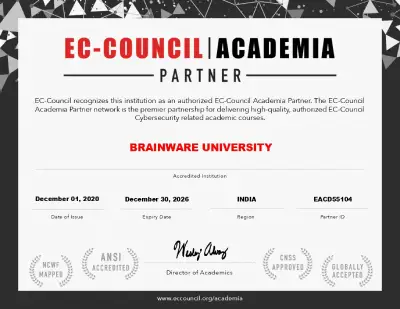

The B.Tech Cyber Security programme at Brainware University is a four-year undergraduate engineering degree focused on protecting digital infrastructure, networks, applications, and data from cyber threats. The programme blends computer science fundamentals with advanced cybersecurity technologies, ethical hacking practices, and industry-aligned training to prepare students for high-demand roles in cyber defence and digital protection.
| Programme | Bachelor of Technology in Computer Science & Engineering - Cyber Security |
|---|---|
| Duration | 4 years |
| Focus Areas |
|
| Salary | B.Tech Cyber Security graduates typically earn ₹6–10 LPA at entry level in roles such as security analyst, SOC engineer, or penetration tester. With experience, global certifications, and specialised expertise, professionals can earn ₹15–30 LPA or more. |
| Popular Job Types |
|
| Hiring Industries |
|
| Top Recruiters | TCS • Infosys • Wipro • IBM • Deloitte • PwC • Accenture • Palo Alto Networks • Kaspersky • Government Cyber Cells |
| Specializations |
|
| Higher Studies |
|
| Benefits |
|
| Internship and Placement | Students undergo internships with IT firms, cybersecurity companies, consulting organisations, and enterprise SOCs. Dedicated placement training begins from the first year. |
| Location | The programme is offered at Brainware University’s Barasat campus with advanced cyber labs and industry-aligned tools. |
| Approvals & Recognition |
|

Educational Qualification:
Candidates must have passed the 10+2 or equivalent examination with Physics and Mathematics as mandatory subjects, along with any one of the following: Chemistry, Computer Science, Electronics, IT, Biology, Informatics Practice, Biotechnology, Technical Vocational Subjects, Agriculture, Engineering Graphics, Business Studies, or Entrepreneurship. Students must have individual pass marks in both theory and practical components, along with a pass in English.
Minimum Marks:
Applicants must secure 60% marks or an equivalent grade in the 10+2 examination, with at least 45% marks or an equivalent grade in any three relevant subjects.
Entrance Exams:
Admission is generally merit-based as per institutional guidelines. Candidates may also be required to appear for entrance tests such as the BET – Brainware Entrance Test or applicable state-level engineering entrance exams.
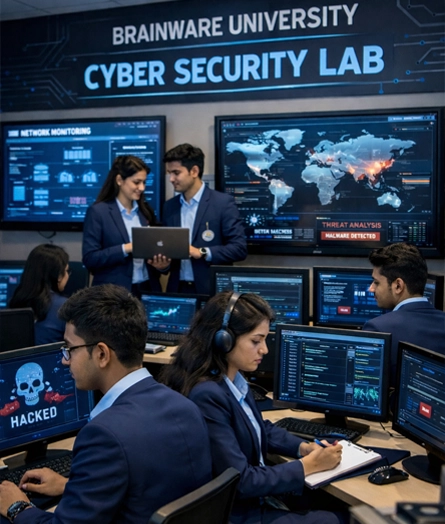
Pursue your passion for cybersecurity, ethical hacking, and digital defence with the B.Tech Cyber Security programme designed to offer high-quality technical education at an affordable cost. The course provides access to advanced cybersecurity labs, cutting-edge security tools, expert faculty mentorship, and practical exposure through industry projects, simulations, and vulnerability assessments. With a balanced investment in academic excellence and hands-on security training, this programme equips students to build successful careers in ethical hacking, network security, cyber forensics, information security analysis, and the rapidly growing cybersecurity industry.
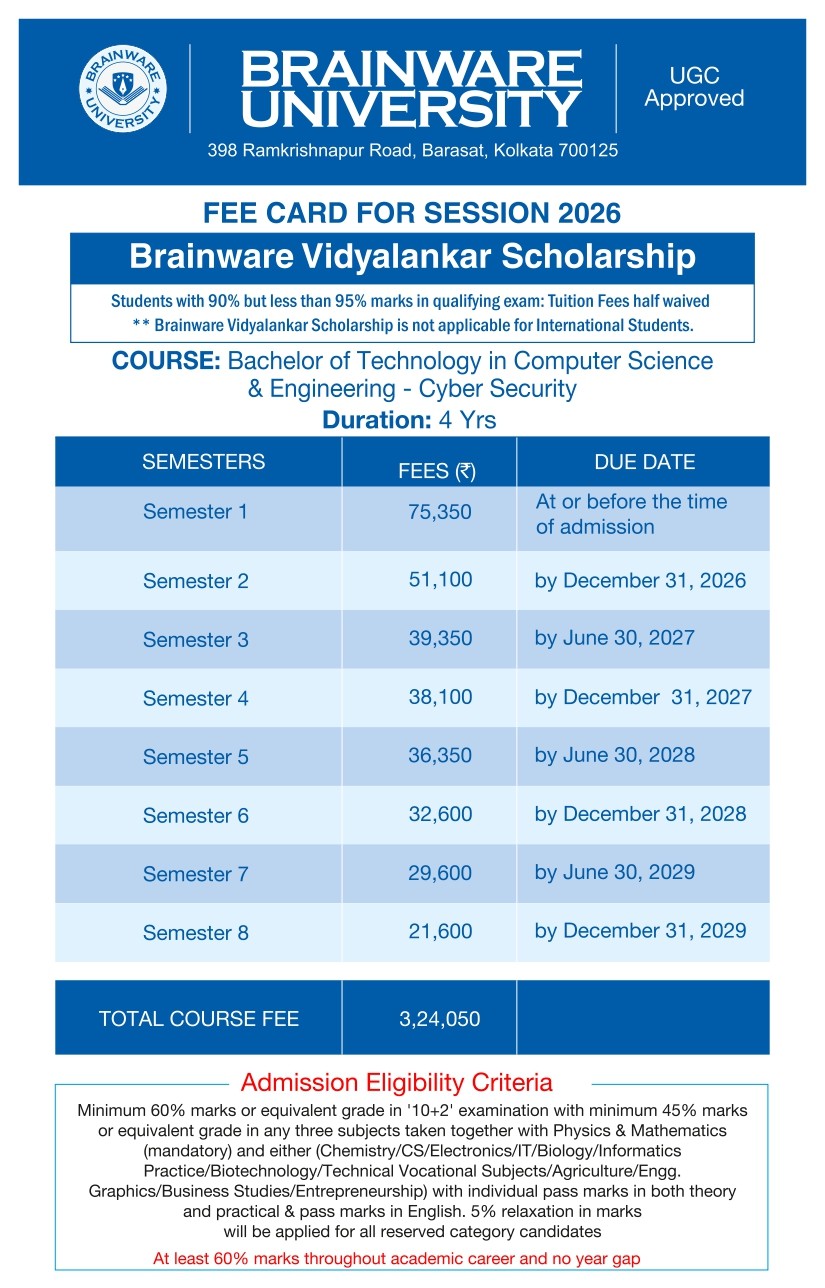
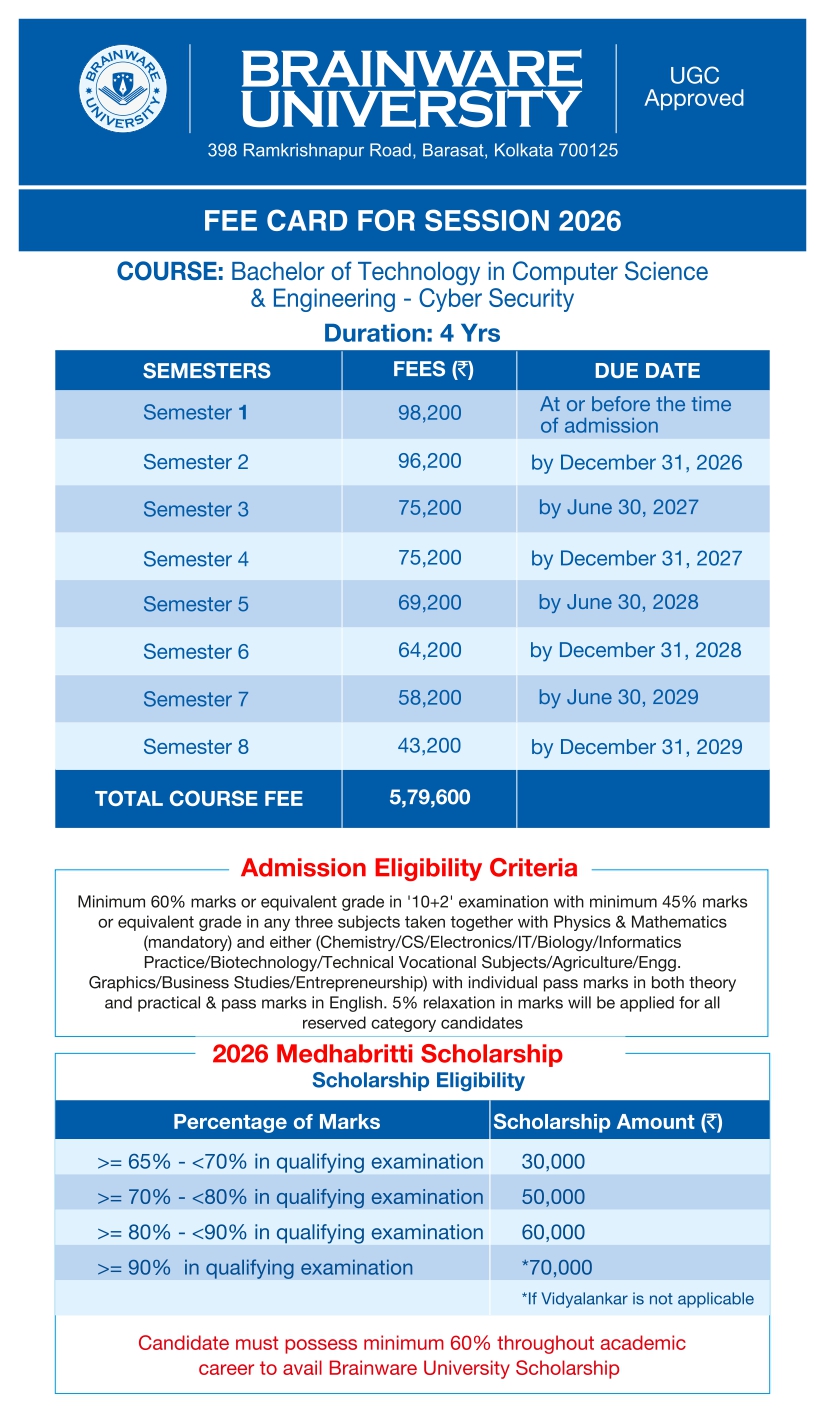
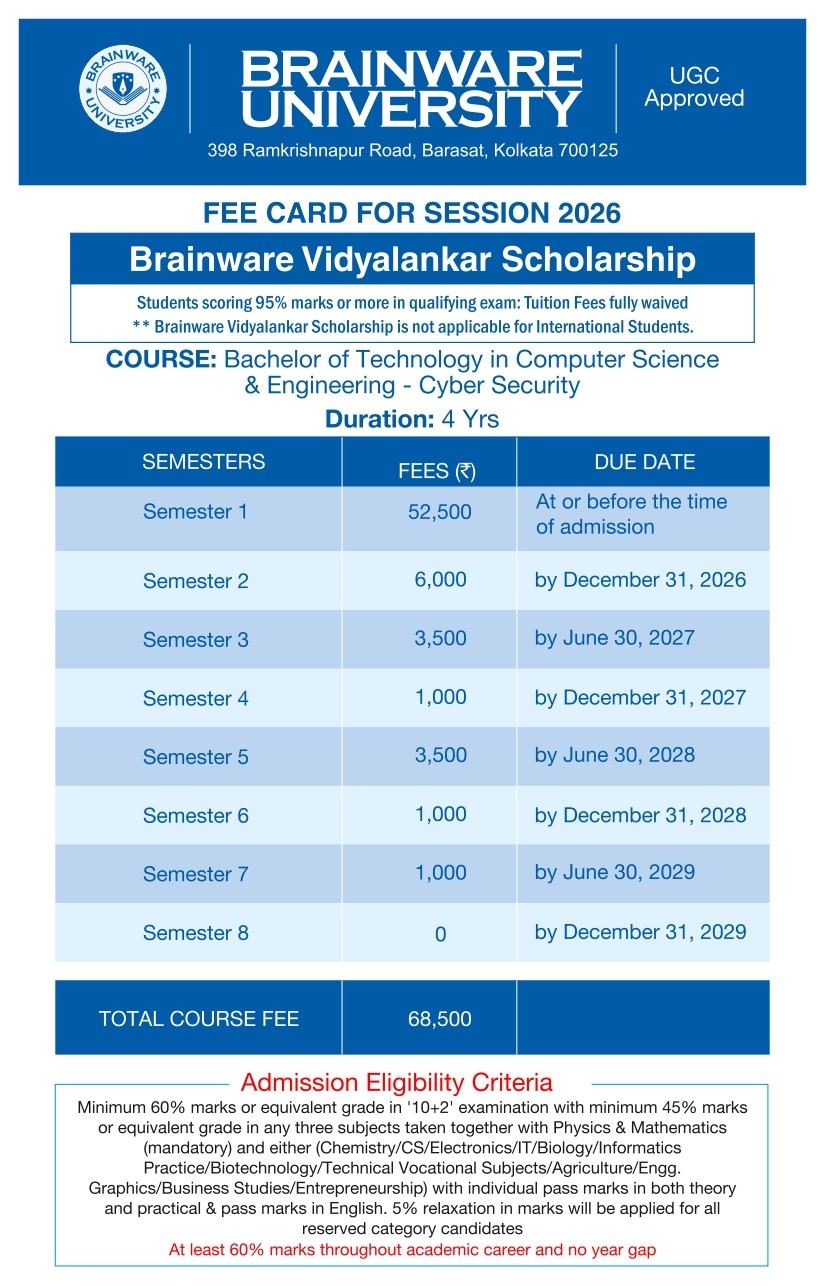
The B.Tech Cyber Security programme is offered at a competitive and transparent fee structure covering academic instruction, advanced cyber labs, security tools, certification-oriented training, internships, and project-based learning. The programme ensures high return on investment by combining global-standard cybersecurity education with strong placement outcomes.
| Semesters | Semester 1 | Semester 2 | Semester 3 | Semester 4 | Semester 5 | Semester 6 | Semester 7 | Semester 8 | Semester 9 | Semester 10 | Total |
|---|---|---|---|---|---|---|---|---|---|---|---|
| Fees (INR) | 98200 | 96200 | 75200 | 75200 | 69200 | 64200 | 58200 | 43200 | 579600 |
**Fees are subject to change, and the application fee of ₹5,000 is non-refundable under any circumstances. Please contact us for further details.
Scholarships(Fees): Brainware University offers merit-based scholarships for top performers and financial aid for deserving students. Scholarships are available for high scorers in entrance exams, board results, and outstanding achievements in innovation or research. Visit our scholarship page for more details.
**Please note that the Brainware Vidyalankar Scholarship is available only to students who passed their qualifying examination in the current admission year. Also, eligibility is strictly restricted to Indian nationals; international students are not eligible to apply.
The cyber security landscape is rapidly evolving as artificial intelligence, machine learning, and automation become essential tools for defending digital infrastructure against sophisticated cyber threats. The B.Tech Cyber Security programme at Brainware University integrates advanced AI-driven technologies with traditional computer science education to prepare students for the next generation of digital defence systems.
Students learn how AI is used to detect anomalies in network behaviour, identify malware patterns, and automate threat detection processes. By combining cyber defence concepts with machine learning algorithms, behavioural analytics, and predictive threat intelligence, the programme equips students with the knowledge required to secure modern digital ecosystems.
The curriculum emphasises hands-on learning through cyber labs, ethical hacking simulations, vulnerability assessments, penetration testing exercises, and digital forensics investigations. Students also explore emerging domains such as AI-based threat detection, blockchain security, cloud security architecture, and intelligent intrusion detection systems.
Through industry partnerships, cybersecurity workshops, hackathons, and live projects, students gain real-world exposure to cyber defence technologies used by enterprises and government agencies. This technology-driven academic approach ensures graduates are prepared for roles in security operations centres (SOC), cyber defence teams, threat intelligence units, and enterprise security architecture.

The programme follows a progressive learning pathway that integrates artificial intelligence and cybersecurity technologies across different stages of engineering education.




Graduates of the B.Tech Cyber Security programme at Brainware University have built successful careers across diverse sectors including information security consulting, enterprise security management, ethical hacking, and cyber threat intelligence.
Many alumni begin their professional journeys as security analysts, penetration testers, SOC engineers, or network security specialists in IT companies and cybersecurity firms. These roles involve monitoring digital infrastructure, detecting cyber threats, analysing vulnerabilities, and strengthening organisational security systems.
With experience and advanced certifications such as Certified Ethical Hacker (CEH), CISSP, CompTIA Security+, and CISA, alumni progress into specialised positions such as security architects, cyber security consultants, threat intelligence analysts, and cloud security specialists.
Several graduates also pursue higher studies such as M.Tech in Cyber Security, MSc Information Security, or advanced research in cybersecurity technologies, contributing to innovation in digital defence and secure computing.
These career journeys demonstrate how the B.Tech Cyber Security programme equips students with the expertise required to protect modern digital infrastructure and respond effectively to the evolving cyber threat landscape.


Brainware University has earned an AA+ rating in India’s Best Engineering Institutes by Careers360. The recognition reflects the University’s strength in academic quality, faculty, infrastructure, research, and student outcomes, reinforcing its position as a trusted destination for industry-aligned engineering education.

Brainware University has been ranked No. 1 Engineering College under a Private University in West Bengal in the IIRF Rankings 2026. The recognition highlights the University’s strength in engineering education, industry-focused learning, research, emerging technologies, and placement outcomes.

Brainware University has been ranked No. 2 Private University in West Bengal by uniRank 2026, marking another recognition of the University's growing presence in the state's higher education landscape.

Brainware University's inclusion in the Times Higher Education (THE) Impact Rankings 2025 reflects its contribution to the UN Sustainable Development Goals (SDGs) through education, innovation, sustainability, community engagement, and responsible institutional practices.

Brainware University has been recognised as the Best Private University of West Bengal in Infrastructure & Placement at Times Now.in – Leaders of Excellence: East 2026, celebrating its commitment to world-class infrastructure and career-focused education.

Brainware University has been recognised by The Times Group for excellence across Engineering (Placement), Law, and MBA Studies. The honours reflect the University’s multidisciplinary strength and its focus on career-oriented, industry-relevant education.

Brainware University received the ABP Ananda Shiksha Samman 2026 for Excellence in Placement & AI-Integrated Academic Infrastructure, acknowledging its emphasis on placement opportunities alongside technology-enabled academic development.

Brainware University has been honoured with the Zee 24 Ghanta Education Excellence Award 2026 for Best Industry Placement & Academic Infrastructure, continuing its recognition in 2022, 2023, 2024, 2025, and 2026. The University was also recognised in 2017 and 2018 for its job-oriented academic initiatives.

Brainware University received the TV9 Uttaran Academic Excellence Honour for Excellence in Placement & AI-Integrated Academic Infrastructure, highlighting its focus on combining career opportunities with an AI-enabled academic and learning environment.

Brainware University was honoured with the R Bangla Sikkha Gourab Samman 2026, recognising its contribution to higher education and continued pursuit of academic excellence and career-focused learning.

Brainware University was honoured as the Best Private University in West Bengal at the Times Now in Business Excellence Awards (East) 2025, recognising its academic quality, modern infrastructure, industry engagement, and focus on student success.

Brainware University was recognised as the Leading University in Infrastructure, Academics & Placement at the Times Business Awards West Bengal 2025, highlighting its strong campus facilities, academic ecosystem, and placement performance across disciplines.

The syllabus is designed to build strong foundations in computing and networking before advancing into ethical hacking, cyber forensics, AI-driven security, and enterprise defence systems. It balances theory, labs, simulations, and industry-oriented projects.
| Semester | Course |
|---|---|
| SEMESTER-I | English for Technical Communication |
| Understanding Harmony and Ethical Human Conduct | |
| Engineering Chemistry | |
| Calculus | |
| Programming for Problem Solving | |
| Engineering Chemistry Lab | |
| Programming for Problem Solving Lab | |
| Workshop and Manufacturing Practices | |
| Design Thinking | |
| Environmental Sciences* | |
| SEMESTER-II | Effective Communication and Soft Skills |
| Semiconductor Physics | |
| Algebra and Vector Calculus | |
| Basic Electrical and Electronics Engineering | |
| Data Structure and Algorithms | |
| Semiconductor Physics Lab | |
| Basic Electrical and Electronics Engineering Lab | |
| Engineering Graphics and Design Lab | |
| Yoga and Sports* | |
| SEMESTER - III | Probability and Statistics |
| Python Programming | |
| Computer Organization and Architecture | |
| Database Management Systems | |
| Python Programming Lab | |
| Computer Organization and Architecture Lab | |
| Database Management Systems Lab | |
| Mini Project - 1 | |
| Constitution of India* | |
| SEMESTER-IV | Practical Computing and Al Tools for Engineers |
| Discrete Mathematics | |
| Operating Systems | |
| Design and Analysis of Algorithms | |
| Object-Oriented Programming | |
| Formal Language and Automata Theory | |
| Operating Systems Lab | |
| Design and Analysis of Algorithms Lab | |
| Object-Oriented Programming Lab | |
| Mini Project - II | |
| SEMESTER-V | Computer Networks |
| Distributed System | |
| Compiler Design | |
| General Proficiency and Workplace Communication | |
| Professional Elective Course - I: Artificial Intelligence, or Image Processing, or Cloud Computing | |
| Computer Networks Lab | |
| Distributed System Lab | |
| Compiler Design Lab | |
| Mini Project - III | |
| SEMESTER - VI | Machine Learning |
| Data Mining and Data Warehousing | |
| Internet of Things | |
| Professional Elective Course - II: Big Data and Analytics, or Soft Computing, or Deep Learning | |
| Open Elective Course - I: Software Project Management, or Organisational Behaviour, or MOOC* | |
| Machine Learning Lab | |
| Data Mining and Data Warehousing Lab | |
| Mini Project - IV | |
| SEMESTER - VII | Software Engineering |
| System Software and Administration | |
| Professional Elective Course - III: Data and Internet Security, or Quantum Computing, or Pattern Recognition | |
| Open Elective Course - II: Entrepreneurship Basics, or Cyber law and Ethics, or MOOC* | |
| Open Elective Course - III: Financial Management, or Engineering Economics, or MOOC* | |
| Software Engineering Tools and Techniques Lab | |
| Internship | |
| Minor Project | |
| SEMESTER - VIII | Major Project |
| Grand Viva - Voce |
Please note that the syllabus is subject to modification. Visit our Syllabus page for the elective subject details and updated syllabus.

Graduates work in IT firms, cybersecurity companies, cloud providers, consulting firms, and enterprises as security analysts, ethical hackers, SOC engineers, consultants, and security architects—protecting systems against evolving cyber threats.
Opportunities exist in government cyber cells, defence organisations, intelligence agencies, public sector units, and regulatory bodies as cyber security officers, analysts, and technical specialists through competitive examinations and recruitment drives.
As digital transformation accelerates across sectors, cyber security professionals are essential for protecting critical infrastructure, data privacy, and national security. The following roles highlight why cyber security expertise is among the most in-demand skill sets globally.
| Area of Opportunity | Why It’s in Demand |
|---|---|
| Information Security Analyst | Frontline Defense & Compliance: Essential for monitoring networks, detecting threats, analyzing vulnerabilities, and ensuring the organization complies with data protection laws (like GDPR, HIPAA). |
| Penetration Tester (Ethical Hacker) | Proactive Security Audits: Needed to legally attack systems to find exploitable weaknesses before malicious actors do. High demand due to the focus on proactive risk mitigation and mandatory security testing. |
| Security Architect | Designing Secure Systems: Crucial for designing the overall security framework, infrastructure, and policies. Demand is driven by the need to integrate security from the ground up, making systems inherently resilient. |
| IT Security Engineer | Building and Implementing Controls: Responsible for implementing, maintaining, and upgrading security tools (firewalls, IDS/IPS). Essential for operationalizing the security architecture and defending against current threats. |
| Security Systems Administrator | Managing Day-to-Day Security Tools: Needed to manage access controls, maintain authentication systems (IAM), and administer security appliances. Vital for the daily upkeep and smooth functioning of all security operations. |
| IT Security Consultant | Expert, Vendor-Neutral Advice: Hired to provide specialized, objective advice on security strategy, risk assessment, vendor selection, and incident response planning, filling knowledge gaps within organizations. |
| System Administrator | Operational Stability and Access Control: The foundation for security. SysAdmins manage the operating systems and user accounts; secure configuration is essential to prevent vulnerabilities exploited by attackers. |
| Hardware Design Engineer | Security at the Chip Level: Required to design and secure the physical components (firmware, hardware security modules). Demand is growing rapidly for IoT and critical infrastructure, where hardware-level security is paramount. |
With rising cyber risks, regulatory mandates, and digital dependence, B.Tech Cyber Security graduates enjoy future-proof, high-growth career opportunities across private, public, and global technology ecosystems.
The demand for B.Tech Cyber Security graduates is expected to grow steadily between 2025 and 2032, driven by the sharp rise in cyberattacks, digital transformation across industries, cloud adoption, and increasingly strict data protection regulations. As organisations become more dependent on digital infrastructure, cyber security has emerged as a critical and non-negotiable function across sectors such as IT, BFSI, healthcare, government, defence, e-commerce, and telecom—making it one of the most stable and future-proof technology careers.
The global cyber security market is projected to grow from approximately USD 215–240 billion in 2025 to USD 600+ billion by 2032, registering a CAGR of around 13–15%. Growth is driven by rising investments in network security, cloud security, endpoint protection, identity management, and threat intelligence.
India’s cyber security market is expected to grow at a CAGR of 18–20%, reaching USD 35–40 billion by 2032. Rapid digitisation, fintech expansion, Digital India initiatives, and increased cybercrime incidents are positioning India as a key cyber security talent and services hub.
The global cyber security workforce demand is projected to grow by 30% or more through 2032, with a persistent talent shortage worldwide. In India, the cyber security skills gap is expected to exceed 1.5 million professionals by 2026, creating strong demand for trained graduates in entry-, mid-, and senior-level roles.
The growing frequency of ransomware attacks, phishing, data breaches, and advanced persistent threats (APTs) has made cyber security a top strategic priority for organisations across all industries.
With widespread adoption of cloud computing, remote work, IoT, and digital platforms, organisations require professionals skilled in cloud security, zero-trust architecture, and secure network design.
Stricter data protection and cyber governance regulations worldwide are increasing the need for cyber security professionals who can ensure compliance, risk management, and data privacy.
Advancements in AI-driven security, cyber forensics, blockchain security, and critical infrastructure protection are creating new specialised roles within the cyber security ecosystem.
Increased investments by governments and global enterprises in national cyber security frameworks, CERTs, digital defence systems, and enterprise security solutions continue to strengthen long-term employment prospects.
Between 2025 and 2032, the cyber security job market will experience sustained and high-value growth rather than short-term spikes. Graduates with a B.Tech in Cyber Security will be at the forefront of protecting digital ecosystems—prepared for stable, high-impact, and globally relevant careers in one of the most essential technology domains of the digital era.


Brainware University maintains strong collaborations with IT companies, cybersecurity firms, global certification bodies, and research organisations. These tie-ups enable internships, expert sessions, certification training, and live industry projects—bridging academia and real-world cyber defence.




The Department of Cyber Science & Technology at Brainware University has signed numerous active MoUs with leading organisations across various industries, strengthening industry–academia collaboration and enhancing student exposure, training, and placement opportunities.
[Click here to view the complete list of MoUs]
Admission Criteria : Candidates must have passed 10+2 with Physics and Mathematics as mandatory subjects, along with one additional approved subject, securing the required minimum aggregate marks as per norms.
Application : Apply online by filling out the enquiry form on the university website. Admission counsellors guide applicants through documentation and eligibility verification.
Entrance Exam : Admission is merit-based or through the Brainware Entrance Test (BET) or applicable state/national engineering entrance exams.
Counselling : Shortlisted candidates attend counselling sessions covering curriculum, fees, internships, certifications, and career pathways.
Direct Admission : Eligible candidates may receive direct admission based on merit and seat availability.
Please follow the given B.Tech Cyber Security admission procedure in Brainware University:


"Brainware students are professionally and technically well-informed as freshers. We are impressed with the level of confidence and positive attitude they demonstrated during their interviews."
Mr. Vaskar Bhattacharya Regional Head-East, Ginnisystems Ltd.
We always find competent and positive students who are almost ready to be professionals. We never get disappointed wherever we come for the recruitment. Well done Brainware University!
Ms. Srimoyee Mukherjee Manager HR Nature Technologies Pvt. Ltd.
The Department of Cyber Science & Technology at Brainware University actively promotes hands-on learning, cyber awareness, industry exposure, research thinking and professional skill development. Through workshops, competitions, expert sessions, conferences, alumni interactions, industry visits and awareness programmes, the department helps students connect classroom learning with real-world cyber security challenges.
The department organises technical events such as BrainCon and SECCOM, along with Capture The Flag competitions, phishing campaign workshops, cyber security demonstrations and problem-solving sessions. These activities help students strengthen analytical thinking, ethical hacking skills, teamwork and practical cyber defence abilities.
Programmes such as Safer Internet Day, Data Privacy Week, Cyber Security Awareness and sessions on data safety help students understand responsible digital behaviour, privacy protection, cyber hygiene, online threats, phishing risks and safe internet practices.
Industry visits and hands-on workshops give students exposure to real-world cyber security practices, professional work environments, security operations, digital infrastructure and industry expectations. These activities help bridge the gap between academic knowledge and professional cyber security applications.
The department conducts sessions on modern-day cyber crimes, recent cyber threats, AI in cyber security, phishing, penetration testing, open-source security, Linux administration, cloud computing, AWS, BGP routing security and cybercrime evidence, including cryptocurrency-related evidence in the courtroom.
Through events such as the International Conference on Computing Technologies in Emerging Areas, BrainCon, SECCOM and interdisciplinary technology challenges, students gain exposure to research, innovation, technical presentation, academic discussion and emerging developments in cyber science and technology.
Alumni talks, panel discussions, certification-oriented sessions, practical workshops and cyber security competitions help students understand career pathways in ethical hacking, SOC operations, network security, cloud security, digital forensics, cyber law, incident response and IT security consulting.

B.Tech CSE (Cyber Security) stands for Bachelor of Technology in Computer Science and Engineering with Cyber Security. The course covers ethical hacking, network security, cyber forensics, and threat protection, preparing students for roles such as cybersecurity analysts, ethical hackers, and security engineers.
The subjects may vary slightly across institutions, but core areas typically include computer fundamentals, databases, hardware and operating systems, switching and routing, infrastructure management, vulnerability assessment, penetration testing, cyber forensics, and cyber law.
No, they are not equivalent. While both focus on cybersecurity, B.Tech in Cyber Security is more engineering-oriented with deeper hardware and software integration, whereas BTech Cyber Security emphasizes theoretical concepts and practical cybersecurity applications.
Both degrees offer strong foundations in cybersecurity, but a BTech degree is generally considered more technical and hands-on. Job roles may overlap, and candidates with relevant certifications, skills, and experience can access similar opportunities regardless of degree type.
Brainware University is an excellent option for pursuing B.Tech in CSE with Cyber Security. The program combines industry-focused training, ethical hacking, network security, and extensive hands-on lab experience.
Admission generally requires passing Class 12 with Physics, Chemistry, and Mathematics. Candidates should refer to Brainware University’s official website for detailed eligibility criteria and admission procedures.
Graduates can work as cybersecurity analysts, ethical hackers, penetration testers, security consultants, or network security engineers across industries such as IT, finance, government, and healthcare.
Yes, cybersecurity is one of the fastest-growing career fields globally, offering strong demand, competitive salaries, and long-term growth opportunities.
Brainware University offers a career-focused BTech CSE – Cyber Security programme with practical learning in ethical hacking, network security, cryptography, cyber forensics, secure programming, cloud security, SOC operations, malware analysis and AI-driven threat detection. Students benefit from cyber lab exposure, EC-Council Academia Partner exposure, certification-oriented learning, internships, expert sessions, industry interactions, faculty mentoring and placement support. The programme prepares students for careers in cyber security, IT security, ethical hacking, SOC operations, network security, digital forensics and cloud security.
Core subjects include Network Security, Ethical Hacking, Cryptography, Digital Forensics, Web Security, Malware Analysis, and Cloud Security.
Career roles include cybersecurity analyst, ethical hacker, malware analyst, network security engineer, forensic analyst, and cybersecurity consultant.
The average starting salary ranges from ₹4 LPA to ₹8 LPA, depending on the organization and role. With experience and certifications, salaries can increase significantly.
Focus on cybersecurity tools, core concepts, and protocols. Practice scenario-based questions and highlight hands-on experience through projects and internships.
Top recruiters include TCS, Infosys, Wipro, Deloitte, PwC, IBM, Microsoft, Google, and specialized cybersecurity firms.
Highlight certifications like CEH or CISSP, relevant internships, project experience in network security or penetration testing, and programming skills.
Practice using tools such as Wireshark, Metasploit, and Kali Linux. Work on real-world projects involving network security and vulnerability assessment.
Certifications such as CEH, CompTIA Security+, CISSP, and CISA add significant value and improve employability.
Commonly used languages include Python, Java, C++, and scripting languages such as Bash and PowerShell.
Online platforms like Coursera, edX, and Udemy offer valuable courses in ethical hacking, digital forensics, and cybersecurity fundamentals.
Concentrate on networking, cryptography, and security protocols. Use practice tests, study guides, and online tutorials for effective preparation.
AI helps detect and prevent cyber threats by analyzing patterns, identifying vulnerabilities, and automating threat response processes.
Ethical hacking involves legally testing systems for vulnerabilities to strengthen security and prevent cyberattacks.
With rapid cloud adoption, securing cloud-based data and infrastructure is critical, leading to strong demand for cloud security professionals.
Key challenges include evolving cyber threats, data breaches, privacy concerns, and securing IoT and cloud environments.
Stay informed by following cybersecurity blogs, attending webinars, subscribing to industry newsletters, and participating in hackathons or competitions.