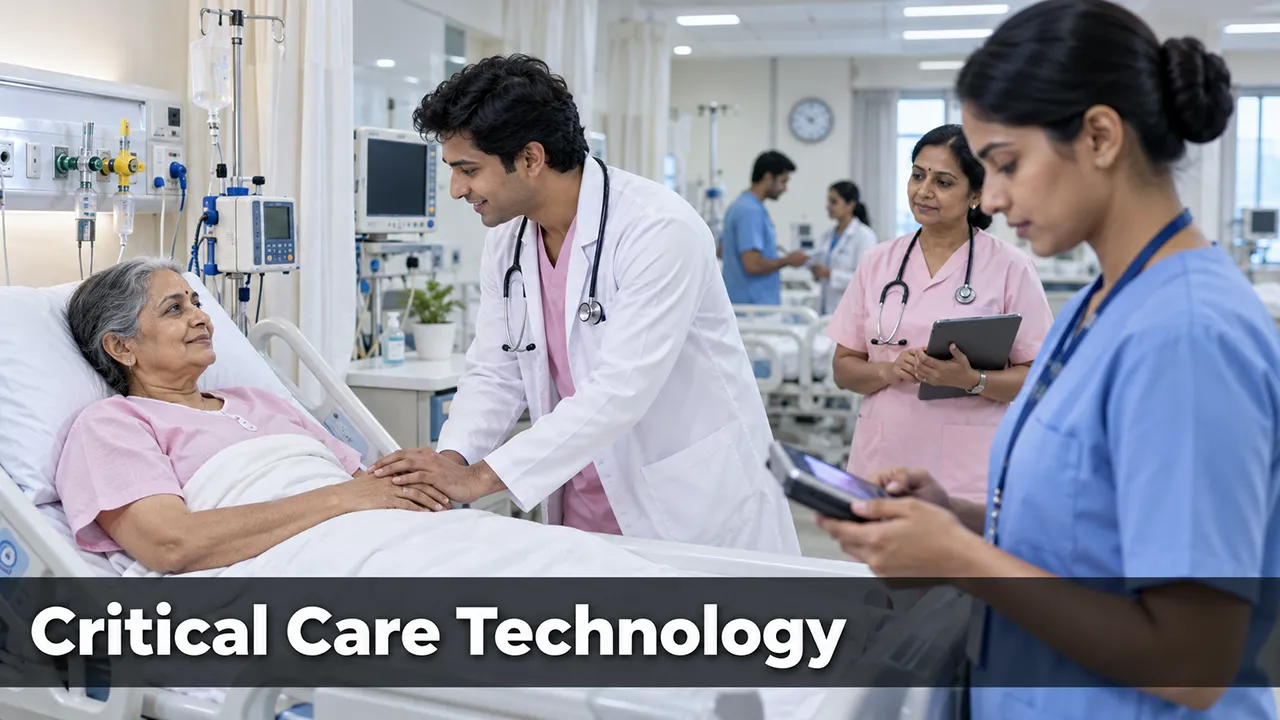
Critical care is one of the most specialised and technology-intensive areas of modern healthcare. Intensive Care Units (ICUs), emergency departments and high-dependency units depend on coordinated healthcare teams, continuous patient monitoring and sophisticated life-support technologies to care for critically ill patients.
This environment creates a need for professionals who understand both healthcare science and the technologies used in intensive and emergency care.
For students interested in biology, medical technology, patient monitoring and hospital-based healthcare, Critical Care Technology can be an important allied health career pathway. However, choosing the right university for this field should involve more than simply finding an institution that offers the programme.
Students should look at the quality of practical training, clinical exposure, simulation facilities, medical equipment, anatomy learning, faculty guidance and opportunities to understand how real critical-care environments function.
What Is Critical Care Technology?
Critical Care Technology is an allied health discipline connected with the monitoring and technological support of patients who require intensive or emergency care.
Professionals working in this area may assist healthcare teams with patient-monitoring systems, respiratory-support technologies, critical-care equipment, emergency procedures and other technical aspects of intensive care.
The field brings together three major areas:
- medical and healthcare science;
- clinical technology; and
- patient-centred support.
This means that students need more than theoretical knowledge. They must gradually learn how physiological parameters are monitored, why different technologies are used, how equipment functions within a clinical environment and how healthcare professionals coordinate while caring for critically ill patients.
Why Critical Care Technology Matters in Modern Healthcare
Critical care has become increasingly dependent on specialised medical technologies.
Patients in intensive care may require continuous monitoring of parameters such as heart rate, blood pressure, oxygen saturation, respiration and other indicators of physiological condition. Depending on the patient’s needs, healthcare teams may also use advanced respiratory-support systems, infusion technologies and other life-support equipment.
The purpose of Critical Care Technology education is therefore not simply to teach students how to operate machines.
Students need to understand the relationship between:
the human body → patient condition → clinical information → monitoring technology → healthcare response.
This relationship is what makes the field both scientifically demanding and practically important.
What Does a Critical Care Technologist Do?
The responsibilities of critical-care professionals can differ according to the hospital, department, clinical setting and scope of their professional role.
In general, they may contribute to areas such as:
- patient monitoring in intensive-care environments;
- handling and observation of critical-care equipment;
- respiratory and life-support systems;
- emergency and trauma-care support;
- recording and communicating monitored parameters;
- infection-control and biomedical-safety practices;
- preparation of critical-care environments; and
- coordination with doctors, nurses and other healthcare professionals.
Critical care is fundamentally a team-based healthcare environment.
A critical care technologist does not replace the physician or nurse. Instead, the professional contributes specialised technical and clinical-support competencies within a multidisciplinary healthcare team.
Understanding this distinction is important for students considering the field.
How to Choose a University for Critical Care Technology
A university should not be selected solely because it offers a critical-care programme.
Students and parents should examine whether the institution provides an environment where theoretical healthcare education is connected with practical and clinical learning.
Here are some of the most important areas to consider.
Practical Learning Infrastructure
Critical-care education requires practical exposure.
Students should have opportunities to understand monitoring equipment, emergency-care procedures and clinical technologies in structured learning environments before entering actual hospital settings.
Simulation and practical demonstrations can help students connect concepts learned in textbooks with their application in healthcare.
Clinical Exposure
A classroom can explain how an ICU functions, but clinical exposure allows students to observe how multidisciplinary healthcare teams actually work.
Students can begin understanding:
- clinical workflow;
- patient safety;
- professional communication;
- infection-control practices;
- documentation;
- teamwork; and
- responsibility within a healthcare environment.
Clinical learning is therefore an important part of preparing students for technology-driven healthcare professions.
Anatomy and Physiology Learning
Critical-care students constantly encounter information connected with human physiology.
Understanding respiration, circulation, cardiovascular function and other body systems provides the foundation for interpreting monitored clinical parameters.
For this reason, strong anatomy and physiology learning should be an important part of the educational environment.
Exposure to Healthcare Technology
Modern ICUs use increasingly sophisticated monitoring and life-support technologies.
Students benefit from developing familiarity with the systems used for patient observation, respiratory support, emergency care and clinical documentation.
They also need to understand that healthcare technology continues to evolve. Learning how to adapt to new systems is therefore as important as becoming familiar with existing ones.
Faculty and Clinical Guidance
Critical care involves complex medical concepts and technologies.
Students need faculty members who can explain not only the scientific principles behind these concepts but also their relevance to professional healthcare settings.
Good mentorship helps bridge the gap between academic knowledge and clinical understanding.
Critical Care Education at Brainware University
Brainware University offers the Bachelor of Science in Critical Care Technology through its Department of Allied Health Sciences.
The programme is designed around critical-care science, patient monitoring, intensive-care technology, respiratory support, emergency-care practices, infection control and the use of equipment associated with critical-care environments.
Rather than duplicating programme-specific information here, students who want to know the latest duration, eligibility, curriculum, fees, admission requirements or other academic details should refer directly to the official programme page.
The purpose of understanding the field first is simple: students should determine whether Critical Care Technology matches their interests and aptitude before evaluating the formal admission requirements of a particular programme.
Learning Through Critical-Care Simulation
Simulation can provide a valuable bridge between classroom learning and hospital exposure.
In a structured learning environment, students can become familiar with patient-monitoring concepts, emergency scenarios and critical-care equipment without the immediate pressure of a real clinical situation.
Simulation-based learning can help develop:
- familiarity with equipment;
- procedural understanding;
- communication;
- decision awareness;
- confidence;
- teamwork; and
- adherence to established protocols.
For critical-care students, these experiences can make later clinical exposure more meaningful.
Patient Monitoring: More Than Reading Numbers
Patient monitoring is one of the central elements of intensive care.
A monitoring system may display multiple physiological parameters at the same time. Students therefore need to understand what these measurements represent and why changes can matter.
Learning may involve concepts connected with:
- cardiac activity;
- blood pressure;
- oxygenation;
- respiration;
- temperature;
- circulation; and
- other indicators of physiological condition.
But professional monitoring is not merely about looking at a screen.
Healthcare professionals must observe, record and communicate relevant information according to clinical protocols and their professional responsibilities.
This is why attention to detail is particularly important in critical-care environments.
Understanding Respiratory and Life-Support Technology
Respiratory support is another important part of intensive-care medicine.
Critically ill patients may experience difficulty maintaining normal respiratory function and may require different forms of support depending on their clinical condition.
Students preparing for critical-care environments therefore need to understand respiratory physiology along with the basic principles behind technologies used to support breathing.
Modern critical-care learning can introduce students to concepts connected with:
- mechanical ventilation;
- non-invasive respiratory support;
- oxygen therapy;
- respiratory monitoring; and
- related life-support systems.
The goal is to understand how these technologies support clinical teams and patient care within supervised healthcare environments.
Emergency and Trauma-Care Awareness
Critical care is closely connected with emergency healthcare.
Some critically ill patients arrive following trauma, sudden illness or rapid deterioration. Others may require intensive monitoring following complex medical or surgical treatment.
Healthcare professionals in such environments need to follow established protocols while communicating clearly and working efficiently.
Scenario-based learning and emergency simulations can therefore help students understand:
- the importance of rapid coordination;
- professional roles within a team;
- systematic response;
- communication under pressure; and
- patient-safety procedures.
These skills cannot be developed effectively through memorisation alone.
Infection Control and Patient Safety
Critically ill patients may be especially vulnerable to infection.
Consequently, infection prevention and biomedical safety form an important part of the critical-care environment.
Students need to understand the importance of:
- hand hygiene;
- aseptic practices;
- safe equipment handling;
- biomedical waste practices;
- infection-prevention protocols; and
- responsible clinical behaviour.
This also teaches an important lesson about healthcare: procedures that appear routine can have major implications for patient safety.
How Technology Is Transforming the Modern ICU
The modern ICU is becoming increasingly digital.
Critical-care environments can use integrated patient-monitoring platforms, sophisticated ventilators, electronic health information systems, digitally managed infusion technologies and other connected clinical systems.
Artificial intelligence is also beginning to influence healthcare technology.
AI-supported tools can analyse patterns in clinical data, assist with monitoring and contribute to early-warning or decision-support systems. However, such tools do not remove the need for trained healthcare professionals or clinical judgement.
For future critical-care professionals, the important skill is therefore not simply knowing how to use today’s technology.
It is developing the ability to adapt responsibly to tomorrow’s technology.
This includes understanding:
- digital patient monitoring;
- data-informed clinical systems;
- technology-assisted workflows;
- intelligent monitoring platforms; and
- responsible use of emerging healthcare technologies.
Human supervision, patient safety, ethical responsibility and clinical protocols remain fundamental.
Why Clinical Internship Matters
Practical laboratories and simulations can prepare students for hospital environments, but supervised clinical exposure provides a different form of learning.
In real healthcare settings, students can observe how professional teams coordinate patient care, how information moves between departments and how clinical protocols guide everyday actions.
Internship and clinical exposure can also help learners develop professional qualities such as:
- accuracy;
- discipline;
- communication;
- teamwork;
- observation;
- empathy;
- responsibility; and
- adaptability.
For a healthcare student, these qualities are as important as technical knowledge.
Skills Students Need for Critical-Care Careers
Critical Care Technology is not suitable for everyone simply because it belongs to the healthcare sector.
Students considering the field should evaluate whether its demands match their interests and personal strengths.
Interest in Medical Science
Students should be curious about the human body, physiology and healthcare.
Scientific concepts form the foundation for understanding what happens inside critical-care environments.
Comfort With Technology
ICUs are technology-intensive.
Students should be comfortable learning how equipment works and willing to continuously update their knowledge as medical technologies change.
Attention to Detail
Critical-care environments require careful observation.
Professionals need to work accurately and responsibly because information related to critically ill patients can be highly significant.
Teamwork
No single professional runs an ICU independently.
Critical care depends on coordinated work among physicians, nurses, technologists and other healthcare specialists.
Communication
Clear communication is essential in healthcare.
Students need to learn how relevant observations and information should be communicated professionally within a clinical team.
Ability to Work Under Pressure
Critical-care and emergency environments can be demanding.
Students need to gradually develop composure, discipline and the ability to follow protocols even in stressful situations.
Commitment to Continuous Learning
Healthcare technology does not remain static.
Professionals need to continue learning throughout their careers as equipment, clinical practices and digital systems evolve.
Where Can Critical-Care Professionals Work?
Professionals trained in critical-care technology may find themselves working across healthcare environments associated with intensive patient monitoring and emergency support.
These can include:
- intensive care units;
- critical care units;
- emergency departments;
- trauma-care environments;
- cardiac-care settings;
- hospitals;
- high-dependency units;
- specialised healthcare centres; and
- organisations working with critical-care medical technologies.
Actual responsibilities and job titles vary according to the employer, healthcare setting, experience and applicable professional requirements.
Students should therefore focus on building strong practical competence and clinical understanding rather than assuming that completing a degree automatically guarantees a particular professional position.
Critical Care Technology and Other Allied Health Fields
Allied health programmes can appear similar because graduates may work within the same hospitals.
Their professional focus, however, can be quite different.
Critical Care Technology is associated primarily with intensive-care environments, patient monitoring and technologies used to support critically ill patients.
Anaesthesia and Operation Theatre Technology is more closely connected with surgical environments, anaesthesia support and operation theatre procedures.
Medical Laboratory Science centres on laboratory-based diagnostic investigation.
Medical Radiology and Imaging Technology focuses on diagnostic imaging.
Physiotherapy focuses on movement, rehabilitation and restoring functional ability.
Optometry is concerned with vision assessment and eye-care services.
Understanding these distinctions can help students choose an allied health field according to the type of professional work that interests them rather than simply selecting a healthcare-related degree.
Who Should Explore Critical Care Technology?
This field may appeal particularly to students who:
- are interested in biology and medical science;
- want to work in healthcare;
- enjoy learning about medical technology;
- are curious about intensive and emergency care;
- can work carefully in structured environments;
- value teamwork;
- are willing to learn practical skills; and
- understand that healthcare requires continuous professional learning.
Students who are unsure about working in hospitals or high-intensity healthcare environments should explore the profession carefully before selecting the academic pathway.
Questions to Ask Before Choosing a University
Instead of asking only, “Which university offers Critical Care Technology?”, prospective students can ask more useful questions:
- Does the university provide practical and simulation-based learning?
- What kind of critical-care equipment can students learn about?
- How is anatomy and physiology taught?
- Is clinical exposure incorporated into the learning process?
- Are students introduced to patient safety and infection-control practices?
- Does the programme prepare students for technology-driven healthcare environments?
- Is there opportunity to understand real hospital workflows?
- What kind of faculty and clinical guidance is available?
- Does the learning environment encourage communication and teamwork?
- Where can students verify the latest programme-specific information?
These questions help students evaluate the quality of the learning environment, not merely the availability of a degree.
Why Practical Competence Matters in Critical Care
Healthcare education cannot depend only on remembering textbook definitions.
A student may be able to define mechanical ventilation but still need practical learning to understand how respiratory support fits into supervised patient care.
A learner may know what oxygen saturation means but still need clinical understanding to appreciate how monitored information is handled inside an ICU.
Critical-care learning therefore works best when students progress through a cycle such as:
Scientific foundation → Demonstration → Practical learning → Simulation → Clinical exposure → Professional competence
This progression helps turn theoretical knowledge into practical understanding.
Frequently Asked Questions About Critical Care Technology
What is Critical Care Technology?
Critical Care Technology is an allied healthcare field associated with intensive and emergency care. It involves understanding patient-monitoring systems, critical-care equipment, respiratory and life-support technologies and other forms of technical support used within multidisciplinary healthcare environments.
What makes Critical Care Technology different from other allied health fields?
Its primary focus is the technology-intensive environment of critical and emergency care. Other allied health disciplines may specialise in diagnostics, imaging, rehabilitation, vision care or surgical support.
Is Critical Care Technology only about operating medical equipment?
No. Equipment is an important component, but students also need foundations in anatomy, physiology, patient monitoring, infection control, healthcare safety, communication and clinical protocols.
Why is practical training important in critical-care education?
Critical-care professionals work in environments where medical science and technology interact continuously. Practical learning, simulation and supervised clinical exposure help students understand how theoretical concepts are applied in healthcare settings.
What skills are important for students interested in this field?
Scientific curiosity, attention to detail, comfort with technology, teamwork, communication, discipline and willingness to continue learning are particularly important.
How is technology changing intensive care?
Modern ICUs increasingly use connected monitoring systems, advanced life-support technologies, digital healthcare platforms and data-supported tools. Future professionals will therefore need both strong healthcare fundamentals and technological adaptability.
How should students choose a university for Critical Care Technology?
Students should compare practical infrastructure, clinical learning, simulation facilities, exposure to relevant healthcare technologies, faculty support, anatomy education, patient-safety training and opportunities for professional development.
Where should students check programme-specific information?
For current information about Brainware University’s Bachelor of Science in Critical Care Technology, students should use the official programme page for details related to curriculum, duration, eligibility, fees and admission requirements.
Building a Future in Technology-Driven Critical Care
Critical Care Technology stands at the intersection of healthcare science, patient support and advanced medical technology.
For students attracted to intensive care and emergency healthcare, the field provides an opportunity to understand how monitoring systems, life-support technologies and trained professionals work together around critically ill patients.
The right educational environment should therefore do more than provide theoretical instruction. It should help students understand anatomy, develop practical skills, encounter clinical technologies and gradually become familiar with the professional expectations of healthcare.