Medical diagnosis often begins long before a treatment plan is finalised. Blood, tissue, urine and other biological samples can provide essential information about infection, disease, organ function and overall health. Behind this diagnostic process are trained laboratory professionals who combine scientific knowledge with precision, technology and quality-control practices.
This makes medical laboratory science an important part of modern healthcare.
For students interested in biology, diagnostics, laboratory investigation and healthcare technology, the field offers a pathway that is very different from direct bedside care. Instead, laboratory professionals contribute to healthcare by generating reliable diagnostic information that supports clinical decision-making.
Choosing the right university for this field should therefore involve more than finding a programme with a familiar name. Students should examine laboratory infrastructure, practical learning, clinical exposure, faculty guidance, research opportunities, quality-control training and exposure to changing diagnostic technologies.
At Brainware University, students interested in undergraduate study can explore the Bachelor of Medical Laboratory Science, while graduates seeking advanced laboratory education can explore the Master of Medical Laboratory Science.
What Is Medical Laboratory Science?
Medical Laboratory Science is an allied health discipline concerned with the scientific analysis of biological samples to support disease detection, diagnosis, monitoring and healthcare decision-making.
Laboratory professionals may work with blood, tissue, body fluids, microorganisms and other specimens using established laboratory methods and diagnostic technologies.
The field brings together several areas of science, including:
- clinical biochemistry;
- haematology;
- microbiology;
- pathology;
- immunology;
- blood banking;
- molecular diagnostics; and
- laboratory quality management.
Because laboratory reports can contribute to important clinical decisions, accuracy, standardisation, safety and careful documentation are central to laboratory practice.
Why Is Medical Laboratory Science Important in Healthcare?
Modern medicine depends extensively on diagnostics.
A physician evaluating a patient may require laboratory investigations to identify an infection, measure biochemical markers, assess blood-cell abnormalities, monitor treatment response or investigate disease progression.
Medical laboratory professionals therefore contribute to healthcare even when patients may never interact with them directly.
Their work can support:
disease detection → diagnostic confirmation → treatment planning → treatment monitoring → public-health surveillance.
This is one reason laboratory science is sometimes described as a crucial behind-the-scenes component of healthcare.
The value of laboratory professionals lies not simply in performing tests, but in maintaining accuracy throughout the diagnostic process.
What Do Medical Laboratory Professionals Actually Do?
The exact responsibilities depend on qualifications, experience, specialisation and the type of healthcare organisation.
Broadly, laboratory professionals may be involved in:
- receiving and processing clinical samples;
- conducting diagnostic investigations;
- working with laboratory instruments;
- maintaining testing protocols;
- documenting and validating laboratory information;
- following biosafety procedures;
- supporting quality-control processes;
- maintaining laboratory records;
- assisting with blood-bank and transfusion-related processes;
- supporting research activities; and
- working with automated and digital diagnostic systems.
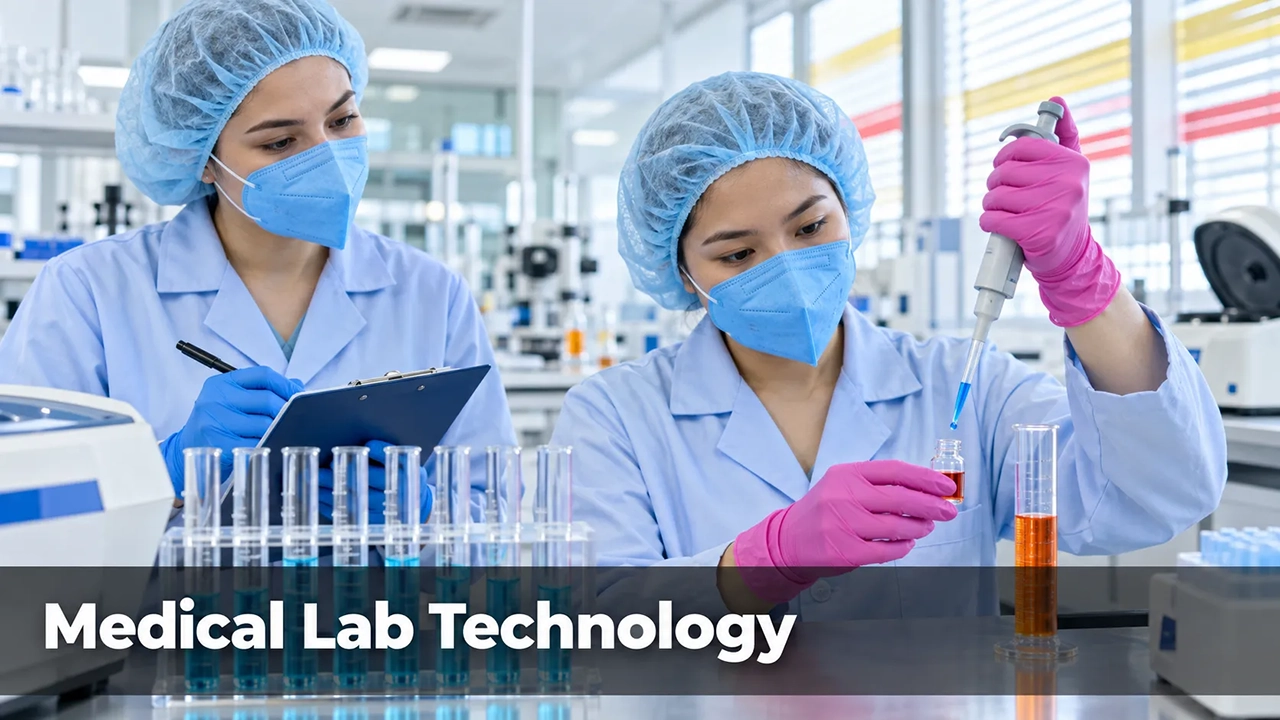
Modern medical laboratories increasingly require professionals to understand both laboratory science and laboratory technology.
Medical Laboratory Science vs Medical Lab Technology: Is There a Difference?
Students frequently encounter terms such as Medical Laboratory Science, Medical Laboratory Technology, MLT, BSc MLT and BMLS while researching the field.
In educational and employment contexts, these terms may sometimes be used differently by different institutions or organisations. They broadly relate to laboratory-based diagnostic healthcare, but students should always rely on the official programme nomenclature used by the university they are considering.
At Brainware University, the current undergraduate programme is officially listed as Bachelor of Medical Laboratory Science.
Using the official name is particularly important when checking academic information, eligibility or applying for admission.
What Should Students Look for in a University for Medical Laboratory Science?
Laboratory science is highly practical. Therefore, the quality of the learning environment can be as important as the subjects listed in a curriculum.
Students and parents can evaluate a university through several factors.
1. Practical Laboratory Exposure
Students need opportunities to perform laboratory procedures rather than simply read about them.
Practical learning can help students understand:
- sample preparation;
- use of laboratory instruments;
- testing procedures;
- measurement accuracy;
- laboratory documentation;
- contamination prevention; and
- quality-control practices.
Repeated practical exposure helps transform scientific concepts into usable laboratory skills.
2. Strong Foundation in Biological Sciences
Laboratory diagnostics require an understanding of how the human body functions and how disease affects biological systems.
Students therefore need foundations in areas such as anatomy, physiology, biochemistry, microbiology and pathology.
These subjects help learners understand the scientific reasoning behind laboratory investigations rather than treating testing procedures as mechanical tasks.
3. Clinical and Diagnostic Exposure
Academic laboratories provide a controlled environment for learning.
Clinical exposure introduces students to professional laboratory workflows.
Students can observe how samples move through different stages, how results are documented, how safety protocols are followed and how laboratory departments interact with the wider healthcare system.
This exposure can help bridge the gap between university practical sessions and professional diagnostic laboratories.
4. Quality Assurance and Laboratory Safety
A laboratory result is useful only when it is reliable.
Students therefore need to understand the importance of:
- quality control;
- calibration;
- standard operating procedures;
- laboratory safety;
- sample integrity;
- biosafety;
- waste management; and
- accurate documentation.
Quality assurance is not an additional part of laboratory science. It is fundamental to trustworthy diagnostics.
5. Research Exposure
Laboratory science is closely connected with biomedical research.
Students who develop research skills can learn to formulate questions, evaluate evidence, analyse laboratory data and understand how diagnostic methods evolve.
Research exposure becomes particularly useful for students considering advanced study, clinical research, molecular diagnostics or academic careers.
Understanding the Major Areas of Laboratory Diagnostics
Medical laboratories contain multiple specialised areas. Students benefit from understanding how these disciplines contribute differently to healthcare.
Clinical Biochemistry
Clinical biochemistry examines chemical substances in body fluids.
Laboratory investigations in this area can help assess organ function, metabolism and several disease-related changes.
Students learn that numerical results are meaningful only when testing procedures, instrumentation and quality-control practices are reliable.
Haematology
Haematology focuses on blood and blood-related disorders.
Laboratory professionals may examine blood cells, haemoglobin and other parameters relevant to diagnostic investigation.
The discipline requires careful sample handling, accurate analysis and an understanding of both normal and abnormal blood findings.
Microbiology
Clinical microbiology is concerned with microorganisms associated with disease.
Students can learn about laboratory methods used to identify bacteria, fungi and other microorganisms and understand how microbiological testing contributes to infection-related healthcare.
Pathology and Histopathology
Pathology examines changes associated with disease.
Histopathology, in particular, involves the laboratory preparation and examination of tissue specimens.
This area demonstrates how laboratory science can combine biological knowledge, precision techniques and microscopic evaluation.
Immunology
Immunology explores the body’s immune system and its responses.
Diagnostic laboratories use immunological methods in several types of disease investigation and clinical testing.
Blood Banking
Blood-bank laboratories require highly controlled procedures because testing accuracy and compatibility can directly affect patient safety.
Students entering laboratory science therefore need to appreciate the importance of documentation, identification, screening and standardisation.
Molecular Diagnostics
Molecular diagnostics is an increasingly important area of modern laboratory medicine.
Techniques associated with DNA, RNA and molecular markers can support disease detection, genetic analysis and other specialised diagnostic investigations.
For students, molecular diagnostics also illustrates how rapidly laboratory healthcare is evolving.
Why Hands-On Laboratory Training Matters
Laboratory science is a profession where small errors can affect the reliability of results.
Knowing the definition of centrifugation is different from correctly preparing and processing a sample.
Knowing how an analyser works theoretically is different from understanding calibration, maintenance, quality control and error identification.
Effective laboratory education therefore needs to follow a progression such as:
Scientific concept → Demonstration → Practical exercise → Repetition → Clinical exposure → Professional competence
This is why students comparing universities should examine laboratories and practical-learning opportunities carefully.
Brainware University’s current undergraduate learning environment includes specialised medical laboratory facilities and equipment used for practical exposure in diagnostic laboratory procedures.
From Manual Testing to Laboratory Automation
Medical laboratories have changed significantly with advances in technology.
Many procedures that once depended heavily on manual processing are now supported by semi-automated or automated systems.
Modern laboratory environments may use technologies connected with:
- automated biochemistry analysis;
- automated haematology;
- immunoassays;
- digital microscopy;
- laboratory information systems;
- molecular diagnostic platforms;
- electronic reporting; and
- data-supported quality control.
Automation can improve efficiency and standardisation, but it does not eliminate the need for trained laboratory professionals.
Professionals still need to understand:
how the test works, whether the sample is appropriate, whether the result is reliable, whether quality-control requirements have been met, and whether technical problems need attention.
Technology therefore changes laboratory responsibilities rather than simply replacing them.
How AI Is Entering Medical Laboratory Science
Artificial intelligence and data-driven tools are beginning to influence diagnostic healthcare.
AI-supported systems can assist in areas such as pattern recognition, digital pathology, laboratory workflow management, data analysis and identification of abnormal findings.
For example, digital systems may help laboratory professionals analyse large quantities of information or flag results that require closer professional review.
However, AI should be understood as a support technology.
Reliable diagnostic practice still depends on:
- validated testing methods;
- appropriate samples;
- quality control;
- trained professionals;
- data security;
- ethical practices; and
- expert interpretation.
Brainware University’s current undergraduate and postgraduate laboratory-science frameworks include exposure to automation, AI-enabled diagnostics, laboratory information systems and other emerging technologies used in contemporary laboratory environments.
This makes digital adaptability increasingly important for future laboratory professionals.
The Importance of Laboratory Information Systems
A modern diagnostic laboratory does more than perform tests.
It also manages significant quantities of information.
Laboratory Information Systems, often referred to as LIS, can help organise workflows connected with samples, test records, results and laboratory reporting.
Students entering the profession therefore benefit from understanding that laboratory competence increasingly includes both scientific accuracy and digital accuracy.
A technically correct laboratory result can still create problems if patient information, sample identification or reporting is incorrect.
For this reason, data management and documentation are integral to laboratory quality.
Why Biosafety Matters in Medical Laboratories
Laboratory professionals can work with biological samples that may contain infectious or hazardous material.
Biosafety is therefore fundamental.
Students need to develop disciplined habits related to:
- personal protective equipment;
- sample handling;
- contamination prevention;
- sterilisation;
- laboratory hygiene;
- disposal of biomedical waste;
- safe handling of chemicals; and
- incident-response protocols.
These practices protect laboratory workers, patients, colleagues and the wider healthcare environment.
Professional laboratory science therefore demands both scientific expertise and responsible behaviour.
The Role of Quality Control in Reliable Diagnostics
Accuracy cannot be assumed merely because sophisticated equipment is being used.
Laboratories need procedures that help confirm whether testing systems are functioning correctly.
Quality-control practices may involve checking instruments, reagents, testing processes, documentation and analytical performance.
Students should understand a central principle:
a fast laboratory result is valuable only when it is also reliable.
Learning quality assurance helps future professionals understand how laboratories maintain consistency and credibility across large numbers of tests.
Clinical Exposure and the Real Laboratory Environment
University laboratories help students learn techniques.
Professional laboratories introduce students to workflow.
In a real diagnostic environment, several processes occur together:
sample collection → identification → transportation → processing → analysis → quality checks → documentation → reporting.
Each stage can affect the final result.
Clinical exposure helps students see how individual laboratory procedures fit within this larger diagnostic pathway.
It also introduces learners to professional communication, time management, laboratory discipline and teamwork.
Medical Laboratory Science and Public Health
Diagnostic laboratories do more than support individual patient treatment.
They can also contribute to public health.
Laboratory testing can support:
- disease surveillance;
- identification of infectious diseases;
- outbreak investigation;
- screening programmes;
- epidemiological monitoring; and
- health research.
This wider role became particularly visible during major infectious-disease outbreaks, when laboratory capacity became essential for understanding patterns of disease.
Students interested in public health may therefore find that laboratory science provides opportunities beyond conventional hospital diagnostics.
Research and Innovation in Diagnostic Science
Medical diagnostics continues to evolve because researchers develop new tests, biomarkers, instruments and analytical approaches.
Students interested in advanced laboratory science can explore areas such as:
- molecular diagnostics;
- biomedical research;
- clinical research;
- microbiology;
- advanced haematology;
- pathology;
- immunology;
- laboratory automation;
- bioinformatics; and
- diagnostic quality management.
Research skills can be particularly valuable for students who want to progress beyond routine laboratory work towards scientific investigation, specialised diagnostics or higher education.
Moving from Undergraduate Learning to Advanced Laboratory Science
Undergraduate laboratory education establishes the scientific and practical foundations required for diagnostic work.
Some graduates later decide to deepen their knowledge through postgraduate education.
At this stage, the focus can move towards more advanced areas of laboratory medicine, molecular approaches, research methodology, quality management, automation and specialised diagnostics.
Brainware University’s Master of Medical Laboratory Science provides a postgraduate pathway for students seeking advanced study in this area.
Students considering higher education should first identify why they want to pursue postgraduate study.
Possible motivations may include:
- developing specialised diagnostic knowledge;
- entering research;
- building laboratory-management expertise;
- exploring molecular diagnostics;
- preparing for academic roles;
- gaining advanced technical skills; or
- progressing towards further research degrees.
The postgraduate programme page should be used for current academic, eligibility and admission information.
Skills Needed for a Career in Medical Laboratory Science
Laboratory professionals require more than knowledge of biological science.
Attention to Detail
Sample identification, measurements and documentation require accuracy.
Even small errors can affect the reliability of laboratory information.
Analytical Thinking
Professionals need to understand whether a result makes scientific and technical sense rather than simply accepting whatever an instrument displays.
Practical Laboratory Skills
Sample preparation, instrument handling and laboratory procedures require repeated practice.
Scientific Curiosity
Diagnostic science changes continuously.
Professionals who understand the reasoning behind laboratory methods can adapt more effectively as technologies evolve.
Digital Adaptability
Automation, digital reporting and laboratory information systems are becoming increasingly common.
Communication
Laboratory professionals need to communicate accurately with colleagues and other healthcare professionals.
Ethical Responsibility
Laboratory information may contain sensitive patient data.
Confidentiality, accurate reporting and professional conduct are therefore essential.
Where Can Medical Laboratory Professionals Work?
Laboratory-science graduates can explore professional environments across healthcare, diagnostics and research.
These may include:
- hospitals;
- pathology laboratories;
- diagnostic centres;
- blood banks;
- public-health laboratories;
- research organisations;
- pharmaceutical companies;
- biotechnology organisations;
- clinical research settings;
- molecular diagnostic laboratories; and
- healthcare technology environments.
Specific positions depend on qualifications, experience, employer requirements and professional competencies.
Students should therefore focus on building scientific and practical capability rather than assuming that a qualification automatically guarantees a particular job role.
Medical Laboratory Science or Another Allied Health Field?
Students interested in healthcare sometimes find it difficult to differentiate between allied health disciplines.
A simple way to understand the difference is to consider the main professional activity.
Medical Laboratory Science focuses primarily on diagnostic investigation of biological samples.
Medical Radiology and Imaging Technology focuses on diagnostic imaging.
Optometry focuses on vision and eye-care assessment.
Physiotherapy focuses on movement, rehabilitation and functional recovery.
Critical Care Technology focuses on intensive-care monitoring and technology-driven clinical support.
Anaesthesia and Operation Theatre Technology is more closely connected with surgical and peri-operative environments.
Students who enjoy laboratory investigation, biological analysis and precision-based scientific work may therefore find Medical Laboratory Science particularly suitable.
Who Should Consider Medical Laboratory Science?
The field may appeal to students who:
- enjoy biology and laboratory science;
- are interested in healthcare diagnostics;
- prefer analytical work;
- can work carefully and systematically;
- are comfortable handling laboratory equipment;
- have strong attention to detail;
- are interested in technology and automation;
- want exposure to biomedical research; and
- are willing to continue learning as diagnostic science evolves.
Students should choose the field because its actual work interests them, not simply because it belongs to healthcare.
Frequently Asked Questions About Medical Laboratory Science
What is Medical Laboratory Science?
Medical Laboratory Science is an allied health discipline focused on laboratory investigation of biological samples to support disease detection, diagnosis, treatment monitoring and healthcare decision-making.
Is Medical Laboratory Science the same as Medical Laboratory Technology?
The terminology can vary among institutions and employers. Both terms are associated with diagnostic laboratory healthcare, but students should use the official programme name followed by the university they are considering when checking academic or admission information.
What subjects are important in medical laboratory science?
The field commonly draws upon biochemistry, microbiology, haematology, pathology, immunology, anatomy, physiology and other areas of biomedical science.
Is laboratory work entirely automated now?
No. Automation is increasingly important, but trained professionals remain essential for sample handling, quality control, instrument management, validation, documentation, troubleshooting and responsible diagnostic practice.
How is AI used in medical laboratories?
AI-supported systems can assist with areas such as pattern recognition, digital pathology, laboratory data analysis, automated workflows and identification of results that may require closer review. Professional oversight and validated laboratory procedures remain essential.
Why is quality control important in a medical laboratory?
Laboratory results can influence healthcare decisions. Quality-control processes help laboratories maintain accuracy, consistency and reliability.
Is Medical Laboratory Science only about working in hospitals?
No. Professionals may also work in diagnostic laboratories, blood banks, research organisations, public-health facilities, biotechnology companies, pharmaceutical organisations and other laboratory-based environments.
Can graduates pursue advanced study in Medical Laboratory Science?
Yes. Students who want deeper knowledge in advanced diagnostics, laboratory research, molecular science, quality management or related areas can explore postgraduate education. Brainware University currently offers the Master of Medical Laboratory Science as an advanced pathway.
How should students choose a university for Medical Laboratory Science?
Students should look beyond the programme name and assess laboratory infrastructure, practical training, clinical exposure, faculty guidance, diagnostic technology, biosafety, quality-control education, research opportunities and exposure to modern laboratory systems.
Where should students check Brainware University’s current course-specific information?
Students should refer to the official Brainware University programme pages for current details about programme structure, duration, eligibility, curriculum, fees, admission and other course-specific information.
Building a Future in Diagnostic Healthcare
Medical laboratory professionals contribute to healthcare at one of its most fundamental stages: understanding what is happening inside the human body.
Their work combines scientific investigation, precision, technology and professional responsibility.
As diagnostics become increasingly automated, molecular and data-driven, future laboratory professionals will need more than the ability to perform traditional tests. They will need to understand quality assurance, digital systems, emerging diagnostic technologies and the scientific reasoning behind laboratory results.
For students choosing where to study, this makes the learning environment especially important.
Brainware University’s Allied Health Sciences ecosystem provides laboratory-based learning, exposure to diagnostic technologies and pathways from undergraduate laboratory science towards advanced postgraduate study.