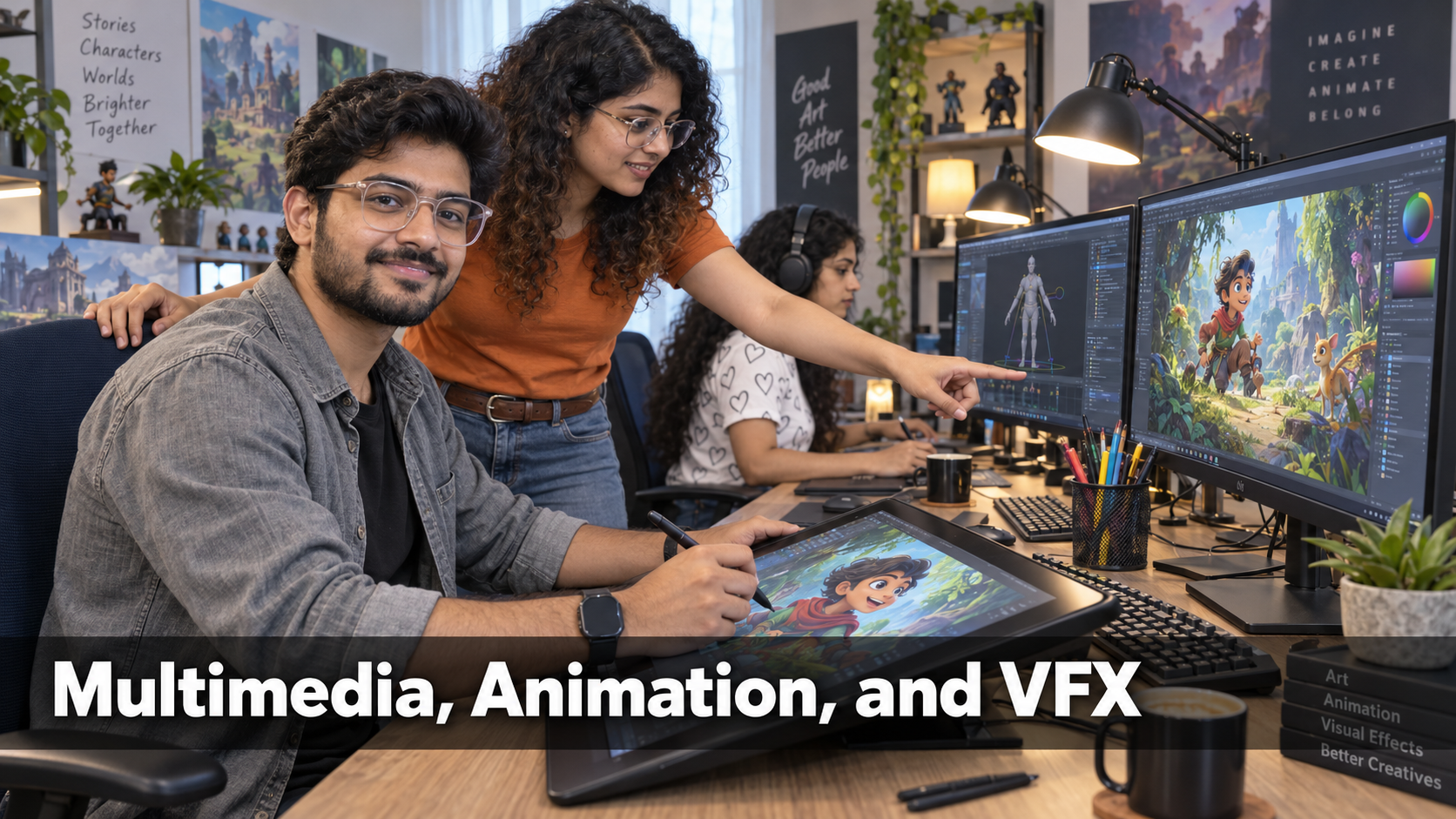
Animation today is much more than drawing characters frame by frame. It sits at the intersection of art, storytelling, design, filmmaking, visual effects, gaming, digital technology and interactive media.
A single animated sequence may involve concept artists, storyboard artists, 2D or 3D animators, modellers, riggers, texture artists, lighting specialists, compositors, editors, sound professionals and technical artists. Gaming and immersive media add another layer through real-time engines, interactive environments, AR/VR experiences and virtual production.
For students who enjoy both creativity and technology, animation and multimedia therefore offer several possible directions rather than one fixed career path.
Choosing the right university for animation, multimedia or VFX education should consequently involve more than checking whether a degree is available. Students should examine the quality of studio learning, portfolio development, exposure to professional creative workflows, software and technology infrastructure, opportunities for practical production, and the extent to which students are encouraged to develop their own visual language.
At Brainware University, students interested in this creative-technology ecosystem can currently explore the Bachelor of Science (Honours) in Animation & Multimedia, the Bachelor of Science (Honours) in Animation, VFX & Gaming, and, for advanced study, the Master of Science in Animation & Multimedia.
What Are Animation, Multimedia and VFX?
Animation, multimedia and visual effects are closely connected fields, but they are not exactly the same.
Animation creates the illusion of movement through sequential images or digitally generated objects. It can include 2D animation, 3D animation, character animation, motion graphics and several other forms of moving visual communication.
Multimedia combines different forms of communication such as images, graphics, animation, video, sound, text and interactive elements to create digital experiences.
Visual Effects or VFX involve creating, manipulating or integrating visual elements that may be difficult, unsafe, expensive or impossible to capture entirely through conventional filming.
Modern creative production frequently combines all three.
A film may use live-action footage, 3D animation, digital environments and compositing. A game may combine character animation, environment design, visual effects and sound. A digital advertising campaign may use motion graphics, typography, animation and video editing.
This convergence is why contemporary creative professionals benefit from understanding not just individual software tools but the larger production pipeline.
Why Are These Fields Becoming More Interconnected?
Digital content is no longer produced for a single screen.
Visual stories now appear across:
- films;
- television;
- OTT platforms;
- video games;
- advertisements;
- social media;
- websites;
- mobile applications;
- e-learning platforms;
- virtual environments;
- augmented reality; and
- immersive experiences.
As platforms converge, the boundaries between animator, designer, editor, VFX artist and interactive-media creator can also overlap.
For students, this means that a strong creative education should develop a combination of:
visual thinking + storytelling + artistic fundamentals + software proficiency + production knowledge + portfolio skills.
Learning only how to operate software is not enough.
Software changes. Creative fundamentals remain much more transferable.
What Should Students Learn Before Becoming Animators or Multimedia Professionals?
Students entering animation sometimes assume that the first step is learning sophisticated 3D software.
In reality, good animation begins much earlier.
Drawing and Visual Observation
Even in a highly digital production environment, observing shape, proportion, movement, composition, light and form remains valuable.
Drawing trains students to see.
It can also help with character exploration, storyboard development, environment design and visual problem-solving.
Design Fundamentals
Colour, balance, hierarchy, contrast, typography and composition influence almost every area of visual communication.
These principles matter whether a student is designing a film frame, game interface, motion graphic, digital advertisement or animated sequence.
Storytelling
Technology can create impressive images, but memorable animation usually needs a reason for those images to exist.
Students therefore benefit from understanding:
- narrative structure;
- character motivation;
- visual pacing;
- shot progression;
- staging;
- mood; and
- audience response.
The ability to tell a story visually remains important across animation, film, advertising and gaming.
Why Storyboarding Matters
A storyboard converts ideas into a visual sequence before full production begins.
It can help creators plan:
- camera angles;
- character positions;
- movement;
- scene transitions;
- timing;
- composition; and
- narrative flow.
This makes storyboarding one of the important bridges between writing and visual production.
A well-developed storyboard can also reduce production confusion because different members of the creative team can understand how a sequence is expected to unfold before expensive or time-consuming animation begins.
Understanding 2D Animation
2D animation remains relevant even as 3D technologies become more sophisticated.
It is widely used in:
- animated storytelling;
- explainer videos;
- advertising;
- motion design;
- educational media;
- digital content;
- social communication; and
- stylised entertainment.
Students learning 2D animation develop an understanding of movement, timing, spacing, anticipation, weight and expression.
These fundamentals can remain useful even when a student later works primarily in 3D.
The technology changes; the principles of believable motion remain important.
Understanding 3D Animation
3D production introduces another set of creative and technical processes.
A typical workflow can involve:
concept → modelling → texturing → rigging → animation → lighting → rendering → compositing.
Different professionals may specialise in different parts of this pipeline.
A modeller creates digital forms.
A texture or material artist develops surface appearance.
A rigger builds the controls that allow characters or objects to move.
An animator creates performance and motion.
Lighting and rendering shape how the final digital scene appears.
This production-chain perspective helps students understand why animation is often a collaborative industry rather than an individual software exercise.
What Is VFX and How Does It Work?
Visual effects allow filmmakers and digital creators to construct or modify imagery beyond what was captured directly by a camera.
VFX production can involve techniques such as:
- compositing;
- rotoscoping;
- chroma-key work;
- digital environments;
- object removal;
- tracking;
- simulation;
- CGI integration;
- lighting integration; and
- colour and image enhancement.
The objective is not always to create something spectacular.
Some of the most effective visual effects are designed not to attract attention at all. Their purpose may simply be to make digitally created elements appear naturally integrated with live-action footage.
For students interested in VFX, understanding photography, cinematography, perspective, lighting and composition can therefore be as important as understanding software.
Gaming Adds Real-Time Interaction
Gaming introduces another major creative pathway.
Unlike a film, where every viewer normally sees the same sequence, games must respond to player interaction.
This changes how digital assets are created.
Game production can involve:
- character design;
- environment modelling;
- game mechanics;
- rigging;
- animation;
- level design;
- lighting;
- user interfaces;
- interactive storytelling;
- real-time rendering; and
- technical optimisation.
Brainware University’s dedicated Animation, VFX & Gaming pathway reflects this convergence by combining animation and VFX with game development, real-time production and immersive media.
For students interested in both art and interactive technology, gaming can therefore provide a different creative direction from conventional animation or film production.
Why Real-Time Engines Matter
Traditionally, complex 3D scenes could require significant rendering time before artists could see the finished result.
Real-time engines are changing this workflow.
Technologies such as Unreal Engine and Unity allow creators to visualise and interact with digital environments much more immediately.
These systems are now relevant not only to gaming but also to areas such as:
- virtual production;
- interactive storytelling;
- pre-visualisation;
- architectural visualisation;
- immersive experiences;
- AR/VR;
- simulation; and
- digital filmmaking.
Students entering creative industries therefore benefit from understanding how real-time workflows are changing the relationship between design, animation and production.
AR, VR and Immersive Media
Augmented Reality and Virtual Reality extend visual communication beyond conventional screens.
Virtual Reality (VR) places the user inside a computer-generated environment.
Augmented Reality (AR) adds digital content to the user’s view of the physical world.
These technologies require professionals to think differently about visual storytelling because the viewer may be able to move, explore or interact with the environment rather than simply watch it.
Skills associated with animation, 3D modelling, game engines, interactive design and spatial storytelling can all contribute to immersive-media production.
Multimedia Goes Beyond Animation
Multimedia education should not be understood as animation alone.
The field can also involve:
- graphic communication;
- digital illustration;
- photography;
- video production;
- motion graphics;
- sound;
- editing;
- interactive media;
- visual branding;
- digital storytelling; and
- web-based visual experiences.
This broader foundation can be particularly valuable for students who are creative but have not yet decided whether they want to specialise in animation, VFX, motion design, video production or another area of digital media.
Why Motion Graphics Are Everywhere
Motion graphics combine movement with graphic design.
They are commonly seen in:
- title sequences;
- advertisements;
- social-media content;
- brand films;
- explainers;
- broadcast graphics;
- digital signage; and
- online video.
Motion designers therefore need both animation skills and design sense.
Typography, hierarchy, timing, composition and sound can all influence whether a motion-graphics piece communicates effectively.
Sound Is Part of Visual Storytelling
Animation is often discussed as if it were purely visual.
In practice, sound can dramatically change how audiences experience an animated sequence.
Creative production may use:
- dialogue;
- ambient sound;
- Foley;
- sound effects;
- music;
- voice recording; and
- sound design.
A strong visual sequence with weak sound may feel incomplete.
This is why exposure to audio production can be useful for students interested in animation, film and multimedia storytelling.
Why Studio-Based Learning Matters
Animation and multimedia are application-oriented disciplines.
A student can understand animation principles theoretically but still need repeated practice to create convincing motion.
Similarly, reading about compositing does not automatically develop the ability to integrate different visual layers convincingly.
Creative education therefore benefits from a progression such as:
Concept → Demonstration → Practice → Project → Review → Revision → Portfolio
The review and revision stages are especially important.
Creative work usually improves through feedback.
Students should learn to evaluate their own work, receive criticism professionally and revise projects rather than treating the first version as the final output.
What Is a Creative Production Pipeline?
Professional creative work rarely begins and ends with a single software package.
A project can move through several stages:
Pre-production
This may include:
- research;
- concept development;
- scriptwriting;
- visual development;
- character design;
- storyboarding; and
- pre-visualisation.
Production
Depending on the project, production may involve:
- modelling;
- rigging;
- animation;
- filming;
- asset creation;
- texturing;
- lighting;
- recording; or
- simulation.
Post-production
The final stage may include:
- compositing;
- editing;
- visual effects;
- colour correction;
- sound;
- motion graphics; and
- final output.
Understanding the complete pipeline helps students see how individual skills connect within a professional project.
Why Portfolio Development Matters
Animation, VFX and design are highly visual professions.
Employers and clients often need to see what a creator can actually do.
This makes the portfolio or showreel particularly important.
A portfolio can demonstrate:
- artistic fundamentals;
- animation quality;
- visual problem-solving;
- technical skills;
- storytelling ability;
- specialisation;
- personal style; and
- project development.
Quality is usually more meaningful than simply displaying a large quantity of unfinished work.
Students should therefore learn how to select, refine and present projects professionally.
Brainware University’s current animation and multimedia learning framework places explicit emphasis on portfolio and showreel development alongside studio-based projects and practical production.
How AI Is Changing Animation and Multimedia
Artificial intelligence is increasingly entering creative-production workflows.
AI-assisted tools can support areas such as:
- visual ideation;
- concept development;
- storyboarding;
- image generation;
- background preparation;
- motion refinement;
- rotoscoping;
- object tracking;
- video editing;
- sound workflows;
- rendering;
- asset creation; and
- production planning.
Brainware University’s current undergraduate and postgraduate animation pages also describe AI-assisted creative workflows, including applications in rigging, motion processing, compositing, storyboarding, editing and virtual production.
However, AI changes the workflow more than it eliminates the need for creative fundamentals.
Generating an image is not the same as understanding composition.
Producing motion automatically is not the same as understanding animation timing.
Creating visual options rapidly is not the same as knowing which option serves the story.
Future creative professionals therefore need to combine:
artistic judgement + storytelling + technical ability + AI literacy.
Responsible Use of AI in Creative Work
AI-assisted production also creates new questions.
Students need to think about:
- originality;
- copyright;
- authorship;
- disclosure;
- dataset ethics;
- consistency;
- visual accuracy; and
- responsible use of generated assets.
The ability to use AI efficiently is valuable, but professional creative work also requires judgement about when AI should be used and whether the resulting material is suitable for a particular project.
The current postgraduate animation framework at Brainware explicitly includes awareness of ethical use of AI-generated visual assets alongside AI-supported creative workflows.
Will AI Replace Animators and VFX Artists?
AI is likely to automate or accelerate parts of the production process, particularly repetitive technical tasks.
That does not make storytelling, design judgement or artistic direction irrelevant.
Instead, the role of creative professionals may increasingly involve deciding:
- what should be created;
- why it should look a certain way;
- how it supports the story;
- whether it is visually coherent;
- how assets fit into a production pipeline; and
- how technology can be used responsibly.
Students should therefore avoid learning only one software package.
The more sustainable foundation is to develop visual thinking and storytelling alongside the ability to adapt to changing tools.
What Makes a Good University for Animation and Multimedia?
Students comparing institutions can ask several useful questions.
Are Strong Creative Fundamentals Taught?
A good programme should not begin and end with software.
Students need exposure to design, drawing, visual communication, storytelling, composition and movement.
Is There Practical Studio Learning?
Animation and VFX require practice.
Students should have opportunities to produce actual work rather than study production entirely through theory.
Are Contemporary Tools and Workflows Available?
Creative industries evolve rapidly.
Exposure to digital animation, VFX, editing, sound, real-time production and other contemporary workflows can help students understand modern production environments.
Is Portfolio Development Part of Learning?
Students should gradually build a body of work rather than suddenly attempt to create a showreel at the end of their studies.
Are There Opportunities for Collaborative Projects?
Films, animations and games are often created by teams.
Collaborative projects can help students understand deadlines, communication, task division, feedback and production responsibility.
Is Industry Exposure Available?
Workshops, live projects, internships, production collaborations and interactions with working professionals can help learners connect classroom knowledge with current creative-industry practices.
Animation and Multimedia Learning at Brainware University
Brainware University’s current animation and multimedia ecosystem combines creative foundations with studio-based and technology-supported learning.
The university’s Animation and Multimedia programme identifies learning across areas such as 2D and 3D animation, VFX and compositing, character design, storyboarding, motion graphics, video editing, graphic design, photography, sound, interactive media and portfolio development. Its learning infrastructure also includes animation and VFX labs, production facilities, sound and photography resources, and project-oriented work.
Students interested in a more gaming-oriented pathway can explore learning that combines animation and VFX with game development, real-time engines, 3D modelling, rigging, AR/VR and immersive media.
For graduates who want to advance their creative and technical practice further, postgraduate study can deepen exposure to animation, VFX, motion graphics, filmmaking, digital design, sound, editing, visual storytelling and multimedia production.
Students should use the respective official programme pages for current information about eligibility, duration, fees, curriculum, admission and other programme-specific details.
Animation & Multimedia or Animation, VFX & Gaming: How Should a Student Think About the Difference?
Students should begin with their interests rather than the similarity of the programme names.
A broader animation-and-multimedia pathway may suit a learner who wants to explore multiple forms of visual communication such as animation, graphic design, video, motion graphics, sound, photography and digital storytelling.
A more specialised animation-VFX-gaming pathway may appeal to students particularly interested in:
- 3D production;
- VFX;
- game art;
- game development;
- real-time engines;
- immersive technology; or
- interactive digital worlds.
Neither direction is automatically “better.”
The more useful question is:
What kind of creative work do I want to spend years learning and practising?
When Does Postgraduate Study Make Sense?
A postgraduate pathway can make sense when a student wants to move beyond foundational undergraduate exposure and develop greater depth in creative production.
Advanced study may be useful for someone who wants to:
- refine a specialisation;
- strengthen a professional portfolio;
- explore advanced animation or VFX workflows;
- develop more sophisticated visual storytelling;
- work on larger creative projects;
- deepen research or conceptual understanding;
- prepare for academic work; or
- integrate newer production technologies into an existing skill set.
However, a postgraduate qualification should not be treated merely as an automatic continuation of undergraduate study.
Students benefit most when they enter advanced study with clear creative goals.
Skills That Matter in Animation, VFX and Multimedia
Observation
Artists need to notice movement, expression, proportion, colour, light and visual detail.
Storytelling
Technology becomes more meaningful when it supports a narrative or communication objective.
Design Sense
Composition, colour and visual hierarchy influence the effectiveness of creative work.
Technical Adaptability
Software changes rapidly. Professionals need to keep learning.
Problem-Solving
Production frequently involves technical and creative challenges that do not have one obvious solution.
Patience
High-quality animation, compositing and design often require revision.
Collaboration
Creative projects commonly involve multiple specialists working together.
Communication
Professionals must explain ideas, understand briefs and respond to feedback.
Portfolio Discipline
Finishing and presenting strong projects is more valuable than accumulating many incomplete experiments.
Where Are Animation and Multimedia Skills Used?
Animation and multimedia skills extend far beyond traditional animated films.
They can contribute to:
- film and television;
- OTT content;
- gaming;
- advertising;
- digital marketing;
- social media;
- e-learning;
- broadcasting;
- design;
- virtual production;
- AR/VR experiences;
- interactive media;
- product visualisation;
- branded content;
- web-based communication; and
- independent digital creation.
This wide application is one reason students should think in terms of transferable creative skills rather than preparing for only one narrow job title.
Film and OTT Production
Films and streaming content use animation and VFX at multiple stages.
Creative teams may work on:
- titles;
- CGI elements;
- digital environments;
- effects;
- compositing;
- motion graphics;
- editing;
- pre-visualisation; and
- promotional content.
Even productions that do not appear heavily effects-driven can use significant digital post-production.
Gaming and Interactive Media
Game development combines visual storytelling with user interaction.
Artists may contribute to characters, environments, props, animation, interfaces, effects and cinematic sequences.
Real-time technologies also mean that gaming skills increasingly overlap with virtual production, simulation and immersive media.
Advertising and Brand Communication
Modern advertising depends heavily on moving visual content.
Brands use animation, motion graphics, short-form video, interactive media and digital design to communicate across multiple platforms.
This creates opportunities for creative professionals who can combine design with storytelling and understand how content changes across screen sizes and media formats.
E-Learning and Educational Media
Animation can help explain processes that are difficult to communicate through text alone.
Educational media can use:
- diagrams;
- motion graphics;
- simulations;
- animated explainers;
- interactive learning; and
- visual storytelling.
This illustrates how animation has applications well beyond entertainment.
Freelancing and Independent Creative Work
Digital production has also made independent work more accessible.
Animators, editors, designers, illustrators and VFX artists can collaborate remotely with clients and creative teams.
However, freelancing requires more than creative skill.
Independent professionals also need to manage:
- briefs;
- deadlines;
- revisions;
- communication;
- pricing;
- project files;
- client expectations; and
- professional portfolios.
Students interested in freelancing should therefore develop professional habits alongside their creative skills.
Frequently Asked Questions About Animation, Multimedia and VFX
What is the difference between animation and VFX?
Animation creates movement in illustrated or computer-generated elements, while VFX generally involves creating or manipulating visual elements for integration into filmed or digital scenes. Modern productions often use both together.
Is multimedia the same as animation?
No. Animation is one part of the wider multimedia field. Multimedia can combine graphics, photography, video, audio, animation, text and interactive digital elements.
Is drawing necessary for animation?
Strong drawing ability is particularly useful in areas such as concept art, storyboarding and 2D animation. Even for students working primarily in 3D, observational and design skills can strengthen visual understanding.
What is the role of VFX in filmmaking?
VFX can be used to create environments, effects, characters or objects that cannot easily be captured through conventional filming. It can also be used for subtle corrections, compositing and enhancement.
How is gaming connected with animation?
Games depend on animation for characters, objects and environments, while game development also adds interactive systems, real-time rendering and player-controlled experiences.
What is a showreel?
A showreel is a curated presentation of a creator’s strongest animation, VFX, motion-design or related work. It helps demonstrate practical ability and visual style to studios, employers or clients.
Is software knowledge enough to become an animator?
No. Software proficiency is useful, but strong creative work also depends on fundamentals such as movement, composition, design, observation and storytelling.
How is AI changing animation and VFX?
AI-assisted tools can support ideation, storyboarding, rotoscoping, tracking, motion refinement, editing, asset creation and other production tasks. Human creative judgement remains important for narrative, visual direction, consistency and responsible use.
What is virtual production?
Virtual production combines digital environments and real-time technologies with filmmaking workflows. Real-time engines can help filmmakers visualise or create virtual environments during different stages of production.
What should students look for in an animation university?
Students should assess creative foundations, practical studios, software and technology exposure, portfolio development, collaborative projects, industry interactions and opportunities to work through complete production pipelines.
Which Brainware programme should a student choose?
The answer depends on the student’s interests. Those looking for broader animation, multimedia and visual-communication exposure can examine Brainware University’s animation-and-multimedia pathway, while students strongly interested in VFX, 3D, gaming and immersive technologies can examine the dedicated animation-VFX-gaming pathway. Current programme details should always be checked on the respective official programme pages.
Can students pursue advanced study after undergraduate animation education?
Yes. Students interested in deeper creative, technical or research-oriented learning can explore postgraduate study. Brainware University currently offers a postgraduate pathway in Animation & Multimedia for advanced creative and multimedia production learning.
Building a Career Around Creativity and Technology
Animation has evolved from a specialised entertainment technique into part of a much larger creative-technology ecosystem.
Today, animation, VFX, gaming, motion design, interactive media and multimedia production increasingly intersect with real-time engines, immersive environments and AI-assisted creative tools.
This makes adaptability important.
Students preparing for this field should not focus exclusively on mastering the software that is popular today. They should build deeper abilities in:
observation, design, storytelling, movement, visual problem-solving, collaboration and creative judgement.
Technology can then become the tool through which those abilities are expressed.