Choosing a B.Tech programme is one of the first major academic decisions for students who want to build a career in technology, computing, engineering or applied sciences. But choosing a B.Tech today is very different from choosing one a decade ago.
The technology industry has expanded rapidly. Software development now intersects with artificial intelligence. Data has become central to business and research. Robotics is bringing intelligent systems into the physical world. Cybersecurity has become essential to almost every digital organisation. Biotechnology is using engineering and computational methods to address challenges in healthcare, pharmaceuticals, agriculture and life sciences.
This means students looking for the best B.Tech university are no longer choosing only between traditional engineering branches. They are also choosing between different technology ecosystems and learning approaches.
A student interested in programming may prefer Computer Science and Engineering. Someone fascinated by intelligent systems may be more interested in Artificial Intelligence and Machine Learning. A student who enjoys mathematics and working with information may find Data Science and AI attractive. Those interested in machines and automation may explore AI and Robotics, while students interested in digital protection may choose Cyber Security. Biotechnology offers another direction for students who want to combine engineering with biological sciences.
Brainware University offers B.Tech pathways across these emerging and established areas, including B.Tech in Computer Science and Engineering, B.Tech in Computer Science & Engineering – Artificial Intelligence & Machine Learning, B.Tech in Computer Science & Engineering – Data Science & Artificial Intelligence, B.Tech in Computer Science & Engineering – Artificial Intelligence & Robotics, B.Tech in Computer Science & Engineering – Cyber Security and B.Tech in Biotechnology.
The important question for students is therefore not simply which B.Tech programme is popular, but which academic direction matches their interests, abilities and future goals.
What Makes B.Tech Education Different?
Bachelor of Technology programmes are designed to combine scientific principles with practical applications.
Students generally work with:
- Mathematics
- Science
- Computing
- Engineering principles
- Problem-solving
- Laboratory work
- Technical projects
- Industry applications
The practical nature of B.Tech education makes learning different from purely theoretical study.
Students are expected to understand how things work and, increasingly, how to build, test, analyse and improve them.
This can involve writing software, analysing data, developing intelligent systems, securing networks, designing robotic applications or conducting biotechnology experiments.
Why Is B.Tech Still Relevant in a Technology-Driven Economy?
Technology has become part of almost every industry.
Banks depend on software and cybersecurity. Hospitals use digital systems and data. Manufacturing increasingly uses automation and robotics. Agriculture is adopting biotechnology and data-driven methods. Businesses use AI and analytics to understand customers and improve operations.
As a result, technology professionals are no longer required only by traditional IT companies.
| Sector | Technology Requirement |
|---|---|
| IT and Software | Programming, applications and cloud systems |
| Banking | Digital systems, analytics and cybersecurity |
| Healthcare | AI, biotechnology and digital health |
| Manufacturing | Robotics, automation and intelligent systems |
| E-commerce | Data, software and customer technologies |
| Pharmaceuticals | Biotechnology and computational research |
| Agriculture | Biotechnology and technology-enabled solutions |
| Defence | Cybersecurity, AI and intelligent systems |
| Research | Advanced computing and scientific innovation |
This cross-industry relevance gives B.Tech graduates several possible directions.
How Should Students Choose a B.Tech Specialisation?
There is no universally perfect B.Tech specialisation.
The right choice depends on what a student enjoys learning and the type of problems they want to solve.
| If You Enjoy… | You May Explore… |
|---|---|
| Programming and software | Computer Science & Engineering |
| Intelligent systems | AI & Machine Learning |
| Mathematics, data and analytics | Data Science & AI |
| Machines, automation and intelligent devices | AI & Robotics |
| Networks, security and digital investigation | Cyber Security |
| Biology, technology and scientific research | Biotechnology |
Students should also consider the kind of work they can imagine doing regularly rather than choosing a field only because it is currently popular.
Computer Science and Engineering: A Broad Technology Foundation
Computer Science and Engineering remains one of the broadest technology-oriented B.Tech pathways.
The B.Tech in Computer Science and Engineering provides a foundation in areas such as programming, data structures and algorithms, databases, computer networks, operating systems and software engineering.
The current programme also includes exposure to areas such as artificial intelligence, machine learning, data analytics, cloud computing, cybersecurity and Internet of Things.
This breadth can be useful for students who want flexibility while developing their computing foundations.
B.Tech in Artificial Intelligence and Machine Learning
Artificial Intelligence has become one of the most influential technologies in the current digital economy.
AI systems can be used for:
- Predictive analysis
- Computer vision
- Natural language processing
- Recommendation systems
- Automation
- Intelligent decision-making
- Pattern recognition
The B.Tech in Computer Science & Engineering – Artificial Intelligence & Machine Learning provides a computing foundation alongside specialised learning in AI and machine learning.
Students who enjoy programming, mathematics and intelligent computational systems may find this pathway relevant.
B.Tech in Data Science and Artificial Intelligence
Data has become central to modern decision-making.
Organisations use data to understand customers, forecast demand, identify patterns and improve performance.
The B.Tech in Computer Science & Engineering – Data Science & Artificial Intelligence combines computer science with data science and AI. The current programme information includes areas such as machine learning, big data engineering, cloud infrastructure, deep learning, generative AI and MLOps.
This pathway can suit students who enjoy analytical problems, mathematics, programming and working with large datasets.
B.Tech in Artificial Intelligence and Robotics
Robotics brings software and physical systems together.
A modern robot may use:
- Sensors
- Cameras
- Embedded systems
- Control systems
- Programming
- Machine learning
- Computer vision
- Mechanical components
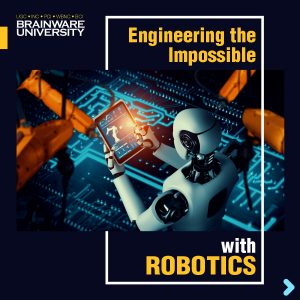
The B.Tech in Computer Science & Engineering – Artificial Intelligence & Robotics combines AI with robotics, automation, embedded systems and intelligent machines. The current programme information includes technologies such as ROS, Python, TensorFlow, MATLAB and Arduino.
Students interested in autonomous systems, intelligent machines and automation can explore this direction.
B.Tech in Cyber Security
Almost every organisation that uses digital technology also needs to protect it.
Cybersecurity focuses on safeguarding:
- Networks
- Applications
- Data
- Devices
- Digital identities
- Cloud infrastructure
The B.Tech in Computer Science & Engineering – Cyber Security combines computer science fundamentals with areas such as network security, ethical hacking, penetration testing, cryptography, cyber forensics and incident response.
This field can appeal to students who enjoy technical investigation, networks, security and problem-solving.
B.Tech in Biotechnology
Technology is also transforming the life sciences.
Biotechnology uses biological knowledge together with scientific and engineering principles to address challenges in areas such as:
- Healthcare
- Pharmaceuticals
- Agriculture
- Food technology
- Environmental science
- Biomedical research
The B.Tech in Biotechnology covers areas including molecular biology, genetics, microbiology, biochemistry, bioinformatics and bioprocess engineering.
The programme also brings computational approaches into biotechnology, including applications involving biological data and AI-supported analysis.
This creates a different B.Tech route for students interested in the intersection of engineering and life sciences.
Why Practical Learning Matters in B.Tech
Engineering knowledge becomes more meaningful when students can apply it.
Practical learning can involve:
- Laboratory experiments
- Coding exercises
- Technical projects
- Simulations
- Prototyping
- Research projects
- Internships
- Industry assignments
A student studying AI, for example, should have opportunities to work with data and models. A cybersecurity student can benefit from controlled security environments. A robotics student needs opportunities to work with hardware and intelligent systems.
Practical experience helps transform abstract concepts into usable skills.
The Role of Projects in B.Tech Education
Projects allow students to combine different subjects.
Consider a simple intelligent application.
A student might need to:
- Identify a problem
- Research existing solutions
- Select appropriate technology
- Design the system
- Build a prototype
- Test the solution
- Analyse the results
- Fix problems
- Present the outcome
This process develops more than technical knowledge.
It also develops:
- Planning
- Teamwork
- Communication
- Creativity
- Problem-solving
- Time management
These skills are useful regardless of the B.Tech specialisation a student chooses.
Industry Exposure During B.Tech
The technology industry changes quickly.
Students therefore benefit from understanding professional practices before graduation.
Industry exposure can include:
- Internships
- Workshops
- Guest lectures
- Industry visits
- Live projects
- Technical competitions
- Professional mentoring
Such experiences can help students understand how technical knowledge is applied outside the classroom.
They can also help students identify the areas in which they want to develop deeper expertise.
Research and Innovation
B.Tech education can also provide an entry point into research.
Students interested in innovation can explore areas such as:
- AI
- Machine learning
- Robotics
- Cybersecurity
- Data science
- Biotechnology
- Automation
- Intelligent systems
Research projects encourage students to ask questions rather than simply look for predetermined answers.
This is particularly useful for students considering higher education or research-oriented careers.
AI Is Becoming an Interdisciplinary Engineering Skill
Artificial Intelligence is no longer confined to one academic department.
It can be applied to:
- Software development
- Data science
- Cybersecurity
- Robotics
- Biotechnology
- Healthcare
- Manufacturing
- Business systems
This means students from different B.Tech backgrounds can benefit from understanding AI.
However, the application of AI differs from one discipline to another.
In cybersecurity, AI may assist with threat detection.
In robotics, it can support perception and autonomous behaviour.
In biotechnology, it can help analyse biological data.
In software development, it can support intelligent applications.
The underlying technology may be similar, but the engineering problem changes.
What Should Students Look for in a B.Tech University?
A university should be evaluated on more than its programme list.
Important factors include:
| Factor | Why It Matters |
|---|---|
| Curriculum | Provides academic foundations and exposure to relevant technologies |
| Laboratories | Enables hands-on technical learning |
| Faculty | Supports subject understanding and project guidance |
| Projects | Develops practical problem-solving ability |
| Industry Exposure | Connects students with professional practices |
| Internships | Provides workplace experience |
| Research | Encourages innovation and deeper exploration |
| Infrastructure | Supports modern technical education |
| Career Preparation | Develops professional and employability skills |
| Student Activities | Encourages teamwork, leadership and communication |
Students should compare these factors alongside their own academic interests.
B.Tech Education at Brainware University
The B.Tech portfolio provides different academic directions within computing, emerging technologies and biotechnology.
Students looking for a broad computing foundation can explore B.Tech in Computer Science and Engineering.
Those interested in intelligent computational systems can consider B.Tech in Computer Science & Engineering – Artificial Intelligence & Machine Learning.
Students interested in data, analytics and AI can explore B.Tech in Computer Science & Engineering – Data Science & Artificial Intelligence.
Those fascinated by intelligent machines and automation can consider B.Tech in Computer Science & Engineering – Artificial Intelligence & Robotics.
Students interested in digital protection can explore B.Tech in Computer Science & Engineering – Cyber Security.
And students who want to combine engineering with life sciences can consider B.Tech in Biotechnology.
Across these programmes, current programme information highlights practical learning, technical projects, laboratories, internships, industry exposure and emerging technology applications.
Students should refer to the respective official programme pages for the latest information regarding eligibility, admission, fees, duration, curriculum and other programme-specific details.
Career Directions After B.Tech
A B.Tech qualification can lead to different career directions depending on the specialisation.
| B.Tech Area | Possible Career Directions |
|---|---|
| Computer Science & Engineering | Software development, cloud, applications and IT |
| AI & Machine Learning | AI engineering and machine learning |
| Data Science & AI | Data analytics, data engineering and AI |
| AI & Robotics | Robotics, automation and intelligent systems |
| Cyber Security | Security analysis, cyber defence and information security |
| Biotechnology | Research, pharmaceuticals, healthcare and biotechnology |
The actual career path depends on technical ability, practical experience, specialisation and continuous learning.
Where Can B.Tech Graduates Work?
Engineering and technology graduates can work across multiple industries.
| Sector | Examples of Applications |
|---|---|
| IT | Software and digital platforms |
| Banking | Analytics, software and cybersecurity |
| Healthcare | Biotechnology, AI and digital health |
| Manufacturing | Robotics and automation |
| Pharmaceuticals | Biotechnology and research |
| E-commerce | Software, data and digital systems |
| Agriculture | Biotechnology and data-driven technologies |
| Cybersecurity | Digital protection and security services |
| Research | Advanced scientific and technological research |
| Startups | Technology products and innovative solutions |
The diversity of applications means students are not necessarily restricted to one industry throughout their careers.
Higher Study Options After B.Tech
A B.Tech degree can also be followed by advanced academic or professional education.
Depending on their interests, graduates may explore:
- M.Tech
- M.Sc
- MBA
- MCA
- Specialised technology certifications
- Research programmes
- Doctoral studies
Students can also develop expertise through professional certifications in areas such as AI, cloud computing, cybersecurity, data analytics and other emerging technologies.
Frequently Asked Questions About B.Tech
What is B.Tech?
B.Tech, or Bachelor of Technology, is an undergraduate degree that combines scientific and mathematical foundations with engineering and technology-based learning.
Which B.Tech specialisation should I choose?
The choice depends on your interests. Programming may point towards CSE, intelligent systems towards AI and ML, data towards Data Science and AI, machines towards Robotics, digital protection towards Cyber Security and biological sciences towards Biotechnology.
Is CSE broader than specialised B.Tech programmes?
Generally, CSE provides a broad computing foundation, while specialised programmes focus more strongly on a particular area such as AI, Data Science, Robotics or Cyber Security.
Is AI useful outside an AI degree?
Yes. AI is increasingly applied in cybersecurity, robotics, data science, software development, biotechnology and other technology areas.
Why are internships important during B.Tech?
Internships provide exposure to professional environments and help students understand how technical knowledge is applied in real organisations.
Is biotechnology a B.Tech field?
Yes. Biotechnology can be studied through engineering-oriented programmes that combine biological sciences with engineering, computational and technological approaches.
What career options are available after B.Tech?
Career possibilities depend on the specialisation and may include software development, AI, data science, cybersecurity, robotics, biotechnology research and other technology-related roles.
What should I check before choosing a B.Tech university?
Look at curriculum, faculty, laboratories, projects, internships, industry exposure, research opportunities, infrastructure and career preparation.
A B.Tech Journey Is Built One Skill at a Time
A four-year B.Tech programme can expose students to an enormous amount of knowledge. But no student graduates knowing everything—and that is not the purpose of the degree.
The purpose is to build a foundation strong enough to keep learning.
A programming concept learned in the first year may become part of a software project later. A mathematical principle may become useful in machine learning. A laboratory experiment may lead to a research question. An internship may reveal an entirely new career interest.
The B.Tech journey is therefore not simply about completing subjects and receiving a degree. It is about gradually developing the ability to understand problems, work with technology and create solutions.
For some students, that journey may lead to software. For others, it may lead to artificial intelligence, data, robotics, cybersecurity or biotechnology.
The technology may differ, but the underlying habit remains the same: keep questioning, keep experimenting and keep improving.
That is the foundation on which a B.Tech education can become more than a qualification—it can become the starting point for a career that continues to evolve with technology itself.