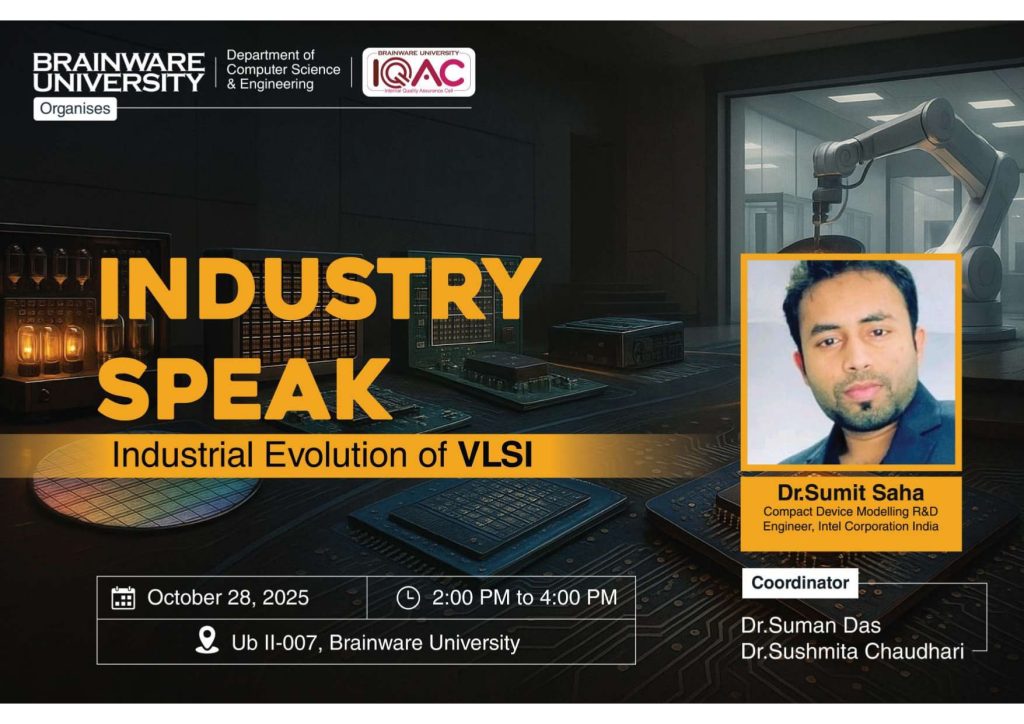
Industry Speak – Industrial evolution of VLSI Computer Science &
Engineering 28.10.2025
The Department of Computer Science and Engineering, in collaboration with the Institution’s Innovation Council (IIC), organised a seminar titled “From Campus to Global Career”, focusing on the technological evolution and industrial significance of Very-Large-Scale Integration (VLSI). The seminar traced the development of integrated circuit technology from the invention of the transistor and early integrated circuits to the progression from SSI, MSI, LSI, VLSI, and ULSI, highlighting the role of continuous miniaturisation and Moore’s Law in increasing transistor density and computational capabilities. The session also examined the transition from full-custom chip design to standard-cell methodologies and System-on-Chip (SoC) architectures, along with the growing importance of Electronic Design Automation (EDA) tools and Hardware Description Languages such as VHDL and Verilog. Through technology timeline reviews, design-flow case studies, and industry-focused discussions, students gained insights into the applications of VLSI in consumer electronics, high-performance computing, artificial intelligence, telecommunications, automotive systems, and the Internet of Things.
The seminar further explored emerging trends and challenges shaping the future of VLSI technology. Discussions focused on advanced packaging approaches such as 2.5D and 3D IC integration, power consumption constraints, physical verification challenges, neuromorphic computing, and the potential integration of quantum computing principles into chip design. Industry deep dives enabled participants to understand how specialised architectures such as GPUs and ASICs support AI and data-centre applications, while VLSI continues to contribute to autonomous systems and power-sensitive IoT technologies. Overall, the seminar provided students with a comprehensive understanding of the evolution, industrial impact, and future directions of VLSI, while highlighting its continued importance as a foundation for technological innovation and advanced engineering applications.