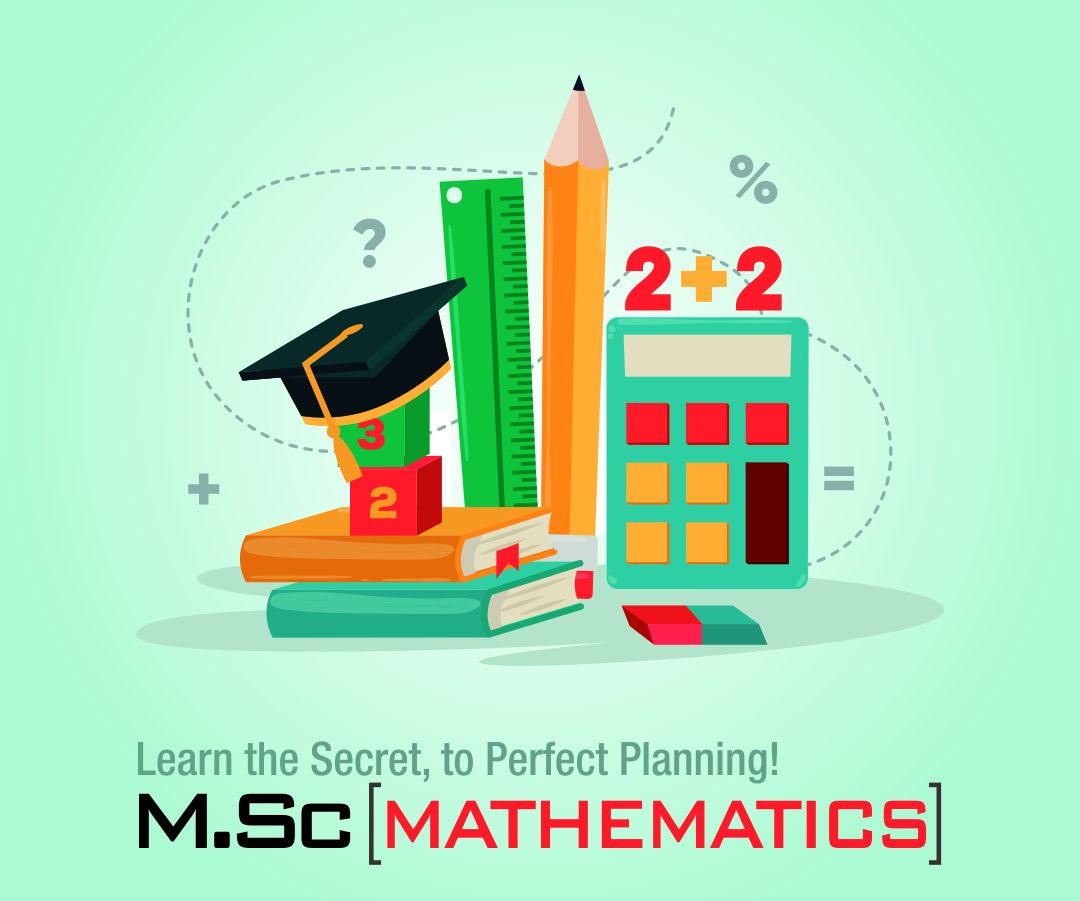
Mathematics is much more than numbers and formulas. It provides the foundation for data analysis, artificial intelligence, finance, statistics, scientific research, cryptography, technology and decision-making.
For students who enjoy logical reasoning and want to study mathematics at an advanced level, an MSc Mathematics can open several academic and professional pathways. The degree develops analytical thinking, problem-solving, quantitative reasoning, mathematical modelling and research skills.
But what can you do after MSc Mathematics?
The career scope extends beyond teaching. Depending on their interests and additional skills, graduates can explore opportunities in data analytics, statistics, finance, actuarial science, research, education, technology, operations research and quantitative roles.
The current MSc Mathematics programme at Brainware University is a two-year postgraduate programme covering areas such as real and complex analysis, algebra, differential equations, statistics, mathematical modelling, numerical methods, operations research, discrete mathematics, computational mathematics, financial mathematics, optimisation and research methods.
Why Study MSc Mathematics?
An MSc Mathematics can help students develop:
- Advanced mathematical reasoning
- Logical and analytical thinking
- Quantitative problem-solving
- Statistical understanding
- Mathematical modelling skills
- Computational thinking
- Research abilities
These skills can be applied across academic, scientific, financial and technology-oriented fields.
Mathematics is also increasingly connected with emerging areas such as artificial intelligence, machine learning, data science and financial technology.
What Do You Study in MSc Mathematics?
Postgraduate mathematics combines pure and applied mathematical concepts. The exact syllabus varies between universities, but important areas can include:
| Area | Focus |
| Real Analysis | Functions, limits, continuity and convergence |
| Complex Analysis | Functions involving complex numbers |
| Linear Algebra | Vectors, matrices and transformations |
| Abstract Algebra | Groups, rings and fields |
| Differential Equations | Mathematical modelling of changing systems |
| Probability & Statistics | Uncertainty and data analysis |
| Numerical Methods | Computational approaches to mathematical problems |
| Mathematical Modelling | Representing real-world systems mathematically |
| Operations Research | Optimisation and decision-making |
| Discrete Mathematics | Discrete structures and computational reasoning |
| Financial Mathematics | Mathematical applications in finance |
| Research Methods | Systematic mathematical investigation |
The current programme also includes R and Python, along with project work, research methodology and dissertation-based learning.
MSc Mathematics and Data Analytics
Data analytics is one of the important modern career directions for mathematics graduates.
Mathematics provides a foundation in:
- Probability
- Statistics
- Patterns
- Prediction
- Optimisation
- Quantitative modelling
Graduates who additionally learn Python, R, SQL, data visualisation and machine learning can explore data-related careers.
The mathematical background helps professionals understand quantitative models rather than simply use analytical tools.
MSc Mathematics and Artificial Intelligence
Artificial intelligence has a strong mathematical foundation.
Areas such as:
- Linear algebra
- Calculus
- Probability
- Statistics
- Optimisation
- Graph theory
are relevant to many machine-learning and AI techniques.
The current MSc Mathematics programme connects mathematical learning with areas including AI, data analytics, optimisation, predictive modelling and computational applications.
Students interested in AI can therefore combine postgraduate mathematics with programming and machine-learning skills to develop a specialised career direction.
Career Scope After MSc Mathematics
The career path after MSc Mathematics depends on interests, additional qualifications and practical skills.
| Career Area | Possible Roles |
| Education | Teacher, lecturer, academic professional |
| Research | Research associate, researcher |
| Data | Data analyst, statistical analyst |
| Finance | Quantitative analyst, risk analyst |
| Insurance | Actuarial and risk-related roles |
| Technology | Computational and analytical roles |
| Operations | Operations research analyst |
| Government | Statistical and analytical positions |
| Consulting | Quantitative and business analysis |
| Scientific Research | Mathematical modelling and computation |
1. Teaching and Education
Teaching remains a natural career pathway for mathematics graduates.
Graduates can explore opportunities in schools, coaching institutions, colleges and other educational organisations, subject to the qualifications required for specific positions.
Students interested in higher education and academic careers can also pursue further qualifications and research.
2. Research and Academia
An MSc can provide a foundation for advanced research in:
- Pure mathematics
- Applied mathematics
- Statistics
- Computational mathematics
- Mathematical modelling
- Operations research
- Financial mathematics
Students interested in academic research can consider a PhD after meeting the relevant eligibility requirements.
3. Data Analyst
Mathematics graduates can move into data analytics by developing programming and data-handling skills.
A data analyst may work on:
- Data cleaning
- Statistical analysis
- Trend identification
- Data visualisation
- Quantitative reporting
Python, R, SQL and visualisation tools can strengthen employability in this area.
4. Statistician
Statistics is used across research, healthcare, finance, business and government.
Statisticians may work on:
- Statistical modelling
- Surveys
- Experimental design
- Data interpretation
- Research analysis
A strong understanding of probability and statistics can therefore support several industries.
5. Actuarial Careers
Actuaries use mathematics and statistics to analyse financial risk, particularly in insurance and related financial sectors.
An MSc Mathematics can provide useful mathematical preparation, although professional actuarial careers generally require additional examinations and qualifications.
6. Quantitative Finance
Financial institutions use mathematical and statistical models to understand risk, markets and investment strategies.
Students interested in this area can explore roles such as:
- Quantitative analyst
- Risk analyst
- Financial modeller
- Quantitative researcher
Additional knowledge of finance, programming and financial markets is valuable.
7. Operations Research
Operations research applies mathematics to complex organisational decisions.
It can be used for:
- Resource allocation
- Scheduling
- Logistics
- Supply-chain optimisation
- Transportation
- Production planning
This makes mathematical optimisation relevant to manufacturing, logistics, business and other industries.
8. Technology and Computational Careers
Mathematics and computing increasingly overlap.
Students who combine mathematics with programming can explore areas such as:
- Algorithms
- Scientific computing
- Simulation
- Data analysis
- Numerical computing
- Optimisation
The current programme’s inclusion of R and Python provides an academic connection between mathematical concepts and computational applications.
9. Cryptography and Cybersecurity
Cryptography is another field where mathematics and technology intersect.
Mathematical concepts from areas such as number theory, algebra and discrete mathematics are important in encryption and secure communication.
Mathematics graduates with additional knowledge of computer science and cybersecurity can explore specialised roles in this area.
10. Analytical and Consulting Roles
Many organisations need professionals who can analyse information, identify patterns, build models and solve quantitative problems.
Mathematics graduates can therefore explore analytical positions in:
- Consulting
- Banking
- Healthcare
- Market research
- Technology
- Business analytics
- Research organisations
The job title may not always contain the word “mathematics,” but mathematical reasoning can remain central to the work.
Government and Public-Sector Opportunities
Depending on recruitment rules and specific qualifications, MSc Mathematics graduates can explore opportunities in areas such as:
- Statistical departments
- Research organisations
- Education
- Banking
- Public-sector finance
- Government examinations
- Survey and analytical work
Students should always check the official notification for the exact eligibility requirements of a particular position.
What Skills Should You Develop Alongside MSc Mathematics?
An MSc provides advanced mathematical knowledge, but additional skills can expand career opportunities.
Programming
Python and R can be useful for analytics and computational work.
Statistics
Strong statistical knowledge supports careers in data, research and finance.
Data Analysis
Understanding how to clean, analyse and visualise data can open additional career paths.
Finance
Financial knowledge can support careers in quantitative finance and risk management.
Communication
Professionals need to explain mathematical findings clearly to non-specialists.
Research
Research skills are useful for academic and industry-based investigation.
Future Scope of MSc Mathematics
The future relevance of mathematics is closely connected with the growth of quantitative technologies.
Important areas include:
- Artificial Intelligence: mathematical foundations support machine learning and optimisation.
- Data Analytics: organisations increasingly rely on quantitative information.
- FinTech: financial technology uses statistics, modelling and computation.
- Actuarial Science: mathematics remains central to risk analysis.
- Scientific Computing: mathematical models support scientific research.
- Operations Research: organisations use optimisation for better decisions.
- Research: mathematics remains fundamental to science and technology.
The current programme also highlights applications involving AI, data analytics, cryptography, risk modelling, optimisation and quantitative decision-making.
Higher Studies After MSc Mathematics
Students who want to continue their academic journey can explore:
- PhD in Mathematics
- PhD in Applied Mathematics
- Statistics
- Computational Mathematics
- Data Science
- Operations Research
- Financial Mathematics
- Interdisciplinary research
Professional certifications or specialised training in data science, actuarial science, machine learning, financial modelling, Python or R can also complement an MSc Mathematics.
MSc Mathematics at Brainware University
The MSc Mathematics programme is a two-year postgraduate programme offered in Barasat, Kolkata.
The programme combines advanced mathematical theory with applied and computational learning. Its curriculum includes analysis, algebra, differential equations, statistics, mathematical modelling, numerical methods, operations research, computational mathematics and research methods.
Students also receive exposure to R and Python, project work and dissertation-based learning, creating connections between mathematics, computation and quantitative applications.
Students considering admission should check the official programme page for the latest eligibility, fees, admission procedure and curriculum information.
Frequently Asked Questions About MSc Mathematics Careers
What can I do after MSc Mathematics?
Graduates can explore careers in teaching, research, data analytics, statistics, finance, actuarial science, operations research, technology and quantitative analysis.
Is MSc Mathematics a good career choice?
It can be a strong option for students who enjoy mathematics and want to develop advanced analytical and quantitative skills. Additional skills such as programming or data analysis can broaden career options.
Can I work in data science after MSc Mathematics?
Yes. Mathematics provides a strong quantitative foundation. Programming, statistics, SQL and machine learning can further prepare graduates for data-related careers.
Can MSc Mathematics graduates work in finance?
Yes. Mathematical skills are useful in quantitative finance, risk analysis, financial modelling and actuarial work. Additional finance knowledge may be required.
Can I pursue a PhD after MSc Mathematics?
Yes. An MSc can provide a foundation for doctoral study in mathematics, applied mathematics, statistics, computational mathematics and related fields, subject to the institution’s eligibility requirements.
Is programming necessary after MSc Mathematics?
Not for every career. However, Python or R can significantly expand opportunities in data, analytics, computational mathematics and technology.
Which industries hire mathematics graduates?
Potential sectors include education, finance, insurance, banking, technology, consulting, research, healthcare analytics, government and data-driven organisations.
What is the future scope of MSc Mathematics?
Its scope is increasingly connected with AI, data analytics, financial modelling, scientific computing, statistics, optimisation and quantitative decision-making.
Building a Career Beyond the Mathematics Classroom
An MSc Mathematics can be the beginning of several different career journeys rather than a qualification leading to only one profession.
Students who enjoy teaching can move towards education. Those interested in abstract concepts may pursue research. Students interested in technology can combine mathematics with programming and data. Finance-oriented graduates can explore quantitative or actuarial pathways, while analytical thinkers can move towards operations research and consulting.
The important point is that mathematical knowledge provides the foundation, while additional skills determine how that knowledge is applied.
As artificial intelligence, data-driven decision-making, financial technology and scientific computing continue to develop, professionals who can understand quantitative models and solve complex problems can remain valuable across industries.
For students who enjoy mathematics and are willing to connect it with modern skills, an MSc Mathematics can therefore provide a flexible foundation for careers in education, research, data, finance, technology and analytical problem-solving.