98%
Placed
in 2025






Cyber Science programmes at Brainware University, Kolkata cover undergraduate, engineering-based, lateral-entry and postgraduate pathways in cyber security, advanced networking, ethical hacking, digital forensics, system administration, network protection and information security. Students can explore programme options such as BTech Cyber Security , BTech Cyber Security Lateral Entry , B.Sc. Advanced Networking & Cyber Security and M.Sc. Advanced Networking & Cyber Security .
This page gives applicants a broad overview of cyber science programme categories, eligibility criteria, fee details, syllabus outline, career options, admission guidance for the 2026 session, placement support and learning benefits. For course-wise syllabus, detailed eligibility, fees, practical exposure and career scope, students should visit the respective individual programme pages.
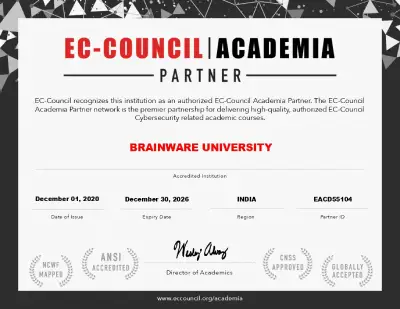
Brainware University is an authorised EC-Council Academia Partner, supporting cyber security and advanced networking learning through globally recognised academic resources, training exposure and certification-oriented knowledge.
This partnership strengthens the university’s focus on practical cyber security education, ethical hacking awareness, network defence, information security and industry-aligned skill development for students pursuing cyber science pathways.

Cyber Science focuses on protecting digital systems, networks, data, applications and information infrastructure from cyber threats. At Brainware University, cyber science programmes are designed to help students understand the technical, analytical and practical aspects of cyber security, advanced networking, ethical hacking, digital forensics and information security.
Students can explore cyber science learning through undergraduate, engineering-based, lateral-entry and postgraduate pathways. These pathways support different academic backgrounds and career goals, helping students build knowledge in computing, network defence, system administration, cyber law, security operations and digital investigation.
Each pathway has its own eligibility criteria, duration, fee structure, syllabus and career scope. Students should check the respective individual programme pages for complete course-wise details.
The learning areas may include network security, ethical hacking, vulnerability assessment, penetration testing, cyber forensics, threat modelling, risk assessment, operating systems, cloud security, security operations, Linux administration, Windows server technology and secure system management.
Students are introduced to how organisations protect sensitive data, detect cyber threats, respond to security incidents and strengthen digital infrastructure.
Cyber science education also includes ethical hacking awareness and defensive security practices. Students learn how vulnerabilities are identified, tested and reported in a responsible and ethical manner.
Through lab-based learning, simulations, case studies and security tools, students develop practical understanding of how cyber attacks happen and how digital systems can be protected.
Advanced networking is an important part of cyber science learning. Students may gain exposure to routing, switching, network architecture, protocols, virtualisation, cloud-based systems, server administration and infrastructure management.
This helps learners understand how complex networks are designed, managed, secured and monitored in real-world IT environments.
Brainware University’s cyber science pathways are supported by practical lab sessions, technology partnerships, value-added training, certification-oriented learning exposure, security tools, projects, workshops and industry-focused academic activities.
The focus is on helping students build technical skills, analytical thinking, problem-solving ability, ethical awareness and career readiness for cyber security, networking and IT infrastructure roles.
Cyber science programmes can support career pathways in cyber security, network administration, information security, ethical hacking, digital forensics, security operations, IT infrastructure, system administration, cloud security and technology consulting.
Career growth depends on the selected programme level, practical skills, certifications, internships, project work, technical proficiency and industry exposure.

The syllabus for cyber science programmes at Brainware University is designed to build knowledge in cyber security, advanced networking, system administration, ethical hacking, digital forensics, risk management and information security.
The exact syllabus varies according to the selected programme level and pathway. The broad learning areas may include:
Students should visit the respective individual programme pages for detailed semester-wise syllabus, course structure, laboratory components and pathway-specific learning outcomes.

The details of cyber science programmes, including duration, fee structure and eligibility criteria, are mentioned below. Since this is a broad category page covering undergraduate, engineering-based, lateral-entry and postgraduate pathways, students should review the programme-wise information carefully before applying.
Cyber science pathways at Brainware University include learning in advanced networking, network security, operating systems, server administration, ethical hacking, threat assessment, security operations and digital infrastructure protection.
Students develop an understanding of how computer networks are designed, managed, monitored and secured across modern IT environments. The learning may include routing, switching, network protocols, virtualisation, cloud-based systems, infrastructure management, vulnerability assessment and cyber defence practices.

Students from cyber science programmes can explore career opportunities across cyber security, advanced networking, IT infrastructure, system administration, information security, cloud security, digital forensics and security operations.
Career options may vary according to the selected programme level, technical skills, certifications, internships, project work, lab exposure and professional experience.
Common career pathways include:


Please follow the given Admission Procedure:


Brainware University has earned an AA+ rating in India’s Best Engineering Institutes by Careers360. The recognition reflects the University’s strength in academic quality, faculty, infrastructure, research, and student outcomes, reinforcing its position as a trusted destination for industry-aligned engineering education.

Brainware University has been ranked No. 1 Engineering College under a Private University in West Bengal in the IIRF Rankings 2026. The recognition highlights the University’s strength in engineering education, industry-focused learning, research, emerging technologies, and placement outcomes.

Brainware University has been ranked No. 2 Private University in West Bengal by uniRank 2026, marking another recognition of the University's growing presence in the state's higher education landscape.

Brainware University's inclusion in the Times Higher Education (THE) Impact Rankings 2025 reflects its contribution to the UN Sustainable Development Goals (SDGs) through education, innovation, sustainability, community engagement, and responsible institutional practices.

Brainware University has been recognised as the Best Private University of West Bengal in Infrastructure & Placement at Times Now.in – Leaders of Excellence: East 2026, celebrating its commitment to world-class infrastructure and career-focused education.

Brainware University has been recognised by The Times Group for excellence across Engineering (Placement), Law, and MBA Studies. The honours reflect the University’s multidisciplinary strength and its focus on career-oriented, industry-relevant education.

Brainware University received the ABP Ananda Shiksha Samman 2026 for Excellence in Placement & AI-Integrated Academic Infrastructure, acknowledging its emphasis on placement opportunities alongside technology-enabled academic development.

Brainware University has been honoured with the Zee 24 Ghanta Education Excellence Award 2026 for Best Industry Placement & Academic Infrastructure, continuing its recognition in 2022, 2023, 2024, 2025, and 2026. The University was also recognised in 2017 and 2018 for its job-oriented academic initiatives.

Brainware University received the TV9 Uttaran Academic Excellence Honour for Excellence in Placement & AI-Integrated Academic Infrastructure, highlighting its focus on combining career opportunities with an AI-enabled academic and learning environment.

Brainware University was honoured with the R Bangla Sikkha Gourab Samman 2026, recognising its contribution to higher education and continued pursuit of academic excellence and career-focused learning.

Brainware University was honoured as the Best Private University in West Bengal at the Times Now in Business Excellence Awards (East) 2025, recognising its academic quality, modern infrastructure, industry engagement, and focus on student success.

Brainware University was recognised as the Leading University in Infrastructure, Academics & Placement at the Times Business Awards West Bengal 2025, highlighting its strong campus facilities, academic ecosystem, and placement performance across disciplines.



It was a great experience at Brainware University as not only I have learned a lot but also they guided me till I got employed.
RajKumar MondalBSc ANCS
We focused a lot on the practical implications and applications of our subject which made us a lot more eligible for the industry.
Mallika MajumderBSc ANCS
Cybersecurity is a high-demand field, and our graduates secure lucrative roles in ethical hacking, IT security, and network administration. Companies such as TCS, Wipro, and IBM hire Brainware University graduates for critical cybersecurity roles.

AMD

ITC Infotech

Alliance Broadband

Amity Educational Group

Tech Ridge Solutions

ITC Infotech

Tech Ridge Solutions

Tech Ridge Solutions


"Brainware students are professionally and technically well-informed as freshers. We are impressed with the level of confidence and positive attitude they demonstrated during their interviews."
Mr. Vaskar Bhattacharya Regional Head-East, Ginnisystems Ltd.
We always find competent and positive students who are almost ready to be professionals. We never get disappointed wherever we come for the recruitment. Well done Brainware University!
Ms. Srimoyee Mukherjee Manager HR Nature Technologies Pvt. Ltd.
Brainware University offers cyber science pathways across engineering-based (BTech), undergraduate, lateral-entry and postgraduate levels. Students can explore cyber security, advanced networking, ethical hacking, digital forensics, system administration, information security and network defence-related learning.
Yes. Students can explore undergraduate or engineering-based cyber science pathways after Class 12, subject to programme-wise eligibility criteria, required subject combinations, minimum marks and university admission norms.
Eligibility varies according to the selected pathway. Some programmes require Class 12 qualification with specific subjects, some are open to students from any discipline, lateral-entry pathways require relevant diploma or degree backgrounds, and postgraduate pathways require graduation with specified subject requirements.
The duration depends on the selected programme. Engineering-based undergraduate pathways are generally 4 years long, lateral-entry pathways are 3 years long, undergraduate honours pathways are 4 years long, and postgraduate pathways are 2 years long.
Basic computer awareness is helpful, but advanced knowledge is not always compulsory at the entry level. Students gradually learn computing fundamentals, networking, operating systems, server administration and security concepts as part of the selected pathway.
Coding is not required for every cyber security or networking role. However, knowledge of programming, scripting, Python, Linux commands and automation can be useful for ethical hacking, security testing, digital forensics, network monitoring and advanced technical roles.
No. Cyber science learning also includes advanced networking, Linux administration, Windows server technology, switching and routing, cloud security, infrastructure management, risk assessment, digital forensics, security operations and information security.
The broad learning areas may include computer fundamentals, hardware and operating systems, computer networking, switching and routing, shell programming, cyber security, ethical hacking, vulnerability assessment, penetration testing, cyber forensics, cyber law, risk management, security operations, cloud security and AI in cyber security.
Students may gain exposure through cyber labs, networking labs, simulations, security tools, projects, workshops, value-added courses, certification-oriented learning, ethical hacking practice, SOC concepts and hands-on technical activities.
Students can explore roles in cyber security, information security, network administration, system administration, cloud security, digital forensics, security operations, IT infrastructure, penetration testing, vulnerability assessment and technical support. Career scope depends on qualification, skills, certifications, internships, projects and recruiter requirements.
Yes. Students can pursue higher studies in cyber security, advanced networking, computer science, information security, cloud computing, digital forensics, data science and allied technology areas, subject to eligibility and admission norms.
Students should visit the respective individual programme pages for detailed syllabus, eligibility, fees, duration, laboratory exposure, admission process, certification-oriented learning and career scope.