98%
Placed
in 2025







The 4-year B.Sc. (Hons.) Advanced Networking and Cyber Security course aims to equip students with specialised knowledge and skills in the fields of advanced networking and cyber security. In an increasingly digital and interconnected world, the b sc in advanced networking and cyber security course provides students with a deep understanding of computer networks, network security, and cyber threats.
Through a comprehensive curriculum, students of the bsc advanced networking and cyber security course learn networking technologies, network design and implementation, network protocols, network management, network security, ethical hacking, cybersecurity techniques, encryption algorithms, vulnerability assessment, digital forensics, cloud security, SOC practices, and incident response. The programme prepares graduates for career opportunities as network security analysts, cyber security analysts, ethical hackers, SOC analysts, information security executives, network administrators, digital forensics assistants, cloud security associates, and IT infrastructure support specialists across IT companies, cyber security firms, financial institutions, consulting organisations, government agencies, and technology-driven industries.
The applicants for Bachelor of Science in Cyber Security will find all admission relevant information on this page including programme overview, syllabus outline, career options, as well as learning benefits. Details concerning computer networking course, eligibility and admission criteria are provided as well.
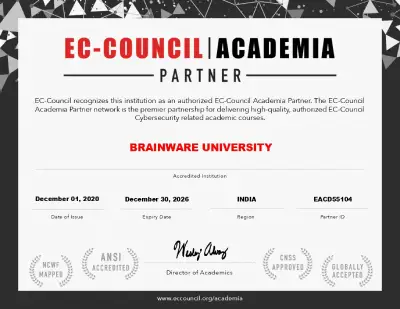
Brainware University proudly holds recognition as an authorised EC-Council Academia Partner, a testament to our commitment to delivering top-quality Cybersecurity academic courses authorised by EC-Council training and education.

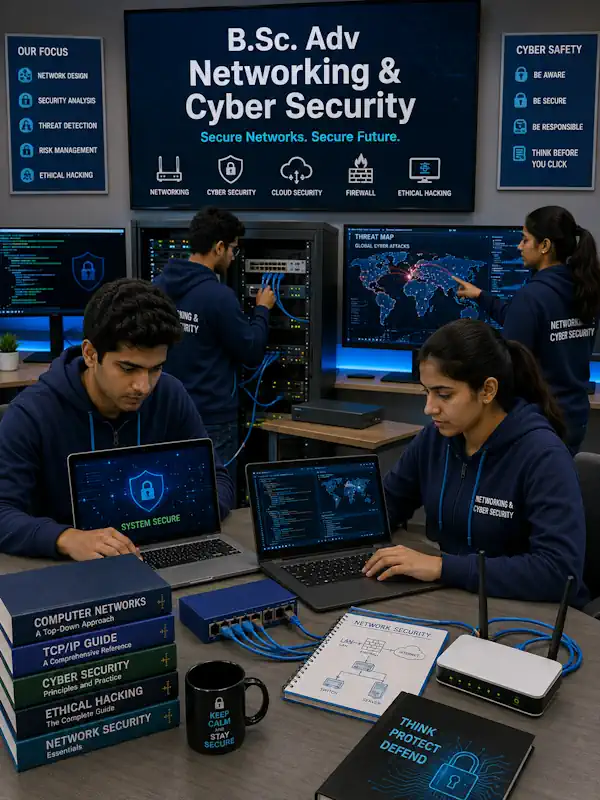
The B.Sc. Advanced Networking & Cyber Security programme at Brainware University equips students with in-depth knowledge of computer networks, cyber defence mechanisms, ethical hacking, and security operations. Designed in collaboration with global technology partners, the programme blends theory, hands-on labs, and industry exposure to prepare professionals capable of securing modern digital infrastructure.
| Programme | Bachelor of Science (Honours) in Advanced Networking & Cyber Security |
|---|---|
| Duration | 4 years |
| Focus Areas |
|
| Salary | Graduates of B.Sc. Advanced Networking & Cyber Security typically begin with salaries ranging from ₹3.5–6 LPA. With experience, certifications, and specialisation in areas such as ethical hacking, SOC operations, or cloud security, professionals can earn ₹8–15 LPA, while senior security architects and consultants may exceed this range in high-risk domains. |
| Popular Job Types |
|
| Hiring Industries |
|
| Top Recruiters |
|
| Specializations |
|
| Higher Studies |
|
| Benefits |
|
| Internship and Placement | Students receive structured internship opportunities through industry partners, security labs, and corporate IT environments. Brainware University’s placement cell provides continuous training, mock interviews, certification guidance, and recruiter access, enabling students to secure roles in cyber defence, networking, and IT security operations. |
| Location | The programme is offered at Brainware University’s technology-driven campus in Barasat, Kolkata, featuring advanced networking labs, cyber ranges, SOC simulation environments, and research facilities. |
| Approvals & Recognition |
|

Educational Qualification: Candidates must have passed the 10+2 or equivalent examination from any recognised board, in any discipline.
Minimum Marks: Applicants must secure 50% marks or an equivalent grade in their 10+2 examination.
Entrance Exams: Admission is generally merit-based according to institutional guidelines. If applicable, candidates may appear for the BET – Brainware Entrance Test.
Pursue your passion for network systems, cybersecurity, and digital protection with the BSc Advanced Networking & Cyber Security programme designed to offer high-quality technical education at an affordable cost. This course provides access to modern computing labs, advanced security tools, expert faculty mentorship, and real-world exposure through hands-on labs, simulations, and industry-based projects. With a balanced investment in academic learning and practical cybersecurity training, this programme prepares students for successful careers in network administration, ethical hacking, security analysis, and the rapidly growing cyber and IT security sector.
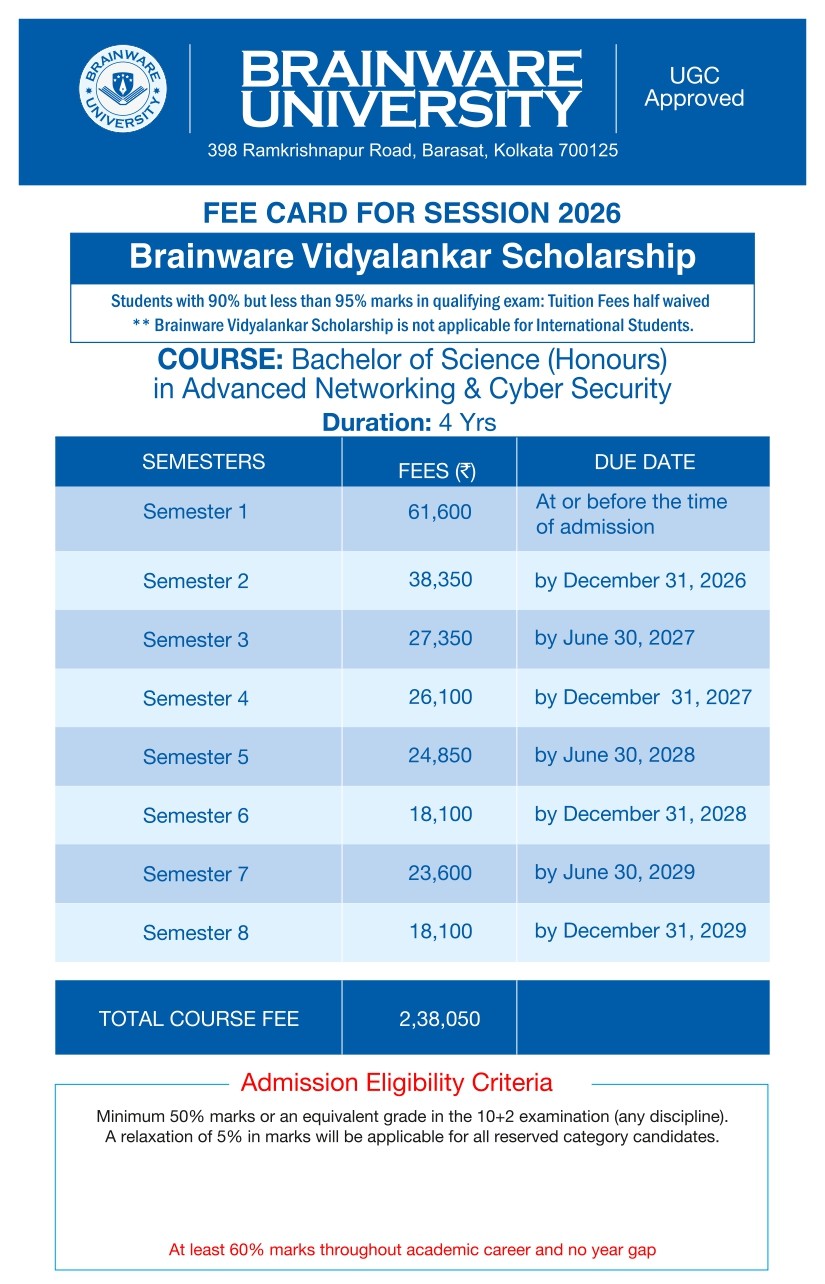
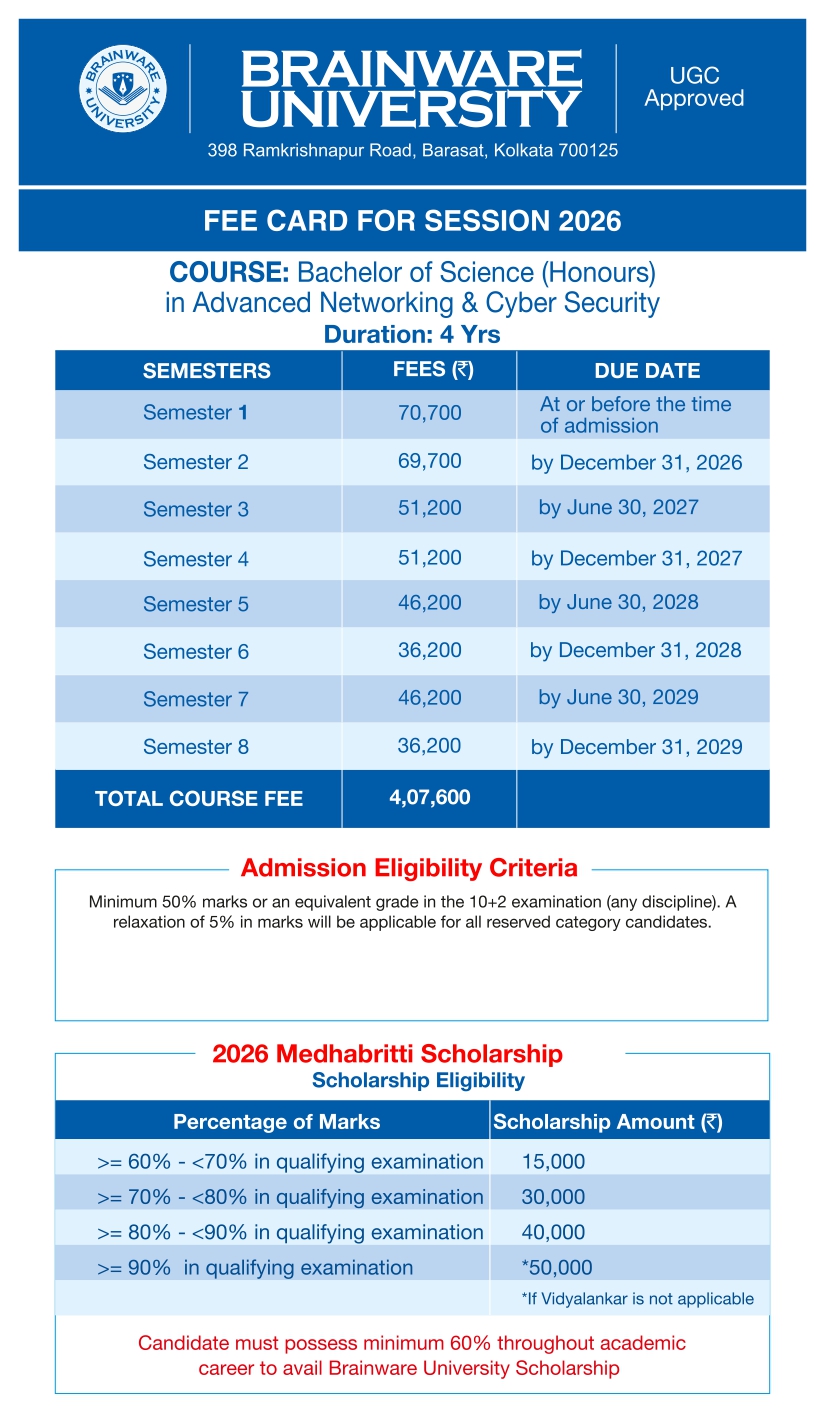
The B.Sc. Advanced Networking & Cyber Security programme follows a transparent and affordable fee structure that covers academic instruction, advanced laboratory access, cyber security tools, simulation environments, and practical training. Semester-wise fees are published separately to ensure clarity for students and parents planning their academic investment.
| Semesters | Semester 1 | Semester 2 | Semester 3 | Semester 4 | Semester 5 | Semester 6 | Semester 7 | Semester 8 | Semester 9 | Semester 10 | Total |
|---|---|---|---|---|---|---|---|---|---|---|---|
| Fees (INR) | 70700 | 69700 | 51200 | 51200 | 46200 | 36200 | 46200 | 36200 | 407600 |
**Fees are subject to change, and the application fee of ₹5,000 is non-refundable under any circumstances. Please contact us for further details.
Scholarships(Fees): Brainware University offers merit-based scholarships for top performers and financial aid for deserving students. Scholarships are available for high scorers in entrance exams, board results, and outstanding achievements in innovation or research. Visit our scholarship page for more details.
**Please note that the Brainware Vidyalankar Scholarship is available only to students who passed their qualifying examination in the current admission year. Also, eligibility is strictly restricted to Indian nationals; international students are not eligible to apply.
Cybersecurity is rapidly evolving with the integration of Artificial Intelligence, machine learning, and intelligent threat detection systems. The B.Sc. The Advanced Networking & Cyber Security programme at Brainware University incorporates AI-enabled technologies to prepare students for modern cyber defence challenges.
The programme trains students to analyse cyber threats, detect network anomalies, and respond to security incidents using intelligent security frameworks. Through real-time simulation labs, cyber ranges, and advanced networking infrastructure, students gain practical experience in AI-driven threat intelligence, automated security monitoring, and predictive cyber defence systems.
With industries increasingly relying on cloud platforms, IoT networks, and digital ecosystems, the programme integrates modern cyber defence practices with AI-powered technologies. Students learn to secure digital infrastructures, design resilient networks, and develop proactive defence strategies that protect organisations against evolving cyber threats.
This blend of network engineering, ethical hacking, and AI-assisted security analytics ensures graduates are prepared for high-demand roles in cybersecurity, digital risk management, and network defence.

The programme introduces artificial intelligence and intelligent security frameworks gradually across the academic journey.




The B.Sc. Advanced Networking & Cyber Security programme at Brainware University maintains strong placement engagement with leading IT companies, cybersecurity firms, and global technology organisations. Students receive specialised training in networking technologies, cyber defence frameworks, and industry certifications to enhance employability.


Cybersecurity is a high-demand field, and our graduates secure lucrative roles in ethical hacking, IT security, and network administration. Companies such as TCS, Wipro, and IBM hire Brainware University graduates for critical cybersecurity roles.
Graduates of the B.Sc. Advanced Networking & Cyber Security programme from Brainware University have progressed into diverse roles across IT services, cyber security firms, financial institutions, telecom sectors, and global technology organisations.
Many alumni begin their careers as network security engineers, SOC analysts, ethical hackers, and system administrators, contributing to the protection of digital infrastructure and enterprise data systems. With experience and industry certifications, they move into advanced roles such as cyber security consultants, penetration testers, security architects, and risk analysts.


Brainware University has earned an AA+ rating in India’s Best Engineering Institutes by Careers360. The recognition reflects the University’s strength in academic quality, faculty, infrastructure, research, and student outcomes, reinforcing its position as a trusted destination for industry-aligned engineering education.

Brainware University has been ranked No. 1 Engineering College under a Private University in West Bengal in the IIRF Rankings 2026. The recognition highlights the University’s strength in engineering education, industry-focused learning, research, emerging technologies, and placement outcomes.

Brainware University has been ranked No. 2 Private University in West Bengal by uniRank 2026, marking another recognition of the University's growing presence in the state's higher education landscape.

Brainware University's inclusion in the Times Higher Education (THE) Impact Rankings 2025 reflects its contribution to the UN Sustainable Development Goals (SDGs) through education, innovation, sustainability, community engagement, and responsible institutional practices.

Brainware University has been recognised as the Best Private University of West Bengal in Infrastructure & Placement at Times Now.in – Leaders of Excellence: East 2026, celebrating its commitment to world-class infrastructure and career-focused education.

Brainware University has been recognised by The Times Group for excellence across Engineering (Placement), Law, and MBA Studies. The honours reflect the University’s multidisciplinary strength and its focus on career-oriented, industry-relevant education.

Brainware University received the ABP Ananda Shiksha Samman 2026 for Excellence in Placement & AI-Integrated Academic Infrastructure, acknowledging its emphasis on placement opportunities alongside technology-enabled academic development.

Brainware University has been honoured with the Zee 24 Ghanta Education Excellence Award 2026 for Best Industry Placement & Academic Infrastructure, continuing its recognition in 2022, 2023, 2024, 2025, and 2026. The University was also recognised in 2017 and 2018 for its job-oriented academic initiatives.

Brainware University received the TV9 Uttaran Academic Excellence Honour for Excellence in Placement & AI-Integrated Academic Infrastructure, highlighting its focus on combining career opportunities with an AI-enabled academic and learning environment.

Brainware University was honoured with the R Bangla Sikkha Gourab Samman 2026, recognising its contribution to higher education and continued pursuit of academic excellence and career-focused learning.

Brainware University was honoured as the Best Private University in West Bengal at the Times Now in Business Excellence Awards (East) 2025, recognising its academic quality, modern infrastructure, industry engagement, and focus on student success.

Brainware University was recognised as the Leading University in Infrastructure, Academics & Placement at the Times Business Awards West Bengal 2025, highlighting its strong campus facilities, academic ecosystem, and placement performance across disciplines.

Embark on a journey towards mastering digital security with our Bachelor of Science (BSc) in Advanced Networking and Cyber Security program at Brainware University. As technology advances, the need for skilled professionals in cyber security becomes increasingly critical. Our program is meticulously designed to equip students with the knowledge and expertise needed to protect digital assets and combat cyber threats effectively.
| Semester | Course |
|---|---|
| SEMESTER-I | Computer Networks |
| Database Management System | |
| Fundamentals of Electronics | |
| Functional English | |
| Soft Skills | |
| Environmental Studies | |
| Computer Peripherals and Maintenance Lab | |
| SEMESTER-II | Linux Administration |
| Sustainability in Indian Knowledge System | |
| Communication Fundamentals | |
| Communicative English | |
| Cyber Security Essentials | |
| Python Programming Lab | |
| Human Values and Ethics | |
| SEMESTER-III | Switching and Routing |
| Vulnerability Analysis and Penetration Testing | |
| Artificial Intelligence and Machine Learning | |
| Vedic Mathematics | |
| Modern Indian Language (Hindi/Bengali/Alternative English/MOOC) | |
| IT Infrastructure Service Management and Entrepreneurship | |
| SEMESTER-IV | Windows Server Administration |
| Windows Server Administration Lab | |
| Web Application Penetration Testing | |
| Web Application Penetration Testing Lab | |
| Threat Modelling | |
| Blockchain and Cryptocurrency | |
| Communicative English Lab | |
| SEMESTER-V | Network Security Essentials |
| Network Security Essentials Lab | |
| Linux Network Service Management | |
| Linux Network Service Management Lab | |
| Network Penetration Testing | |
| Digital Watermarking and Steganography | |
| Project | |
| SEMESTER-VI | Windows Server Management |
| Windows Server Management Lab | |
| Security Operations Center Management | |
| Security Operations Center Management Lab | |
| Information Security Management | |
| Cryptography and Network Security | |
| SEMESTER-VII (Honours) | Security Audit and Compliances |
| Cloud Security | |
| Cloud Security Lab | |
| Digital Forensics | |
| Digital Forensics Lab | |
| IoT Security | |
| SEMESTER-VIII (Honours) | Data Security and Analytics |
| Artificial Intelligence in Cyber Security | |
| Artificial Intelligence in Cyber Security Lab | |
| Virtualization Technology | |
| Virtualization Technology Lab | |
| Cyber Security Law and IPR |
Please note that the syllabus is subject to modification. Visit our Syllabus page for the elective subject details and updated syllabus.

Graduates work in IT firms, cyber security consultancies, cloud service providers, banks, telecom companies, and MNCs. They secure roles in network defence, ethical hacking, SOC monitoring, risk assessment, and security architecture—making them essential assets in the private sector.
Opportunities exist in government IT departments, defence organisations, cyber crime units, public sector banks, e-governance bodies, and national security agencies. Cyber professionals play a key role in protecting national digital infrastructure and sensitive data systems.
Cyber security professionals are the backbone of digital trust in modern organisations. As cyber threats grow in complexity, industries require skilled experts to design, monitor, and defend secure systems. The following roles highlight why advanced networking and cyber security expertise remains in constant demand.
| Area of Opportunity | Why It’s in Demand |
|---|---|
| Information Security Analyst | Essential for monitoring networks, detecting threats, analyzing vulnerabilities, and ensuring compliance with data protection laws such as GDPR and HIPAA. |
| Penetration Tester (Ethical Hacker) | Required to legally attack systems to identify exploitable weaknesses before malicious actors do, supporting proactive risk mitigation and mandatory security testing. |
| Security Architect | Crucial for designing secure system frameworks, infrastructure, and policies by integrating security from the ground up. |
| IT Security Engineer | Responsible for implementing, maintaining, and upgrading security tools such as firewalls and IDS/IPS to defend against evolving threats. |
| Security Systems Administrator | Manages access controls, authentication systems, and security appliances to ensure smooth daily security operations. |
| IT Security Consultant | Provides expert, vendor-neutral guidance on security strategy, risk assessment, vendor selection, and incident response planning. |
| System Administrator | Ensures operational stability by managing operating systems and user accounts with secure configurations to prevent vulnerabilities. |
| Hardware Design Engineer | Designs and secures hardware components such as firmware and hardware security modules, especially critical for IoT and infrastructure security. |
With global digitalisation accelerating, careers in advanced networking and cyber security offer stability, prestige, and long-term growth. Graduates equipped with strong technical foundations and industry certifications are well-positioned to lead the future of digital defence.
The demand for B.Sc. Advanced Networking & Cyber Security graduates is expected to grow rapidly between 2025 and 2032, driven by accelerated digital transformation, rising cyber threats, cloud adoption, and increased dependence on secure network infrastructure across industries. Cybersecurity has become a critical business priority, making skilled professionals highly valuable.
Global Cybersecurity Market Expansion
The global cybersecurity market is projected to grow at a strong pace through 2032, with organisations worldwide increasing investments to protect data, networks, and digital assets.
India’s Cybersecurity & Networking Industry Growth
India’s cybersecurity and advanced networking sector is expected to grow at a high double-digit CAGR, supported by IT expansion, fintech growth, cloud services, 5G deployment, and government digital initiatives.
Rising Employment Opportunities
Cybersecurity and network security roles are projected to grow much faster than average, with a persistent global shortage of skilled professionals creating strong job security and career mobility.
Increasing incidents of cybercrime, ransomware, and data breaches are driving continuous demand for security analysts, network defenders, and ethical hackers.
The expansion of cloud computing, IoT devices, and high-speed networks has increased the complexity of securing digital infrastructure, boosting demand for advanced networking and security expertise.
Stricter data protection and cybersecurity regulations are compelling organisations to strengthen security teams and risk management functions.
Growth in e-commerce, fintech, remote work, and online services is accelerating the need for secure and reliable network systems.From 2025 to 2032, B.Sc. Advanced Networking & Cyber Security will remain a high-growth and future-proof career path. Graduates with strong technical, analytical, and security skills will find abundant opportunities across IT companies, cybersecurity firms, telecom providers, financial institutions, government organisations, and global enterprises.


Brainware University collaborates with leading cyber security labs, IT service providers, and technology partners to offer students hands-on exposure through workshops, simulations, certification training, and live projects. These tie-ups bridge the gap between academic theory and real-world cyber defence practice.





The admission process for B.Sc. Advanced Networking & Cyber Security at Brainware University is transparent, student-friendly, and merit-based. Applicants are guided at every step—from enquiry to enrolment—ensuring a smooth transition into the programme.
Admission Criteria : Candidates must have passed 10+2 from a recognised board with a minimum of 50% marks. Admission is merit-based, with BET (Brainware Entrance Test) applicable where required.
Application: Students can apply online by filling out the enquiry form. Admission counsellors assist with document verification and next steps.
Entrance Exam: BET evaluates aptitude, logical reasoning, and foundational IT knowledge. High scorers may qualify for scholarships.
Counselling: Shortlisted candidates attend counselling sessions covering curriculum, fees, internships, certifications, and career pathways.
Direct Admission: Eligible candidates may receive direct admission based on merit and seat availability.
Please follow the BSc Advanced Networking & Cyber Security admission procedure at Brainware University:


It was a great experience at Brainware University as not only I have learned a lot but also they guided me till I got employed.
RajKumar MondalBSc ANCS
We focused a lot on the practical implications and applications of our subject which made us a lot more eligible for the industry.
Mallika MajumderBSc ANCS

"Brainware students are professionally and technically well-informed as freshers. We are impressed with the level of confidence and positive attitude they demonstrated during their interviews."
Mr. Vaskar Bhattacharya Regional Head-East, Ginnisystems Ltd.
We always find competent and positive students who are almost ready to be professionals. We never get disappointed wherever we come for the recruitment. Well done Brainware University!
Ms. Srimoyee Mukherjee Manager HR Nature Technologies Pvt. Ltd.
The Department of Cyber Science & Technology at Brainware University actively promotes hands-on learning, cyber awareness, industry exposure, and research-oriented academic development. Through seminars, workshops, competitions, expert sessions, alumni interactions, conferences, and cyber security awareness programmes, the department helps students connect classroom learning with real-world cyber challenges.
The department organises events such as SECCOM and BrainCon, where students participate in cyber awareness activities, Capture the Flag competitions, technical challenges, and practical problem-solving sessions. These platforms help students sharpen their analytical thinking, ethical hacking mindset, teamwork, and cyber defence skills.
Students regularly gain exposure to industry professionals, cyber security experts, law-enforcement officials, alumni, and academicians through panel discussions, seminars, and specialised sessions. Topics such as modern-day cyber crimes, digital forensics, cyber laws, cryptocurrency-related cybercrime evidence, ethical hacking, network security, cloud security, and cyber threat management are covered through these interactions.
The department encourages students and faculty members to engage with emerging areas of computing and cyber security through conferences and academic events. Programmes such as the International Conference on Computing Technologies in Emerging Areas provide a platform for learning, innovation, collaboration, and exposure to current technological developments.
Alumni talks, career-oriented seminars, certification-focused sessions, and hands-on workshops help students understand industry expectations, professional roles, and the skills required in cyber security, networking, digital forensics, security operations, and IT infrastructure management.
The department also conducts cyber awareness initiatives on safer internet practices, password security, responsible digital behaviour, and protection against online threats. These activities build digital responsibility among students and the wider community.
Through workshops on ethical hacking, penetration testing, bug bounty, digital forensics, Linux administration, cloud computing, network security, and cyber laws, the department strengthens students’ technical competence and prepares them for careers in cyber security, network administration, security analysis, and digital investigation.

The subjects covered in the BSc Cyber Security course may vary slightly from one university or college to another. However, the core subjects typically include computer fundamentals, database management, hardware and operating systems, switching and routing, infrastructure management, vulnerability and penetration testing, cyber forensics, and cyber law.
BSc Advanced Networking & Cyber Security stands for Bachelor of Science in Advanced Networking and Cyber Security. The course focuses on computer networks, ethical hacking, cybersecurity tools, threat detection, and digital protection techniques, preparing students for roles in network administration, security analysis, and ethical hacking.
No, BSc Cyber Security is not equivalent to B.Tech in Cyber Security. While both focus on cybersecurity, B.Tech is more engineering- and technology-oriented, whereas BSc focuses more on theoretical and practical aspects of cyber security.
A BSc in Cyber Security offers strong job prospects in information security roles such as security analyst, penetration tester, and cyber security consultant. While BTech is considered more technical, both degrees provide a solid foundation, and additional certifications can significantly enhance employability.
Brainware University offers a leading B.Sc. Advanced Networking & Cyber Security program with state-of-the-art labs, industry-aligned curriculum, and strong placement support.
Brainware University offers a career-focused B.Sc. (Hons.) Advanced Networking & Cyber Security programme with hands-on training in computer networking, ethical hacking, cyber security, SOC practices, cloud security, digital forensics, and incident response. Students benefit from advanced cyber security labs, EC-Council Academia Partnership, Red Hat and Cisco collaborations, certification-oriented learning, internships, and placement support, helping them prepare for careers in network security, cyber defence, ethical hacking, IT security, and security operations.
Candidates must have passed 10+2 or equivalent examination from any recognised board, in any discipline, with at least 50% marks or equivalent grade. A 5% relaxation in marks is applicable for reserved category candidates. Admission is merit-based as per university guidelines, with BET applicable where required.
Graduates can work as Network Security Engineers, Cyber Security Analysts, Ethical Hackers, Information Security Specialists, and Network Administrators in IT companies, government organizations, and tech firms.
Yes, with the rapid rise in cyber threats and demand for data protection, this program offers excellent career prospects and long-term growth opportunities.
The curriculum includes Networking Fundamentals, Cryptography, Ethical Hacking, Cyber Law, Network Administration, Information Security Management, and Cloud Security.
Job roles include Cyber Security Analyst, Network Security Engineer, Information Security Officer, Ethical Hacker, IT Consultant, and System Administrator across multiple industries.
The starting salary generally ranges between ₹3.5 to ₹6 LPA, depending on skills, certifications, and industry exposure.
Focus on practical skills such as network configuration, firewall management, encryption techniques, and be prepared to answer questions related to cyber threats and risk mitigation.
Top recruiters include IBM, Infosys, Wipro, TCS, and cybersecurity firms such as Kaspersky, McAfee, and Palo Alto Networks.
Highlight your technical skills, hands-on lab experience, internships, and certifications like CEH, CISSP, or CompTIA Security+.
Practice using real networking tools, participate in lab sessions, and enroll in professional platforms like Cisco Networking Academy and CompTIA.
Certifications such as CompTIA Security+, CEH, CISSP, CCNA, and CISM significantly enhance career prospects in this domain.
You can specialize in Ethical Hacking, Cloud Security, or Digital Forensics through advanced certifications, workshops, and research projects.
Stay informed by following cybersecurity blogs, joining professional forums, attending conferences and webinars, and reading reputed academic journals.