98%
Placed
in 2025






Brainware University transformed me, fostering confidence and capability for conquering the world.
M. Tech in Industrial Automation and Robotics is a two-year (four-semester) full-time program, offered by the Department of Mechanical Engineering under the School of Engineering Sciences. It combines theoretical knowledge with hands-on learning to develop cutting-edge automation and robotic systems for digital manufacturing and service industries. It is a research-driven program that provides students with specialized expertise in intelligent automation, smart manufacturing and robotic control systems. Designed to meet the growing demand for highly skilled professionals in Industry 4.0, the curriculum emphasizes the integration of IoT, Robotics and automation in modern industrial processes.
The applicants for MTech in Robotics Engineering and Automation will find all the relevant information on this page, including programme overview, syllabus outline, career options, and learning benefits. It also covers all the admission-relevant information for MTech in Robotics and Automation colleges in Kolkata, as well as Brainware.
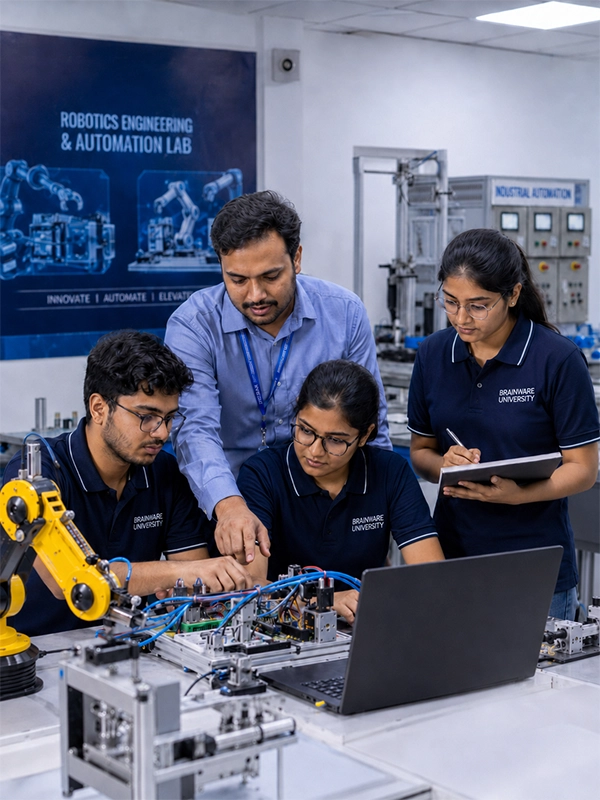

MTech Robotics & Automation at Brainware University is a 2-year postgraduate engineering programme focused on robotics engineering, industrial automation, intelligent control systems, AI for robotics, machine vision, sensors, and Industry 4.0 applications. The course is designed for graduates seeking advanced technical expertise in automation-driven manufacturing, robotics research, smart systems, and emerging engineering careers.
| Programme | Master of Technology in Robotics & Automation |
|---|---|
| Duration | 2 Years |
| Focus Areas | Robotics engineering, industrial automation, AI for robotics, embedded systems, robotic vision, control systems, mechatronics, sensors, Industrial Internet of Things, machine learning in robotics, smart manufacturing, mobile robotics, and Industry 4.0 technologies. |
| Salary | Graduates of MTech Robotics & Automation may explore roles with entry-level salary packages commonly ranging from ₹4 LPA to ₹8 LPA, depending on skills, internship exposure, project portfolio, recruiter profile, and interview performance. Higher packages may be offered in AI robotics, industrial automation, R&D, product engineering, and advanced manufacturing roles. |
| Popular Job Types | Robotics Engineer, Automation Engineer, Industrial Automation Specialist, Robot Design Engineer, Control Systems Engineer, Mechatronics Engineer, Process Automation Engineer, AI Robotics Engineer, R&D Engineer, Product Design Engineer, Quality Engineer, and Robotics Software Developer. |
| Hiring Industries | Manufacturing, automotive, aerospace, electronics, logistics, industrial automation, healthcare technology, smart factories, robotics startups, research organisations, defence technology, energy, consumer electronics, and AI-integrated engineering firms. |
| Top Recruiters | Robotics and automation graduates may find opportunities with companies and organisations working in industrial automation, smart manufacturing, embedded systems, product development, AI-enabled robotics, and engineering services. Recruiter participation may vary by year, industry demand, student profile, and placement cycle. |
| Specializations | Industrial Automation, Robotics Engineering, Intelligent Control Systems, AI-Integrated Robotics, Machine Vision, Mechatronics, Smart Manufacturing, Industrial Internet of Things, Embedded Robotics, and Automation System Design. |
| Higher Studies | Graduates can pursue PhD programmes in Robotics, Automation, Mechanical Engineering, Mechatronics, Artificial Intelligence, Control Systems, Industrial Engineering, or related interdisciplinary domains. They may also take advanced certifications in ROS, PLC, SCADA, AI, machine vision, embedded systems, and Industry 4.0 technologies. |
| Benefits | The programme supports advanced engineering learning through research-based coursework, robotics laboratories, automation tools, project-based assignments, technical mentorship, industry-oriented modules, and career preparation for robotics engineering colleges, automation firms, manufacturing industries, and R&D organisations. |
| Internship and Placement | Students receive exposure to internships, live projects, hands-on laboratory work, pre-placement training, interview preparation, and placement assistance. The programme aims to build technical depth, problem-solving ability, and industry readiness for robotics and automation careers. |
| Location | Brainware University, Barasat, Kolkata, West Bengal. |
| Approvals & Recognition | Brainware University is a UGC-recognised university. The MTech Robotics & Automation programme is offered under the university’s academic framework, with curriculum, evaluation, and learning outcomes aligned with postgraduate engineering education standards. |
MTech Robotics & Automation is a strong choice for engineering graduates who want advanced careers in robotics engineering, industrial automation, smart manufacturing, AI-integrated systems, and Industry 4.0 technologies. The programme develops expertise in robotic design, sensors, control systems, automation tools, machine vision, and intelligent systems used across modern industries.
A master’s degree in automation or robotics engineering helps students move beyond basic engineering knowledge and enter specialised technical roles. The course is suitable for students interested in automation-driven factories, autonomous systems, robotics software, industrial control, mechatronics, and applied research.
Key reasons to study MTech Robotics & Automation include:
For students comparing good robotics colleges, the right MTech programme should combine technical depth, hands-on training, industry exposure, research orientation, and career support.

Educational Qualification: Candidates must hold a degree in B.E./B.Tech/AMIE/AMIETE in CSE, IT, or any relevant engineering discipline, OR a postgraduate degree such as MCA/MSc in Computer Science or IT.
Minimum Marks: Applicants must have secured a minimum of 50% marks or an equivalent grade in the qualifying examination.
Entrance Criteria: Admission is based on merit or through the BET (Brainware Entrance Test) conducted by the university.
Pursue your passion for intelligent machines, automation systems, and next-generation robotics with the MTech in Robotics and Automation programme designed to offer high-quality technical education at an affordable cost. This course provides access to advanced robotics labs, automation tools, simulation platforms, expert faculty mentorship, and real-world exposure through hands-on experiments, industry projects, and research-focused learning. With a balanced investment in advanced academic training and practical robotics applications, this programme prepares students for successful careers in robotics engineering, automation design, industrial robotics, AI-integrated systems, and the rapidly evolving automation and smart manufacturing ecosystem.
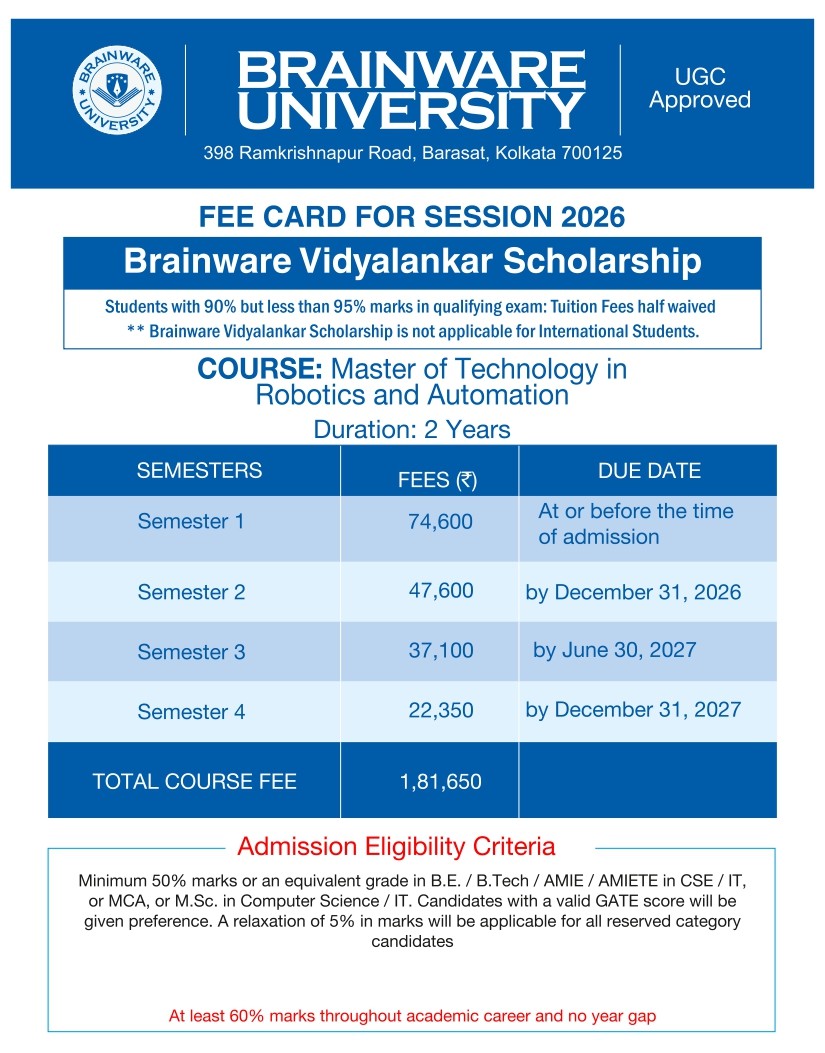
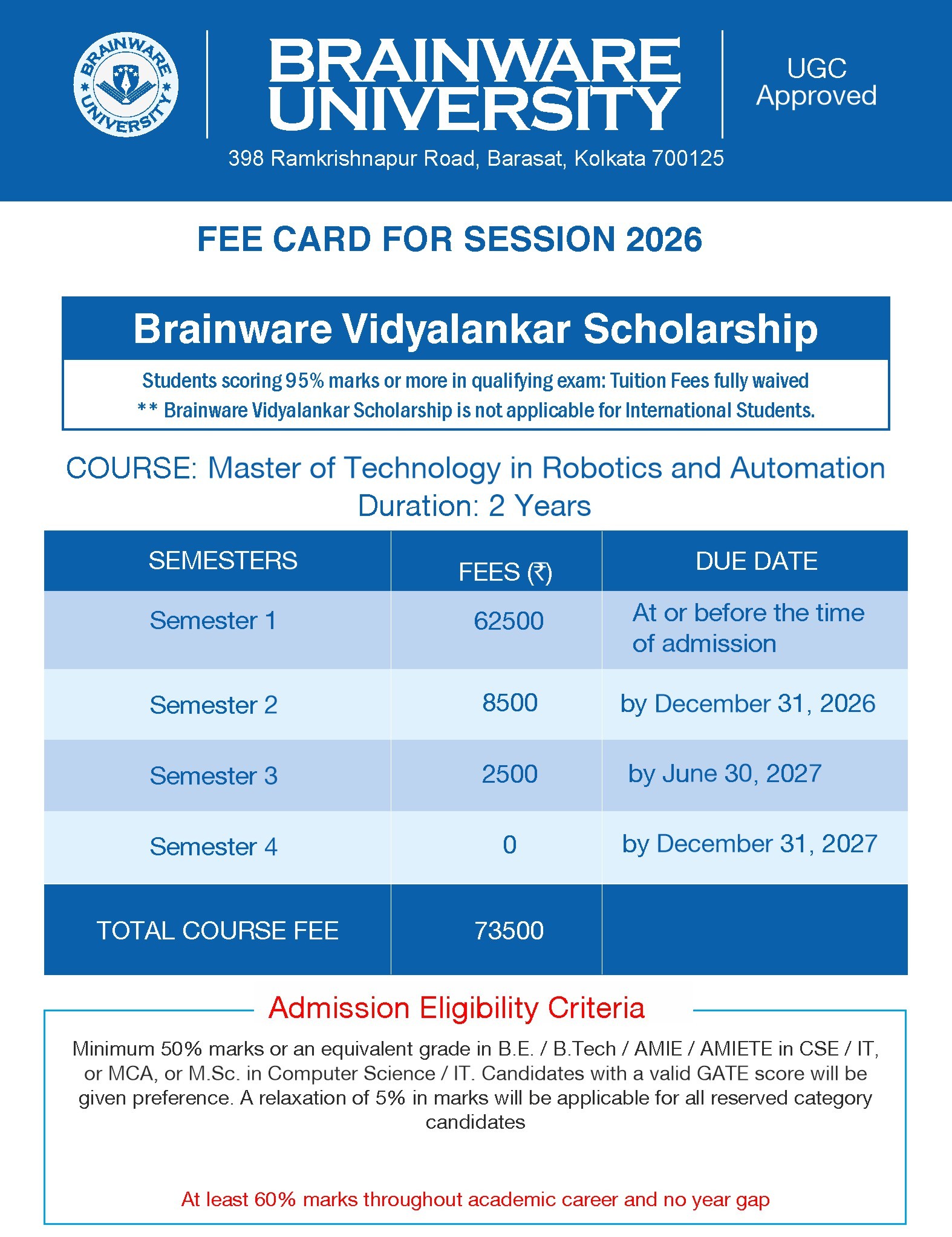
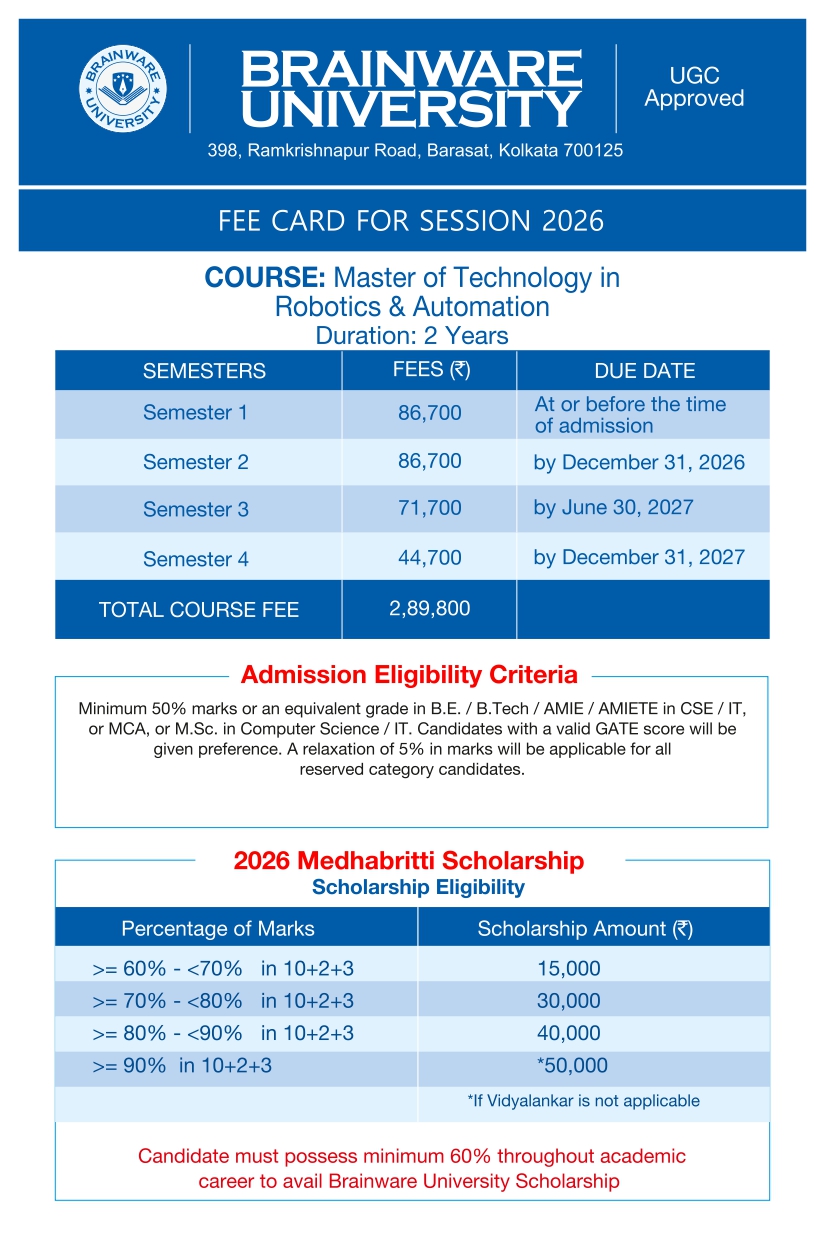
Brainware University offers an affordable fee structure for students based on university norms, academic merit, and applicable scholarship criteria. Students applying for MTech Robotics & Automation should check the latest scholarship details, fee benefits, and admission-linked offers through the official scholarships page or by speaking with the admission counselling team.
| Semesters | Semester 1 | Semester 2 | Semester 3 | Semester 4 | Semester 5 | Semester 6 | Semester 7 | Semester 8 | Semester 9 | Semester 10 | Total |
|---|---|---|---|---|---|---|---|---|---|---|---|
| Fees (INR) | 86700 | 86700 | 71700 | 44700 | 2,89,800 |
**Fees are subject to change, and the application fee of ₹5,000 is non-refundable under any circumstances. Please contact us for further details.
Scholarships(Fees): Brainware University offers merit-based scholarships for top performers and financial aid for deserving students. Scholarships are available for high scorers in entrance exams, board results, and outstanding achievements in innovation or research. Visit our scholarship page for more details.
**Please note that the Brainware Vidyalankar Scholarship is available only to students who passed their qualifying examination in the current admission year. Also, eligibility is strictly restricted to Indian nationals; international students are not eligible to apply.
MTech in Robotics and Automation uses AI to connect robotic intelligence with industrial problem-solving. Students learn how artificial intelligence, machine learning, computer vision, sensors, and automation platforms work together to build systems that can observe, process, decide, and act in real-world engineering environments.
The programme supports academic and industry innovation through project-based learning in robotic perception, control logic, smart manufacturing, intelligent automation, machine learning in robotics, and Industrial Internet of Things. These areas are central to the future of robotics engineering universities and automation-focused industries.
Students are trained to understand how AI-driven robotics can be used in:
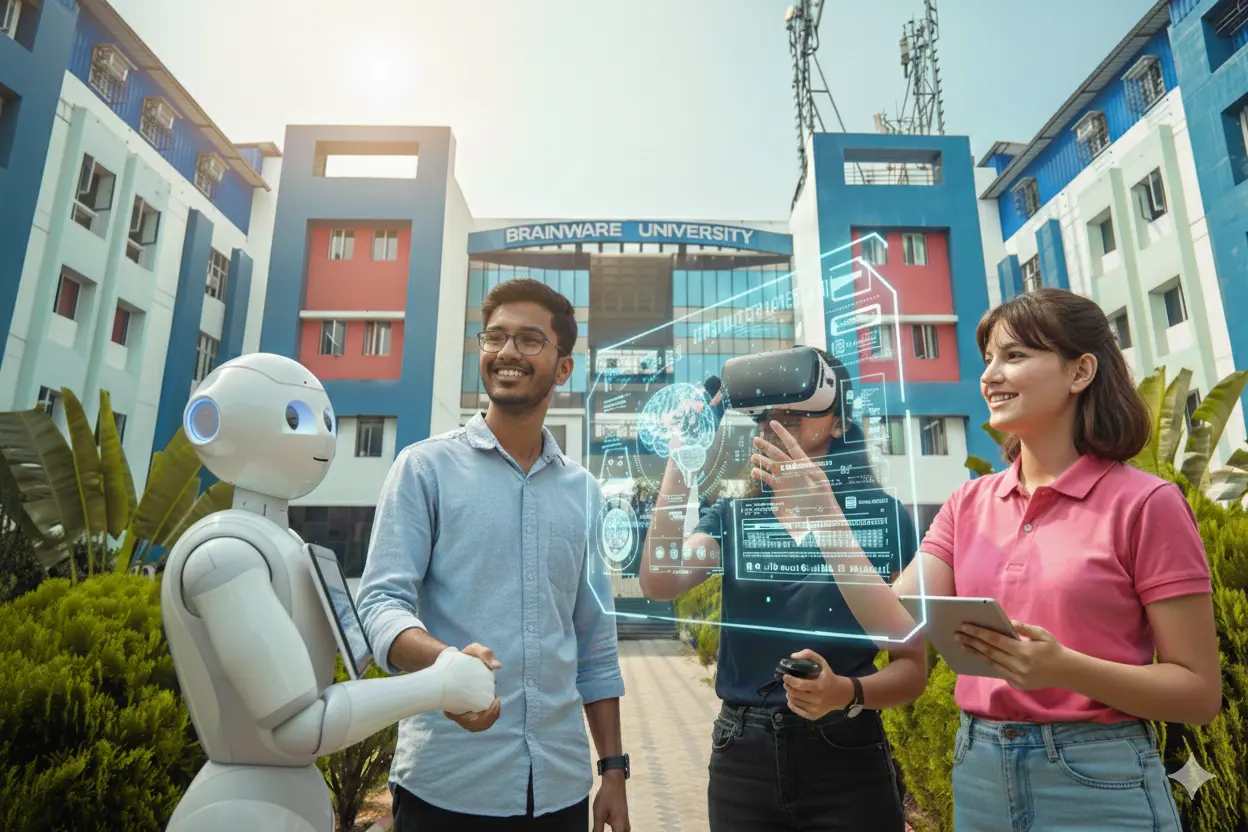
The end-to-end AI learning spectrum in MTech Robotics & Automation covers the full technical path from data capture to intelligent action. Students study sensors, signals, image processing, robotic vision, machine learning, control systems, embedded applications, and automation workflows that allow machines to function with greater precision and autonomy.
This learning spectrum helps students understand how a robotics system is built, trained, tested, deployed, and improved. It connects theory with application through laboratory work, simulations, coding practice, control models, and automation-based problem solving.
Key learning areas may include:


Brainware University is a strong choice for MTech Robotics & Automation because the programme combines postgraduate engineering theory with hands-on learning in robotics, automation, AI, control systems, sensors, and Industry 4.0 technologies. Students receive academic mentoring, laboratory exposure, project-based training, and placement support within a recognised university ecosystem in Kolkata.
The programme is suited for students searching for MTech in Robotics, masters in automation, masters in robotics and automation, or a master degree in robotics with practical training. Brainware University’s curriculum is structured to help students build industry-ready knowledge in robotic systems, intelligent automation, mechatronics, and smart manufacturing.
Key academic strengths include:
The best colleges for MTech Robotics & Automation should offer a strong mix of academic depth, laboratory exposure, industry-oriented modules, research projects, qualified faculty, placement support, and modern automation learning. Students should compare curriculum quality, eligibility, fees, robotics labs, internship scope, and career guidance before applying.
Brainware University stands out among robotics engineering colleges in Kolkata and West Bengal for students seeking a structured MTech Robotics and Automation course. The programme covers robotics, AI, machine learning, robotic vision, industrial IoT, mechatronics, control systems, and automation laboratories.
When choosing among the best robotics engineering colleges in India, students should check:



Brainware University has earned an AA+ rating in India’s Best Engineering Institutes by Careers360. The recognition reflects the University’s strength in academic quality, faculty, infrastructure, research, and student outcomes, reinforcing its position as a trusted destination for industry-aligned engineering education.

Brainware University has been ranked No. 1 Engineering College under a Private University in West Bengal in the IIRF Rankings 2026. The recognition highlights the University’s strength in engineering education, industry-focused learning, research, emerging technologies, and placement outcomes.

Brainware University has been ranked No. 2 Private University in West Bengal by uniRank 2026, marking another recognition of the University's growing presence in the state's higher education landscape.
Brainware University's inclusion in the Times Higher Education (THE) Impact Rankings 2025 reflects its contribution to the UN Sustainable Development Goals (SDGs) through education, innovation, sustainability, community engagement, and responsible institutional practices.

Brainware University has been recognised as the Best Private University of West Bengal in Infrastructure & Placement at Times Now.in – Leaders of Excellence: East 2026, celebrating its commitment to world-class infrastructure and career-focused education.

Brainware University has been recognised by The Times Group for excellence across Engineering (Placement), Law, and MBA Studies. The honours reflect the University’s multidisciplinary strength and its focus on career-oriented, industry-relevant education.

Brainware University received the ABP Ananda Shiksha Samman 2026 for Excellence in Placement & AI-Integrated Academic Infrastructure, acknowledging its emphasis on placement opportunities alongside technology-enabled academic development.

Brainware University has been honoured with the Zee 24 Ghanta Education Excellence Award 2026 for Best Industry Placement & Academic Infrastructure, continuing its recognition in 2022, 2023, 2024, 2025, and 2026. The University was also recognised in 2017 and 2018 for its job-oriented academic initiatives.

Brainware University received the TV9 Uttaran Academic Excellence Honour for Excellence in Placement & AI-Integrated Academic Infrastructure, highlighting its focus on combining career opportunities with an AI-enabled academic and learning environment.

Brainware University was honoured with the R Bangla Sikkha Gourab Samman 2026, recognising its contribution to higher education and continued pursuit of academic excellence and career-focused learning.

Brainware University was honoured as the Best Private University in West Bengal at the Times Now in Business Excellence Awards (East) 2025, recognising its academic quality, modern infrastructure, industry engagement, and focus on student success.

Brainware University was recognised as the Leading University in Infrastructure, Academics & Placement at the Times Business Awards West Bengal 2025, highlighting its strong campus facilities, academic ecosystem, and placement performance across disciplines.

The syllabi of MTech Robotics & Automation build the technical base required for advanced robotics engineering and industrial automation. Students study robotics fundamentals, control systems, sensors, robotic programming, research methodology, embedded systems, and robot design through a mix of theory, laboratory practice, and applied projects.
These subjects help students understand how robotic systems are planned, designed, controlled, tested, and improved. The foundation modules are especially useful for students entering the programme from mechanical, electrical, electronics, computer science, IT, mechatronics, or related engineering backgrounds.
Core learning areas may include:
The industry-driven advanced modules prepare students for specialised roles in automation, smart manufacturing, AI robotics, machine vision, and industrial IoT. These subjects connect postgraduate theory with practical engineering problems seen in manufacturing, healthcare technology, automotive systems, logistics, aerospace, and R&D environments.
Advanced learning areas include:
These modules help students build the analytical and technical ability required for automation design, robotic system integration, process optimisation, and advanced engineering research.
| Semester | Course name |
|---|---|
| Semester I | Research Methodology and Ethics |
| Robotic Engineering and RTOS Programming | |
| Advanced Control System in Robotics | |
| Electronics in Robotic Technology | |
| Signal Processing in Mechatronic System | |
| Embedded System Application for Robotics | |
| Robot Design Laboratory | |
| Robotics and Automation Laboratory | |
| English for Research Paper Writing | |
| Semester II | Industrial Internet of Things and Industry 4.0 |
| Industrial Automation | |
| Mechatronics System Design | |
| Micro and Nano Robotics | |
| MOOC | |
| Measurement and Sensor for Robotics | |
| Python Programming for Automation | |
| Artificial Intelligence and Machine Learning for Robotics | |
| Stress Management by Yoga | |
| Professional Communication, Collaboration, and Career Skills | |
| Semester III | Dissertation-I |
| Semester IV | Dissertation-II |
Please note that the syllabus is subject to modification. Visit our Syllabus page for the elective subject details and updated syllabus.

MTech Robotics & Automation graduates can explore corporate and private-sector roles in manufacturing, automotive, aerospace, electronics, logistics, healthcare technology, industrial automation, robotics startups, AI product companies, and engineering consulting firms. The demand is linked to the wider adoption of smart factories, autonomous systems, robotic production lines, and automation-led efficiency.
Students with strong skills in programming, control systems, sensors, machine vision, AI, MATLAB, Python, C++, embedded systems, PLC, SCADA, and robotics simulation may have better opportunities in technical interviews.
MTech Robotics & Automation graduates may also explore government and public-sector opportunities in research laboratories, defence technology, space research, public-sector manufacturing units, technical education, scientific organisations, and engineering services. These roles often value advanced knowledge of control systems, robotics, automation, mechatronics, AI, and product development.
Candidates should regularly check official recruitment portals, eligibility rules, examination requirements, and organisation-specific notifications.
MTech Robotics & Automation opens career opportunities in both software-driven and hardware-driven engineering roles. The programme prepares students for work in coding, robot design, automation planning, process optimisation, machine vision, industrial control, and R&D. The following table explains why each area is in demand across modern robotics and automation industries.
| Area of Opportunity | Why It’s in Demand |
|---|---|
| Software Development Engineer | AI/ML Integration: Essential for writing the complex code that controls robot movement, integrates sensor data, and develops the AI/ML algorithms that enable autonomous decision-making and navigation. |
| Aerospace Robotics Engineer | Exploration and High-Precision Tasks: High demand for designing and programming robots used in extreme environments, such as space and underwater, or for high-precision tasks in aircraft manufacturing and maintenance. |
| Robot Design Engineers | Innovation in Mechatronics: Required to conceptualize and design the mechanical systems, end-effectors, and kinematics of new robotic systems for manufacturing, surgery, or domestic use. |
| Automated Product Designer | Efficiency and Customization: Needed to design products and the systems that manufacture them for automated assembly. This minimizes human error and increases production speed and flexibility. |
| Senior Robotics Specialist | Expert Troubleshooting and Strategy: Experienced engineers needed to lead teams, troubleshoot complex integrated systems, and advise companies on adopting advanced robotics strategies for large-scale operations. |
| Process Engineer | Optimization and Workflow: Crucial for analyzing existing manufacturing or production lines and integrating robots efficiently to improve workflow, reduce cycle time, and minimize operational costs. |
| Quality Engineer | Reliability and Standards: Essential for designing and implementing testing protocols to ensure that both the robot hardware and software meet rigorous industry standards for safety, precision, and durability. |
| R&D Software Engineer | Future Technology Development: Needed in research labs to develop next-generation algorithms for computer vision, haptics, human-robot interaction, and advanced control systems. |
The career scope after MTech Robotics & Automation depends on the student’s technical skills, project portfolio, internship exposure, and ability to work across mechanical, electrical, electronics, and computing domains. Graduates who combine robotics knowledge with AI, programming, sensors, automation tools, and system integration can build careers in fast-growing engineering sectors.
The demand for M.Tech Robotics & Automation graduates is expected to grow significantly between 2025 and 2032, driven by Industry 4.0, Artificial Intelligence, smart manufacturing, autonomous systems, and industrial automation. As industries increasingly adopt intelligent machines and automated processes, robotics professionals will be in high demand across manufacturing, healthcare, automotive, logistics, aerospace, and defence sectors.
Between 2025 and 2032, M.Tech Robotics & Automation is expected to remain a high-growth engineering field. Graduates with expertise in robotics, automation, AI, embedded systems, and control technologies will find excellent career opportunities across emerging technology-driven industries worldwide.


Industry-institute engagement is an important part of MTech Robotics & Automation because the field depends heavily on applied engineering, laboratory practice, and exposure to current industrial systems. Brainware University supports practical learning through industry visits, hands-on sessions, internships, technical workshops, expert interactions, and project-based learning.
Key benefits of industry-institute exposure include:


MTech Robotics & Automation admission 2026 at Brainware University is open to eligible candidates who want to pursue advanced postgraduate study in robotics engineering, industrial automation, AI-integrated systems, and smart manufacturing technologies. Applicants should review the eligibility criteria, application process, entrance requirements, counselling steps, and fee details before applying.
Admission Criteria: Admission to MTech Robotics & Automation is based on academic eligibility, merit, and university admission norms. Candidates must have a relevant engineering or postgraduate qualification with the required minimum marks. The university may also consider performance in BET, the Brainware Entrance Test, as part of the admission process.
Application: Candidates can apply online by filling up the enquiry or application form on the Brainware University website. Applicants need to provide their name, course preference, location, phone number, email ID, and academic details. After submission, the admission counselling team will guide them through the next steps.
Entrance Exam: Admission may be based on merit or through BET, the Brainware Entrance Test conducted by Brainware University. BET helps assess the candidate’s readiness for the selected programme. Candidates should confirm the current entrance process, dates, and requirements with the admission office before applying.
Counselling: After application and eligibility review, shortlisted candidates receive counselling support from the university admission team. Counselling helps students understand the MTech Robotics and Automation course, fees, eligibility, academic structure, career scope, scholarships, and admission formalities.
Direct Admission: Direct admission may be available for eligible candidates as per university norms, seat availability, and admission criteria. Students seeking MTech Robotics admission 2026 should contact the admission counsellor to confirm eligibility, required documents, fee details, and the latest admission procedure.
Please follow the given MTech Robotics & Automation admission procedure at Brainware University:


"Brainware students are professionally and technically well-informed as freshers. We are impressed with the level of confidence and positive attitude they demonstrated during their interviews."
Mr. Vaskar Bhattacharya Regional Head-East, Ginnisystems Ltd.
We always find competent and positive students who are almost ready to be professionals. We never get disappointed wherever we come for the recruitment. Well done Brainware University!
Ms. Srimoyee Mukherjee Manager HR Nature Technologies Pvt. Ltd.
The Department of Electronics & Communication Engineering has consistently promoted innovation, industry engagement, and technological excellence through a series of impactful academic and professional activities. Some of the department's notable achievements include:
The department successfully organized the FutureTech Awareness Drive (DABD Conference), bringing together experts from multiple engineering and technology disciplines. The conference exposed students to emerging trends in Artificial Intelligence, Data Science, Robotics, Biotechnology, and Communication Engineering, fostering interdisciplinary learning and innovation-oriented thinking among future engineers.
ECE students participated in an educational visit to the Regional Remote Sensing Centre (ISRO), Kolkata, gaining firsthand exposure to satellite technology, remote sensing applications, and space research. This industry-academic interaction provided valuable practical insights beyond classroom learning and strengthened students' understanding of advanced communication and aerospace technologies.
The department organized a specialized Virtual Laboratory Workshop featuring distinguished experts from IIT Kharagpur. The workshop introduced students to advanced virtual experimentation platforms, enabling them to explore engineering concepts through simulation-based learning and modern digital laboratory practices. This initiative enhanced practical knowledge and encouraged technology-enabled education.
These achievements reflect the department's commitment to providing industry exposure, research-oriented learning, and opportunities that prepare students for the rapidly evolving technological landscape.

M.Tech in Robotics & Automation is a specialized postgraduate program that focuses on the study of robotics and automation technologies in various settings. It equips students with knowledge and skills related to the design, development, implementation, and management of robotic systems and automation processes used in industries.
Students should choose Brainware University for M.Tech in Robotics and Automation in 2026 because the programme develops advanced skills in robotics, control systems, industrial automation, embedded systems, intelligent machines, and smart manufacturing. Supported by Brainware’s 98% placement rate across courses, 1000+ recruiters, practical training, internships, and live projects, the course helps students prepare for careers in automation industries, robotics research, manufacturing technology, and Industry 4.0 roles.
The full form is Master of Technology in Robotics and Automation, and the course covers robotic system design, control systems, sensors, automation technologies, embedded systems, and AI-driven applications, with hands-on labs and industry-focused projects.
The prerequisites for pursuing M.Tech in Robotics & Automation may vary among institutions. Generally, a bachelor's degree in engineering or a related field is required. Some institutions may have specific requirements related to the discipline of the bachelor's degree, such as mechanical engineering, electrical engineering, or mechatronics. It is advisable to check the eligibility criteria of the specific program or institution you are interested in.
The subjects covered in an M.Tech in Robotics & Automation program typically include robotics fundamentals, automation, control systems, sensor systems, machine vision, robotic kinematics and dynamics, artificial intelligence for robotics, robotic programming, robotics applications, and process automation. Additionally, there may be elective courses and specialization options based on the program or institution.
Graduates of M.Tech in Robotics & Automation programs have diverse career prospects in industries that employ robotics and automation technologies. They can work as robotics engineers, automation engineers, control systems engineers, robotic system integrators, automation consultants, robotics project managers, research and development engineers, and manufacturing engineers. Industries such as automotive, aerospace, manufacturing, logistics, healthcare, and energy often seek professionals with expertise in robotics and automation.
Yes, M.Tech in Robotics & Automation programs often provide research opportunities to students. These opportunities may include research projects, thesis work, or collaborations with industry partners. Engaging in research allows students to deepen their understanding of robotics and automation concepts, contribute to advancements in the field, and improve their prospects for further academic pursuits or research-oriented careers.
An M.Tech in Robotics & Automation program helps students develop various skills, including robotics system design, automation techniques, programming robotic systems, control systems design, sensor integration, machine vision implementation, kinematics and dynamics analysis, process automation, project management, and problem-solving in the context of robotics and automation. Students also gain practical experience through hands-on projects and industry internships.
While some institutions may offer distance learning or online programs in M.Tech, it is less common for specialized fields like Robotics & Automation. The hands-on nature of the subject often requires practical laboratory experience and interactions with physical robotic systems. However, it is advisable to research and check with specific institutions if they offer any online or hybrid programs in this field.
Within Robotics & Automation, students can explore various research areas during their M.Tech program. Some popular research areas include robot kinematics and dynamics, robot motion planning, human-robot collaboration, robot perception and sensing, intelligent control systems, machine learning for robotics, automation optimization, swarm robotics, and advanced robotics applications in specific industries. The choice of research area often depends on individual interests and the expertise of the faculty within the program.
The duration of an M.Tech in Robotics & Automation program typically ranges from 2 to 2.5 years, depending on the institution and the program structure. Some programs may offer part-time options, which can extend the duration. It's essential to check the specific program requirements and consult the institution for accurate information regarding the duration of the program.
M.Tech in Robotics and Automation is a postgraduate engineering program that focuses on designing, developing, and implementing robotic systems and automated technologies for industries like manufacturing, healthcare, and space exploration.
Brainware University is among the top choices for this course, offering industry-focused training, hands-on projects, and advanced research opportunities.
Admission typically requires a B.Tech/B.E. degree in Mechanical, Electrical, Electronics, Computer Science, or a related field. Some universities also require GATE scores or entrance exams.
Core subjects include Robotics Engineering, Artificial Intelligence, Automation Systems, Machine Vision, Industrial Robotics, and Control Systems.
The program usually lasts for 2 years, divided into 4 semesters.
Graduates can work as Robotics Engineers, Automation Specialists, AI & ML Engineers, Research Scientists, or in sectors like automotive, space, defense, and healthcare.
The salary varies based on experience, but typically ranges from ₹6 LPA to ₹20 LPA, with opportunities to earn more in research and international roles.
Top recruiters include Boston Dynamics, Tesla, ABB, Siemens, ISRO, DRDO, FANUC, and companies specializing in industrial automation and AI.
Focus on programming (Python, C++, MATLAB), control systems, AI algorithms, and robotics frameworks like ROS (Robot Operating System).
Yes, research in AI-driven robotics, autonomous systems, and industrial automation can lead to innovation and career growth in this evolving field.
Python, C++, Java, and MATLAB are widely used for robotics and automation development.
Work on robotic simulations, build small robotic projects, participate in hackathons, and practice using platforms like Arduino and Raspberry Pi.
Engage in internships, work on robotic projects, explore IoT-based automation, and contribute to open-source robotics frameworks.
Include robotics projects, automation designs, AI-based models, and GitHub contributions demonstrating problem-solving skills.
Strong knowledge of linear algebra, control theory, probability, and kinematics is essential for robotics development.
Trends include AI-powered robotics, autonomous vehicles, robotic process automation (RPA), human-robot collaboration, and swarm robotics.
AI enables robots to learn, adapt, and make decisions, enhancing automation in industries like healthcare, logistics, and space exploration.
Robots improve precision in manufacturing, assist in medical surgeries, automate logistics, and enhance safety in hazardous environments.
Popular tools include ROS (Robot Operating System), Gazebo, OpenCV, TensorFlow, and Arduino IDE for building and simulating robotic models.
Follow robotics research papers, join AI and robotics forums, attend industry expos, and subscribe to tech blogs like MIT Robotics and IEEE Robotics & Automation.