98%
Placed
in 2025






Brainware University transformed me, fostering confidence and capability for conquering the world.
The M. Tech in Data Science is a 2-year, postgraduate program designed to equip students with advanced knowledge and skills in the field of data analysis, machine learning, and computational intelligence. Blending theoretical foundations with hands-on training, the program emphasizes real-world applications of data science in diverse industries. With a strong focus on statistics, programming, big data technologies, and domain-specific analytics, students will emerge as proficient data professionals ready to tackle complex problems in a data-driven world.
The demand graph for the MTech data science course in India shows an upward curve over the last few years and has become an indispensable part of a business operation. Brainware University is listed as one of the top data science colleges in Kolkata, offering career-building programmes in data science course with placement assistance.
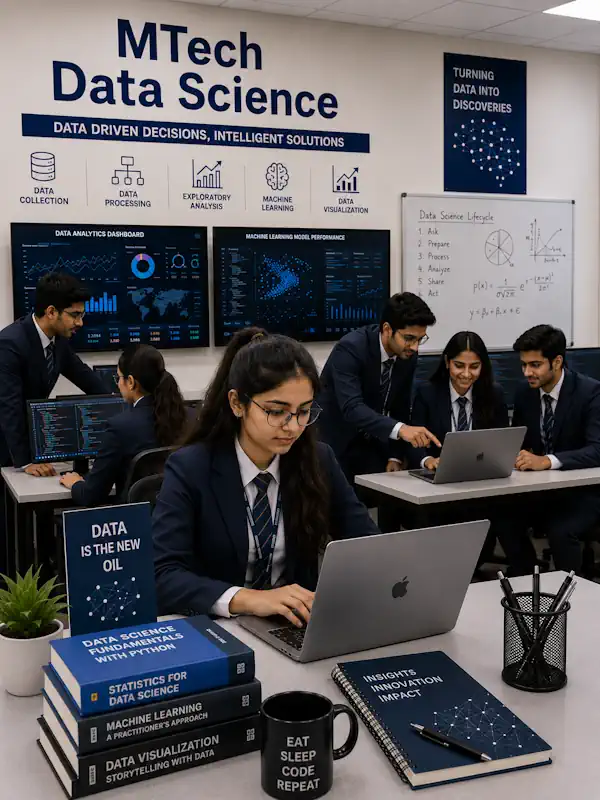

MTech in Data Science at Brainware University is a 2-year postgraduate engineering programme focused on data engineering, artificial intelligence, machine learning, big data analytics, cloud computing, statistical modelling, and business intelligence. The course prepares students for advanced technical roles in data-driven industries, AI product teams, analytics firms, research organisations, and digital transformation projects.
| Programme | Master of Technology in Computer Science & Engineering - Data Science |
|---|---|
| Duration | 2 years |
| Focus Areas | Data Science, Data Engineering, Artificial Intelligence, Machine Learning, Big Data Analytics, Cloud Computing, Statistical Modelling, Data Mining, Predictive Analytics, Business Intelligence, Deep Learning, Natural Language Processing, Database Systems, Research Methodology, and AI-driven decision systems. |
| Salary | Graduates of MTech Data Science may explore entry-level and early-career salary packages commonly ranging from ₹5 LPA to ₹10 LPA, depending on technical skills, coding ability, project portfolio, internship exposure, recruiter profile, and interview performance. Higher packages may be available in AI engineering, data engineering, cloud analytics, and advanced machine learning roles. |
| Popular Job Types | Data Scientist, Data Analyst, Data Engineer, Machine Learning Engineer, AI Engineer, Big Data Engineer, Business Intelligence Developer, Cloud Data Engineer, Research Associate, Data Architect, Analytics Consultant, NLP Engineer, and MLOps Engineer. |
| Hiring Industries | IT services, AI product companies, banking and finance, healthcare analytics, e-commerce, telecom, manufacturing, logistics, EdTech, FinTech, consulting, cloud services, cybersecurity, research organisations, and public-sector data projects. |
| Top Recruiters | MTech Data Science graduates may find opportunities with companies working in IT services, AI development, analytics consulting, cloud computing, data engineering, business intelligence, financial technology, and digital transformation. Recruiter participation may vary by year, student profile, skill level, and placement cycle. |
| Specializations | Data Science, Artificial Intelligence, Machine Learning, Big Data Engineering, Cloud Data Systems, Data Analytics, Business Intelligence, Predictive Modelling, Natural Language Processing, Deep Learning, and Data-driven Software Engineering. |
| Higher Studies | Graduates can pursue PhD programmes in Computer Science, Data Science, Artificial Intelligence, Machine Learning, Computational Intelligence, Big Data Analytics, Information Systems, or related interdisciplinary areas. They may also take advanced certifications in cloud platforms, MLOps, Python, R, SQL, Power BI, Tableau, TensorFlow, PyTorch, and big data frameworks. |
| Benefits | The programme supports advanced learning through research-based coursework, hands-on data science practice, programming assignments, analytics tools, AI model development, dissertation work, technical mentorship, and placement-oriented training. It is suited for students seeking an MTech data science course with applied learning and postgraduate engineering depth. |
| Internship and Placement | Students receive exposure to internships, live projects, data analytics assignments, technical workshops, pre-placement training, resume support, interview preparation, and placement assistance. The programme aims to build job-ready skills for data science, AI, data engineering, cloud analytics, and machine learning careers. |
| Location | Brainware University, Barasat, Kolkata, West Bengal. |
| Approvals & Recognition | Brainware University is a UGC-recognised university. The MTech CSE Data Science programme is offered under the university’s academic framework, with curriculum, evaluation, and learning outcomes aligned with postgraduate engineering education standards. |
Key reasons to study MTech CSE Data Science include:

Educational Qualification: Candidates must hold a B.E./B.Tech degree or an equivalent qualification (AMIE/AMIETE) in CSE, IT, or allied fields. Graduates of MCA, MSc in Computer Science/IT.
Minimum Marks: Applicants should have a minimum of 50% marks or an equivalent grade in their qualifying degree.
A 5% relaxation in marks is available for all reserved category candidates.
Entrance Criteria: Admission is offered either through merit in the qualifying examination or the BET (Brainware Entrance Test). Candidates with a valid GATE score will be given preference during the selection process.
Pursue your passion for advanced analytics, machine learning, and data-driven innovation with the MTech in Data Science programme designed to offer high-quality technical education at an affordable cost. This course provides access to modern computing labs, industry-grade data science tools, expert faculty mentorship, and real-world exposure through hands-on projects, datasets, and research-driven learning. With a balanced investment in advanced academic training and practical data science applications, this programme prepares students for successful careers in data analysis, AI engineering, business intelligence, and the rapidly expanding data and technology ecosystem.
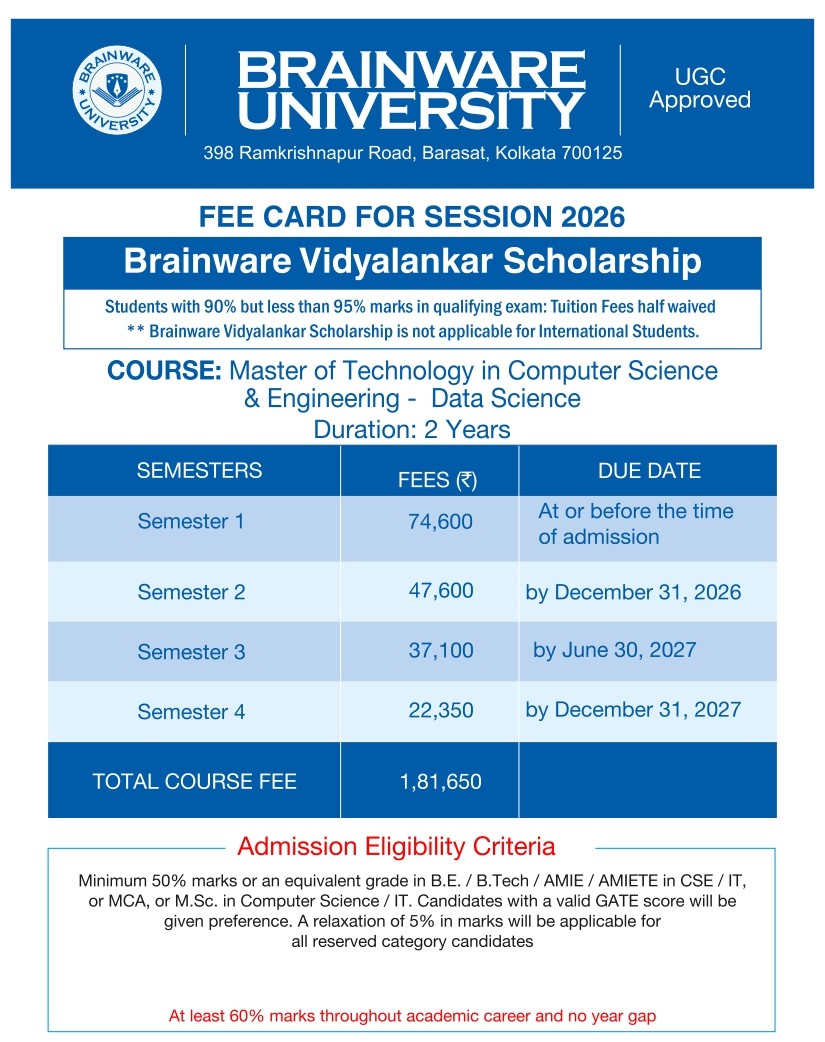
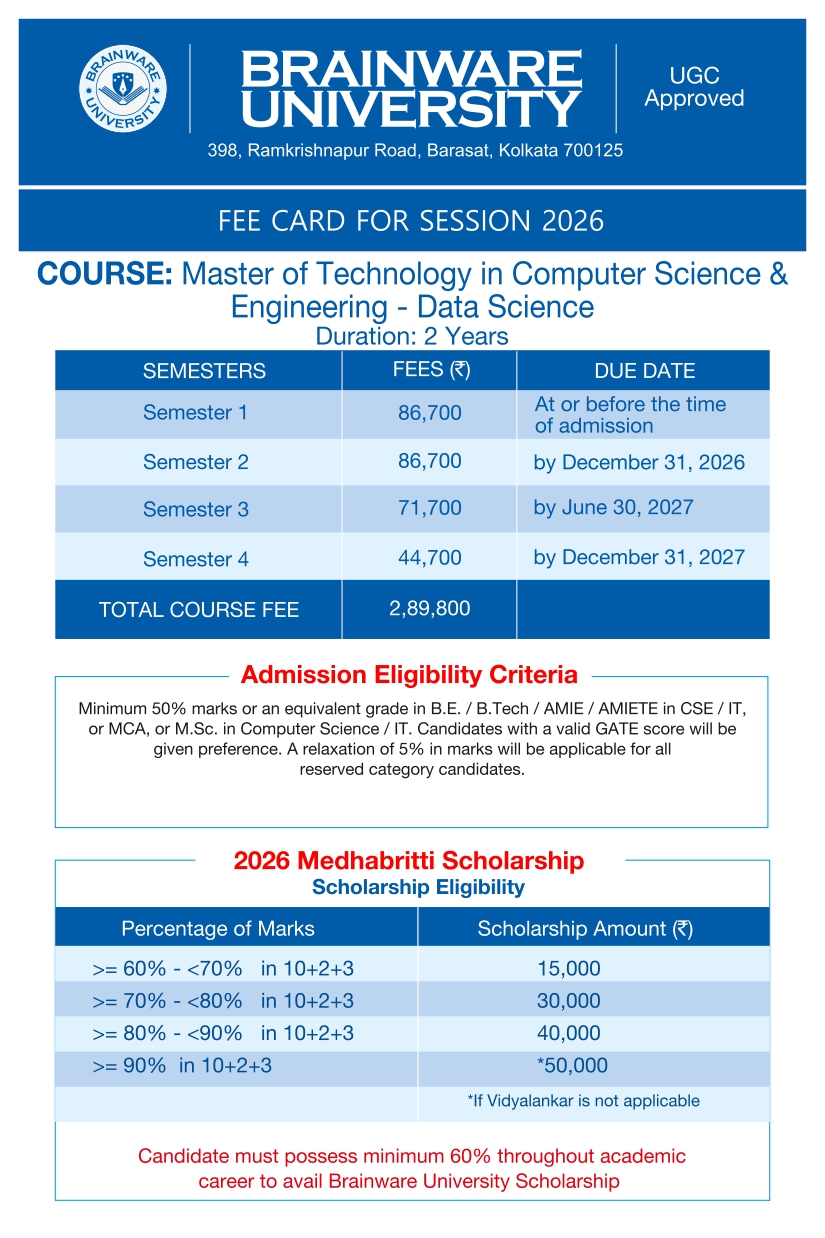
The MTech Data Science programme at Brainware University is designed to provide advanced technical education in data science, artificial intelligence, machine learning, big data analytics, and data engineering at a competitive fee structure. The fee covers access to academic resources, laboratory facilities, project-based learning, research guidance, technical workshops, and placement support. Students are advised to contact the admission office or refer to the latest university fee notification for updated semester-wise fee details.
| Semesters | Semester 1 | Semester 2 | Semester 3 | Semester 4 | Semester 5 | Semester 6 | Semester 7 | Semester 8 | Semester 9 | Semester 10 | Total |
|---|---|---|---|---|---|---|---|---|---|---|---|
| Fees (INR) | 86700 | 86700 | 71700 | 44700 | 2,89,800 |
**Fees are subject to change, and the application fee of ₹5,000 is non-refundable under any circumstances. Please contact us for further details.
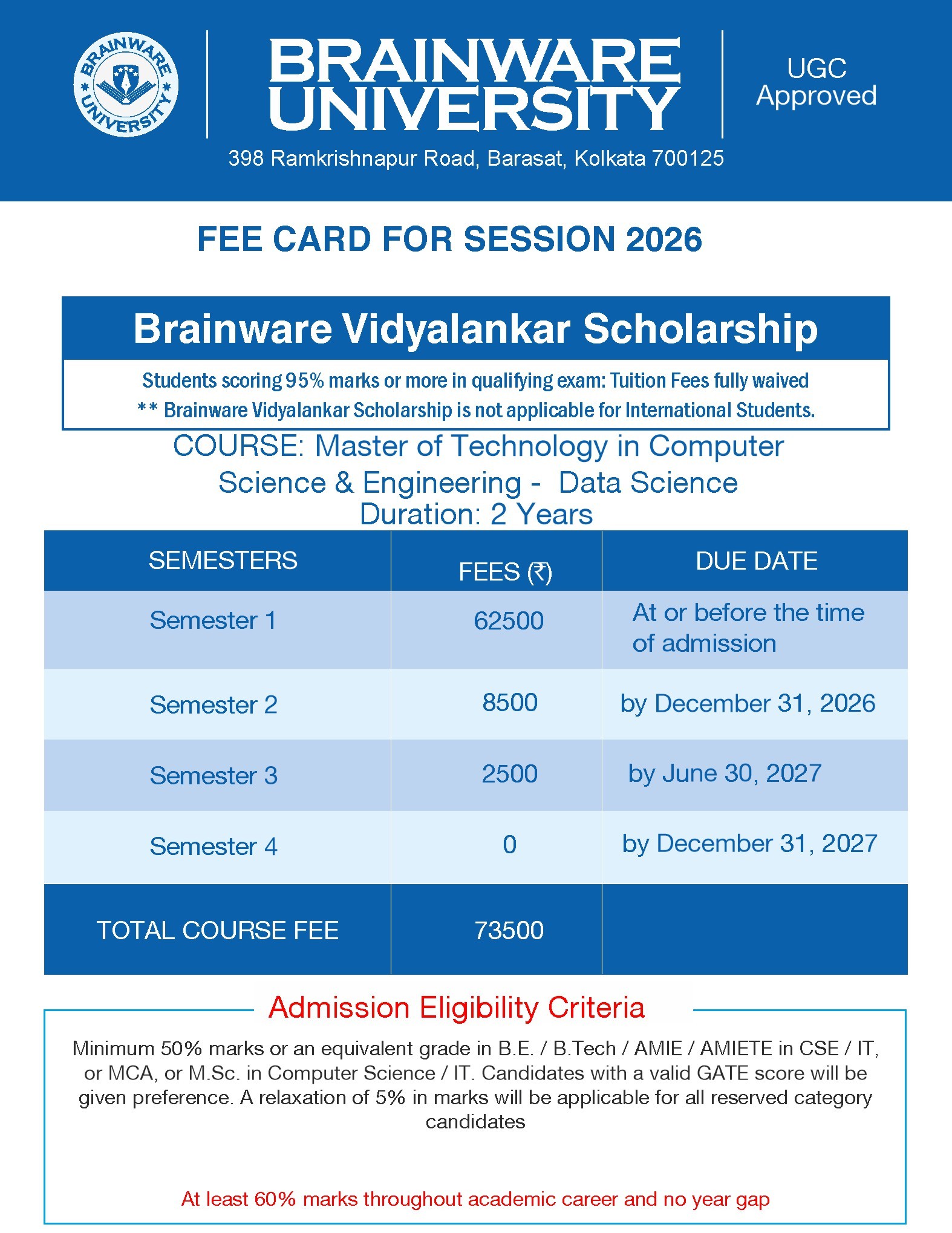
Scholarships(Fees): Brainware University offers merit-based scholarships for top performers and financial aid for deserving students. Scholarships are available for high scorers in entrance exams, board results, and outstanding achievements in innovation or research. Visit our scholarship page for more details.
**Please note that the Brainware Vidyalankar Scholarship is available only to students who passed their qualifying examination in the current admission year. Also, eligibility is strictly restricted to Indian nationals; international students are not eligible to apply.
MTech in Data Science connects artificial intelligence with large-scale data processing, predictive modelling, and automated decision-making. Students learn how data is collected, cleaned, stored, analysed, visualised, and converted into actionable intelligence using AI, machine learning, statistical methods, and data engineering pipelines.
The programme supports academic and industry innovation by training students in real-world data workflows. These include data preprocessing, supervised and unsupervised learning, deep learning, natural language processing, big data tools, cloud-based analytics, and business intelligence dashboards.
Students learn how AI-driven data science is used in:
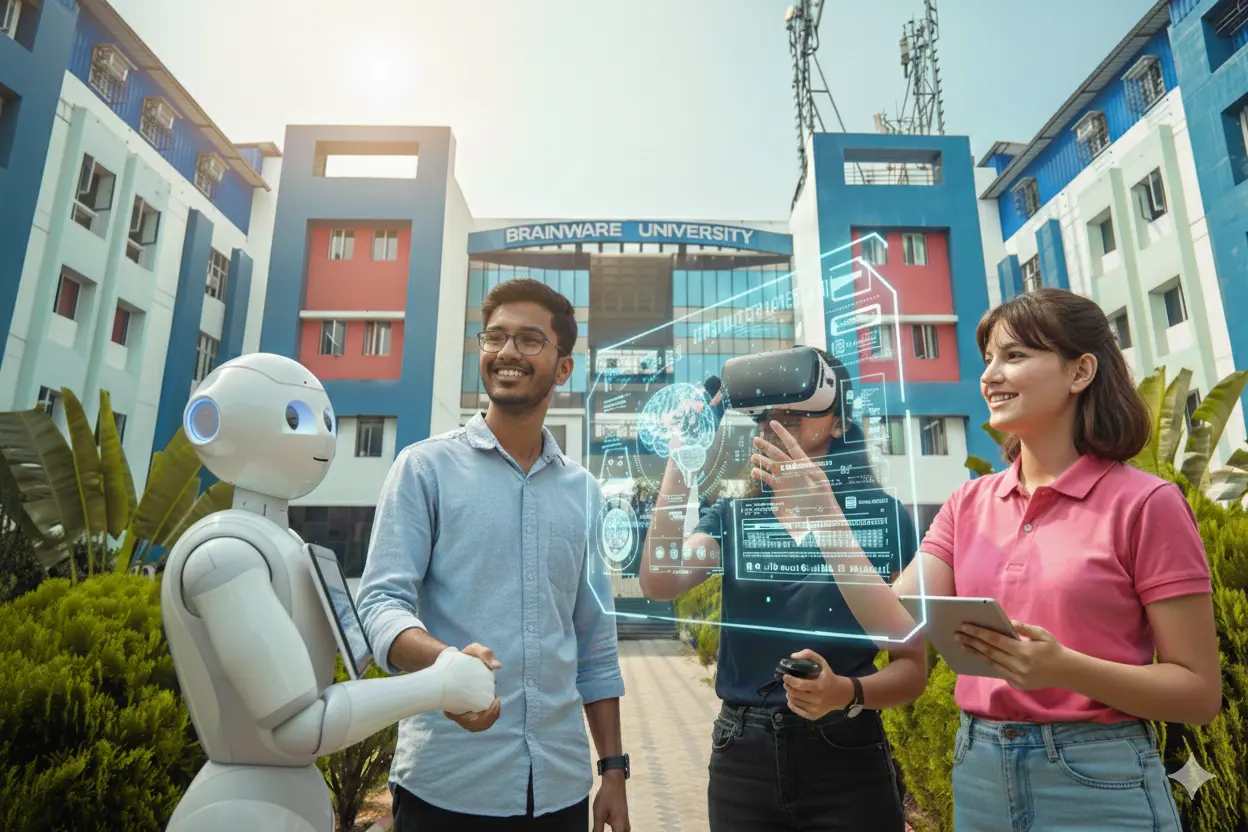
The end-to-end AI learning spectrum in MTech Data Science covers the complete journey from raw data to intelligent prediction. Students study data collection, cleaning, transformation, model development, algorithm selection, evaluation, deployment, and interpretation of results for academic and industry use.
This learning spectrum helps students understand how AI systems are built responsibly and effectively. It connects mathematics, programming, statistics, databases, machine learning, and cloud technologies with practical problem solving.
Key learning areas include:





Key academic strengths include:
When comparing MTech Data Science colleges, students should check:

The success of MTech Data Science graduates reflects the growing demand for professionals skilled in analytics, artificial intelligence, machine learning, and data engineering. Alumni from postgraduate data science programmes have built careers across technology companies, consulting firms, financial institutions, healthcare organisations, research centres, and cloud-based enterprises.


Brainware University has earned an AA+ rating in India’s Best Engineering Institutes by Careers360. The recognition reflects the University’s strength in academic quality, faculty, infrastructure, research, and student outcomes, reinforcing its position as a trusted destination for industry-aligned engineering education.

Brainware University has been ranked No. 1 Engineering College under a Private University in West Bengal in the IIRF Rankings 2026. The recognition highlights the University’s strength in engineering education, industry-focused learning, research, emerging technologies, and placement outcomes.

Brainware University has been ranked No. 2 Private University in West Bengal by uniRank 2026, marking another recognition of the University's growing presence in the state's higher education landscape.
Brainware University's inclusion in the Times Higher Education (THE) Impact Rankings 2025 reflects its contribution to the UN Sustainable Development Goals (SDGs) through education, innovation, sustainability, community engagement, and responsible institutional practices.

Brainware University has been recognised as the Best Private University of West Bengal in Infrastructure & Placement at Times Now.in – Leaders of Excellence: East 2026, celebrating its commitment to world-class infrastructure and career-focused education.

Brainware University has been recognised by The Times Group for excellence across Engineering (Placement), Law, and MBA Studies. The honours reflect the University’s multidisciplinary strength and its focus on career-oriented, industry-relevant education.

Brainware University received the ABP Ananda Shiksha Samman 2026 for Excellence in Placement & AI-Integrated Academic Infrastructure, acknowledging its emphasis on placement opportunities alongside technology-enabled academic development.

Brainware University has been honoured with the Zee 24 Ghanta Education Excellence Award 2026 for Best Industry Placement & Academic Infrastructure, continuing its recognition in 2022, 2023, 2024, 2025, and 2026. The University was also recognised in 2017 and 2018 for its job-oriented academic initiatives.

Brainware University received the TV9 Uttaran Academic Excellence Honour for Excellence in Placement & AI-Integrated Academic Infrastructure, highlighting its focus on combining career opportunities with an AI-enabled academic and learning environment.

Brainware University was honoured with the R Bangla Sikkha Gourab Samman 2026, recognising its contribution to higher education and continued pursuit of academic excellence and career-focused learning.

Brainware University was honoured as the Best Private University in West Bengal at the Times Now in Business Excellence Awards (East) 2025, recognising its academic quality, modern infrastructure, industry engagement, and focus on student success.

Brainware University was recognised as the Leading University in Infrastructure, Academics & Placement at the Times Business Awards West Bengal 2025, highlighting its strong campus facilities, academic ecosystem, and placement performance across disciplines.

The MTech in Data Science syllabus is designed to build postgraduate-level expertise in computer science, data engineering, artificial intelligence, machine learning, big data analytics, and applied research. It trains students to work with structured and unstructured data, develop AI models, and solve real-world analytics problems.
The syllabus may include the following scope of learning:
The core foundations of MTech Data Science build essential knowledge in computer science, mathematics, programming, statistics, databases, and research methods. These areas help students understand how data is stored, processed, analysed, and used for intelligent decision-making.
Core learning areas include:
These foundation subjects help students from CSE, IT, MCA, MSc Computer Science, and related backgrounds prepare for advanced data science learning.
The industry-driven advanced modules prepare students for specialised work in AI, big data systems, data engineering, business intelligence, and machine learning deployment. These subjects are aligned with the skills needed in technology companies, analytics firms, digital businesses, and research teams.
Advanced learning areas include:
These modules help students build the technical depth required for data scientist, data engineer, AI engineer, and analytics consultant roles.
| Semester | Course |
|---|---|
| Semester I | Research Methodology, IPR and Ethics |
| Computational Mathematics for Data Science | |
| Advanced Algorithm | |
| Big Data Analytics | |
| Data Mining and Pattern Recognition | |
| Scalable System for Data Science | |
| Advanced Algorithm Lab | |
| Big Data Analytics Lab | |
| English for Research Paper Writing | |
| Semester II | Artificial Intelligence for Data Science |
| Elective: Nature-Inspired Algorithm / Natural Language Processing / MOOC | |
| Time Series Data Analysis | |
| Machine Learning for Data Science | |
| Social Media and Web Analytics | |
| Advanced Web Technology | |
| Stress Management by Yoga | |
| Professional Communication, Collaboration, and Career Skills | |
| Semester III | Dissertation-I |
| Semester IV | Dissertation-II |
Please note that the syllabus is subject to modification. Visit our Syllabus page for the elective subject details and updated syllabus.


MTech Data Science graduates can work in corporate and private-sector roles across IT services, AI companies, analytics firms, banks, FinTech organisations, healthcare technology companies, cloud service providers, consulting firms, and digital businesses. The demand is linked to the need for automation, forecasting, personalisation, and data-backed decision-making.
Students with strong portfolios in Python, SQL, machine learning, dashboarding, cloud platforms, data pipelines, and real-world projects are better positioned for competitive data science roles.
MTech Data Science graduates may explore government and public-sector roles in data analysis, digital governance, public policy analytics, research, cybersecurity, defence technology, public-sector banks, statistical organisations, and technology-driven public projects.
Candidates should check official recruitment notifications, eligibility criteria, examination rules, and organisation-specific requirements.
MTech Data Science prepares students for technical roles that combine programming, statistics, AI, database systems, and business understanding. The following table explains why major career areas in data science are in demand across modern industries.
| Area of Opportunity | Why It’s in Demand |
|---|---|
| Data Scientist | Strategic Intelligence & Prediction: The core role, highly demanded for designing and implementing predictive models and advanced statistical methods to derive strategic business value from complex data. |
| Machine Learning Engineer | Productionising AI: Crucial for taking machine learning models and deploying them into scalable, production-ready systems and software that can handle real-time data and continuous operation. |
| Machine Learning Scientist | Algorithm Innovation: Needed for fundamental research, developing novel machine learning algorithms, and advancing AI theory and applications, often within research and development departments. |
| Applications Architect | AI-Powered System Design: Required to define the structure of applications that integrate sophisticated data models while ensuring that the final product is scalable, robust, and aligned with the organisation’s data strategy. |
| Enterprise Architect | Organisational Data Strategy: A senior role focused on aligning an organisation’s data ecosystem, technology stack, and IT infrastructure with business objectives and data governance standards. |
| Data Architect | Data Governance and Blueprinting: Essential for designing how data is modelled, stored in data lakes or warehouses, integrated, and governed to ensure quality, security, and accessibility. |
| Infrastructure Architect | Optimising Computational Resources: Needed to design high-performance computing environments and cloud resources for large-scale data processing and machine learning model training. |
| Data Engineer | Building Data Pipelines (ETL): Responsible for constructing and maintaining robust pipelines that clean, aggregate, and transform raw data into reliable datasets for analysts and machine learning models. |
| Business Intelligence Developer | Reporting and Visualisation: Required to transform complex data insights into actionable dashboards and reports, enabling non-technical users to monitor performance and make informed decisions. |
| Statistician | Methodological Rigour and Validation: Applies advanced statistical theory and methodology to ensure that data analysis, experimental design, and machine learning model validation are accurate and reliable. |
| Data Analyst | Translating Data into Insights: Essential for cleaning, examining, and interpreting data to answer business questions and bridge the gap between raw information and decision-makers. |
The career scope after MTech Data Science depends on the student’s technical skills, problem-solving ability, internship exposure, project portfolio, and confidence with industry tools. Graduates who combine programming, statistics, AI, data engineering, and communication skills can build careers in fast-growing data-driven sectors.
The job market for MTech Data Science graduates is expected to grow strongly from 2025 to 2032 as industries expand their use of artificial intelligence, big data analytics, data engineering, cloud platforms, and automated decision systems. Demand will be highest for professionals who can combine programming, statistics, machine learning, business understanding, and responsible AI practices.
Data science will continue to move beyond traditional IT roles. By 2032, skilled professionals will be needed across banking, healthcare, manufacturing, e-commerce, logistics, telecom, cybersecurity, education, governance, and research. Companies will look for postgraduate talent who can build reliable data pipelines, train AI models, interpret complex datasets, and support high-value business decisions.
The growth of data science jobs will be driven by AI adoption, digital transformation, cloud computing, automation, and the rising need for real-time decision-making. Organisations will need data professionals who can handle large datasets, build predictive models, create dashboards, and deploy machine learning systems in production environments.
The fastest-growing roles for MTech Data Science graduates will include data scientist, data engineer, machine learning engineer, AI engineer, cloud data engineer, business intelligence developer, NLP engineer, big data engineer, analytics consultant, and MLOps engineer. These roles require a blend of coding, data handling, model building, and industry problem-solving.
High-growth career roles include:
MTech Data Science graduates will find opportunities in industries that depend on digital platforms, customer data, automation, risk analysis, and predictive intelligence. From 2025 to 2032, hiring is expected to expand across both technology companies and non-technology sectors that are becoming data-driven.
Key hiring industries include:
The most valuable data science skills from 2025 to 2032 will include Python, SQL, statistics, machine learning, data engineering, cloud computing, business intelligence, deep learning, NLP, big data tools, and model deployment. Employers will prefer candidates who can work with both technical systems and real business problems.
Important skill areas include:
The growth outlook for MTech Data Science graduates is positive because organisations are shifting from basic reporting to intelligent, automated, and predictive systems. By 2032, the strongest career advantage will belong to candidates who can combine AI model development with data engineering, domain knowledge, and deployment-ready technical skills.
Students completing an MTech data science course should focus on building a strong portfolio through live projects, internships, research work, GitHub repositories, dashboarding assignments, cloud-based analytics projects, and machine learning case studies.
A postgraduate degree can provide an advantage in:
The future data science job market will reward students who can move beyond tool familiarity and show deeper problem-solving ability. Employers will seek professionals who can ask the right questions, clean and prepare data, select suitable models, explain outcomes, and deploy reliable solutions.
For MTech CSE Data Science students, the 2025–2032 period offers strong career potential in India and abroad. The best opportunities will go to graduates who build applied skills in data science, AI, machine learning, data engineering, cloud computing, and business analytics while maintaining a strong academic and research foundation.


Brainware University's Department of Computer Science and Engineering is excited to announce the formalization of a strategic partnership with Code Clouds IT Solutions Pvt. Ltd. Through this Memorandum of Understanding (MOU), both entities aim to foster a collaborative environment for innovative research, knowledge exchange, and industry-oriented training programs. The MOU establishes a platform for joint research projects, technical workshops, and internships, empowering students and faculty to engage in real-world problem-solving and technological advancements. This partnership solidifies our commitment to nurturing technological excellence and ensuring our students are well-equipped with practical skills and knowledge to excel in the ever-evolving tech landscape.
Brainware University's Department of Computer Science and Engineering proudly announces the signing of an MOU with Consilio Intelligence Research Lab, marking a significant step toward the enhancement of research and academic collaboration. This collaboration aims to promote joint initiatives, including research projects, knowledge sharing, and training programs that align with the latest industry trends and technological advancements. By fostering an environment of innovation and academic synergy, this MOU endeavours to provide students and faculty with invaluable opportunities for skill development, collaborative research, and exposure to cutting-edge technologies, further enriching the academic experience and preparing individuals for the demands of a dynamic tech-driven world.
The Department of CSE is delighted to formalize a strategic partnership with DCPL Tech through the signing of a Memorandum of Understanding (MOU). This collaboration marks the beginning of an enriching relationship focused on promoting mutual cooperation in research, training, and technological innovation. The MOU aims to establish joint research projects, seminars, and skill development initiatives, creating an environment that fosters innovation and academic excellence. Through this partnership, students and faculty will have access to practical experiences, industry insights, and opportunities to engage with emerging technologies, empowering them to thrive in the competitive landscape of the tech industry.
Brainware University's Department of CSE proudly announces the signing of an MOU with Tata Consultancy Pvt. Ltd., a significant milestone in fostering a collaborative and mutually beneficial relationship. This partnership sets the stage for joint initiatives focusing on research, development, and industry-aligned education. The MOU facilitates collaborative projects, training programs, and knowledge exchange to bridge the gap between academia and industry. This alliance will provide students and faculty with exposure to real-world challenges, technological expertise, and valuable insights from industry leaders, ensuring a comprehensive and practical learning experience in the field of computer science and engineering.
Brainware University's Department of Computer Science and Engineering is pleased to formalize an alliance with Webskitters Technology Solutions Pvt. Ltd. through the signing of a Memorandum of Understanding (MOU). This partnership symbolizes a commitment to foster an environment of collaboration, innovation, and knowledge-sharing. The MOU outlines joint research initiatives, workshops, and internship opportunities aimed at providing students and faculty with exposure to real-world industry practices and cutting-edge technological advancements. Through this collaboration, both entities strive to bridge the gap between academia and industry, equipping students with the skills and expertise necessary to excel in the ever-evolving landscape of technology and software development.

MTech Data Science admission 2026 at Brainware University is open to eligible candidates who want to pursue advanced postgraduate study in data science, AI, machine learning, data engineering, and analytics. Applicants should review the eligibility criteria, application process, entrance requirements, counselling steps, direct admission options, and fee details before applying.
Admission Criteria: Admission to MTech CSE Data Science is based on academic eligibility, merit, and university admission norms. Candidates must have a relevant engineering or postgraduate qualification with the required minimum marks. The university may also consider performance in BET, the Brainware Entrance Test, as part of the admission process.
Application: Candidates can apply online by filling up the enquiry or application form on the Brainware University website. Applicants need to provide their name, course preference, location, phone number, email ID, and academic details. After submission, the admission counselling team will guide them through the next steps.
Entrance Exam: Admission may be based on merit or through BET, the Brainware Entrance Test conducted by Brainware University. Candidates searching for MTech in Data Science without GATE or MTech Data Science direct admission should confirm the latest admission norms with the university admission office.
Counselling: After application and eligibility review, shortlisted candidates receive counselling support from the university admission team. Counselling helps students understand the MTech Data Science course, fees, eligibility, syllabus, placement scope, scholarships, and admission formalities.
Direct Admission:Direct admission may be available for eligible candidates as per university norms, seat availability, and admission criteria. Students seeking MTech Data Science admission 2026 should contact the admission counsellor to confirm eligibility, required documents, fee details, and the latest admission procedure.
Please follow the given MTech Data Science Admission Procedure in Brainware University:


"Brainware students are professionally and technically well-informed as freshers. We are impressed with the level of confidence and positive attitude they demonstrated during their interviews."
Mr. Vaskar Bhattacharya Regional Head-East, Ginnisystems Ltd.
We always find competent and positive students who are almost ready to be professionals. We never get disappointed wherever we come for the recruitment. Well done Brainware University!
Ms. Srimoyee Mukherjee Manager HR Nature Technologies Pvt. Ltd.
Brainware University's Department of Computer Science and Engineering (CSE) stands at the forefront of technological innovation and academic excellence. Here's a glimpse into the department's remarkable achievements and contributions:
The Department of CSE and CSE (AI) successfully organized the 4th International Conference on Current Research in Engineering and Technology (ICCRET 2025), bringing together researchers, academicians, and industry experts from India and abroad. Focused on Innovation in Engineering and Technology for Sustainable Development, the conference featured distinguished speakers, including Padma Shri Dr. Bimal Kumar Roy and Prof. Dilip Kumar Banerjee, and provided a platform for knowledge sharing, research dissemination, and academic collaboration.
The department organized a comprehensive 10-day Faculty Development Programme (FDP) for its faculty members. The FDP aimed to equip faculty with knowledge about current technologies and the latest research work, ensuring that they stay abreast of industry advancements. This initiative reflects Brainware University's commitment to providing high-quality education through skilled and updated faculty.
Recognizing the importance of practical skills, CSE students had the opportunity to visit Euphoria Genx for hands-on training on web development using PHP and MySql. These practical sessions bridge the gap between theoretical knowledge and industry requirements, preparing students for successful careers in the dynamic field of technology.
The department organized the prestigious ICACDS - 2023, bringing together experts from academia and industry. Notable speakers included Dr. Dipti Prasad Mukherjee (Deputy Director, Indian Statistical Institute), Welmoed Spahr (Vice President of Publishing, Springer Nature Books), and Vipin Tyagi (Jaypee University of Engineering). This conference showcased Brainware University's commitment to advancing research and fostering collaboration on a global scale.
The department invited esteemed guests from CodeClouds to share valuable insights on executing business strategies with CSE students. The speakers, Mr. Subhojit Ganguly (COO, CodeClouds) and Mr. Biplab Pal (VP and R&D CodeClouds) provided students with real-world perspectives, aligning academic learning with industry practices.
Brainware University's Department of Computer Science and Engineering continues to elevate the standards of education and industry readiness. Through pioneering events, hands-on training, and collaborations with industry leaders, the department ensures that its students are well-prepared to excel in the dynamic and ever-evolving field of computer science and engineering.

M.Tech in CSE with a specialization in Data Science is a postgraduate engineering programme that focuses on computer science principles and techniques relevant to data science. It combines core computer science subjects with specialised courses in data analytics, machine learning, statistics, and data mining.
MTech CSE (Data Science) stands for Master of Technology in Computer Science and Engineering – Data Science. This postgraduate programme focuses on advanced data analytics, programming, machine learning, big data technologies, statistical modelling, AI applications, and research-based problem-solving. Students gain hands-on experience with real-world datasets, computational tools, and industry-oriented projects to build expertise in data-driven decision-making and intelligent system development.
To be eligible for M.Tech in CSE (Data Science), candidates generally need a B.E. or B.Tech in Computer Science and Engineering, Information Technology, or a related discipline. Candidates with an eligible postgraduate qualification in Computer Science, Mathematics, or a related field may also apply, subject to university norms. Applicants must meet the prescribed minimum marks and applicable entrance or merit-based admission requirements.
The Data Science specialization typically covers data structures, algorithms, Python and R programming, database management, statistics, machine learning, data visualisation, big data technologies, artificial intelligence, data engineering, cloud computing, and research methodology.
Graduates can explore careers as Data Scientists, Data Analysts, Machine Learning Engineers, AI Engineers, Data Engineers, Business Intelligence Analysts, Analytics Consultants, NLP Engineers, MLOps Engineers, and Cloud Data Engineers across IT, finance, healthcare, e-commerce, telecom, manufacturing, and consulting sectors.
Yes. M.Tech programmes commonly include laboratory assignments, live projects, research work, dissertation-based learning, and internship opportunities. These activities help students apply data science concepts to real-world datasets and industry problems.
Yes. Graduates can pursue PhD programmes and research fellowships in Data Science, Artificial Intelligence, Machine Learning, Computer Science, Big Data Analytics, and related fields. They may also pursue specialised certifications in cloud computing, MLOps, business intelligence, and responsible AI.
Brainware University offers an industry-oriented Data Science programme with practical exposure to AI, machine learning, big data, analytics, and cloud technologies. Students benefit from laboratory-based learning, projects, research guidance, faculty mentorship, industry interaction, pre-placement training, and placement assistance.
Coding is a fundamental skill in Data Science. Languages such as Python, R, SQL, Java, and Scala are used for data manipulation, statistical analysis, machine learning, data visualisation, pipeline development, and working with data science libraries and frameworks.
A successful Data Science career requires technical skills in programming, statistics, machine learning, database systems, data engineering, cloud platforms, and visualisation. Critical thinking, problem-solving, communication, teamwork, business understanding, and ethical data handling are also important.
Yes. Data Science is a rapidly evolving field with research opportunities in machine learning, deep learning, natural language processing, computer vision, predictive analytics, data engineering, responsible AI, big data systems, and intelligent automation. Students can participate in research projects and pursue further research in academia or industry.
M.Tech in Computer Science and Engineering (Data Science) is a postgraduate programme focused on big data analytics, machine learning, artificial intelligence, statistical modelling, data engineering, and cloud computing. It prepares students to develop data-driven solutions and intelligent systems.
Students should compare curriculum quality, faculty expertise, laboratory infrastructure, research opportunities, industry exposure, internship support, academic recognition, and placement assistance when selecting a college. Brainware University offers an industry-aligned M.Tech Data Science programme with practical learning, research guidance, and career preparation.
Admission may be based on GATE scores, a university entrance examination, merit-based evaluation, or another selection process prescribed by the institution. Candidates must satisfy the programme’s academic eligibility and applicable university admission norms.
The curriculum may include Big Data Analytics, Machine Learning, Deep Learning, Artificial Intelligence, Python and R programming, Statistical Methods, Cloud Computing, Data Engineering, Natural Language Processing, Business Intelligence, Data Visualisation, and dissertation work.
The M.Tech in Computer Science and Engineering (Data Science) programme has a duration of 2 years, divided into 4 semesters.
Graduates can pursue roles such as Data Scientist, Machine Learning Engineer, AI Engineer, Data Analyst, Data Engineer, Big Data Developer, Business Intelligence Analyst, Cloud Data Engineer, NLP Engineer, MLOps Engineer, Analytics Consultant, and Research Engineer.
Salary packages vary according to technical expertise, project experience, job role, employer, location, and industry demand. Graduates with strong skills in machine learning, cloud data engineering, MLOps, big data, and artificial intelligence may access better career growth with experience.
Graduates may explore opportunities with IT companies, AI and analytics firms, cloud service providers, consulting organisations, banks, FinTech companies, healthcare technology firms, e-commerce businesses, telecom companies, and research organisations. Recruiter participation varies according to the placement cycle and candidate profile.
Focus on Python, SQL, statistics, probability, data structures, machine learning algorithms, model evaluation, data visualisation, database systems, cloud computing, and real-world case studies. Candidates should also be prepared to explain their projects, dissertation, internships, and model-development decisions.
A strong resume should highlight data science projects, machine learning models, internships, research publications, hackathons, certifications, cloud computing skills, dashboard projects, programming expertise, GitHub repositories, and experience with real-world datasets.
Students can improve their skills by working with real-world datasets, participating in hackathons, contributing to open-source projects, completing internships, reading AI research papers, building dashboards, deploying machine learning models, and undertaking dissertation-based research.
Python, R, SQL, and Scala are commonly used in Data Science. Java may also be useful for software development, big data frameworks, and enterprise-level data applications.
In-demand skills include data wrangling, feature engineering, machine learning, deep learning, natural language processing, time-series analysis, cloud-based data engineering, big data processing, business intelligence, MLOps, and model deployment.
Students can gain practical experience through industry projects, internships, research laboratory collaborations, hackathons, open-source contributions, cloud-based projects, machine learning deployments, and dissertation work involving real-world datasets.
Students can follow recognised research publications, technical documentation, AI conferences, professional communities, open-source projects, Kaggle competitions, industry webinars, and updates from leading AI and cloud organisations.
AI is enabling automated data processing, predictive analytics, intelligent recommendations, natural language systems, computer vision applications, Generative AI, and automated decision support. This is creating new roles in AI engineering, MLOps, model governance, and responsible data systems.
Cloud computing supports scalable data storage, distributed processing, machine learning model training, real-time analytics, and production deployment. Skills in platforms such as AWS, Microsoft Azure, and Google Cloud can strengthen career prospects in cloud-based analytics and AI.
Cybersecurity is important because Data Science systems handle sensitive and valuable information. Professionals need awareness of data privacy, encryption, access control, secure pipelines, fraud detection, ethical AI, and compliance requirements.
Graduates can contribute by conducting applied research, developing new algorithms, publishing papers, creating datasets, improving machine learning models, participating in funded projects, and collaborating with universities, research laboratories, and technology companies.
Career paths in startups include AI Engineer, Data Scientist, Machine Learning Engineer, Data Engineer, Analytics Consultant, Product Data Analyst, NLP Engineer, MLOps Engineer, Business Intelligence Developer, and Cloud Data Engineer.