98%
Placed
in 2025






Brainware University transformed me, fostering confidence and capability for conquering the world.
Master of Science in Applied Psychology is a 2-year postgraduate programme that studies human behaviour, mental processes, counselling, psychological assessment, research methods, mental health, community psychology, and applied psychological practice. The course is designed for graduates who want advanced academic and practical training for careers in counselling, research, healthcare support, education, HR, social work, and mental wellness.
The MSc Applied Psychology programme at Brainware University helps students understand how psychological theories are used in real-world settings such as clinics, schools, workplaces, communities, rehabilitation centres, and wellness programmes.
The applicants for M Sc Applied Psychology will find all the relevant information on this page including programme overview, syllabus outline, career options as well learning benefits.
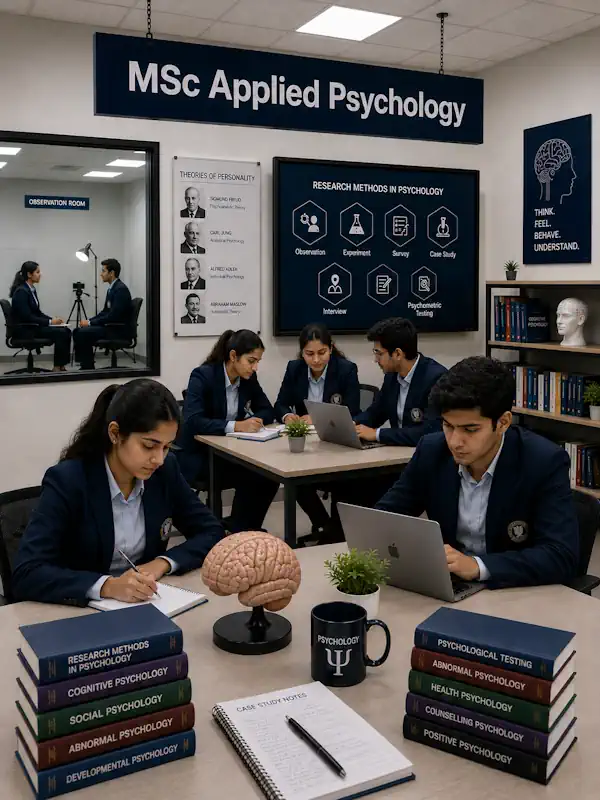

M.Sc Psychology at Brainware University is a 2-year postgraduate programme focused on applied psychology, counselling, clinical foundations, psychological assessment, research methods, behavioural science, community mental health, workplace psychology, and wellness support. The programme prepares students for careers in mental health support, counselling, research, education, HR, social services, and allied healthcare settings.
| Programme | Master of Science in Applied Psychology |
|---|---|
| Duration | 2 years |
| Focus Areas | Applied Psychology, Counselling Psychology, Clinical Psychology Foundations, Psychological Assessment, Research Methodology, Cognitive Psychology, Developmental Psychology, Social Psychology, Health Psychology, Community Psychology, Organisational Behaviour, Mental Health Awareness, Behavioural Intervention, and Psychological Testing. |
| Salary | Graduates of MSc Applied Psychology may explore entry-level salary packages commonly ranging from ₹3 LPA to ₹6 LPA, depending on role, internship exposure, counselling skills, research experience, recruiter profile, and interview performance. Higher growth may be possible in counselling, clinical support, HR, organisational psychology, research, wellness consulting, and specialised practice with further qualifications and experience. |
| Popular Job Types | Senior Psychologist, Counsellor, Child Support Specialist, Community Relations Officer, Social Worker, Lifestyle Coach, Senior Psychological Consultant, Health Educator, Research Assistant, Mental Health Support Worker, HR Executive, Behaviour Analyst, Rehabilitation Support Professional, and Wellness Programme Coordinator. |
| Hiring Industries | Hospitals, mental health clinics, counselling centres, schools, colleges, universities, NGOs, rehabilitation centres, corporate HR departments, wellness organisations, research institutes, healthcare organisations, social welfare agencies, community development projects, and public health programmes. |
| Top Recruiters | MSc Applied Psychology graduates may find opportunities with hospitals, mental health centres, counselling clinics, schools, NGOs, rehabilitation centres, research organisations, corporate HR teams, wellness companies, and community health projects. Recruiter participation may vary by year, student profile, internship exposure, skill level, and placement cycle. |
| Specializations | Counselling Psychology, Clinical Psychology Foundations, Child and Developmental Psychology, Health Psychology, Community Psychology, Organisational Psychology, Research Psychology, Behavioural Science, Mental Wellness, Rehabilitation Support, and Psychological Assessment. |
| Higher Studies | Graduates can pursue PhD programmes in Psychology, Applied Psychology, Clinical Psychology, Counselling Psychology, Organisational Psychology, Health Psychology, Community Psychology, or Behavioural Sciences. They may also pursue further professional training, supervised practice, and certifications in counselling, CBT, psychological first aid, rehabilitation, mental health support, and research methods. |
| Benefits | The programme supports advanced psychology learning through theoretical study, psychological assessment practice, counselling skill development, research training, field exposure, wellness initiatives, internships, mentoring, and placement-oriented preparation. It is suitable for students seeking MSc Psychology courses, masters in psychology courses, or a psychology master degree with applied learning. |
| Internship and Placement | Students receive exposure to internships, field visits, psychological assessment practice, research projects, counselling-based learning, outreach activities, pre-placement training, interview preparation, and placement assistance. The programme aims to build job-ready skills for counselling, mental health support, education, HR, research, community work, and allied healthcare roles. |
| Location | Brainware University, Barasat, Kolkata, West Bengal. |
| Approvals & Recognition | Brainware University is a UGC-recognised university. The M.Sc Applied Psychology programme is offered under the university’s academic framework, with curriculum, evaluation, and learning outcomes aligned with postgraduate psychology education standards. |
Key reasons to study MSc Psychology include:

Educational Qualification: Candidates must have completed graduation or an equivalent degree from a UGC-recognised university.
Minimum Marks: Applicants are required to secure a minimum of 50% marks or an equivalent grade in graduation.
A 5% relaxation in marks is applicable for reserved category candidates, as per government and university norms.
Entrance Examination: Admission to the M.Sc. Psychology (Applied Psychology) programme at Brainware University is based on performance in the Brainware Entrance Test (BET), the university’s official entrance examination for postgraduate admissions.
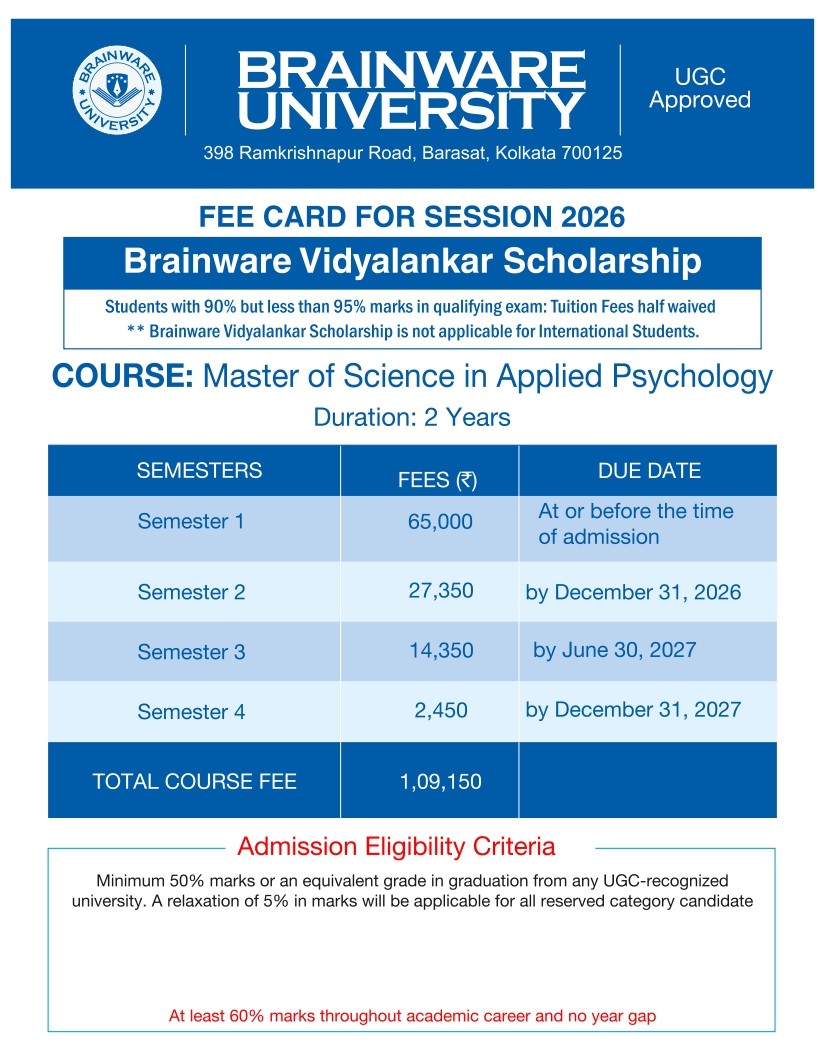
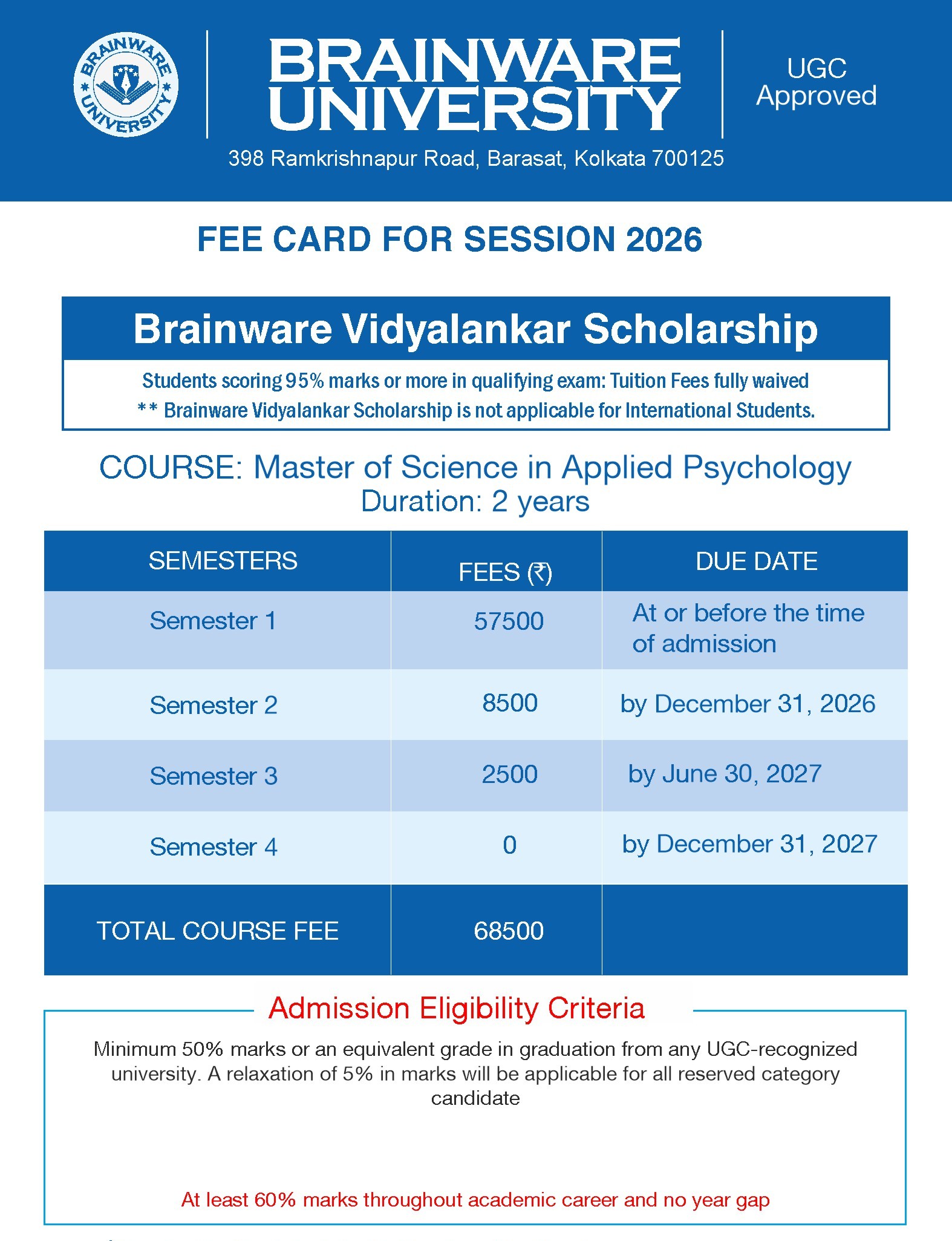
Concerned about the M.Sc. Psychology fees? At Brainware University, we offer a well-structured postgraduate programme in Psychology at an affordable fee, ensuring quality education without financial burden.
Designed for graduates interested in human behaviour and mental processes, the programme covers key areas such as clinical, cognitive, and counselling psychology—preparing students for careers in mental health, research, and related fields.
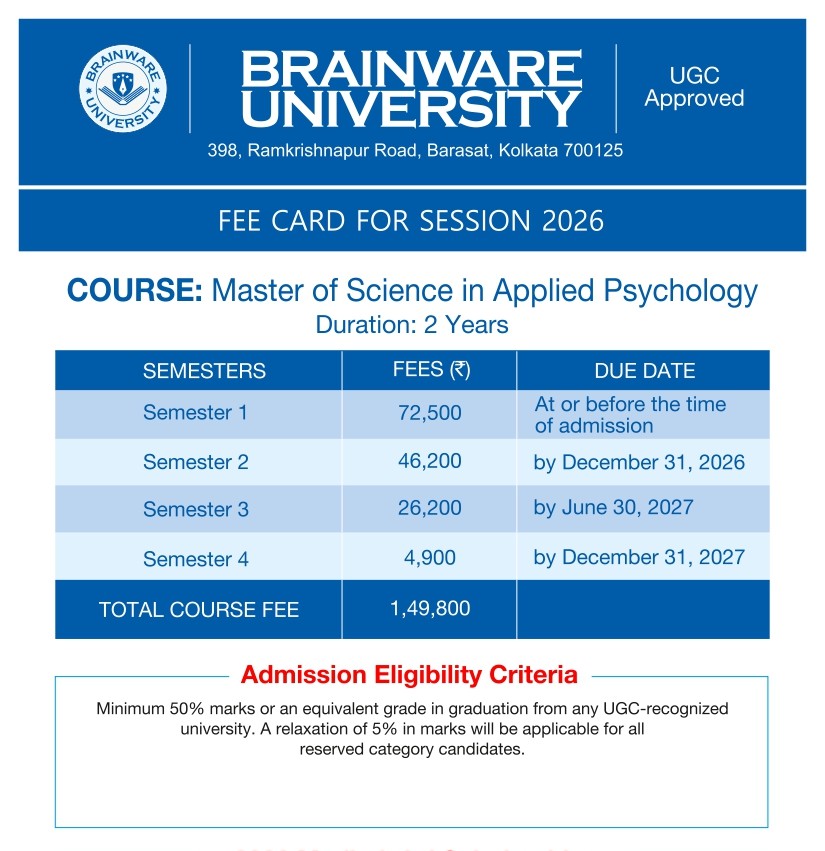
The M.Sc Psychology fee structure at Brainware University is designed to support quality postgraduate education in applied psychology, counselling, psychological assessment, research methods, behavioural science, and mental health studies. The fee generally covers academic instruction, practical learning, laboratory exposure, field-based activities, research guidance, student support, and placement-oriented preparation as per university norms.
| Semesters | Semester 1 | Semester 2 | Semester 3 | Semester 4 | Semester 5 | Semester 6 | Semester 7 | Semester 8 | Semester 9 | Semester 10 | Total |
|---|---|---|---|---|---|---|---|---|---|---|---|
| Fees (INR) | 72500 | 46200 | 26200 | 4900 | 1,49,800 |
**Fees are subject to change, and the application fee of ₹5,000 is non-refundable under any circumstances. Please contact us for further details.
Scholarships(Fees): Brainware University offers merit-based scholarships for top performers and financial aid for deserving students. Scholarships are available for high scorers in entrance exams, board results, and outstanding achievements in innovation or research. Visit our scholarship page for more details.
**Please note that the Brainware Vidyalankar Scholarship is available only to students who passed their qualifying examination in the current admission year. Also, eligibility is strictly restricted to Indian nationals; international students are not eligible to apply.
AI-driven psychology education helps students understand how data, digital tools, and intelligent systems are changing mental health support, psychological research, workplace wellness, learning analytics, and behavioural assessment. In applied psychology, AI can support screening, research analysis, digital counselling workflows, mental health awareness, and evidence-based intervention planning.
The programme helps students understand both the possibilities and limits of AI in psychology. Technology can support data analysis and service access, but human empathy, ethics, confidentiality, professional judgment, and responsible practice remain central to psychological work.
AI and digital innovation are relevant in areas such as:

The end-to-end AI learning spectrum in MSc Psychology covers the responsible use of digital tools from data collection and assessment support to interpretation, intervention planning, follow-up, and research reporting. Students learn how technology can assist psychological practice while respecting privacy, consent, ethics, and human dignity.
This learning approach helps students understand how psychology professionals can use technology without replacing the human relationship at the centre of counselling and mental health work.
Key learning areas include:



Key academic strengths include:
When comparing psychology colleges, students should check:
The placement scoreboard for M.Sc Psychology reflects the programme’s career focus across counselling, mental health support, HR, research, education, wellness, social work, and community outreach. Students are trained for interviews, communication tasks, case-based discussions, research presentations, and role-specific placement processes.


M.Sc Psychology placement support at Brainware University helps students prepare for careers in mental health support, counselling, education, community outreach, HR, research, wellness, and allied healthcare roles. The programme encourages students to develop strong communication skills, ethical awareness, assessment knowledge, research ability, and practical confidence.


Brainware University has earned an AA+ rating in India’s Best Engineering Institutes by Careers360. The recognition reflects the University’s strength in academic quality, faculty, infrastructure, research, and student outcomes, reinforcing its position as a trusted destination for industry-aligned engineering education.

Brainware University has been ranked No. 1 Engineering College under a Private University in West Bengal in the IIRF Rankings 2026. The recognition highlights the University’s strength in engineering education, industry-focused learning, research, emerging technologies, and placement outcomes.

Brainware University has been ranked No. 2 Private University in West Bengal by uniRank 2026, marking another recognition of the University's growing presence in the state's higher education landscape.
Brainware University's inclusion in the Times Higher Education (THE) Impact Rankings 2025 reflects its contribution to the UN Sustainable Development Goals (SDGs) through education, innovation, sustainability, community engagement, and responsible institutional practices.

Brainware University has been recognised as the Best Private University of West Bengal in Infrastructure & Placement at Times Now.in – Leaders of Excellence: East 2026, celebrating its commitment to world-class infrastructure and career-focused education.

Brainware University has been recognised by The Times Group for excellence across Engineering (Placement), Law, and MBA Studies. The honours reflect the University’s multidisciplinary strength and its focus on career-oriented, industry-relevant education.

Brainware University received the ABP Ananda Shiksha Samman 2026 for Excellence in Placement & AI-Integrated Academic Infrastructure, acknowledging its emphasis on placement opportunities alongside technology-enabled academic development.

Brainware University has been honoured with the Zee 24 Ghanta Education Excellence Award 2026 for Best Industry Placement & Academic Infrastructure, continuing its recognition in 2022, 2023, 2024, 2025, and 2026. The University was also recognised in 2017 and 2018 for its job-oriented academic initiatives.

Brainware University received the TV9 Uttaran Academic Excellence Honour for Excellence in Placement & AI-Integrated Academic Infrastructure, highlighting its focus on combining career opportunities with an AI-enabled academic and learning environment.

Brainware University was honoured with the R Bangla Sikkha Gourab Samman 2026, recognising its contribution to higher education and continued pursuit of academic excellence and career-focused learning.

Brainware University was honoured as the Best Private University in West Bengal at the Times Now in Business Excellence Awards (East) 2025, recognising its academic quality, modern infrastructure, industry engagement, and focus on student success.

Brainware University was recognised as the Leading University in Infrastructure, Academics & Placement at the Times Business Awards West Bengal 2025, highlighting its strong campus facilities, academic ecosystem, and placement performance across disciplines.

The MSc Applied Psychology syllabus is designed to build postgraduate-level knowledge of human behaviour, mental processes, counselling, psychological assessment, research methods, clinical foundations, developmental psychology, health psychology, organisational behaviour, and community mental health. The curriculum combines theoretical learning with applied practice, field exposure, and research-oriented training.
The syllabus prepares students to understand psychological concepts, assess behavioural patterns, support mental wellness, conduct research, and apply psychology in education, healthcare, workplaces, communities, and social service settings.
The core foundation modules in MSc Psychology help students develop strong academic understanding of psychological theories, research methods, assessment principles, counselling skills, and human development. These subjects build the base required for applied psychology practice and higher studies.
Core learning areas include:
These foundation areas help students connect psychological theory with professional practice and research.
The evolving and high-growth areas in MSc Psychology prepare students for emerging opportunities in mental health support, counselling, workplace wellness, child development, behavioural research, digital mental health, rehabilitation, and community care. These areas are becoming increasingly important as society gives greater attention to mental well-being and emotional resilience.
Advanced learning areas include:
These modules help students build practical readiness for psychology-related careers in healthcare, education, HR, community development, and research.
| Semester | Course |
|---|---|
| Semester I | Research Methodology & Ethics |
| Applied Cognitive Psychology & Neuropsychology | |
| Theories of Personality and its Applications | |
| Applied Social Psychology and Communication | |
| Applied Cognitive Psychology and Personality Lab | |
| Applied Social Psychology Lab | |
| Semester II | Counseling Psychology |
| Psychometry and Statistics in Applied Psychology | |
| Psychotherapeutic and Counselling Skills | |
| Internship | |
| Elective: Clinical Psychology / Industrial and Organizational Psychology / MOOC | |
| Elective Lab: Clinical Interview and Assessment Lab / Client Interview and Selection Lab | |
| Literature Review-Based Project | |
| Professional Communication, Collaboration, and Career Skills | |
| Semester III | Project |
| Professional Practice | |
| Semester IV | Dissertation |
Please note that the syllabus is subject to modification. Visit our Syllabus page for the elective subject details and updated syllabus.

MSc Psychology graduates can work in private-sector roles across counselling centres, schools, hospitals, mental health clinics, rehabilitation centres, corporate HR teams, wellness organisations, research agencies, NGOs, and social service organisations. Career growth depends on counselling skills, assessment knowledge, ethical awareness, internship exposure, and further professional training.
Students with strong communication skills, empathy, assessment awareness, research ability, field exposure, and professional ethics are better positioned for psychology-related roles.
MSc Psychology graduates may explore government and public-sector opportunities in public health, education, rehabilitation, correctional services, child welfare, social justice, community mental health, research, and public counselling projects. These roles often require psychological knowledge, communication skills, documentation ability, and awareness of social and mental health systems.
Candidates should check official recruitment notifications, eligibility rules, examination patterns, and organisation-specific requirements.
MSc Psychology career prospects are strong for students who want to work in mental health support, counselling, research, education, HR, social work, community outreach, and wellness. A Master of Science in Applied Psychology gives graduates a deeper understanding of behaviour, assessment, intervention, research, and ethical psychological practice.
| Area of Opportunity | Why It’s in Demand |
|---|---|
| Senior Psychologist | Expert Intervention & Leadership: Required to handle complex clinical cases, provide advanced therapeutic interventions such as CBT or DBT, and lead teams of junior counsellors in hospitals or private practice. |
| Child Support Specialist | Early Intervention Focus: High demand due to rising awareness of childhood developmental disorders such as ADHD and autism, along with the need for specialised emotional and academic support for children. |
| Community Relations Officer | Systemic Social Change: Essential for building connections between organisations and the public, managing outreach programmes, and addressing mental health concerns at the community level. |
| Social Worker | Vulnerable Population Support: Crucial for providing counselling and resources to individuals in crisis, helping them navigate welfare systems, and supporting people affected by trauma, poverty, or domestic issues. |
| Lifestyle Coach | Preventive Wellness: Growing demand for non-clinical, goal-oriented guidance that helps individuals improve behaviour, manage stress, and achieve better work-life balance through psychological techniques. |
| Senior Psychological Consultant | Corporate & Strategic Advisory: Hired by organisations to develop workplace wellness policies, improve employee retention, and provide expert psychological insights for legal or organisational strategy. |
| Health Educator | Behavioural Health Literacy: Needed to design public health campaigns that promote healthy lifestyles, reduce stigma around mental illness, and teach preventive mental health practices to the public. |
The career scope after MSc Psychology depends on the student’s specialisation, practical exposure, counselling skill, research work, internship record, ethical awareness, and communication ability. Graduates who combine psychological knowledge with empathy, assessment skills, research methods, and field experience can build meaningful careers across healthcare, education, HR, social service, and wellness sectors.
The job market for MSc Psychology graduates is expected to grow steadily from 2025 to 2032 as mental health awareness, workplace wellness, school counselling, community support, digital mental health, and behavioural research become more important. Demand will rise for trained professionals who can support emotional well-being, assessment, counselling, research, and intervention planning.
Global and Indian career trends indicate a stronger need for mental health and behavioural science professionals. WHO reported in 2025 that more than 1 billion people live with mental health disorders, while international labour projections show continued growth for psychology-related careers. This creates long-term relevance for students trained in applied psychology, counselling, research, and mental wellness.
Psychology career growth will be driven by rising mental health awareness, workplace stress, child and adolescent support needs, ageing populations, digital counselling, community mental health programmes, and demand for evidence-based behavioural interventions. Organisations will need professionals who understand both human behaviour and ethical support systems.
Major growth drivers include:
The fastest-growing roles for MSc Psychology graduates will include Counsellor, Mental Health Support Worker, Child Support Specialist, School Counselling Assistant, HR and Wellness Executive, Research Assistant, Behaviour Analyst, Community Mental Health Worker, Rehabilitation Support Professional, and Health Educator. These roles require empathy, communication, assessment awareness, documentation, and ethical practice.
High-growth career roles include:
MSc Psychology graduates will find opportunities in sectors that need behavioural understanding, counselling support, research skills, people management, and mental wellness services. Hiring is expected across healthcare, education, corporate, NGO, research, and community development spaces.
Key hiring industries include:
The most valuable psychology skills from 2025 to 2032 will include counselling communication, psychological assessment awareness, research methods, ethical practice, empathy, active listening, case documentation, data interpretation, crisis support, and digital mental health awareness. Employers will prefer candidates with practical exposure and responsible professional conduct.
Important skill areas include:
The growth outlook for MSc Psychology graduates is positive because mental health and behavioural well-being are now recognised as essential parts of education, healthcare, workplaces, and communities. By 2032, the strongest opportunities will favour students with practical training, supervised exposure, research experience, and strong ethical awareness.
Students should focus on building:
The future psychology job market will reward students who can combine academic understanding with human sensitivity, practical exposure, and ethical responsibility. Employers will seek professionals who can support people with care, communicate clearly, understand behavioural patterns, and work responsibly within professional boundaries.
For students choosing a psychology master degree or masters in psychology universities, the focus should be on curriculum quality, faculty mentorship, internship exposure, psychology lab facilities, field visits, research training, and placement support. Brainware University’s MSc Applied Psychology programme is structured to support these academic and career needs for students aiming at psychology careers from 2025 onwards.


MSc Psychology admission 2026 at Brainware University is open to eligible graduates who want advanced postgraduate training in applied psychology, counselling, psychological assessment, research methods, mental health, and behavioural science. Applicants should review eligibility, BET requirements, application steps, counselling process, fees, scholarships, and required documents before applying.
Admission Criteria: Admission to M.Sc Applied Psychology is based on academic eligibility and university admission norms. Candidates must have completed graduation or an equivalent degree from a UGC-recognised university with the required minimum marks. Admission is based on performance in BET, the Brainware Entrance Test.
Application: Candidates can apply online by filling up the enquiry or application form on the Brainware University website. Applicants need to provide their name, course preference, location, phone number, email ID, and academic details. After submission, the admission counselling team will guide them through the next steps.
Entrance Exam: Admission to the M.Sc Psychology programme is based on BET, the Brainware Entrance Test conducted by the university for postgraduate admission. Candidates should confirm the current BET schedule, mode, syllabus, and selection requirements with the admission office before applying.
Counselling: After application and eligibility review, shortlisted candidates receive counselling support from the university admission team. Counselling helps students understand the MSc Psychology course, eligibility, fees, subjects, scholarship options, placement scope, documents required, and final admission steps.
Direct Admission: Direct admission may be available for eligible candidates as per university norms, seat availability, and admission criteria. Students seeking MSc Psychology admission 2026, MSc Applied Psychology admission, or masters in psychology courses should contact the admission counsellor to confirm eligibility, BET requirements, documents, fee details, and the latest admission procedure.
Please follow the given MSc Psychology Admission Procedure in Brainware University:

"Brainware students are professionally and technically well-informed as freshers. We are impressed with the level of confidence and positive attitude they demonstrated during their interviews."
Mr. Vaskar Bhattacharya Regional Head-East, Ginnisystems Ltd.
We always find competent and positive students who are almost ready to be professionals. We never get disappointed wherever we come for the recruitment. Well done Brainware University!
Ms. Srimoyee Mukherjee Manager HR Nature Technologies Pvt. Ltd.
The Department of Psychology at Brainware University supports applied learning through academic activities, expert sessions, workshops, outreach programmes, mental wellness initiatives, clinical exposure, field visits, and research-oriented learning. These activities help students connect psychological theory with real-life contexts in counselling, mental health awareness, community support, and behavioural science.
https://www.brainwareuniversity.ac.in/departments/psychology/activities.php
The M.Sc. in Applied Psychology programme focuses on the practical application of psychological theories, principles, and research methods in professional settings. It equips students with advanced knowledge and skills in areas such as counselling psychology, clinical foundations, organisational psychology, health psychology, psychological assessment, and behavioural research.
Students should choose Brainware University for MSc in Applied Psychology in 2026 because the programme provides a strong foundation in psychological theories, counselling approaches, clinical perspectives, research methods, testing, assessment, and applied mental health practices. With practical training, supervised exposure, a 98% placement rate across courses, 1000+ recruiters, and career support, Brainware University helps students prepare for roles in counselling centres, schools, hospitals, NGOs, HR settings, research, and further professional training.
Eligibility requirements vary across universities. Applicants generally need a bachelor’s degree in psychology or a related discipline from a recognised institution. Some universities may also prescribe minimum marks, entrance examinations, personal interviews, or additional academic requirements.
The curriculum typically includes psychological assessment, research methodology, statistics for psychology, ethics, psychopathology, counselling skills, cognitive psychology, developmental psychology, social psychology, health psychology, and behavioural intervention concepts. Electives may cover organisational, forensic, clinical, or community psychology.
Graduates may explore roles in counselling support, mental health services, behavioural research, human resources, employee wellness, rehabilitation, education, community outreach, and social welfare. They may work in hospitals, clinics, educational institutions, corporate organisations, NGOs, research institutes, and public health projects, subject to role-specific qualification norms.
Many institutions offer internships, supervised fieldwork, practical placements, case-study-based learning, psychological assessment practice, and community outreach opportunities. These experiences help students apply theoretical knowledge in real-world settings under professional guidance.
Some universities may offer part-time, blended, or online study options. Availability depends on the institution, programme structure, practical training requirements, and applicable academic regulations. Applicants should verify the current mode of delivery directly with the university.
The M.Sc. in Applied Psychology programme is generally completed in 2 years across 4 semesters. Programme duration may differ for part-time, online, accelerated, or institution-specific formats.
Students develop skills in psychological assessment, research design, data analysis, counselling communication, observation, case documentation, ethical practice, interpersonal communication, critical thinking, behavioural interpretation, and evidence-based decision-making.
Some universities may accept applicants from related academic disciplines, while others require a bachelor’s degree in psychology. Additional foundation courses, entrance requirements, or prerequisite subjects may apply. Candidates should check the specific eligibility rules of the institution.
Students can review the official university website for information about eligibility, fees, curriculum, faculty, admission dates, scholarships, practical training, and career support. They may also contact the university’s admission office or programme coordinator for clarification.
M.Sc. in Applied Psychology is a postgraduate programme that focuses on applying psychological theories and research to areas such as mental health, counselling, education, human resources, healthcare, rehabilitation, workplace wellness, and community support.
Students should compare curriculum quality, faculty experience, psychology laboratories, mental wellness exposure, research opportunities, internships, fieldwork, university recognition, and placement support. Brainware University offers an industry-relevant M.Sc. in Applied Psychology programme with practical learning, faculty mentorship, research exposure, and career preparation.
Applicants generally need a bachelor’s degree in psychology or an eligible related discipline from a recognised institution. Admission may be based on academic merit, a university entrance examination, an interview, or other criteria prescribed by the institution.
The curriculum may include cognitive psychology, counselling psychology, clinical psychology foundations, psychological assessment, developmental psychology, psychopathology, research methodology, statistics, health psychology, community psychology, ethics, and behavioural intervention concepts.
The programme has a duration of 2 years and is generally divided into 4 semesters.
Graduates may pursue roles such as Counsellor, Mental Health Support Worker, Child Support Specialist, Behaviour Analyst, HR and Wellness Executive, Research Assistant, Rehabilitation Support Professional, Community Outreach Coordinator, School Counselling Assistant, and Health Educator. Eligibility requirements vary by role and organisation.
Salary depends on the candidate’s role, qualifications, practical experience, specialisation, employer, location, and professional credentials. Career growth may improve with supervised experience, additional certifications, research exposure, and higher qualifications.
Graduates may explore opportunities in hospitals, mental health clinics, counselling centres, schools, colleges, universities, corporate HR departments, employee wellness teams, NGOs, rehabilitation centres, child development centres, research institutes, public health projects, and digital mental health platforms.
Candidates should revise psychological assessment concepts, counselling communication, research methods, ethics, confidentiality, case documentation, mental health awareness, referral procedures, and behavioural analysis. They should also be prepared to discuss internships, fieldwork, research projects, and case-based scenarios.
Yes. The programme can support diverse career pathways in mental health services, counselling support, education, workplace wellness, human resources, rehabilitation, community outreach, research, and higher studies. Career options depend on the graduate’s qualifications, practical training, specialisation, and applicable professional norms.
Important skills include empathy, active listening, rapport building, observation, psychological assessment awareness, research methodology, data interpretation, ethical judgement, report writing, critical thinking, problem-solving, and professional communication.
Students should develop an academic understanding of psychological assessment principles, test selection, administration, scoring, interpretation, validity, reliability, ethics, and reporting. The use of specific clinical tests may require supervised training, certification, or professional authorisation.
Students can improve their skills through supervised internships, role-playing exercises, workshops, case discussions, active-listening practice, fieldwork, reflective learning, and training under qualified mental health professionals. Independent therapeutic practice may require additional professional qualifications and registration.
Relevant certificate courses may include psychological first aid, counselling skills, child and adolescent support, workplace wellness, research methods, crisis intervention, rehabilitation support, and mental health awareness. Students should choose programmes offered by credible institutions and verify whether additional qualifications are required for specialised practice.
A strong resume should highlight internships, fieldwork, research projects, dissertation work, psychological assessment exposure, counselling skills, workshops, certificate courses, community outreach, report writing, presentations, and relevant professional competencies.
AI supports psychological research through data coding, behavioural pattern analysis, sentiment analysis, literature mapping, digital screening tools, and predictive research models. Its use must involve informed consent, privacy protection, bias monitoring, ethical oversight, and qualified human supervision.
Emerging trends include digital mental health, tele-counselling awareness, workplace wellness, child and adolescent mental health, community-based interventions, behavioural analytics, mindfulness-based support, neuropsychological research, trauma-informed practice, and evidence-based psychological services.
Applied psychology supports employee engagement, workplace wellness, leadership development, conflict resolution, motivation, team building, organisational behaviour, talent assessment, stress management, and employee assistance programmes.
Forensic psychology-related opportunities may exist in correctional support, rehabilitation programmes, behavioural research, victim support, legal consultation, and community services. Specialised roles may require additional qualifications, supervised training, registration, and compliance with professional eligibility norms.
Psychology contributes to healthcare through mental health support, behavioural assessment, stress management, rehabilitation, patient counselling, treatment adherence, lifestyle modification, pain management, community health awareness, and support for individuals and families coping with illness.