98%
Placed
in 2025






Brainware University transformed me, fostering confidence and capability for conquering the world.
Master of Science in Nutrition & Dietetics is a 2-year postgraduate programme focused on clinical nutrition, diet therapy, public health nutrition, food science, nutritional biochemistry, food safety, sports nutrition, community nutrition, and research. The course prepares graduates for careers in hospitals, wellness centres, food companies, public health organisations, research institutions, fitness centres, and nutrition consulting.
The MSc Nutrition and Dietetics course at Brainware University combines academic learning with diet planning, laboratory work, case studies, field exposure, nutritional assessment, research, and internship-based training. Applicants will find complete information on this page about MSc Nutrition and Dietetics eligibility, fees, admission, syllabus, career options, placement support, and practical learning.
The applicants for MSc Food Nutrition and Dietetics will find all the programme relevant information on this page, including programme overview, career scopes, syllabus outline, duration, eligibility and admission as well as learning features.
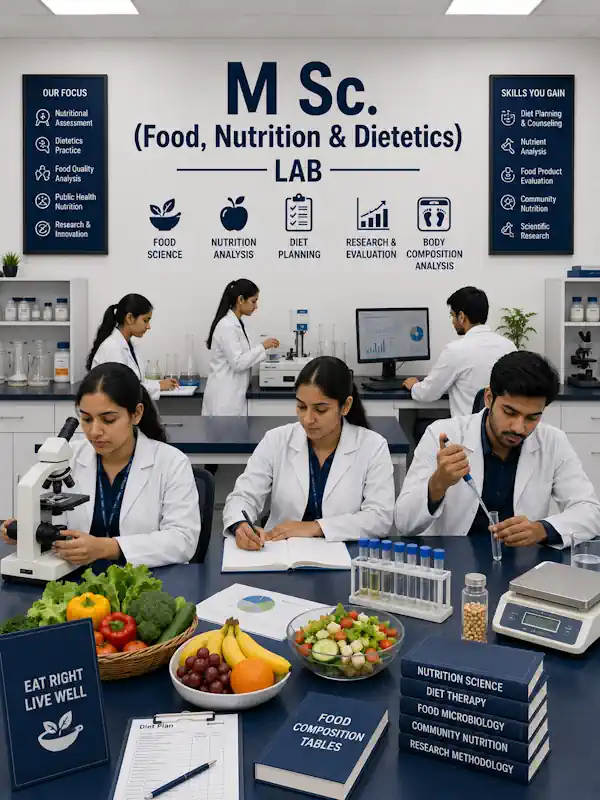

MSc Nutrition and Dietetics at Brainware University is a 2-year postgraduate programme that develops advanced knowledge of food science, clinical nutrition, therapeutic diets, public health, nutritional assessment, food safety, sports nutrition, and diet counselling.
| Programme | Master of Science in Nutrition & Dietetics |
|---|---|
| Duration | 2 years |
| Focus Areas | Clinical Nutrition, Diet Therapy, Food Science, Nutritional Biochemistry, Public Health Nutrition, Community Nutrition, Sports Nutrition, Food Microbiology, Food Safety, Nutritional Assessment, Meal Planning, Maternal and Child Nutrition, Research Methodology, Food Quality Control, and Wellness Management. |
| Salary | MSc Nutrition and Dietetics graduates may explore entry-level salary packages commonly ranging from ₹3 LPA to ₹6 LPA, depending on practical skills, internship experience, employer type, specialisation, location, and interview performance. Career growth may improve in clinical dietetics, sports nutrition, food quality, research, corporate wellness, and private consulting. |
| Popular Job Types | Clinical Dietitian, Nutritionist, Public Health Nutritionist, Sports Nutritionist, Diet Consultant, Food Quality Analyst, Nutrition Research Associate, Wellness Coach, Community Nutrition Officer, Nutrition Educator, Food Safety Executive, Health Programme Coordinator, and Nutrition Content Specialist. |
| Hiring Industries | Hospitals, healthcare organisations, wellness clinics, fitness centres, food manufacturing companies, public health agencies, NGOs, research institutions, sports organisations, nutraceutical companies, schools, corporate wellness firms, diagnostic centres, maternity clinics, and government nutrition programmes. |
| Top Recruiters | Graduates may find opportunities with hospitals, food companies, wellness organisations, public health bodies, fitness centres, NGOs, healthcare startups, nutrition consultancies, research institutions, and food-testing laboratories. Recruiter participation varies by year, student profile, internship record, and placement cycle. |
| Specializations | Clinical Nutrition, Therapeutic Dietetics, Sports Nutrition, Public Health Nutrition, Community Nutrition, Food Safety, Food Quality Control, Maternal and Child Nutrition, Nutraceuticals, Wellness Nutrition, Nutrition Research, and Diet Counselling. |
| Higher Studies | Graduates may pursue PhD programmes in Nutrition, Dietetics, Food Science, Public Health, Clinical Nutrition, Biochemistry, Community Nutrition, or related interdisciplinary areas. They may also undertake certifications in sports nutrition, diabetes education, food safety, HACCP, clinical nutrition, wellness coaching, and nutritional counselling. |
| Benefits | The programme develops advanced knowledge of diet planning, disease-specific nutrition, food safety, nutritional assessment, counselling, research, and public health. It is suitable for students seeking MSc Nutrition, MSc Dietetics, MSc Food and Nutrition, or a master degree in Nutrition and Dietetics. |
| Internship and Placement | Students receive exposure to hospital internships, diet-planning assignments, clinical case studies, community nutrition projects, laboratory work, research activities, pre-placement preparation, interview support, and placement assistance. |
| Location | Brainware University, Barasat, Kolkata, West Bengal. |
| Approvals & Recognition | Brainware University is a UGC-recognised university. The MSc Nutrition and Dietetics programme is offered under the university’s academic framework and applicable higher-education norms. Applicants should verify the latest programme recognition and curriculum details through official university sources. |
Key reasons to study MSc Nutrition and Dietetics include:

Educational Qualification: Candidates must hold a B.Sc. degree in Biological Sciences or Chemistry from a UGC-recognized university.
Minimum Marks: Applicants are required to secure a minimum of 50% marks in the qualifying examination. A relaxation of 5% in marks is applicable for candidates belonging to reserved categories, as per university norms.
Admission Process: Admission to the M.Sc. in Nutrition & Dietetics programme at Brainware University is conducted according to the university's admission guidelines and eligibility criteria.
Brainware University offers the M.Sc. in Nutrition & Dietetics programme at an affordable fee structure, enabling students to gain advanced knowledge and practical expertise in nutrition, diet planning, public health, and clinical nutrition. The programme combines academic excellence with hands-on learning to prepare graduates for diverse careers in healthcare and wellness sectors.
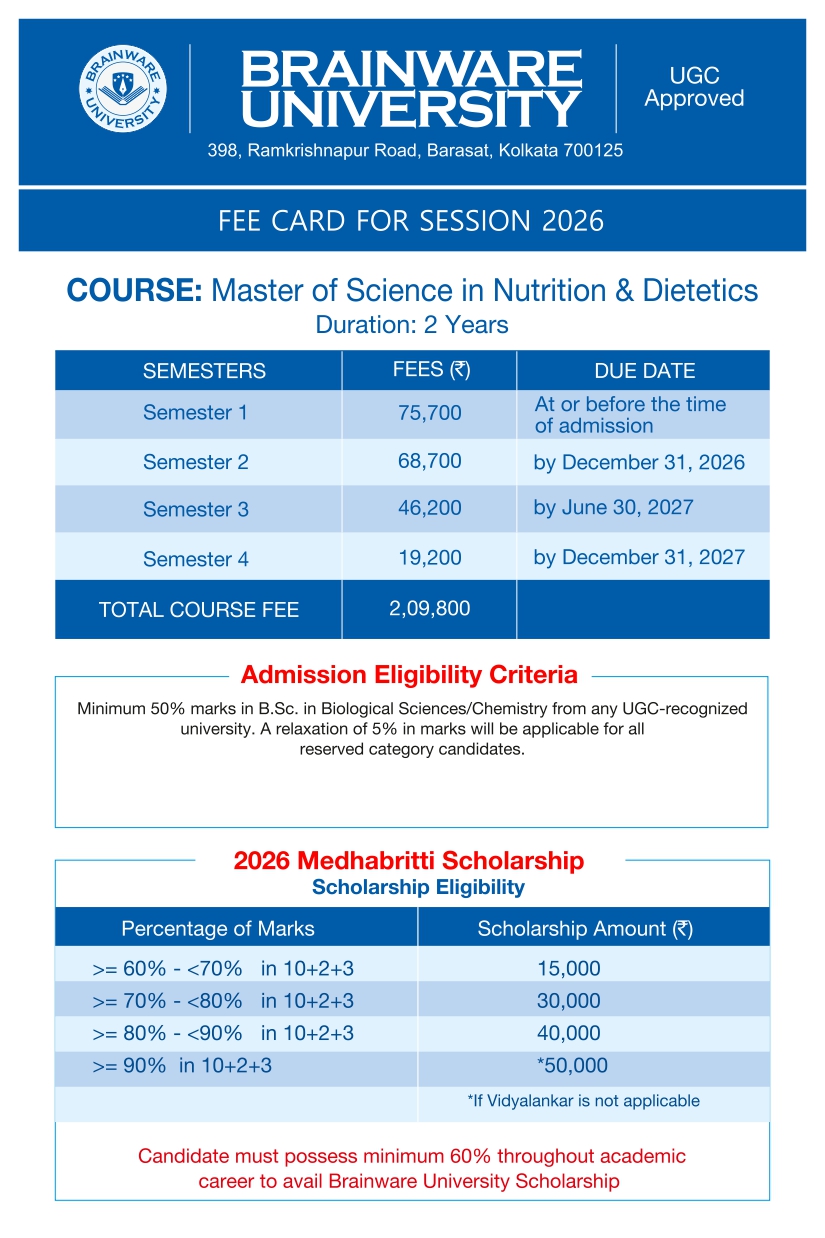
The MSc Nutrition and Dietetics fee structure at Brainware University is designed to support postgraduate education in clinical nutrition, food science, public health, diet planning, research, food safety, and laboratory-based learning. The fee generally covers academic instruction, practical work, case studies, research guidance, student support, and placement-oriented preparation.
| Semesters | Semester 1 | Semester 2 | Semester 3 | Semester 4 | Semester 5 | Semester 6 | Semester 7 | Semester 8 | Semester 9 | Semester 10 | Total |
|---|---|---|---|---|---|---|---|---|---|---|---|
| Fees (INR) | 75700 | 68700 | 46200 | 19200 | 2,09,800 |
**Fees are subject to change, and the application fee of ₹5,000 is non-refundable under any circumstances. Please contact us for further details.
Scholarships(Fees): Brainware University offers merit-based scholarships for top performers and financial aid for deserving students. Scholarships are available for high scorers in entrance exams, board results, and outstanding achievements in innovation or research. Visit our scholarship page for more details.
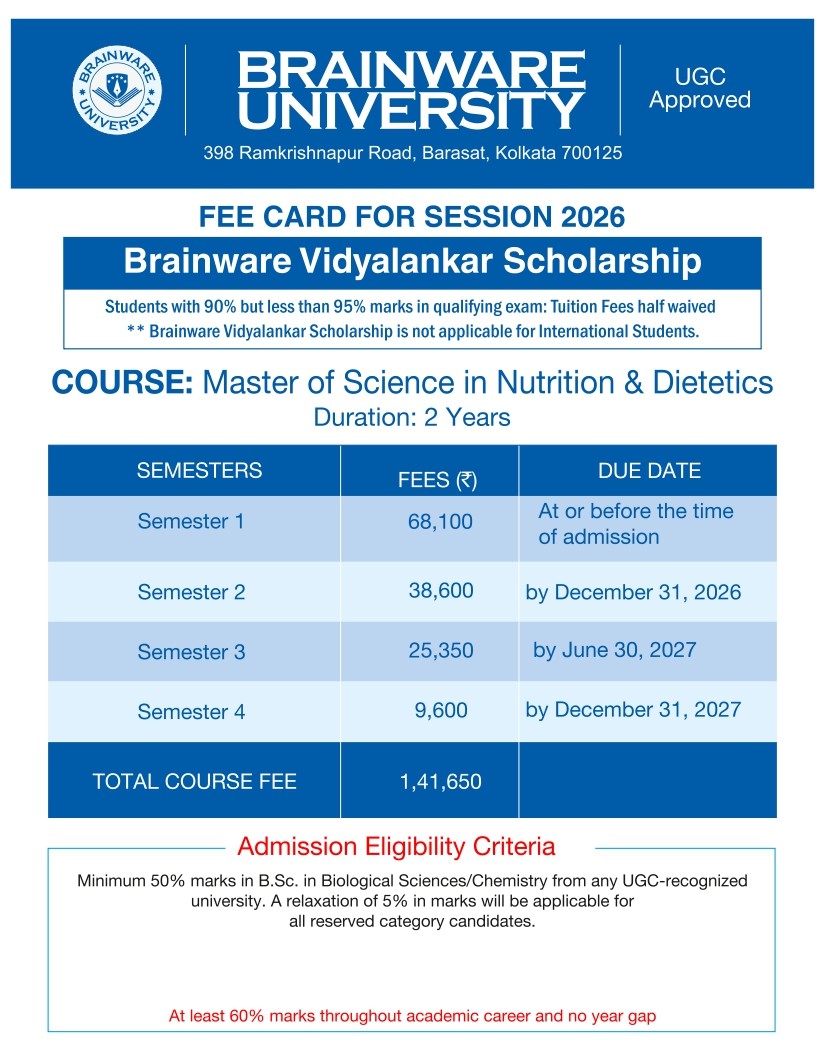
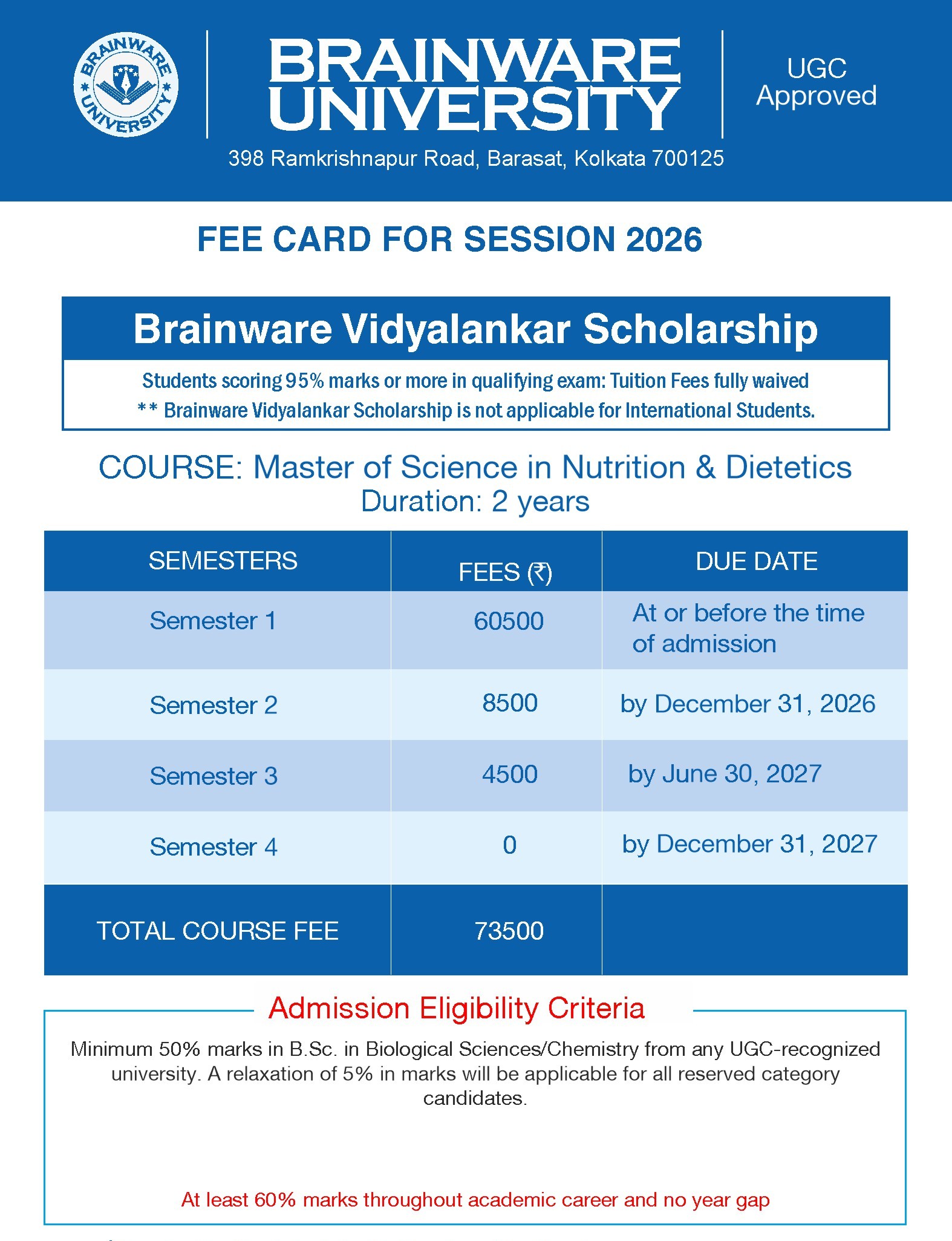
**Please note that the Brainware Vidyalankar Scholarship is available only to students who passed their qualifying examination in the current admission year. Also, eligibility is strictly restricted to Indian nationals; international students are not eligible to apply.
AI and digital tools are changing nutrition practice through personalised meal planning, dietary tracking, health-risk assessment, food databases, remote counselling, wearable devices, and nutrition analytics. MSc Nutrition students need to understand how technology supports evidence-based diet planning while maintaining professional judgment, patient privacy, and ethical care.
Digital tools can help nutrition professionals assess food intake, monitor progress, compare nutrient values, and manage large amounts of health data. They do not replace clinical assessment, cultural understanding, behavioural counselling, or personalised human guidance.
AI and digital innovation are relevant in areas such as:

The end-to-end AI learning spectrum in MSc Nutrition and Dietetics covers the full nutrition-care process from assessment and diagnosis to diet planning, counselling, monitoring, evaluation, and reporting. Students learn how digital tools support each stage while professional interpretation remains essential.
Key learning areas include:

Key academic strengths include:
When comparing colleges, students should check:



Brainware University has earned an AA+ rating in India’s Best Engineering Institutes by Careers360. The recognition reflects the University’s strength in academic quality, faculty, infrastructure, research, and student outcomes, reinforcing its position as a trusted destination for industry-aligned engineering education.

Brainware University has been ranked No. 1 Engineering College under a Private University in West Bengal in the IIRF Rankings 2026. The recognition highlights the University’s strength in engineering education, industry-focused learning, research, emerging technologies, and placement outcomes.

Brainware University has been ranked No. 2 Private University in West Bengal by uniRank 2026, marking another recognition of the University's growing presence in the state's higher education landscape.
Brainware University's inclusion in the Times Higher Education (THE) Impact Rankings 2025 reflects its contribution to the UN Sustainable Development Goals (SDGs) through education, innovation, sustainability, community engagement, and responsible institutional practices.

Brainware University has been recognised as the Best Private University of West Bengal in Infrastructure & Placement at Times Now.in – Leaders of Excellence: East 2026, celebrating its commitment to world-class infrastructure and career-focused education.

Brainware University has been recognised by The Times Group for excellence across Engineering (Placement), Law, and MBA Studies. The honours reflect the University’s multidisciplinary strength and its focus on career-oriented, industry-relevant education.

Brainware University received the ABP Ananda Shiksha Samman 2026 for Excellence in Placement & AI-Integrated Academic Infrastructure, acknowledging its emphasis on placement opportunities alongside technology-enabled academic development.

Brainware University has been honoured with the Zee 24 Ghanta Education Excellence Award 2026 for Best Industry Placement & Academic Infrastructure, continuing its recognition in 2022, 2023, 2024, 2025, and 2026. The University was also recognised in 2017 and 2018 for its job-oriented academic initiatives.

Brainware University received the TV9 Uttaran Academic Excellence Honour for Excellence in Placement & AI-Integrated Academic Infrastructure, highlighting its focus on combining career opportunities with an AI-enabled academic and learning environment.

Brainware University was honoured with the R Bangla Sikkha Gourab Samman 2026, recognising its contribution to higher education and continued pursuit of academic excellence and career-focused learning.

Brainware University was honoured as the Best Private University in West Bengal at the Times Now in Business Excellence Awards (East) 2025, recognising its academic quality, modern infrastructure, industry engagement, and focus on student success.

Brainware University was recognised as the Leading University in Infrastructure, Academics & Placement at the Times Business Awards West Bengal 2025, highlighting its strong campus facilities, academic ecosystem, and placement performance across disciplines.

The MSc Nutrition and Dietetics syllabus is designed to build advanced knowledge of human nutrition, diet therapy, food science, public health, nutritional biochemistry, food microbiology, food safety, research methods, and counselling.
The curriculum combines theory, laboratory learning, case studies, fieldwork, research, and internships so that students can apply nutrition science in healthcare, food industries, wellness, sports, and public health.
Core subjects build the scientific and practical base required for advanced nutrition and dietetics practice.
Core learning areas include:
The evolving areas in nutrition prepare students for personalised nutrition, sports dietetics, nutrigenomics, gut-health research, digital nutrition, functional foods, and sustainable food systems.
Advanced learning areas include:
FSSAI regulations cover areas such as health supplements, nutraceuticals, foods for special dietary use, foods for special medical purposes, probiotics, prebiotics, and novel foods, making regulatory and product-awareness skills increasingly relevant.
| Semester | Course |
|---|---|
| Semester I | Research Methodology and Ethics / MOOC |
| Advanced Food Science and Nutrition | |
| Advanced Medical Biochemistry | |
| Biomedical Physiology and Molecular Pathophysiology | |
| Advanced Enteral and Parenteral Nutrition | |
| Advanced Food Science and Nutrition Lab | |
| Semester II | Industrial Management and Entrepreneurship |
| Nutrition Science and Immunology | |
| Advanced Food Microbiology / Advanced Food Biotechnology / Advanced Food Processing / MOOC | |
| Internship | |
| Advanced Nutrition Studies | |
| Biostatistics | |
| Professional Communication, Collaboration, and Career Skills | |
| Semester III | Nutrigenetics and Nutrigenomics |
| Advances in Public Health Nutrition | |
| Applied Dietetics for Preventive and Clinical Care | |
| Nutrition Assessment Methods and Applications for Dietitians | |
| Project | |
| Semester IV | Dissertation |
Please note that the syllabus is subject to modification. Visit our Syllabus page for the elective subject details and updated syllabus.

MSc Nutrition and Dietetics graduates can work in private hospitals, wellness clinics, food companies, fitness centres, nutrition consultancies, sports organisations, nutraceutical firms, research bodies, and corporate wellness companies.
Graduates may explore government and public-sector opportunities in public health, nutrition programmes, hospitals, food safety, community health, education, research, and welfare schemes.
Candidates should review official recruitment notifications, examination rules, age limits, and role-specific eligibility requirements.
MSc Nutrition and Dietetics career prospects extend across hospitals, wellness, food industries, sports, public health, research, community nutrition, and private consulting. Graduates develop skills in diet planning, nutritional assessment, food safety, counselling, research, and disease-specific nutrition.
| Area of Opportunity | Why It’s in Demand |
|---|---|
| Clinical Dietitian | Hospitals and healthcare facilities require qualified professionals to develop nutrition plans and support patient recovery. |
| Nutritionist | Growing awareness of healthy lifestyles has increased demand for experts who can provide personalised dietary guidance. |
| Public Health Nutritionist | Government agencies and NGOs need nutrition professionals to address community health and nutrition challenges. |
| Sports Nutritionist | Athletes and fitness enthusiasts seek specialised nutrition advice to enhance performance and recovery. |
| Diet Consultant | Individuals and organisations rely on diet consultants for customised meal planning and wellness strategies. |
| Food Quality Analyst | Food manufacturers require professionals to ensure nutritional standards, quality control, and regulatory compliance. |
| Nutrition Research Associate | Research institutions and healthcare organisations need experts to contribute to nutrition and health-related studies. |
| Wellness Coach | The expanding wellness industry creates opportunities for professionals who promote healthy living and preventive healthcare. |
| Community Nutrition Officer | Community health programmes require specialists to design and implement nutrition awareness initiatives. |
| Nutrition Educator | Educational institutions and health organisations seek professionals who can teach and promote evidence-based nutrition practices. |
The career scope after MSc Nutrition and Dietetics depends on practical skills, internship exposure, counselling ability, research experience, specialisation, and professional development. Graduates who build expertise in clinical nutrition, sports nutrition, food quality, public health, or private practice can improve their career progression.
The job market for nutrition and dietetics graduates is expected to grow steadily from 2025 to 2032 as hospitals, wellness services, public health programmes, sports organisations, food companies, and digital health platforms increase their focus on preventive nutrition and personalised dietary care.
Employment of dietitians and nutritionists is projected to grow 6% from 2024 to 2034 in the United States, faster than the average for all occupations, with about 6,200 openings expected each year. While this is not an India-specific projection, it reflects wider demand for qualified nutrition professionals.
Career growth will be driven by rising lifestyle diseases, preventive healthcare, hospital expansion, sports nutrition, food safety, public health, personalised nutrition, and wellness services.
High-growth roles are likely to include Clinical Dietitian, Sports Nutritionist, Public Health Nutritionist, Wellness Coach, Food Quality Analyst, Nutrition Research Associate, Digital Nutrition Consultant, and Community Nutrition Officer.
The outlook is positive for graduates who combine scientific knowledge with practical diet-planning, counselling, research, and digital skills. Healthcare occupations overall are projected to grow much faster than the average from 2024 to 2034, supporting wider demand across allied healthcare roles.

Key features and learning outcomes include:

MSc Nutrition and Dietetics admission 2026 at Brainware University is open to eligible graduates who want advanced education in clinical nutrition, food science, diet therapy, public health, food safety, and research.
Admission Criteria: Candidates must hold a B.Sc degree in Biological Sciences or Chemistry from a UGC-recognised university and secure at least 50% marks in the qualifying examination. A 5% relaxation applies to reserved-category candidates according to university norms.
Application: Candidates can apply through the online enquiry or application form on the Brainware University website. Applicants must provide their name, programme preference, location, phone number, email address, and academic details.
Entrance Exam: Admission is conducted according to the university’s current eligibility and selection guidelines. Candidates should confirm whether an entrance examination, merit assessment, counselling process, or other requirement applies for the 2026 academic session.
Counselling: Eligible applicants receive counselling support from the university admission team. Counselling covers the MSc Nutrition and Dietetics course, eligibility, fees, syllabus, internship, scholarships, career scope, placement support, and required documents.
Direct Admission: Direct admission may be available according to eligibility, merit, seat availability, and university norms. Students seeking MSc Nutrition admission, MSc Dietetics admission, or MSc Nutrition and Dietetics admission should contact the admission office for the latest process.
Please follow the given MSc Nutrition and Dietetics Admission Procedure in Brainware University:

The Department of Food and Nutrition at Brainware University supports practical and research-oriented learning through workshops, health camps, food-analysis activities, nutrition-awareness programmes, expert sessions, community outreach, seminars, and student research.
https://www.brainwareuniversity.ac.in/departments/food-nutrition/activities.php
The MSc Nutrition and Dietetics program is a two-year course, spanning four semesters, offering in-depth knowledge in nutrition, dietetics, and food science.
Candidates must hold a Bachelor’s degree in science, preferably in nutrition, dietetics, home science, or related fields, to meet the eligibility requirements.
Graduates can pursue careers as Clinical Dietitians, Nutrition Consultants, Public Health Nutritionists, Food Safety Officers, Health and Wellness Coaches, and Research Scientists.
The fees for the MSc Nutrition and Dietetics program vary, and we recommend contacting Brainware University for the latest fee structure and any scholarship opportunities.
Yes, Brainware University has a dedicated placement cell that helps students with career counselling, interview preparation, and job placement in leading healthcare, food, and wellness organizations.
Brainware University's M.Sc. in Nutrition & Dietetics programme combines advanced academic learning with practical training in clinical nutrition, diet planning, public health, and wellness management. With experienced faculty, modern laboratory facilities, industry exposure, and research-oriented learning, students develop the skills needed for successful careers in healthcare, nutrition consulting, wellness, and research. The programme is further strengthened by the university's 98% placement record across programmes, providing graduates with excellent career opportunities.
The curriculum includes courses like Nutritional Biochemistry, Clinical Nutrition and Diet Therapy, Public Health Nutrition, Food Microbiology, and Food Safety, among others.
Yes, the program includes hands-on training through lab work, internships, and real-world case studies to prepare students for industry demands.
This program offers an advanced curriculum focused on clinical and public health nutrition, dietetics, and food science, combining practical and theoretical knowledge to prepare students for specialized roles in the field.
Candidates with a science background are encouraged to apply, though a Bachelor’s degree in nutrition, dietetics, or a related field is preferred.
Admissions for the MSc Nutrition and Dietetics program are open for the 2026 academic year. We encourage prospective students to apply early to secure their spot in this competitive program.
M.Sc. in Food, Nutrition & Dietetics is a postgraduate program focusing on human nutrition, diet planning, clinical nutrition, food science, and public health nutrition.
Brainware University offers a comprehensive M.Sc. program with industry-relevant training, expert faculty, and career-focused learning.
Admission is based on merit or entrance exams, depending on the university’s criteria. A B.Sc. in Nutrition, Dietetics, or related fields is usually required.
The course duration is 2 years (4 semesters).
Key subjects include Clinical Nutrition, Public Health Nutrition, Food Microbiology, Therapeutic Diets, Sports Nutrition, and Food Safety & Quality Control.
Graduates can work as Clinical Dietitians, Nutrition Consultants, Public Health Nutritionists, Sports Nutritionists, Food Safety Officers, and Research Analysts
The salary ranges from ₹4-12 LPA, depending on job role, experience, and location.
Top employers include hospitals, wellness clinics, food companies, NGOs, fitness centers, and research institutions.
Focus on nutritional science concepts, food safety regulations, patient case studies, and dietary counseling techniques
Highlight internships, research work, certifications in clinical nutrition, experience in food analysis, and diet planning projects.
Practice meal planning for different health conditions, track nutrient intake, and stay updated with dietary guidelines.
Learn nutrient analysis software like NutriCalc, MyFitnessPal, and WHO dietary guidelines.
Participate in hospital internships, community nutrition projects, food industry training, and clinical case studies.
Diet analysis, nutritional counseling, food safety knowledge, meal planning, and research-based food science expertise.
Follow nutrition research journals, attend dietetics conferences, and join professional organizations like the Indian Dietetic Association (IDA).
AI-powered meal planning, digital diet tracking apps, personalized nutrition programs, and predictive health analytics are shaping the industry.
Personalized nutrition, plant-based diets, functional foods, gut microbiome research, and sustainable food innovations are trending.
Sports nutrition focuses on athlete performance and muscle recovery, while clinical nutrition deals with disease-specific diet planning
Certifications in Certified Clinical Nutritionist (CCN), Certified Dietitian, HACCP Food Safety, and Sports Nutrition.
Gain expertise in food product development, quality control, regulatory affairs, and nutritional labelling compliance.