98%
Placed
in 2025






Brainware University transformed me, fostering confidence and capability for conquering the world.
Master of Science in Bioinformatics is a 2-year postgraduate programme that combines biology, computer science, statistics, genomics, molecular biology, and data analytics. The course trains students to manage and interpret complex biological data for applications in drug discovery, precision medicine, healthcare research, biotechnology, agriculture, and molecular diagnostics.
The MSc Bioinformatics course at Brainware University combines theoretical learning with programming, biological database analysis, genomics, proteomics, structural bioinformatics, molecular modelling, research projects, and laboratory exposure. Applicants will find complete information on this page about MSc Bioinformatics eligibility, fees, admission, syllabus, internships, career options, placement support, and higher studies.
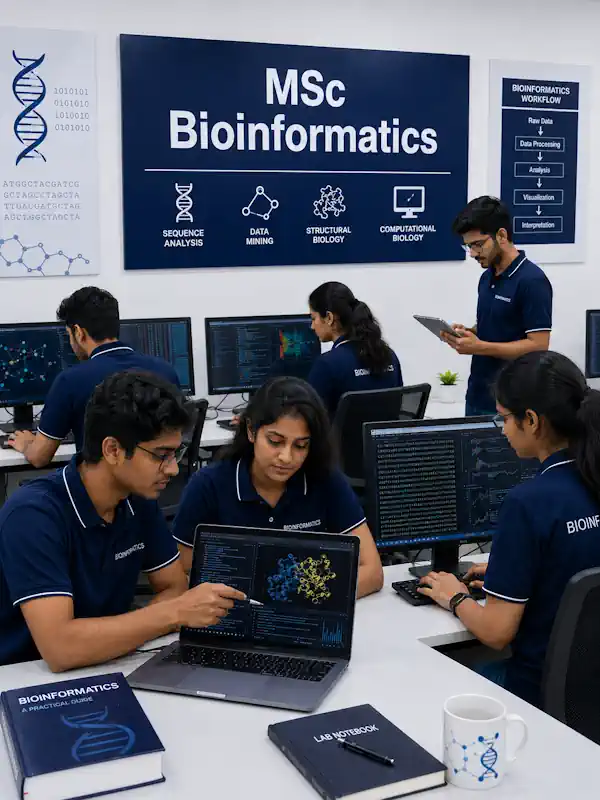

MSc Bioinformatics at Brainware University is a 2-year interdisciplinary postgraduate programme focused on computational biology, genomics, biological databases, programming, statistics, molecular modelling, drug discovery, and biomedical data analysis.
| Programme | Master of Science in Bioinformatics |
|---|---|
| Duration | 2 years |
| Focus Areas | Bioinformatics, Computational Biology, Genomics, Proteomics, Transcriptomics, Biological Databases, Molecular Biology, Biostatistics, Programming in Python and R, Structural Bioinformatics, Molecular Modelling, Drug Discovery, Machine Learning, Biomedical Data Science, Systems Biology, and Research Methodology. |
| Salary | MSc Bioinformatics graduates may explore entry-level salary packages commonly ranging from ₹3.5 LPA to ₹7 LPA, depending on programming ability, research experience, data-analysis skills, internship exposure, employer type, and job role. Career growth may improve in genomics, drug discovery, biomedical data science, computational biology, and clinical research with experience or doctoral study. |
| Popular Job Types | Bioinformatics Analyst, Computational Biologist, Genomics Data Analyst, Clinical Data Analyst, Research Associate, Biostatistician, Drug Discovery Scientist, Biomedical Data Scientist, Genomic Research Scientist, Biotechnology Research Associate, Molecular Modelling Associate, Database Curator, and Scientific Programmer. |
| Hiring Industries | Biotechnology companies, pharmaceutical firms, genomics laboratories, healthcare organisations, clinical research organisations, diagnostics companies, research institutes, universities, agricultural biotechnology firms, data science companies, molecular diagnostic laboratories, public health organisations, and biomedical technology companies. |
| Top Recruiters | Graduates may find opportunities with biotechnology companies, pharmaceutical organisations, genomics firms, clinical research organisations, healthcare analytics companies, diagnostic laboratories, academic institutions, research centres, and life-science technology businesses. Recruiter participation varies by year, student skills, research exposure, and placement cycle. |
| Specializations | Genomics, Proteomics, Structural Bioinformatics, Computational Biology, Biomedical Data Science, Drug Discovery, Pharmacogenomics, Systems Biology, Molecular Modelling, Clinical Bioinformatics, Agricultural Bioinformatics, Biostatistics, and Machine Learning in Bioinformatics. |
| Higher Studies | Graduates may pursue PhD programmes in Bioinformatics, Computational Biology, Genomics, Biotechnology, Biomedical Data Science, Systems Biology, Biostatistics, Molecular Biology, Drug Discovery, or related interdisciplinary fields. They may also pursue certifications in genomic data science, Python, R, machine learning, molecular modelling, clinical research, and biostatistics. |
| Benefits | The programme develops biological knowledge, computational thinking, programming ability, statistical reasoning, database skills, research competence, and scientific communication. It is suitable for students seeking an MSc Bioinformatics course, bioinformatics master degree, or postgraduate career at the intersection of biology and data science. |
| Internship and Placement | Students receive exposure to bioinformatics internships, research projects, biological database work, genomics analysis, molecular modelling, scientific programming, resume development, interview preparation, and placement support. |
| Location | Brainware University, Barasat, Kolkata, West Bengal. |
| Approvals & Recognition | Brainware University is a UGC-recognised university. The MSc Bioinformatics programme is offered under the university’s academic framework and applicable postgraduate education norms. |
Key reasons to study MSc Bioinformatics include:

Educational Qualification: Candidates must hold a Bachelor's degree in any field of Pure or Applied Sciences from a UGC-recognized university.
Minimum Marks: Applicants are required to secure a minimum of 55% marks in the qualifying examination. A relaxation of 5% in marks is applicable for candidates belonging to reserved categories, as per university norms.
Admission Process: Admission to the M.Sc. in Bioinformatics programme at Brainware University is conducted according to the university's admission guidelines and eligibility criteria.
Brainware University offers the M.Sc. in Bioinformatics programme at an affordable fee structure, enabling students to gain advanced knowledge in computational biology, genomics, data analysis, and biotechnology. The programme combines theoretical learning with practical applications to prepare graduates for careers in research, healthcare, pharmaceuticals, and life sciences.
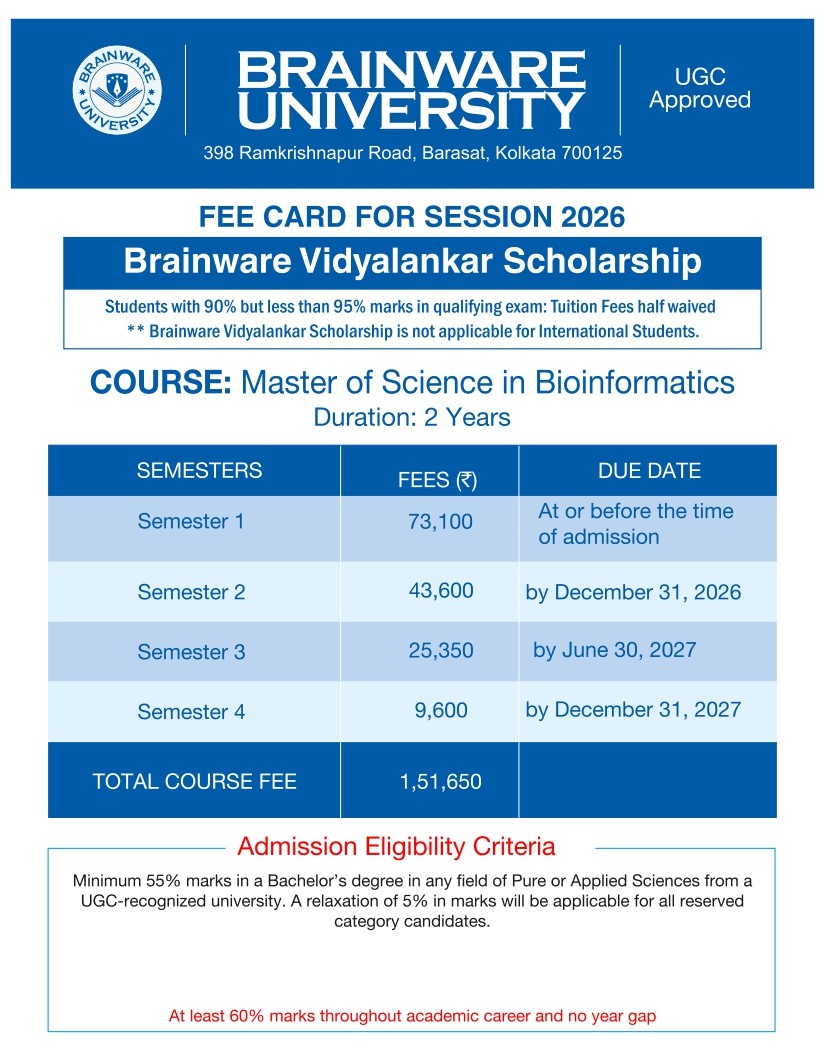
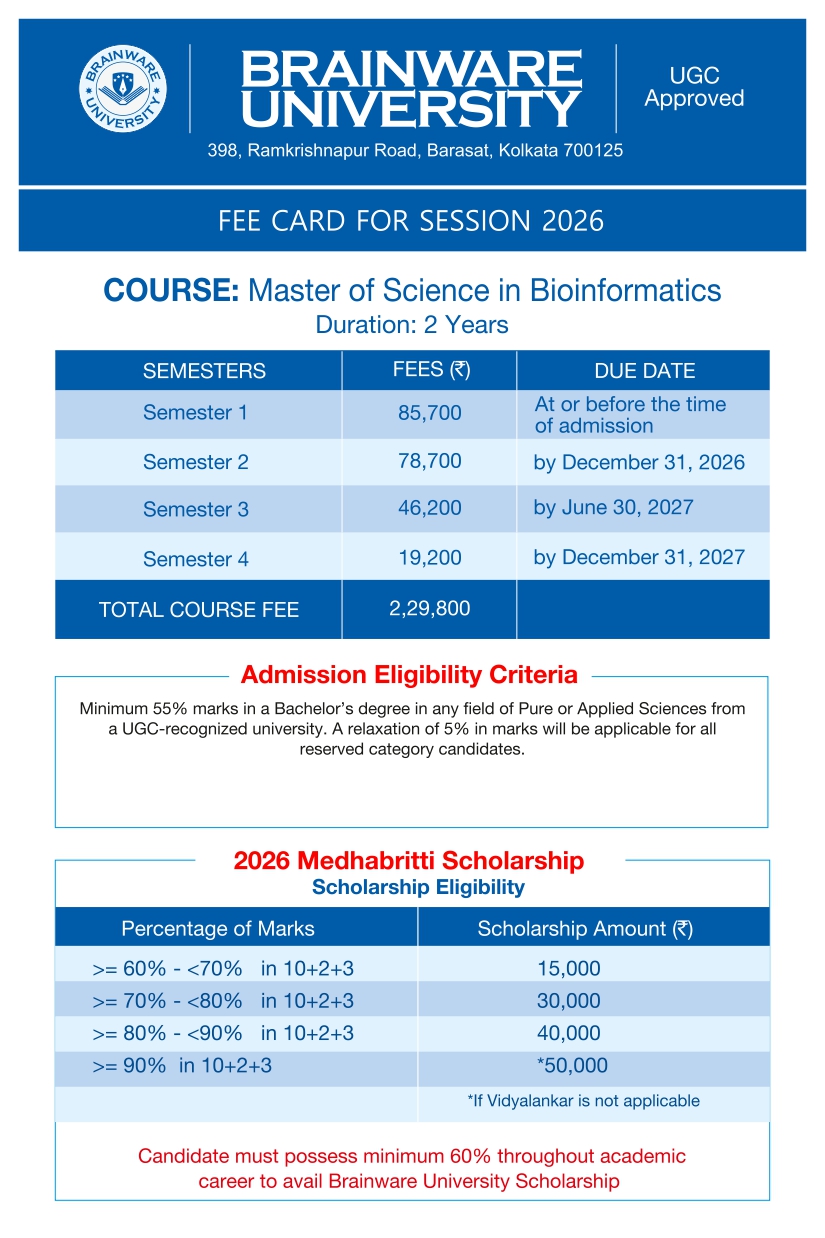
The MSc Bioinformatics fee structure at Brainware University is designed to support postgraduate education in computational biology, genomics, programming, molecular modelling, statistics, biotechnology, and research. The fee generally covers academic instruction, laboratory exposure, computational practice, project work, research guidance, student support, and placement preparation.
| Semesters | Semester 1 | Semester 2 | Semester 3 | Semester 4 | Semester 5 | Semester 6 | Semester 7 | Semester 8 | Semester 9 | Semester 10 | Total |
|---|---|---|---|---|---|---|---|---|---|---|---|
| Fees (INR) | 85700 | 78700 | 46200 | 19200 | 2,29,800 |
**Fees are subject to change, and the application fee of ₹5,000 is non-refundable under any circumstances. Please contact us for further details.
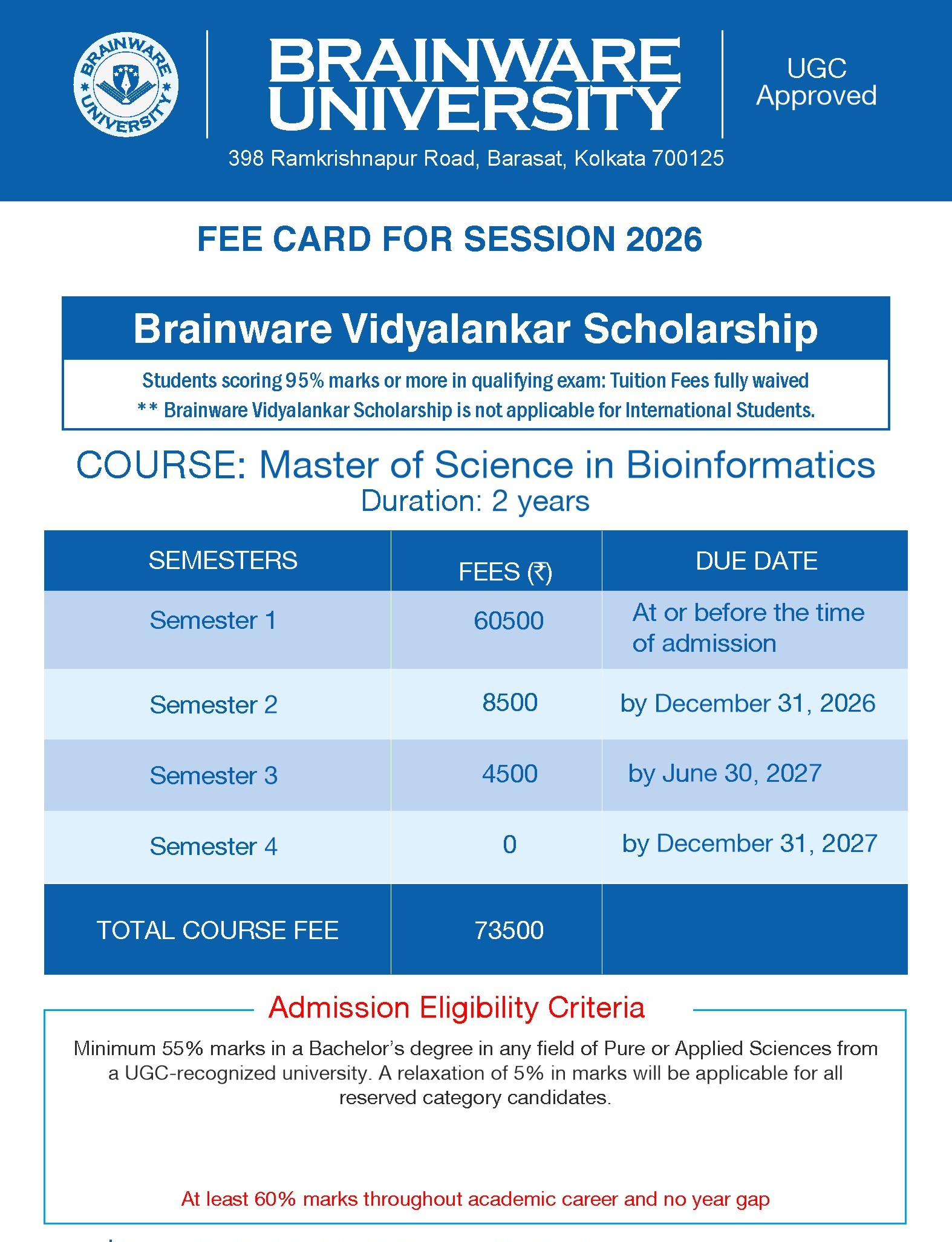
Scholarships(Fees): Brainware University offers merit-based scholarships for top performers and financial aid for deserving students. Scholarships are available for high scorers in entrance exams, board results, and outstanding achievements in innovation or research. Visit our scholarship page for more details.
**Please note that the Brainware Vidyalankar Scholarship is available only to students who passed their qualifying examination in the current admission year. Also, eligibility is strictly restricted to Indian nationals; international students are not eligible to apply.
Artificial intelligence is reshaping bioinformatics through automated sequence analysis, protein-structure prediction, disease-risk modelling, drug-target identification, biomedical image analysis, and large-scale interpretation of genomic data. MSc Bioinformatics students need both biological understanding and computational skills to evaluate these systems responsibly.
Rapid developments in sequencing, machine learning, and data science have increased demand for professionals trained in bioinformatics, high-performance computing, and genomic data governance.
AI-driven applications include:

The end-to-end AI learning spectrum in MSc Bioinformatics covers the complete process from biological sample data and sequence acquisition to cleaning, analysis, modelling, interpretation, visualisation, and scientific reporting.
Students learn how computational pipelines are created, tested, validated, and applied to biological questions. They also study the ethical use of genomic and healthcare data, including privacy, bias, reproducibility, and responsible interpretation.
Key learning areas include:




Key academic strengths include:

MSc Bioinformatics alumni can build careers across genomics, computational biology, biotechnology, pharmaceuticals, biomedical data science, healthcare research, clinical analytics, and academia. Their progression reflects the value of combining biological knowledge with programming, statistics, and computational research.


Brainware University has earned an AA+ rating in India’s Best Engineering Institutes by Careers360. The recognition reflects the University’s strength in academic quality, faculty, infrastructure, research, and student outcomes, reinforcing its position as a trusted destination for industry-aligned engineering education.

Brainware University has been ranked No. 1 Engineering College under a Private University in West Bengal in the IIRF Rankings 2026. The recognition highlights the University’s strength in engineering education, industry-focused learning, research, emerging technologies, and placement outcomes.

Brainware University has been ranked No. 2 Private University in West Bengal by uniRank 2026, marking another recognition of the University's growing presence in the state's higher education landscape.

Brainware University's inclusion in the Times Higher Education (THE) Impact Rankings 2025 reflects its contribution to the UN Sustainable Development Goals (SDGs) through education, innovation, sustainability, community engagement, and responsible institutional practices.

Brainware University has been recognised as the Best Private University of West Bengal in Infrastructure & Placement at Times Now.in – Leaders of Excellence: East 2026, celebrating its commitment to world-class infrastructure and career-focused education.

Brainware University has been recognised by The Times Group for excellence across Engineering (Placement), Law, and MBA Studies. The honours reflect the University’s multidisciplinary strength and its focus on career-oriented, industry-relevant education.

Brainware University received the ABP Ananda Shiksha Samman 2026 for Excellence in Placement & AI-Integrated Academic Infrastructure, acknowledging its emphasis on placement opportunities alongside technology-enabled academic development.

Brainware University has been honoured with the Zee 24 Ghanta Education Excellence Award 2026 for Best Industry Placement & Academic Infrastructure, continuing its recognition in 2022, 2023, 2024, 2025, and 2026. The University was also recognised in 2017 and 2018 for its job-oriented academic initiatives.

Brainware University received the TV9 Uttaran Academic Excellence Honour for Excellence in Placement & AI-Integrated Academic Infrastructure, highlighting its focus on combining career opportunities with an AI-enabled academic and learning environment.

Brainware University was honoured with the R Bangla Sikkha Gourab Samman 2026, recognising its contribution to higher education and continued pursuit of academic excellence and career-focused learning.

Brainware University was honoured as the Best Private University in West Bengal at the Times Now in Business Excellence Awards (East) 2025, recognising its academic quality, modern infrastructure, industry engagement, and focus on student success.

Brainware University was recognised as the Leading University in Infrastructure, Academics & Placement at the Times Business Awards West Bengal 2025, highlighting its strong campus facilities, academic ecosystem, and placement performance across disciplines.

The MSc Bioinformatics syllabus is designed to provide advanced knowledge of computational biology, molecular biology, genomics, proteomics, programming, statistics, biological databases, drug discovery, and scientific research.
The curriculum combines classroom study, computational practice, laboratory work, case studies, projects, and dissertation-based learning.
Core modules build the scientific and computational foundation required for bioinformatics research and industry work.
Core learning areas include:
The evolving areas in bioinformatics prepare students for applications in precision medicine, AI-driven drug discovery, clinical genomics, microbiome research, multi-omics, and biomedical data science.
Advanced learning areas include:
Bioinformatics is increasingly used in drug research to interpret genomics, transcriptomics, proteomics, and metabolomics data, support target identification, and advance precision medicine.
| Semester | Course |
|---|---|
| Semester I | Research Methodology and Ethics |
| Biological Data Science | |
| Biological Database Management System | |
| Python Programming for Biologists | |
| Biological Database Management System Lab | |
| Python Programming for Biologists Lab | |
| Semester II | Biomathematics and Biostatistics |
| Cheminformatics and Drug Discovery | |
| Elective 1: Clinical Trials and Pharmacovigilance or MOOC | |
| Elective 2: R Programming or C Programming and Data Structure | |
| Computer-Aided Drug Design | |
| Proteogenomics | |
| Professional Communication, Collaboration, and Career Skills | |
| Semester III | Project |
| Semester IV | Dissertation |
Please note that the syllabus is subject to modification. Visit our Syllabus page for the elective subject details and updated syllabus.

MSc Bioinformatics graduates can work in biotechnology, pharmaceutical research, genomics, clinical research, healthcare analytics, diagnostics, software, and biomedical data companies.
Students with strong skills in Python, R, genomics, statistics, databases, and molecular biology are better positioned for private-sector roles.
Graduates may explore government and public-sector opportunities in research institutes, public health laboratories, universities, agricultural research centres, genomic projects, healthcare research, and scientific agencies.
Candidates should review official recruitment notifications, fellowship conditions, examinations, and project-specific eligibility.
MSc Bioinformatics career prospects extend across biotechnology, pharmaceuticals, genomics, healthcare, clinical research, data science, agriculture, and academic research. Graduates develop skills in biological interpretation, programming, statistical analysis, database use, molecular modelling, and scientific communication.
| Area of Opportunity | Why It’s in Demand |
|---|---|
| Bioinformatics Analyst | Research institutions and biotech companies require professionals who can analyse complex biological and genomic data. |
| Computational Biologist | The integration of biology and computing has increased demand for experts who can model and interpret biological systems. |
| Genomics Data Analyst | Advances in genome sequencing have created opportunities for specialists who can process and interpret genetic information. |
| Clinical Data Analyst | Healthcare and pharmaceutical organisations need professionals to manage and analyse clinical and medical datasets. |
| Research Associate (Bioinformatics) | Universities and research laboratories seek skilled researchers to support biological and computational studies. |
| Biostatistician | Clinical research and public health projects require experts who can apply statistical methods to biological data. |
| Drug Discovery Scientist | Pharmaceutical companies rely on bioinformatics professionals to accelerate drug development and target identification. |
| Biomedical Data Scientist | The growing use of healthcare data has increased demand for specialists who can derive meaningful insights from complex datasets. |
| Genomic Research Scientist | Research organisations need scientists to investigate genetic variations and their impact on health and disease. |
| Biotechnology Research Associate | Biotechnology firms require professionals who can support innovation in molecular biology, genetics, and life sciences research. |
The career scope after MSc Bioinformatics depends on computational proficiency, research exposure, biological knowledge, internship experience, and project quality. Graduates who build strong skills in Python, R, genomics, machine learning, cloud computing, and molecular modelling can pursue specialised research and industry roles.
The job market for MSc Bioinformatics graduates is expected to expand from 2025 to 2032 as genomics, biomedical data science, precision medicine, pharmaceutical research, clinical analytics, and AI-driven drug discovery continue to grow.
NHGRI states that bioinformatics and computational biology are fundamental across genomics, while recent workforce research notes rising demand for expertise in bioinformatics, high-performance computing, machine learning, and genomic data governance.
Career growth will be driven by:
High-growth roles are likely to include:
Key hiring industries include:
Important skills include:
The growth outlook is strong for graduates who combine life-science knowledge with computational and statistical skills. As an adjacent labour-market indicator, employment of data scientists is projected to grow 34% from 2024 to 2034, while computer and information research scientist employment is projected to grow 20%. These figures are not specific to bioinformatics, but they demonstrate strong demand for advanced data and computational research skills.
Students should focus on building:
The future bioinformatics workplace will require professionals who can connect biological questions with data, algorithms, statistics, and scientific evidence. Employers will prefer graduates who can manage large datasets, design reproducible workflows, interpret results, and communicate findings responsibly.
For students choosing an MSc Bioinformatics college, the focus should be on computational training, genomics, programming, laboratory facilities, research exposure, internships, faculty guidance, and placement support.

These learning features ensure that graduates from Brainware University’s MSc Bioinformatics program are well-prepared to excel in bioinformatics and computational biology, offering both the technical skills and practical experience essential for success in this evolving field.

| Laboratory | Facilities |
|---|---|
| Animal Bioinformatics Lab. | Rotary centrifuge, REMI 4° centrifuge, blood group testing facility, sugar testing facility, dialysis facility, ice maker, water distillation unit, microtome, dissecting microscope binocular. |
| Plant Bioinformatics & Cytogenetic Lab. | Plant physiology, LAF with HEPA, plant growth chamber (digitally controlled), karyotyping facility, breeding facility, pH meter, UV spectrophotometer, weighing balance, light microscope, hot air oven, plant tissue culture facility. |
| Microbiology Lab. | HEPA-LAF chamber, anaerobic culture unit, BOD facility, mushroom spawn production facility, soil testing facility, autoclave, digital pH meter, weighing balance, bacterial and fungal staining and culture facilities, light microscope, colony counter. |
| Bioprocess Technology Lab. | 5 Lts capacity bioreactor, fermentation facility, down-stream processing facility, enzymology, water treatment facility, HEPA-LAF, incubator cum shaker. |
| Molecular Biology Lab. | 96 well PCR machine (Thermocycler), gel-electrophoresis unit (horizontal & vertical), gel-doc system computerized, DNA, RNA, protein experimental facility, UV Transilluminator, micro centrifuge machine, vortexer, weighing balance. |

Industry-institute engagement helps MSc Bioinformatics students connect academic learning with biotechnology, pharmaceuticals, genomics, healthcare analytics, and scientific research.




The Department of Biotechnology at Brainware University has signed multiple active MoUs with leading organisations across various industries, strengthening industry-academia collaboration and enhancing student exposure, training, and placement opportunities.
[Click here to view the complete list of MoUs]
MSc Bioinformatics admission 2026 at Brainware University is open to eligible science graduates who want advanced education in computational biology, genomics, biological data analysis, programming, molecular modelling, and biomedical research.
Admission Criteria: Candidates must hold a bachelor’s degree in any field of Pure or Applied Sciences from a UGC-recognised university.
Applicants must secure at least 55% marks in the qualifying examination. A 5% relaxation applies to reserved-category candidates according to university norms.
Application: Candidates can apply through the Brainware University online enquiry or application form. Applicants must provide their name, programme preference, location, phone number, email address, and academic details.
Entrance Exam: Admission is conducted according to the university’s current selection guidelines. Candidates should confirm whether an entrance examination, merit assessment, interview, or counselling process applies for the 2026 academic session.
Counselling: Eligible candidates receive counselling support covering programme structure, MSc Bioinformatics eligibility, fees, syllabus, laboratory facilities, internship opportunities, career options, scholarships, and required documents.
Direct Admission: MSc Bioinformatics direct admission may be available according to academic eligibility, merit, seat availability, and university norms. Applicants should contact the admission office for the latest process.
Please follow the given MSc Bioinformatics Admission Procedure in Brainware University:

The Department of Biotechnology supports bioinformatics education through research activities, seminars, workshops, laboratory training, scientific events, expert lectures, student projects, and interdisciplinary learning.
https://www.brainwareuniversity.ac.in/departments/biotechnology/activities.php
MSc Bioinformatics is a postgraduate degree program that focuses on the application of biological processes, organisms, or systems in various fields, including healthcare, agriculture, environmental science, and pharmaceuticals. It combines principles of biology, genetics, molecular biology, biochemistry, and other related disciplines to develop innovative solutions and technologies.
The prerequisites for pursuing MSc in Bioinformatics may vary among institutions. Typically, a bachelor's degree in Bioinformatics, biology, microbiology, biochemistry, genetics, or a related field is required. Some programs may have specific coursework or minimum GPA requirements. It is advisable to check the eligibility criteria of the specific program or institution you are interested in.
The subjects covered in an MSc Bioinformatics program may include molecular biology, genetics, biochemistry, cell biology, bioprocess engineering, genetic engineering, microbiology, bioinformatics, immunology, genomics, proteomics, biostatistics, and ethical considerations in Bioinformatics. The program may also include laboratory work, research projects, and seminars to provide practical experience and research skills.
Graduates of MSc Bioinformatics programs have diverse career prospects in industries, research institutions, and government organizations. They can work in areas such as pharmaceuticals, biopharmaceuticals, healthcare, agriculture, food and beverage, environmental science, forensic science, Bioinformatics companies, research and development, quality control, regulatory affairs, and academia. Roles may include research scientist, biotechnologist, laboratory manager, product development specialist, quality assurance officer, and scientific writer.
Brainware University's M.Sc. in Bioinformatics programme offers a multidisciplinary learning experience that integrates biology, biotechnology, computer science, and data analytics. With experienced faculty, modern laboratories, research-driven training, and exposure to emerging technologies in genomics and computational biology, students gain the expertise required for careers in biotechnology, pharmaceuticals, healthcare, and scientific research. The programme is further supported by the university's 98% placement record across programmes, helping graduates access diverse career opportunities in the life sciences sector.
Yes, MSc Bioinformatics programs often provide research opportunities to students. These opportunities may include research projects, internships, or collaborations with industry partners or research institutions. Engaging in research allows students to gain practical skills, contribute to advancements in the field, and explore specific areas of interest within Bioinformatics.
An MSc Bioinformatics program helps students develop various skills, including molecular biology techniques, genetic engineering methods, laboratory techniques, bioinformatics analysis, data interpretation, research design and execution, scientific communication, project management, critical thinking, and problem-solving in the context of Bioinformatics. Students also gain experience in working with advanced instruments and technologies used in the field.
While some institutions may offer distance learning or online programs in MSc Bioinformatics, it is important to note that practical laboratory work and hands-on experience are integral components of the program. Therefore, it is advisable to research and check with specific institutions to determine if they offer any online or hybrid programs in this field and if they provide adequate laboratory facilities or in-person components to ensure comprehensive learning.
Within Bioinformatics, students can explore various research areas during their MSc program. Some popular research areas include genetic engineering, biopharmaceutical production, agricultural Bioinformatics, environmental Bioinformatics, molecular diagnostics, stem cell research, bioinformatics, synthetic biology, proteomics, genomics, and drug discovery. The choice of research area often depends on individual interests and the expertise of the faculty within the program.
The duration of an MSc Bioinformatics program typically ranges from 1 to 2 years, depending on the institution and the program structure. Some programs may offer part-time options, which can extend the duration. The duration may also vary if the program includes a research project or thesis component. It's essential to check the specific program requirements and consult the institution for accurate information regarding the duration of the program.
M.Sc. in Bioinformatics is a postgraduate program that combines biology, computer science, and data analysis to study biological data, genomics, and computational biology.
Brainware University offers an advanced M.Sc. Bioinformatics program with hands-on training in computational biology, big data analysis, and molecular modeling.
Candidates must have a B.Sc. degree in Biotechnology, Bioinformatics, Life Sciences, Computer Science, or related fields with a minimum required percentage.
The course duration is 2 years (4 semesters).
Core subjects include Genomics, Proteomics, Computational Biology, Machine Learning in Bioinformatics, Structural Bioinformatics, and Biomedical Data Science.
Graduates can work as Bioinformatics Scientists, Computational Biologists, Biostatisticians, Genomics Analysts, Drug Discovery Specialists, and Data Scientists.
The salary ranges from ₹5-15 LPA, depending on experience and job role.
Pharmaceutical companies, research labs, biotech firms, IT companies, healthcare organizations, and government agencies hire bioinformatics professionals.
Focus on biological data analysis, machine learning algorithms, computational tools (Python, R, MATLAB), and genome sequencing techniques.
Highlight hands-on experience in bioinformatics tools, research projects, certifications in Python/R, and knowledge of molecular biology.
Work on genomics data sets, learn Python and R, participate in bioinformatics projects, and contribute to open-source biological databases.
Popular tools include BLAST, Clustal Omega, PyMOL, AutoDock, Bioconductor, and NCBI databases.
Participate in internships at biotech companies, research fellowships, online bioinformatics challenges, and academic collaborations.
Genomics analysis, programming (Python/R), molecular modeling, machine learning, and biomedical data science.
Follow bioinformatics journals, attend conferences, take online courses, and join professional organizations like ISCB (International Society for Computational Biology).
AI and Machine Learning are revolutionizing genomics, drug discovery, precision medicine, and disease prediction using large-scale biological data.
Personalized medicine, CRISPR gene editing, microbiome analysis, AI-driven drug discovery, and computational virology are trending.
Bioinformatics helps identify drug targets, analyze protein structures, model molecular interactions, and accelerate drug development using computational simulations.
Certified Bioinformatics Specialist, Genomic Data Science Certification, Computational Biology Certification, and AI in Healthcare Certifications.
Gain expertise in biomedical informatics, clinical research, regulatory compliance, and molecular diagnostics for pharma careers.