98%
Placed
in 2025






Brainware University transformed me, fostering confidence and capability for conquering the world.
The Master of Optometry programme, also known as M. Optometry, M Optom course, or MSc Optometry in common search usage, is a 2-year postgraduate programme for students who want advanced knowledge in vision care, clinical optometry, ocular disease management, contact lenses, low vision care, binocular vision, paediatric optometry, vision therapy, diagnostic procedures, and optometry research.
Students looking for an optometry masters degree, master degree optometry, or MSc Optometry colleges can use this page to understand course duration, eligibility, fees, syllabus, clinical training, career options, admission process, and learning benefits. The programme is suitable for candidates who have completed a Bachelor in Optometry and want to build careers in hospitals, eye clinics, optical chains, diagnostic centres, research organisations, public health vision care, academic institutions, and private practice.
At Brainware University, the Masters in Optometry programme is designed to combine advanced classroom learning with practical clinical exposure. Students develop patient-care skills, diagnostic understanding, research ability, and professional confidence for specialised roles in optometry and allied eye care.
The applicants will find all admission-relevant information on this page including the MSc optometry programme overview, MSc optometry syllabus outline, MSc optometry fees, career options, as well as learning benefits. Details concerning course, eligibility and admission criteria are provided as well.
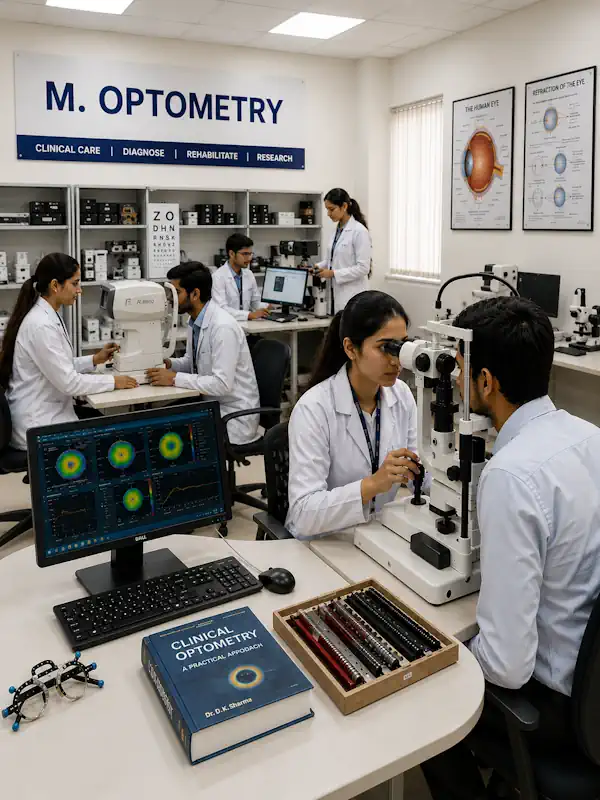

Master of Optometry (M. Optometry) is a specialised postgraduate programme designed to develop advanced clinical expertise in eye care, vision science, ocular disease management, and optometric research. The programme equips students with the knowledge and practical skills required to excel in clinical practice, healthcare institutions, vision care centres, research organisations, and academic settings.
| Programme | Master of Optometry |
|---|---|
| Duration | 2 years |
| Focus Areas | The Masters in Optometry programme at Brainware University is a 2-year postgraduate course that prepares students for advanced clinical, diagnostic, research, and professional roles in optometry and vision care. |
| Salary | Salary after Master of Optometry depends on clinical skill, internship experience, diagnostic expertise, communication ability, research exposure, employer type, location, and chosen role. Graduates may explore opportunities in eye hospitals, clinics, optical chains, diagnostic centres, research organisations, and academic institutions. |
| Popular Job Types | Clinical Optometrist, Contact Lens Specialist, Paediatric Optometrist, Vision Therapy Specialist, Low Vision Specialist, Ocular Disease Specialist, Vision Science Researcher, Ophthalmic Equipment Specialist, Clinical Instructor, Academic Associate, Eye Clinic Manager, and Private Eye Clinic Owner. |
| Hiring Industries | Eye Hospitals, Multispeciality Hospitals, Optical Chains, Eye Clinics, Diagnostic Centres, Ophthalmic Equipment Companies, Research Organisations, Public Health Vision Programmes, Academic Institutions, NGOs, Corporate Healthcare Groups, and Private Practice Setups. |
| Top Recruiters | Master of Optometry graduates may explore opportunities with eye hospitals, healthcare groups, optical retail chains, ophthalmic equipment companies, diagnostic centres, public health organisations, research bodies, and private clinics. |
| Specializations | Advanced Clinical Optometry, Contact Lens Practice, Paediatric Optometry, Vision Therapy, Low Vision Rehabilitation, Ocular Disease Management, Community Optometry, Binocular Vision, Ophthalmic Diagnostics, and Vision Science Research. |
| Higher Studies | Graduates can pursue PhD in Optometry, PhD in Vision Science, clinical fellowships, research programmes, advanced certifications in contact lens practice, vision therapy, low vision rehabilitation, ocular imaging, paediatric optometry, public health optometry, and academic or research-based pathways. |
| Benefits | The programme offers advanced clinical learning, hands-on diagnostic training, optometry lab exposure, hospital and eye clinic exposure, research-based learning, patient-care practice, professional mentoring, placement training, and preparation for specialised eye care careers. |
| Internship and Placement | Students may receive clinical exposure through internships, hospital visits, eye care practice, diagnostic training, workshops, patient-care observation, and placement support. Training may include resume preparation, interview readiness, clinical case discussion, communication skills, and professional grooming. |
| Location | Brainware University, Barasat, Kolkata, West Bengal. |
| Approvals & Recognition | UGC Recognised. PCI Approved. |

Educational Qualification: Candidates must have completed a Bachelor in Optometry from a recognised university.
Minimum Marks: A minimum of 55% marks or equivalent grade in the qualifying examination is required.
Age Criteria: Candidates should have completed 21 years of age as of December 31st of the year of admission.
Relaxation Criteria: A 5% relaxation in marks will be applicable for all reserved category candidates.
Build a successful career in advanced eye care, vision science, and clinical optometry with the Masters in Optometry programme designed to provide high-quality education and practical clinical exposure at an affordable cost. The programme offers access to modern optometry labs, advanced diagnostic instruments, experienced faculty guidance, and hands-on training through clinical practice and research-based learning. Students gain in-depth knowledge of ocular diseases, contact lenses, low vision care, vision therapy, and advanced diagnostic procedures, preparing them for careers in hospitals, eye clinics, research organisations, optical industries, and academic institutions.
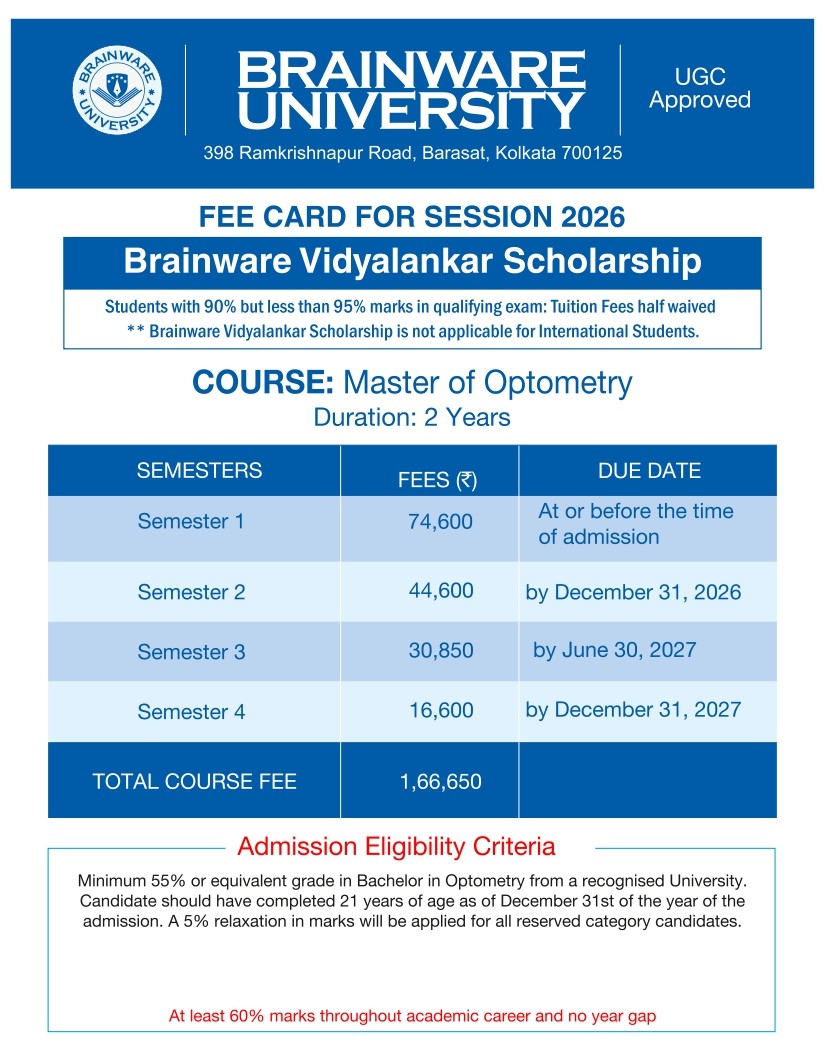
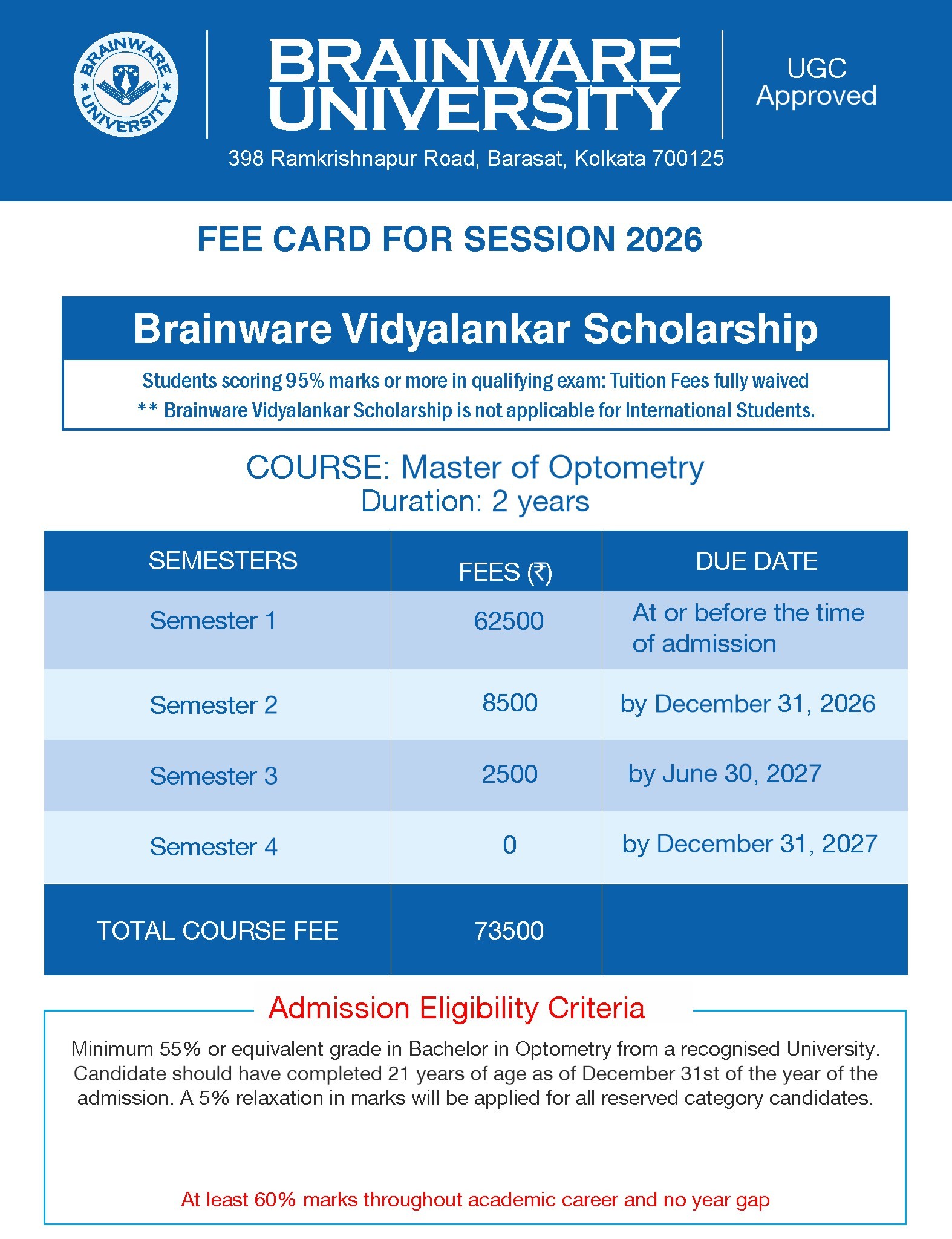
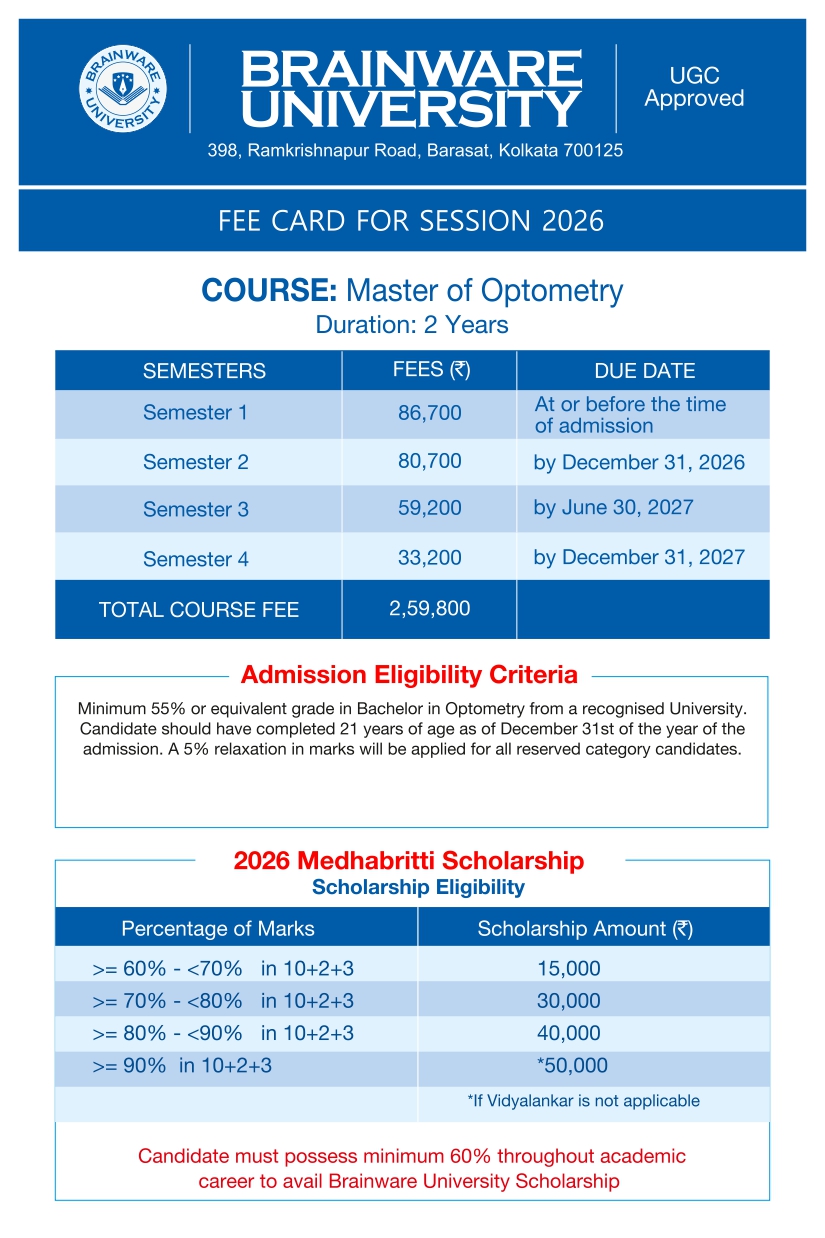
Students searching for Master of Optometry fees, MSc Optometry fees, or M Optometry fees should check the latest semester-wise fee structure from the official Brainware University admission office before applying. Fees may be revised as per university policy, and the final payable amount should be confirmed before admission.
| Semesters | Semester 1 | Semester 2 | Semester 3 | Semester 4 | Semester 5 | Semester 6 | Semester 7 | Semester 8 | Semester 9 | Semester 10 | Total |
|---|---|---|---|---|---|---|---|---|---|---|---|
| Fees (INR) | 86700 | 80700 | 59200 | 33200 | 2,59,800 |
**Fees are subject to change, and the application fee of ₹5,000 is non-refundable under any circumstances. Please contact us for further details.
Scholarships(Fees): Brainware University offers merit-based scholarships for top performers and financial aid for deserving students. Scholarships are available for high scorers in entrance exams, board results, and outstanding achievements in innovation or research. Visit our scholarship page for more details.
**Please note that the Brainware Vidyalankar Scholarship is available only to students who passed their qualifying examination in the current admission year. Also, eligibility is strictly restricted to Indian nationals; international students are not eligible to apply.
Artificial Intelligence is increasingly used in modern eye care for screening, image analysis, disease risk detection, tele-optometry, patient record management, and clinical decision support. The Master of Optometry programme can introduce students to how AI-enabled tools are changing optometric practice and vision science.
AI in optometry may support retinal image analysis, diabetic retinopathy screening, glaucoma risk assessment, automated refraction, ocular imaging, myopia management, dry eye assessment, and patient follow-up systems. Students learn how technology can assist clinical judgement while understanding that ethical care, patient communication, and professional interpretation remain essential.
This exposure helps postgraduate optometry students prepare for a healthcare environment where clinical skills and digital tools work together. It also builds awareness of responsible technology use, patient data privacy, accuracy of screening tools, and the role of human expertise in eye care.

The AI learning spectrum in Master of Optometry should introduce students to practical applications of digital health and intelligent screening systems in eye care. The objective is to help students understand how AI can support clinical assessment, early detection, documentation, and patient management.
Key learning areas may include:
This exposure helps students become familiar with the changing relationship between optometry, digital diagnostics, and patient-centred eye care.




Graduates from health science and optometry-related programmes can build meaningful careers across hospitals, eye clinics, optical chains, diagnostic centres, community eye care programmes, research organisations, academic institutions, and private practice. Their career journeys show how clinical training, patient-care skills, diagnostic knowledge, and professional discipline can create strong opportunities in the healthcare sector.


Brainware University has earned an AA+ rating in India’s Best Engineering Institutes by Careers360. The recognition reflects the University’s strength in academic quality, faculty, infrastructure, research, and student outcomes, reinforcing its position as a trusted destination for industry-aligned engineering education.

Brainware University has been ranked No. 1 Engineering College under a Private University in West Bengal in the IIRF Rankings 2026. The recognition highlights the University’s strength in engineering education, industry-focused learning, research, emerging technologies, and placement outcomes.

Brainware University has been ranked No. 2 Private University in West Bengal by uniRank 2026, marking another recognition of the University's growing presence in the state's higher education landscape.

Brainware University's inclusion in the Times Higher Education (THE) Impact Rankings 2025 reflects its contribution to the UN Sustainable Development Goals (SDGs) through education, innovation, sustainability, community engagement, and responsible institutional practices.

Brainware University has been recognised as the Best Private University of West Bengal in Infrastructure & Placement at Times Now.in – Leaders of Excellence: East 2026, celebrating its commitment to world-class infrastructure and career-focused education.

Brainware University has been recognised by The Times Group for excellence across Engineering (Placement), Law, and MBA Studies. The honours reflect the University’s multidisciplinary strength and its focus on career-oriented, industry-relevant education.

Brainware University received the ABP Ananda Shiksha Samman 2026 for Excellence in Placement & AI-Integrated Academic Infrastructure, acknowledging its emphasis on placement opportunities alongside technology-enabled academic development.

Brainware University has been honoured with the Zee 24 Ghanta Education Excellence Award 2026 for Best Industry Placement & Academic Infrastructure, continuing its recognition in 2022, 2023, 2024, 2025, and 2026. The University was also recognised in 2017 and 2018 for its job-oriented academic initiatives.

Brainware University received the TV9 Uttaran Academic Excellence Honour for Excellence in Placement & AI-Integrated Academic Infrastructure, highlighting its focus on combining career opportunities with an AI-enabled academic and learning environment.

Brainware University was honoured with the R Bangla Sikkha Gourab Samman 2026, recognising its contribution to higher education and continued pursuit of academic excellence and career-focused learning.

Brainware University was honoured as the Best Private University in West Bengal at the Times Now in Business Excellence Awards (East) 2025, recognising its academic quality, modern infrastructure, industry engagement, and focus on student success.

Brainware University was recognised as the Leading University in Infrastructure, Academics & Placement at the Times Business Awards West Bengal 2025, highlighting its strong campus facilities, academic ecosystem, and placement performance across disciplines.

The Masters in Optometry syllabus is designed to provide advanced knowledge of vision science, clinical optometry, ocular diseases, contact lens practice, paediatric optometry, low vision care, vision therapy, diagnostic techniques, and research methodology. The curriculum supports students who want to specialise in clinical eye care, research, academic work, or professional optometry practice.
The syllabus combines classroom learning with lab training, clinical case discussions, diagnostic practice, patient-care exposure, seminars, assignments, and research-based learning. Students gain deeper understanding of eye health, vision correction, ocular assessment, advanced instruments, and evidence-based optometric practice.
The core foundations of Master of Optometry help students strengthen the clinical and scientific base required for advanced optometry practice. These areas build understanding of the eye, vision function, diagnostic reasoning, patient care, and research methods.
Core learning areas may include:
These subjects help students develop the ability to assess vision problems, support eye care management, interpret clinical findings, and communicate effectively with patients.
The industry-driven advanced modules in Master of Optometry focus on specialised areas that are increasingly important in hospitals, clinics, optical chains, eye care technology companies, research organisations, and community health programmes.
Advanced learning areas may include:
These modules help students prepare for advanced practice, research, hospital-based roles, optical industry careers, and specialised patient-care services.
| Semester | Course |
|---|---|
| Semester I | Applied Ocular Biology for Ocular Diseases |
| Advanced Ocular Diagnostics and Management | |
| Binocular Vision and Paediatric Optometry | |
| Fundamentals of Research and Intellectual Property Rights | |
| Advanced Ocular Diagnostics Practical | |
| Comprehensive Eye Care Clinic - I | |
| Research Project - I | |
| Semester II | Advance Contact Lens Care |
| Epidemiology and Public Health | |
| Binocular Vision and Neuro-Optometric Rehabilitation | |
| Pedagogy | |
| Speciality Clinic - I | |
| Comprehensive Eye Care Clinic - II | |
| Elective: Community Optometry / Scientific Communications in Clinical Practice | |
| Research Project - II | |
| Semester III | Low Vision Care and Rehabilitation |
| Advanced Optometric Optics | |
| Application of AI in Optometry | |
| Speciality Clinic - II | |
| Elective: Geriatric Optometry / Eye Care for Special Population | |
| Comprehensive Eye Care Clinic - III | |
| Research Project - III | |
| Semester IV | Research Project and Dissertation |
| Grand Viva-Voce |
Please note that the syllabus is subject to modification. Visit our Syllabus page for the elective subject details and updated syllabus.

MSc Optometry graduates can explore corporate and private-sector jobs in eye hospitals, multispeciality hospitals, optical retail chains, eye clinics, diagnostic centres, ophthalmic equipment companies, healthcare startups, research organisations, and private practice settings.
Students with strong clinical skills, internship exposure, patient communication ability, research work, and diagnostic instrument handling can build stronger profiles for private healthcare roles.
M Optometry graduates can apply for government and public-sector opportunities where vision care, eye screening, public health, clinical support, research, and teaching skills are required. Opportunities may be available in government hospitals, public health programmes, community eye care projects, research institutions, academic institutions, NGOs working with government projects, and vision screening initiatives.
Candidates should check official recruitment notifications for eligibility, experience requirements, age limits, selection procedures, and professional registration requirements where applicable.
| Career Role / Specialization | Description |
|---|---|
| Clinical Optometrist | Focuses on advanced primary eye care, including the diagnosis and management of ocular diseases, performing comprehensive eye examinations, and prescribing specialised corrective lenses. |
| Contact Lens Specialist | Specialises in fitting advanced and specialty contact lenses, such as scleral, orthokeratology, or prosthetic lenses, for patients with complex corneal conditions like keratoconus. |
| Paediatric Optometrist | Provides vision care for infants and children, including the management of binocular vision anomalies, childhood myopia, and healthy visual development. |
| Vision Therapy Specialist | Designs and implements non-surgical treatment programmes to improve eye coordination, tracking, and focusing abilities in patients with amblyopia or brain-injury-related vision problems. |
| Vision Science Researcher | Works in academic or corporate settings to conduct research on ocular health, new treatment methods, and the development of innovative ophthalmic products. |
| Ophthalmic Equipment Specialist | Connects technology with clinical eye care by helping develop, market, demonstrate, or provide training for diagnostic equipment such as OCT, visual field analysers, and retinal imaging systems. |
| Private Eye Clinic Owner | Manages an independent optometry practice by combining clinical expertise with business operations to provide personalised eye care services to the community. |
Overall, a Master of Optometry degree offers strong career scope for students who want specialised roles in clinical eye care, diagnostic support, contact lenses, paediatric optometry, low vision care, vision therapy, research, teaching, and private practice. Graduates who build strong clinical records, complete internships seriously, develop patient-care skills, and stay updated with diagnostic technology can create better long-term career opportunities.
The job market for MSc Optometry graduates from 2025 to 2032 is expected to grow with rising demand for preventive eye care, digital eye strain management, paediatric vision care, diabetic eye screening, myopia control, low vision rehabilitation, and advanced diagnostic services.
Between 2025 and 2032, optometry professionals with advanced clinical skills, diagnostic instrument knowledge, internship experience, and digital health awareness will be better prepared for the changing eye care sector.


Industry-institute tie-ups help Master of Optometry students connect academic learning with real healthcare practice. Through collaborations with eye hospitals, healthcare organisations, optical chains, diagnostic centres, and eye care professionals, students may gain exposure to clinical training, workshops, internships, case-based learning, and patient-care environments.





Master of Optometry admission 2026 at Brainware University is open for eligible candidates who want to pursue advanced postgraduate study in clinical optometry, vision science, contact lens practice, low vision care, paediatric optometry, ocular disease assessment, and eye care research.
Admission Criteria: Candidates applying for the Master of Optometry programme must have completed a Bachelor in Optometry from a recognised university.
Applicants must secure at least 55% marks or an equivalent grade in the qualifying examination. A 5% relaxation in marks is applicable for reserved category candidates as per university norms.
Application: Students can apply for Master of Optometry admission 2026 by filling out the enquiry or application form available on the Brainware University website. Applicants must enter their name, select M. Optometry from the course drop-down menu, choose their location, and submit a valid phone number and email ID.
Entrance Exam: Admission to the Master of Optometry programme may be based on merit and/or BET, the Brainware Entrance Test, as per university admission norms.
Counselling: After application submission, eligible candidates are guided through counselling by the university admission team. Counselling helps students understand Master of Optometry eligibility, course duration, fees, scholarships, syllabus, clinical exposure, internship opportunities, placement support, and career pathways.
Direct Admission: Direct admission to the Master of Optometry programme may be available for eligible candidates as per university norms, subject to academic qualification, age criteria, merit, entrance requirement where applicable, seat availability, document verification, and admission guidelines.
Please follow the given Masters in Optometry Admission Procedure in Brainware University:

In the fast-evolving landscape of healthcare, Brainware University's commitment to excellence and innovation takes center stage. The university's various departments have orchestrated groundbreaking events and sessions, leaving an indelible mark on the industry and its stakeholders.
The university organized an insightful session that demystified the world of AYUSH. Featuring speakers like Dr. Krishnendu Mohanta, a Homoeopathic Medical Officer from the Department of Health and Family Welfare, and Dr. Sinchan Das, a Homoeopathic Physician and Researcher, this session addressed the myths and facts surrounding alternative healthcare practices. Brainware University is at the forefront of promoting holistic health education.
Dr. Ranjan Kumar Srivastava, Founder and MD of Renaissance Hospital, shared his wisdom on the scope and prospects of Allied Health Science. This session illuminated the diverse career paths within the healthcare industry, providing students with valuable insights into this dynamic field.
On World Health Day, Brainware University hosted an intriguing session with Rana Dasgupta, the eastern region CEO of Apollo Hospitals Group. The event featured Lieutenant Abhijit Majumder, COO of Apollo Hospitals Group Kolkata, and Phalguni Mookhopadhayay, the Hon'ble Chancellor of Brainware University. Together, they discussed crucial aspects of healthcare leadership and the collective responsibility of institutions towards public health.
The Optometry industry took centre stage as Brainware University's C2C cell organized a seminar in collaboration with Lenskart. Sreejit Sarkar, Regional Training Manager East, Professional Optometry Service, Lenskart, provided a captivating sneak peek into the industry's latest trends and innovations.
Brainware University's various departments continue to spearhead initiatives that not only enhance academic learning but also foster a deeper understanding of the ever-evolving healthcare landscape. Through these remarkable events and sessions, the university is making a positive impact on the industry and preparing its stakeholders for the challenges and opportunities that lie ahead.

The Master of Optometry course at Brainware University typically spans over a duration of two years, comprising four semesters.
Students should choose Brainware University for Master of Optometry in 2026 because the programme develops advanced clinical knowledge in vision science, ocular diseases, contact lenses, binocular vision, low vision care, paediatric optometry, and diagnostic procedures. With clinical exposure, hands-on training, a 98% placement rate across courses, 1000+ recruiters, internships, and placement assistance, Brainware University prepares students for careers in hospitals, eye care centres, optical industries, clinics, research, and academic roles.
Candidates should have completed a Bachelor's degree in Optometry or related fields from a recognized university. Additionally, they may need to clear an entrance examination or meet other criteria set by the university.
Graduates of the Master of Optometry program can explore various career opportunities such as Optometrist in hospitals, clinics, or private practice, Optometry researcher, Academician, Ophthalmic Consultant, among others.
Yes, Brainware University emphasizes practical training and provides hands-on experience through clinical internships, workshops, and laboratory sessions to equip students with real-world skills.
The curriculum covers a wide range of topics including Clinical Optometry, Ocular Diseases, Contact Lens Practice, Low Vision Aids, Binocular Vision, and Pediatric Optometry among others, to provide students with comprehensive knowledge and skills.
Yes, Brainware University encourages research activities and provides opportunities for students to engage in research projects, publish papers, and participate in conferences to enhance their academic and professional growth.
Brainware University may offer scholarships or financial assistance to deserving candidates based on academic merit, performance in entrance exams, or other criteria as per the university's policies.
Brainware University offers state-of-the-art laboratories, well-equipped clinics, library resources, and access to advanced technology to facilitate learning and research in the field of Optometry.
Yes, graduates can opt for higher studies such as Ph.D. in Optometry or related disciplines to delve deeper into specialized areas or pursue academic and research-oriented careers.
Interested candidates can visit the official website of Brainware University for admission-related information, including eligibility criteria, application procedure, important dates, and contact details for further assistance.
A Master of Optometry (M.Optom) is a postgraduate program that focuses on advanced clinical optometry, vision science, contact lenses, low vision care, and ocular diseases.
Brainware University offers a comprehensive M.Optom program with advanced clinical training, research opportunities, and experienced faculty.
You need a Bachelor’s degree in Optometry (B.Optom) or a related field. Admission may be based on merit, entrance exams, or personal interviews.
The curriculum includes Ocular Pharmacology, Contact Lens Studies, Low Vision & Rehabilitation, Pediatric Optometry, Clinical Optometry, and Research Methodology.
The course duration is 2 years, divided into 4 semesters, including clinical internships and research projects.
Graduates can work as Optometrists, Vision Therapists, Contact Lens Specialists, Ocular Disease Specialists, Clinical Researchers, and Academicians.
Entry-level salaries start from ₹4-6 LPA, while experienced professionals can earn ₹8-12 LPA in hospitals, clinics, and research labs.
Top employers include hospitals, eye clinics, optical chains (Lenskart, Titan Eye+), research institutes, and multinational eye care companies.
Focus on clinical case studies, patient management, advanced diagnostic techniques, and research trends in optometry.
Yes! The demand for skilled optometrists is rising due to increasing eye disorders, digital eye strain, and advancements in vision technology.
Key skills include clinical diagnosis, vision therapy, ocular disease management, contact lens fitting, and patient counseling.
Gain hands-on training through internships, case studies, attending workshops, and using advanced diagnostic equipment.
Certifications in Contact Lens Fitting, Vision Therapy, Low Vision Rehabilitation, and Ocular Imaging enhance job prospects.
Highlight internships, clinical experience, certifications, research projects, and expertise in diagnostic techniques.
Follow optometry journals, attend industry conferences, enroll in online courses, and network with experts.
AI is helping in automated eye screening, early detection of ocular diseases, and personalized vision correction.
Trends include smart contact lenses, AI-powered retinal scans, blue light protection eyewear, and tele-optometry.
Optometrists recommend blue light-blocking lenses, vision exercises, ergonomic adjustments, and dry eye management.
Optometrists play a crucial role in detecting and managing diabetic retinopathy, glaucoma, and other vision complications.
Pediatric optometrists diagnose and treat myopia, lazy eye, strabismus, and other childhood vision disorders.