98%
Placed
in 2025






Brainware University transformed me, fostering confidence and capability for conquering the world.
Master of Pharmacy in Pharmaceutical Chemistry is a 2-year postgraduate pharmacy programme focused on drug design, medicinal chemistry, organic synthesis, pharmaceutical analysis, molecular modelling, drug discovery, quality control, regulatory affairs, and pharmaceutical research. The course is designed for B.Pharm graduates who want advanced training in chemical, analytical, and research-based areas of pharmaceutical sciences.
The M Pharm Pharmaceutical Chemistry programme at Brainware University helps students understand how drug molecules are designed, synthesised, analysed, evaluated, standardised, and developed for therapeutic use. Applicants will find complete information on this page about M Pharm Pharmaceutical Chemistry course details, course duration, eligibility, fees, admission process, syllabus outline, internship scope, career options, placement support, and learning benefits.
The applicants will find all Master of Pharmacy admission relevant information on this page including the Masters in Pharmacy programme overview, syllabus outline, career options, as well as learning benefits. M Pharm Pharmaceutical Chemistry course information concerning M Pharm Pharmaceutical Chemistry course fees, M Pharm Pharmaceutical Chemistry eligibility criteria and M Pharm Pharmaceutical Chemistry admission criteria are provided as well.
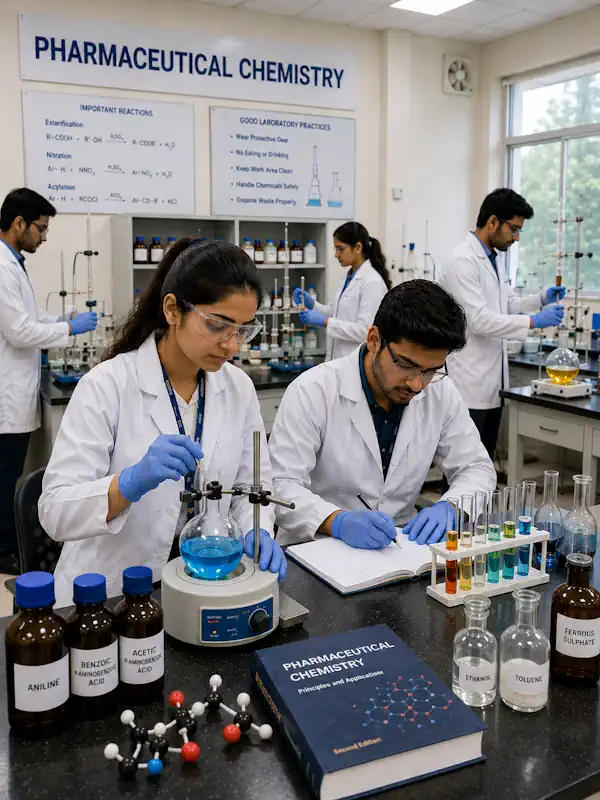

M Pharm Pharmaceutical Chemistry at Brainware University is a 2-year postgraduate programme focused on medicinal chemistry, drug design, organic synthesis, pharmaceutical analysis, molecular modelling, regulatory affairs, and research methodology. The course prepares students for careers in pharmaceutical R&D, drug discovery, quality control, analytical laboratories, clinical research, pharmacovigilance, and academic research.
| Programme | Master of Pharmacy in Pharmaceutical Chemistry |
|---|---|
| Duration | 2 years |
| Focus Areas | Pharmaceutical Chemistry, Medicinal Chemistry, Drug Design, Organic Synthesis, Pharmaceutical Analysis, Molecular Modelling, Spectroscopic Analysis, Chromatographic Techniques, Pharmacokinetics, Drug Discovery, Quality Control, Quality Assurance, Regulatory Affairs, Clinical Research, Pharmacovigilance, and Pharmaceutical Research. |
| Salary | Graduates of M Pharm Pharmaceutical Chemistry may explore entry-level salary packages commonly ranging from ₹3.5 LPA to ₹7 LPA, depending on technical skills, laboratory exposure, research work, analytical chemistry knowledge, recruiter profile, and interview performance. Higher growth may be possible in R&D, medicinal chemistry, regulatory affairs, pharmacovigilance, pharmaceutical analysis, and quality leadership roles with experience. |
| Popular Job Types | Pharmaceutical Chemist, R&D Scientist, Medicinal Chemist, Drug Discovery Scientist, Quality Control Analyst, Quality Assurance Officer, Clinical Research Associate, Analytical Scientist, Regulatory Affairs Associate, Pharmacovigilance Officer, Pharmaceutical Production Executive, Formulation Development Associate, Medical Writer, Scientific Officer, and Lecturer in Pharmacy Colleges. |
| Hiring Industries | Pharmaceutical companies, biotechnology firms, drug discovery laboratories, clinical research organisations, analytical testing laboratories, quality control units, regulatory affairs firms, pharmacovigilance companies, pharmaceutical manufacturing units, academic institutions, research organisations, nutraceutical companies, healthcare companies, and public-sector research bodies. |
| Top Recruiters | M Pharm Pharmaceutical Chemistry graduates may find opportunities with pharmaceutical companies, clinical research organisations, analytical laboratories, quality testing units, biotechnology companies, drug safety firms, academic institutions, and research organisations. Recruiter participation may vary by year, student profile, skill level, internship exposure, and placement cycle. |
| Specializations | Medicinal Chemistry, Pharmaceutical Analysis, Drug Design, Organic Synthesis, Molecular Modelling, Drug Discovery, Analytical Chemistry, Regulatory Affairs, Pharmacovigilance, Clinical Research, Quality Control, Quality Assurance, and Pharmaceutical Research. |
| Higher Studies | Graduates can pursue PhD programmes in Pharmaceutical Chemistry, Medicinal Chemistry, Pharmaceutical Sciences, Drug Discovery, Pharmaceutical Analysis, Pharmacology, Clinical Research, Regulatory Science, or related chemical and healthcare research areas. They may also take certifications in clinical research, pharmacovigilance, regulatory affairs, medical writing, quality assurance, GMP, GLP, and analytical techniques. |
| Benefits | The programme supports advanced pharmacy learning through medicinal chemistry study, pharmaceutical research, laboratory-based training, drug synthesis exposure, analytical method understanding, dissertation work, faculty mentorship, and placement-oriented preparation. It is suitable for students seeking M Pharm Pharmaceutical Chemistry, m pharmacy, m pharm course, or pharmaceutical chemistry syllabus details. |
| Internship and Placement | Students receive exposure to internships, research projects, laboratory assignments, pharmaceutical analysis practice, dissertation work, pre-placement training, interview preparation, and placement assistance. The programme aims to build job-ready skills for pharmaceutical R&D, analytical laboratories, quality control, regulatory affairs, clinical research, pharmacovigilance, and academic roles. |
| Location | Brainware University, Barasat, Kolkata, West Bengal. |
| Approvals & Recognition | Brainware University is a UGC-recognised university, and its pharmacy programmes are offered under the applicable academic and professional regulatory framework. Applicants should verify the latest approval and recognition status from official university sources before admission. |
Key reasons to study M Pharm Pharmaceutical Chemistry include:

Educational Qualification: Candidates must have completed B.Pharm from a recognised university or institution.
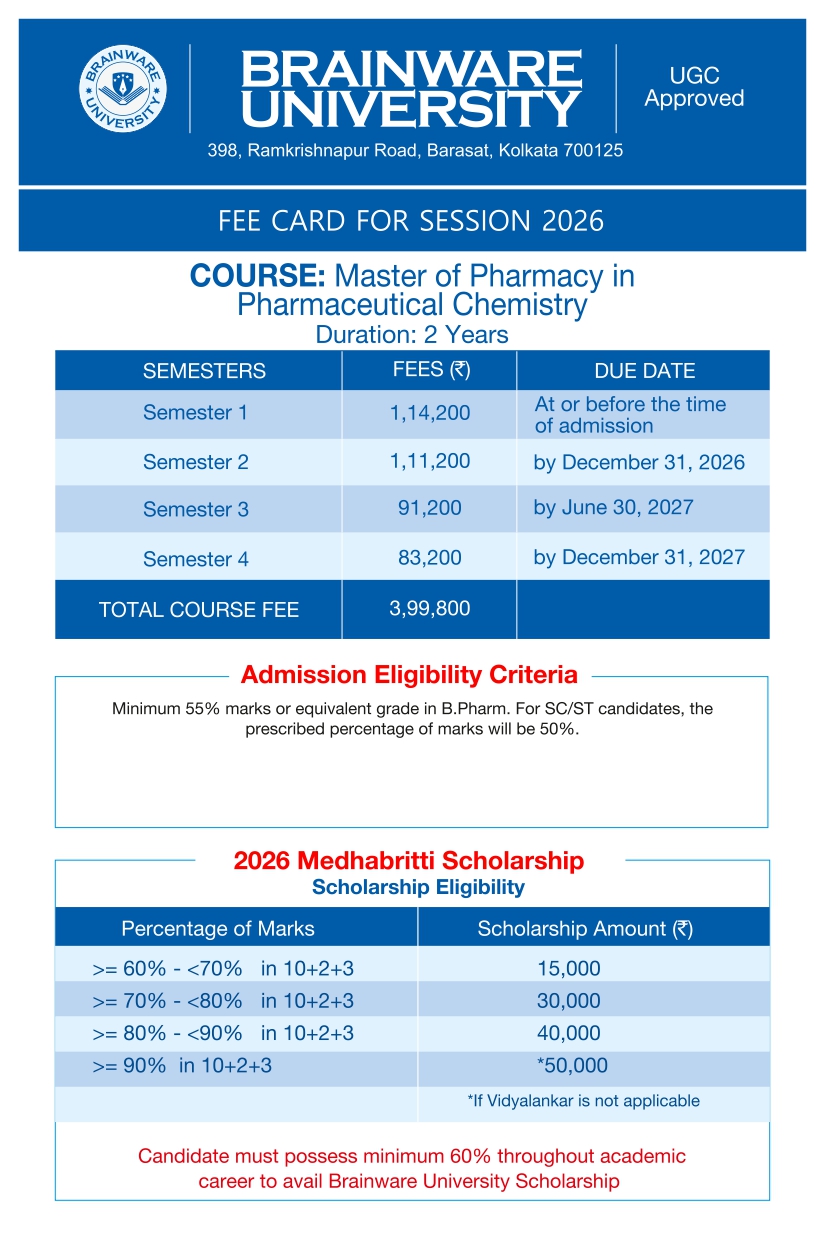
Minimum Marks: Applicants are required to secure a minimum of 55% marks or an equivalent grade in B.Pharm. For SC/ST candidates, the minimum required marks are 50%, as per university norms.
Entrance Examination: Admission to the M.Pharm (Pharmaceutical Chemistry) programme at Brainware University is based on performance in the Brainware Entrance Test (BET), the university's official entrance examination for postgraduate programmes.
Concerned about pursuing advanced studies in pharmaceutical sciences? At Brainware University, we are committed to providing quality postgraduate education that combines academic excellence with industry relevance. The M.Pharm (Pharmaceutical Chemistry) programme is designed to equip students with in-depth knowledge of drug design, medicinal chemistry, organic synthesis, pharmaceutical analysis, molecular modelling, and pharmaceutical research.
With a curriculum focused on modern drug development and chemical research, students gain hands-on experience through advanced laboratory training, research projects, and industry-oriented learning. Supported by experienced faculty members and state-of-the-art facilities, graduates are well prepared for careers in pharmaceutical industries, research and development organisations, quality control laboratories, regulatory sectors, and academic institutions.
The total course fee for M Pharm Pharmaceutical Chemistry at Brainware University is ₹3,99,800. The fee structure is designed to support advanced postgraduate education in pharmaceutical chemistry, medicinal chemistry, drug design, pharmaceutical analysis, molecular modelling, research methodology, and laboratory-based learning.
| Semesters | Semester 1 | Semester 2 | Semester 3 | Semester 4 | Semester 5 | Semester 6 | Semester 7 | Semester 8 | Semester 9 | Semester 10 | Total |
|---|---|---|---|---|---|---|---|---|---|---|---|
| Fees (INR) | 114200 | 111200 | 91200 | 83200 | 3,99,800 |
**Fees are subject to change, and the application fee of ₹5,000 is non-refundable under any circumstances. Please contact us for further details.
Scholarships(Fees): Brainware University offers merit-based scholarships for top performers and financial aid for deserving students. Scholarships are available for high scorers in entrance exams, board results, and outstanding achievements in innovation or research. Visit our scholarship page for more details.
**Please note that the Brainware Vidyalankar Scholarship is available only to students who passed their qualifying examination in the current admission year. Also, eligibility is strictly restricted to Indian nationals; international students are not eligible to apply.
AI-driven pharmaceutical chemistry helps students understand how artificial intelligence, molecular modelling, data analytics, and computational tools are reshaping drug discovery, compound screening, medicinal chemistry, toxicity prediction, pharmaceutical analysis, and research planning. AI can support faster identification of promising molecules and improve research efficiency in early-stage drug development.
The programme connects traditional pharmaceutical chemistry with emerging digital and computational approaches used in modern pharmaceutical research. Students gain awareness of how data-led tools support drug design, structure-activity relationship studies, molecular docking, analytical interpretation, and scientific documentation.
AI and digital innovation are relevant in areas such as:

The end-to-end AI learning spectrum in M Pharm Pharmaceutical Chemistry covers the research journey from molecule selection and literature review to synthesis planning, analytical evaluation, data interpretation, safety review, and scientific reporting. Students learn how digital tools can support research decisions while maintaining scientific accuracy and regulatory responsibility.
This learning spectrum helps students understand how pharmaceutical chemistry professionals can combine laboratory knowledge with computational awareness. AI can assist discovery and analysis, but expert judgment, validation, ethical practice, and experimental accuracy remain essential.
Key learning areas include:


Key academic strengths include:
When comparing M Pharm colleges, students should check:

Alumni from M Pharm Pharmaceutical Chemistry can build careers across pharmaceutical R&D, medicinal chemistry, drug discovery, quality control, quality assurance, clinical research, regulatory affairs, pharmacovigilance, analytical science, medical writing, academia, and research. Their career journeys show how postgraduate pharmacy training can support both industry and research pathways.


Brainware University has earned an AA+ rating in India’s Best Engineering Institutes by Careers360. The recognition reflects the University’s strength in academic quality, faculty, infrastructure, research, and student outcomes, reinforcing its position as a trusted destination for industry-aligned engineering education.

Brainware University has been ranked No. 1 Engineering College under a Private University in West Bengal in the IIRF Rankings 2026. The recognition highlights the University’s strength in engineering education, industry-focused learning, research, emerging technologies, and placement outcomes.

Brainware University has been ranked No. 2 Private University in West Bengal by uniRank 2026, marking another recognition of the University's growing presence in the state's higher education landscape.

Brainware University's inclusion in the Times Higher Education (THE) Impact Rankings 2025 reflects its contribution to the UN Sustainable Development Goals (SDGs) through education, innovation, sustainability, community engagement, and responsible institutional practices.

Brainware University has been recognised as the Best Private University of West Bengal in Infrastructure & Placement at Times Now.in – Leaders of Excellence: East 2026, celebrating its commitment to world-class infrastructure and career-focused education.

Brainware University has been recognised by The Times Group for excellence across Engineering (Placement), Law, and MBA Studies. The honours reflect the University’s multidisciplinary strength and its focus on career-oriented, industry-relevant education.

Brainware University received the ABP Ananda Shiksha Samman 2026 for Excellence in Placement & AI-Integrated Academic Infrastructure, acknowledging its emphasis on placement opportunities alongside technology-enabled academic development.

Brainware University has been honoured with the Zee 24 Ghanta Education Excellence Award 2026 for Best Industry Placement & Academic Infrastructure, continuing its recognition in 2022, 2023, 2024, 2025, and 2026. The University was also recognised in 2017 and 2018 for its job-oriented academic initiatives.

Brainware University received the TV9 Uttaran Academic Excellence Honour for Excellence in Placement & AI-Integrated Academic Infrastructure, highlighting its focus on combining career opportunities with an AI-enabled academic and learning environment.

Brainware University was honoured with the R Bangla Sikkha Gourab Samman 2026, recognising its contribution to higher education and continued pursuit of academic excellence and career-focused learning.

Brainware University was honoured as the Best Private University in West Bengal at the Times Now in Business Excellence Awards (East) 2025, recognising its academic quality, modern infrastructure, industry engagement, and focus on student success.

Brainware University was recognised as the Leading University in Infrastructure, Academics & Placement at the Times Business Awards West Bengal 2025, highlighting its strong campus facilities, academic ecosystem, and placement performance across disciplines.

The M Pharm Pharmaceutical Chemistry syllabus is designed to build postgraduate-level expertise in medicinal chemistry, drug design, organic synthesis, pharmaceutical analysis, molecular modelling, analytical techniques, research methodology, quality systems, and pharmaceutical research. The curriculum combines classroom learning, laboratory practice, research assignments, and dissertation work.
The syllabus prepares students to understand how drug molecules are designed, synthesised, characterised, tested, and studied for therapeutic use. It also supports careers in R&D, drug discovery, pharmaceutical analysis, quality control, regulatory affairs, and higher studies.
The core foundation modules in M Pharm Pharmaceutical Chemistry help students develop advanced knowledge of drug chemistry, medicinal chemistry, organic synthesis, analytical methods, pharmacokinetics, and pharmaceutical research. These subjects build the scientific base required for drug discovery and pharmaceutical analysis.
Core learning areas include:
These foundation areas help students connect chemical theory with laboratory and pharmaceutical industry applications.
The evolving and high-growth areas in M Pharm Pharmaceutical Chemistry prepare students for emerging opportunities in AI-assisted drug discovery, computational chemistry, green chemistry, analytical research, quality systems, clinical research, regulatory affairs, pharmacovigilance, and medicinal chemistry innovation.
Advanced learning areas include:
These modules help students build technical and research readiness for the future of pharmaceutical chemistry.
| Semester | Course |
|---|---|
| Semester I | Modern Pharmaceutical Analytical Techniques |
| Advanced Organic Chemistry - I | |
| Advanced Medicinal Chemistry | |
| Chemistry of Natural Products | |
| Pharmaceutical Chemistry Practical - I | |
| Seminar / Assignment | |
| Semester II | Advanced Spectral Analysis |
| Advanced Organic Chemistry - II | |
| Computer Aided Drug Design | |
| Pharmaceutical Process Chemistry | |
| Pharmaceutical Chemistry Practical - II | |
| Seminar / Assignment | |
| Semester III | Research Methodology and Biostatistics |
| Journal Club | |
| Discussion / Presentation (Proposal Presentation) | |
| Research Work | |
| Semester IV | Journal Club |
| Research Work & Colloquium | |
| Discussion / Final Presentation | |
| Co-curricular Activities |
Please note that the syllabus is subject to modification. Visit our Syllabus page for the elective subject details and updated syllabus.

M Pharm Pharmaceutical Chemistry graduates can work in private-sector roles across pharmaceutical companies, biotechnology firms, analytical laboratories, clinical research organisations, quality testing units, regulatory affairs consultancies, pharmacovigilance firms, medical writing companies, and manufacturing organisations. Career growth depends on laboratory skills, chemical knowledge, research exposure, documentation accuracy, and industry readiness.
Students with strong skills in medicinal chemistry, drug synthesis, spectroscopic analysis, chromatographic techniques, molecular modelling, regulatory documentation, and pharmaceutical research are better positioned for industry roles.
M Pharm Pharmaceutical Chemistry graduates may explore government and public-sector opportunities in drug regulation, public research institutions, hospital pharmacy, drug testing laboratories, public-sector pharmaceutical units, teaching, and healthcare administration. These roles often require knowledge of pharmaceutical chemistry, drug safety, analytical testing, quality systems, and regulatory norms.
Candidates should check official recruitment notifications, eligibility rules, examination patterns, and organisation-specific requirements.
M Pharm Pharmaceutical Chemistry career prospects are strong for students who want to work in drug design, medicinal chemistry, pharmaceutical analysis, quality control, clinical research, regulatory affairs, pharmacovigilance, academia, and research. A Master of Pharmacy in Pharmaceutical Chemistry gives graduates specialised knowledge of drug molecules, synthesis methods, analytical testing, and pharmaceutical research.
| Area of Opportunity | Why It’s in Demand |
|---|---|
| Pharmaceutical Chemist | The pharmaceutical industry requires experts in drug design, synthesis, and evaluation to develop safe and effective medicines for emerging healthcare challenges. |
| Research & Development (R&D) Scientist | Continuous innovation in pharmaceuticals and biotechnology has increased demand for professionals who can discover, develop, and improve drug molecules and formulations. |
| Medicinal Chemist | Growing investments in drug discovery and precision medicine have created opportunities for specialists who can design and optimise therapeutic compounds. |
| Drug Discovery Scientist | Pharmaceutical and biotechnology companies seek skilled researchers to identify new drug candidates and accelerate the development of innovative treatments. |
| Quality Control (QC) Analyst | Strict regulatory standards require qualified professionals to ensure the quality, safety, and consistency of pharmaceutical products before market release. |
| Quality Assurance (QA) Officer | Increasing emphasis on compliance with national and international regulations has made quality assurance a critical function in pharmaceutical manufacturing. |
| Clinical Research Associate | Clinical trials and drug development activities are expanding globally, creating demand for professionals who can manage research studies, ensure regulatory compliance, and support new drug approvals. |
| Analytical Scientist | Advanced analytical techniques are essential for drug testing, validation, and quality assessment, driving demand for skilled analytical professionals. |
| Regulatory Affairs Associate | Pharmaceutical companies need experts who can navigate complex regulatory frameworks and facilitate timely approval of medicines and healthcare products. |
| Pharmacovigilance Officer | The growing focus on patient safety and post-marketing surveillance has increased the need for professionals who monitor and assess adverse drug reactions. |
| Pharmaceutical Production Executive | Expanding pharmaceutical manufacturing operations require specialists who can oversee production processes while maintaining quality and efficiency. |
| Formulation Development Associate | Demand for innovative drug delivery systems and improved formulations has created opportunities in formulation research and product development. |
| Academician / Lecturer in Pharmacy Colleges | The expansion of pharmacy education and research institutions has generated demand for qualified faculty members and academic researchers. |
| Scientific Officer in Research Organisations | Government and private research institutes require scientific professionals to contribute to pharmaceutical research, innovation, and technology development. |
| Medical Writing and Scientific Documentation Specialist | The increasing need for accurate scientific communication, regulatory submissions, and research documentation has expanded opportunities in medical writing. |
The career scope after M Pharm Pharmaceutical Chemistry depends on the student’s laboratory skills, research exposure, dissertation work, analytical chemistry knowledge, regulatory awareness, and communication ability. Graduates who combine pharmaceutical chemistry expertise with research methods, quality systems, pharmacovigilance awareness, and documentation skills can build stable careers in pharmaceutical and healthcare sectors.
The job market for M Pharm Pharmaceutical Chemistry graduates is expected to grow steadily from 2025 to 2032 as pharmaceutical companies, biotechnology firms, clinical research organisations, analytical laboratories, and regulatory bodies expand their focus on drug discovery, quality testing, drug safety, and research-led innovation. India’s pharmaceutical sector continues to show growth, and AI adoption is also increasing in pharmaceutical R&D.
Demand will be especially relevant for graduates trained in medicinal chemistry, drug design, analytical techniques, quality control, regulatory affairs, clinical research, pharmacovigilance, and computational chemistry. WHO defines pharmacovigilance as the science and activities related to detecting, assessing, understanding, and preventing adverse medicine or vaccine-related problems, which reinforces the growing importance of drug safety roles.
Pharmaceutical chemistry career growth will be driven by drug discovery, analytical research, regulatory compliance, drug safety monitoring, quality assurance, generic medicine development, biosimilars, personalised medicine, and AI-supported R&D. Pharmaceutical organisations will need professionals who understand both chemical research and industry documentation.
Major growth drivers include:
The fastest-growing roles for M Pharm Pharmaceutical Chemistry graduates will include Medicinal Chemist, Drug Discovery Scientist, R&D Scientist, Analytical Scientist, Quality Control Analyst, Regulatory Affairs Associate, Pharmacovigilance Officer, Clinical Research Associate, Medical Writer, and Scientific Officer. These roles require chemical knowledge, laboratory skill, documentation discipline, and regulatory awareness.
High-growth career roles include:
M Pharm Pharmaceutical Chemistry graduates will find opportunities in industries and organisations that depend on drug discovery, chemical analysis, medicine quality, regulatory compliance, and clinical research. Hiring is expected across pharmaceutical, biotechnology, healthcare, academic, and research sectors.
Key hiring industries include:
The most valuable skills from 2025 to 2032 will include medicinal chemistry, organic synthesis, pharmaceutical analysis, spectroscopy, chromatography, molecular modelling, regulatory documentation, pharmacovigilance, clinical research awareness, scientific writing, and data interpretation. Employers will prefer candidates who combine laboratory skill with compliance and documentation discipline.
Important skill areas include:
The growth outlook for M Pharm Pharmaceutical Chemistry graduates is positive because pharmaceutical and healthcare industries need qualified professionals who can support safer medicines, stronger quality systems, faster research, and reliable regulatory processes. By 2032, the strongest opportunities will favour students with laboratory confidence, research exposure, analytical skill, and awareness of digital pharmaceutical tools.
Students should focus on building:
The future pharmaceutical job market will reward students who can combine chemical science with practical industry readiness. Employers will seek professionals who understand drug design, analytical testing, quality standards, regulatory responsibility, patient safety, and emerging technology in pharmaceutical research.
For students choosing M Pharm Pharmaceutical Chemistry, the focus should be on curriculum quality, laboratory infrastructure, faculty mentorship, industry exposure, research guidance, professional approval status, and placement support. Brainware University’s Master of Pharmacy in Pharmaceutical Chemistry programme is structured to support these academic and career needs for students aiming at pharmaceutical chemistry careers from 2025 onwards.


Industry-institute engagement is important for M Pharm Pharmaceutical Chemistry because pharmaceutical education depends on practical exposure, research awareness, laboratory discipline, and understanding of real drug development systems. Brainware University supports this learning through academic activities, industry visits, workshops, laboratory exposure, healthcare outreach, and collaboration-oriented initiatives.





M Pharm Pharmaceutical Chemistry admission 2026 at Brainware University is open to eligible B.Pharm graduates who want advanced postgraduate education in drug design, medicinal chemistry, pharmaceutical analysis, molecular modelling, drug discovery, quality control, and pharmaceutical research. Applicants should review eligibility, BET requirements, application steps, counselling process, fees, scholarships, and document requirements before applying.
Admission Criteria: Admission to Master of Pharmacy in Pharmaceutical Chemistry is based on academic eligibility and university admission norms. Candidates must have completed B.Pharm from a recognised university or institution with the required minimum marks. Admission is based on performance in BET, the Brainware Entrance Test.
Application: Candidates can apply online by filling up the enquiry or application form on the Brainware University website. Applicants need to provide their name, course preference, location, phone number, email ID, and academic details. After submission, the admission counselling team will guide them through the next steps.
Entrance Exam: Admission to the M Pharm Pharmaceutical Chemistry programme is based on BET, the Brainware Entrance Test conducted by the university for postgraduate admission. Candidates should confirm the current BET schedule, syllabus, mode, and selection requirements with the admission office before applying.
Counselling: After application and eligibility review, shortlisted candidates receive counselling support from the university admission team. Counselling helps students understand the M Pharm Pharmaceutical Chemistry course, eligibility, fees, syllabus, scholarship options, placement scope, documents required, and final admission steps.
Direct Admission: Direct admission may be available for eligible candidates as per university norms, seat availability, and admission criteria. Students seeking M Pharm Pharmaceutical Chemistry admission 2026, M Pharm admission, or pharmacy admission should contact the admission counsellor to confirm eligibility, required documents, BET requirements, and the latest admission procedure.
Please follow the given M Pharm Pharmaceutical Chemistry Admission Procedure in Brainware University:

Through these initiatives, the department has built a strong ecosystem for academic excellence, innovation, research collaboration, and community engagement, making it a recognised leader in pharmacy education in Eastern India.

Students are given the theoretical knowledge, professional behaviours, and clinical skills necessary to become pharmacists through the programme’s integration of science and practice.
Students should choose Brainware University for M.Pharm in Pharmaceutical Chemistry in 2026 because the programme develops advanced knowledge in medicinal chemistry, drug design, analytical techniques, organic synthesis, pharmaceutical analysis, and quality control. Supported by research-driven learning, laboratory training, a 98% placement rate across courses, 1000+ recruiters, industry exposure, and placement assistance, Brainware University helps students prepare for careers in pharmaceutical research, analytical laboratories, quality control, drug development, and academia.
Since M.Pharm in Pharmaceutical Chemistry is a postgraduate degree and not a doctoral qualification, graduates cannot use the prefix “Dr.” solely on the basis of completing this programme.
The average annual salary for MPharm professionals in India may range from ₹2.5 lakh to ₹5.2 lakh at the entry level. Salary packages vary depending on the candidate’s skills, experience, job role, employer, location, and industry demand.
BPharm is an undergraduate pharmacy degree, while MPharm is a postgraduate programme pursued after BPharm. Students interested in advanced knowledge, research and development, specialised pharmaceutical roles, higher studies, or academic careers may consider pursuing an MPharm degree.
M.Pharm in Pharmaceutical Chemistry is a promising field in India with career opportunities in research and development, clinical research, drug safety, regulatory affairs, quality control, pharmaceutical manufacturing, medicinal chemistry, and drug discovery. Graduates may also pursue entrepreneurship, doctoral programmes, research fellowships, and academic careers while contributing to the development of new drugs, drug delivery systems, and pharmaceutical formulations.
Research areas include drug discovery and development, medicinal chemistry, organic synthesis, pharmaceutical analysis, pharmacokinetics and pharmacodynamics, clinical research, toxicology, quality control, computational chemistry, biotechnology, nanotechnology, and advanced drug delivery systems.
Popular career profiles include Medicinal Chemist, Drug Discovery Scientist, Research and Development Scientist, Clinical Research Associate, Quality Control Analyst, Analytical Scientist, Regulatory Affairs Associate, Pharmacovigilance Officer, Drug Inspector, Pharmaceutical Scientist, and Formulation Development Associate.
M.Pharm in Pharmaceutical Chemistry is a postgraduate programme focused on drug design, medicinal chemistry, pharmaceutical synthesis, compound analysis, quality evaluation, molecular modelling, and research in pharmaceutical sciences.
Students should compare curriculum quality, laboratory infrastructure, faculty experience, research opportunities, industry exposure, professional approval status, and placement support when selecting a college. Brainware University offers an industry-oriented M.Pharm in Pharmaceutical Chemistry programme with advanced laboratories, research opportunities, faculty mentorship, and placement preparation.
Admission is generally based on completion of B.Pharm from a recognised institution, the required minimum marks, and the admission criteria of the respective university. Selection may involve GPAT scores, a university entrance examination, merit-based evaluation, or other applicable admission requirements.
The M.Pharm in Pharmaceutical Chemistry programme has a duration of 2 years, divided into 4 semesters.
The curriculum generally includes medicinal chemistry, advanced organic chemistry, pharmaceutical analysis, drug design and development, spectroscopic analysis, chromatographic techniques, pharmacokinetics, quality systems, research methodology, practical training, and dissertation work.
Graduates can pursue careers as Medicinal Chemists, Pharmaceutical Chemists, Drug Discovery Scientists, R&D Scientists, Analytical Scientists, Quality Control Analysts, Quality Assurance Officers, Regulatory Affairs Associates, Clinical Research Associates, and Pharmacovigilance Officers.
Salary packages vary according to technical expertise, research experience, job role, employer, location, and industry demand. Graduates with strong skills in drug design, pharmaceutical analysis, regulatory affairs, quality systems, and computational chemistry may access better career growth with experience.
Graduates may explore opportunities with pharmaceutical manufacturers, biotechnology companies, drug discovery laboratories, clinical research organisations, analytical testing laboratories, regulatory consultancies, and pharmacovigilance firms. Recruiter participation varies according to the placement cycle, job requirements, and candidate profile.
Revise medicinal chemistry, drug synthesis, pharmaceutical analysis, spectroscopic and chromatographic techniques, pharmacokinetics, quality systems, regulatory requirements, and problem-solving concepts. Candidates should also be prepared to explain their dissertation, laboratory projects, research findings, and internship experience.
A strong resume should highlight research projects, dissertation work, drug synthesis experience, analytical skills, laboratory techniques, software knowledge, industrial training, publications, conference participation, and understanding of quality and regulatory guidelines.
Students can improve these skills by working on organic synthesis and medicinal chemistry projects, practising analytical techniques, participating in laboratory research, attending pharmaceutical workshops, completing internships, and undertaking dissertation-based research.
Useful tools may include ChemDraw, molecular docking software, QSAR tools, molecular modelling platforms, statistical analysis software, pharmacokinetic simulation tools, reference management software, and scientific data-analysis applications. Tool availability depends on the institution and research area.
In-demand skills include medicinal chemistry, drug design, organic synthesis, spectroscopic interpretation, chromatographic analysis, analytical method development, pharmacokinetics, molecular docking, QSAR, ADMET prediction, quality control, and regulatory documentation.
Students can gain practical experience through laboratory projects, dissertation research, industrial internships, workshops, analytical method development, research publications, conference presentations, and collaboration with pharmaceutical companies and research organisations.
Students should read peer-reviewed pharmaceutical journals, follow regulatory and research updates, attend conferences, webinars, workshops, and industry events, and engage with recognised pharmaceutical, scientific, and professional organisations.
Artificial intelligence supports drug discovery, molecular screening, compound optimisation, toxicity prediction, ADMET analysis, structure-activity relationship studies, analytical data interpretation, and predictive research workflows in pharmaceutical R&D.
Important trends include eco-friendly synthesis, reduced use of hazardous solvents, solvent-free reactions, energy-efficient processes, recyclable catalysts, waste reduction, safer reagents, and sustainable pharmaceutical manufacturing practices.
Computational chemistry helps researchers study molecular interactions, screen potential compounds, predict biological activity, evaluate ADMET properties, optimise lead molecules, and reduce the time and cost associated with early-stage drug discovery.
Career prospects are growing in medicinal chemistry, drug discovery, biopharmaceuticals, personalised medicine, analytical research, synthetic chemistry, computational drug design, regulatory science, quality systems, and pharmaceutical product development.
Graduates can contribute by conducting pharmaceutical research, publishing scientific papers, developing new drug candidates, supporting patent applications, participating in clinical and analytical studies, and collaborating with national and international pharmaceutical R&D teams.