98%
Placed
in 2025






Brainware University transformed me, fostering confidence and capability for conquering the world.
Master of Medical Laboratory Science is a postgraduate programme designed for graduates who want advanced knowledge and practical training in clinical diagnostics, laboratory medicine, pathology, microbiology, biochemistry, haematology, immunology, and molecular testing. The course prepares students for specialised roles in hospitals, diagnostic laboratories, research centres, public health organisations, and healthcare institutions.
The programme develops the scientific, technical, analytical, and research skills required to perform and interpret complex laboratory investigations accurately. Students gain exposure to advanced diagnostic methods, quality control, laboratory management, biomedical research, clinical data interpretation, and emerging technologies used in modern medical laboratories.
The applicants will find all MLS admission relevant information on this page including the MSc Medical Lab Technology programme overview, syllabus outline, career options, as well as learning benefits. MLS course information concerning MLS course fees, MLS eligibility criteria and MLS admission criteria are provided as well.
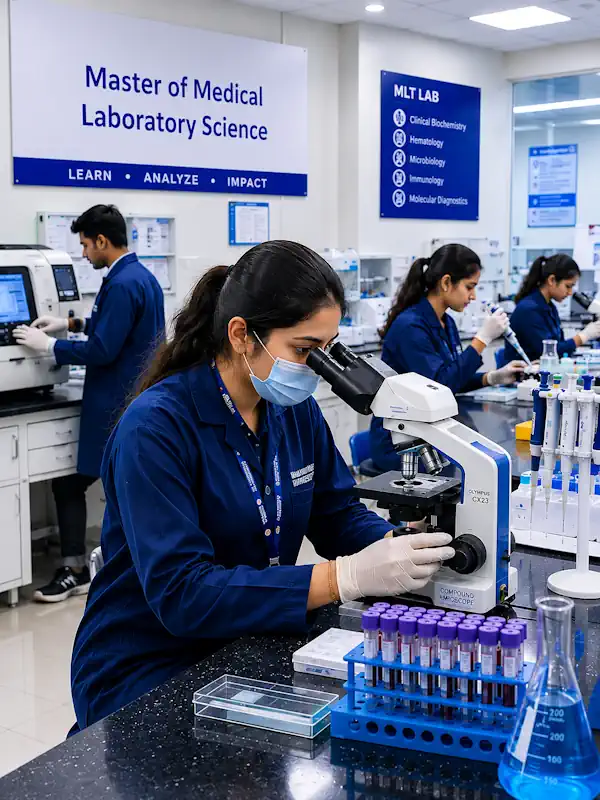

The MSc Medical Laboratory Science programme at Brainware University is a two-year postgraduate course focused on advanced diagnostic science, laboratory automation, molecular biology, AI-enabled testing, and clinical research, preparing graduates for leadership roles in modern diagnostic and healthcare ecosystems.
| Programme | Master of Medical Laboratory Science |
|---|---|
| Duration | 2 years |
| Focus Areas |
|
| Salary | Graduates of MSc Medical Laboratory Science typically earn ₹4–6 LPA at entry level. With experience and specialisation, professionals can earn ₹8–12 LPA, while laboratory managers, molecular technologists, and research scientists in advanced diagnostic centres may earn even higher compensation. |
| Popular Job Types |
|
| Hiring Industries |
|
| Top Recruiters |
|
| Specializations |
|
| Higher Studies |
|
| Benefits |
|
| Internship and Placement | Students undergo hospital-based internships, diagnostic lab training, and research projects through university-hospital tie-ups. The placement cell provides continuous skill development, interview preparation, and recruiter engagement to ensure employability from day one. |
| Location | The programme is offered at Brainware University’s Barasat campus, equipped with advanced medical laboratories and supported by strong hospital and diagnostic centre collaborations across Kolkata. |
| Approvals & Recognition |
|

Educational Qualification: Candidates must have completed a Bachelor in Medical Laboratory Technology (MLT) from any recognized University or B.Sc. in Biological Science / Life Sciences (excluding Botany).
Minimum Marks: Minimum 55% marks or equivalent grade in Bachelor in MLT or 60% marks or equivalent grade in B.Sc. Biological Science / Life Sciences.
A 5% relaxation in marks will be applied for all reserved category candidates.
Entrance Criteria: Admission is based on merit or through the Brainware Entrance Test (BET) as applicable.
Pursue your passion for clinical diagnostics, pathology, microbiology, hematology, and laboratory medicine with the Master of Medical Laboratory Science programme designed to deliver high-quality professional education at an affordable cost. The course offers access to advanced diagnostic laboratories, modern medical instruments, expert faculty guidance, and hands-on clinical exposure through practical training, hospital-oriented lab work, and project-based learning. With a balanced investment in theoretical foundations and intensive laboratory practice, this programme prepares students for successful careers in diagnostic laboratories, hospitals, research centres, public health institutions, and the expanding healthcare and medical testing industry.
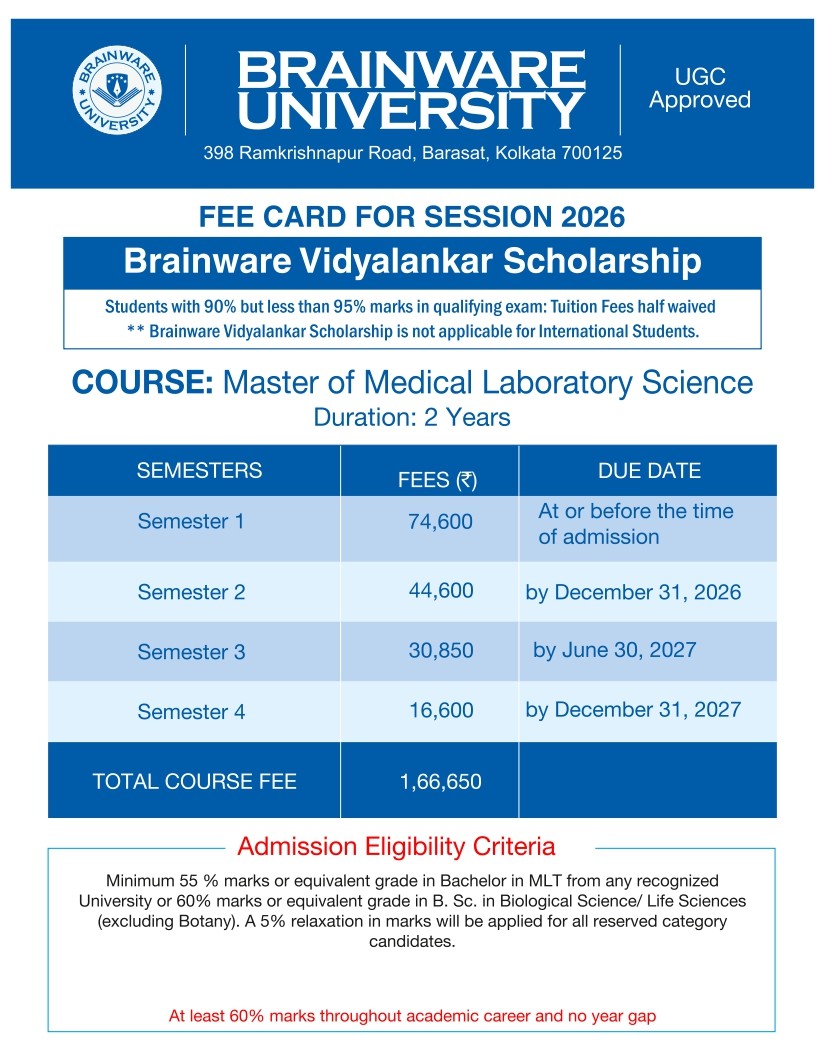
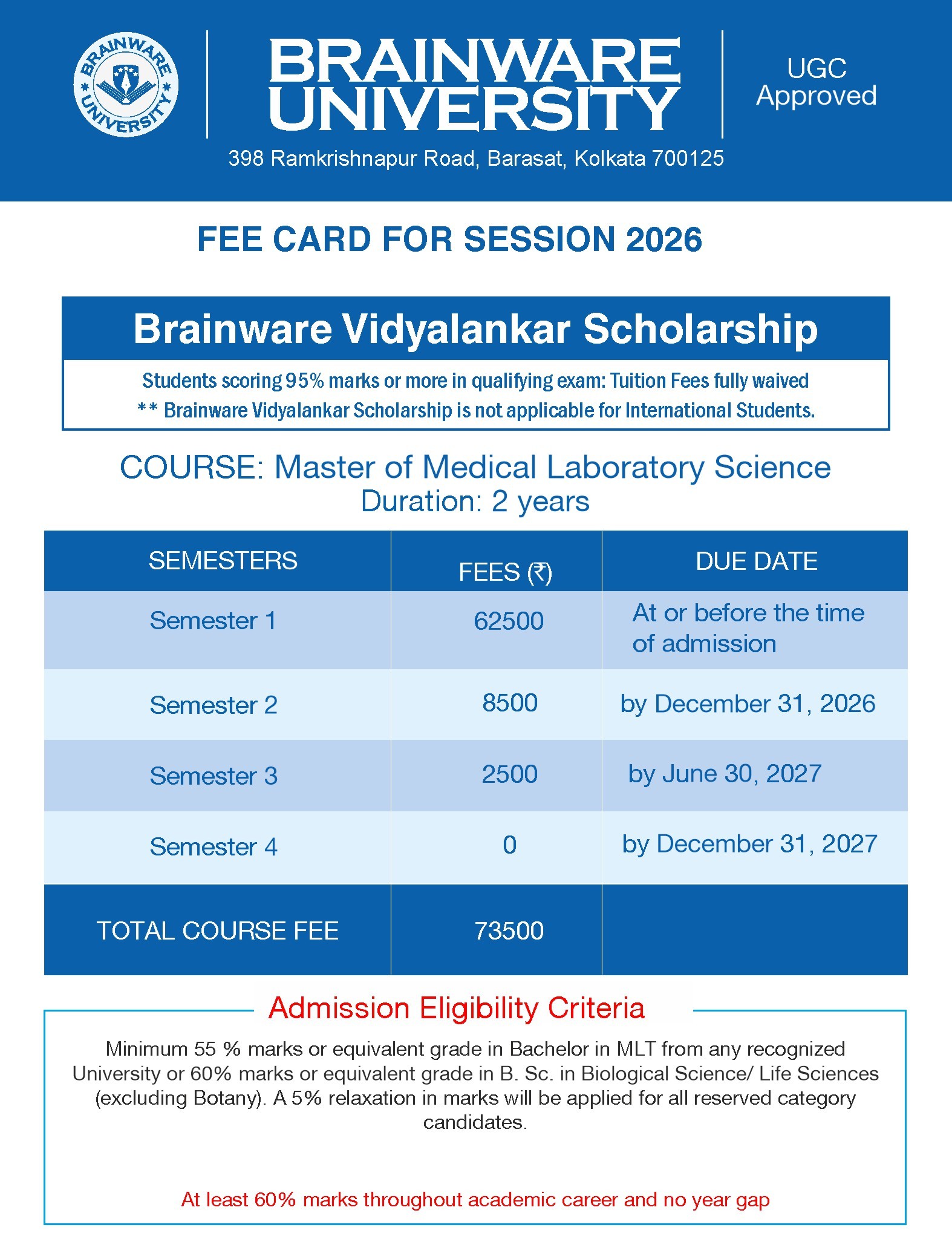
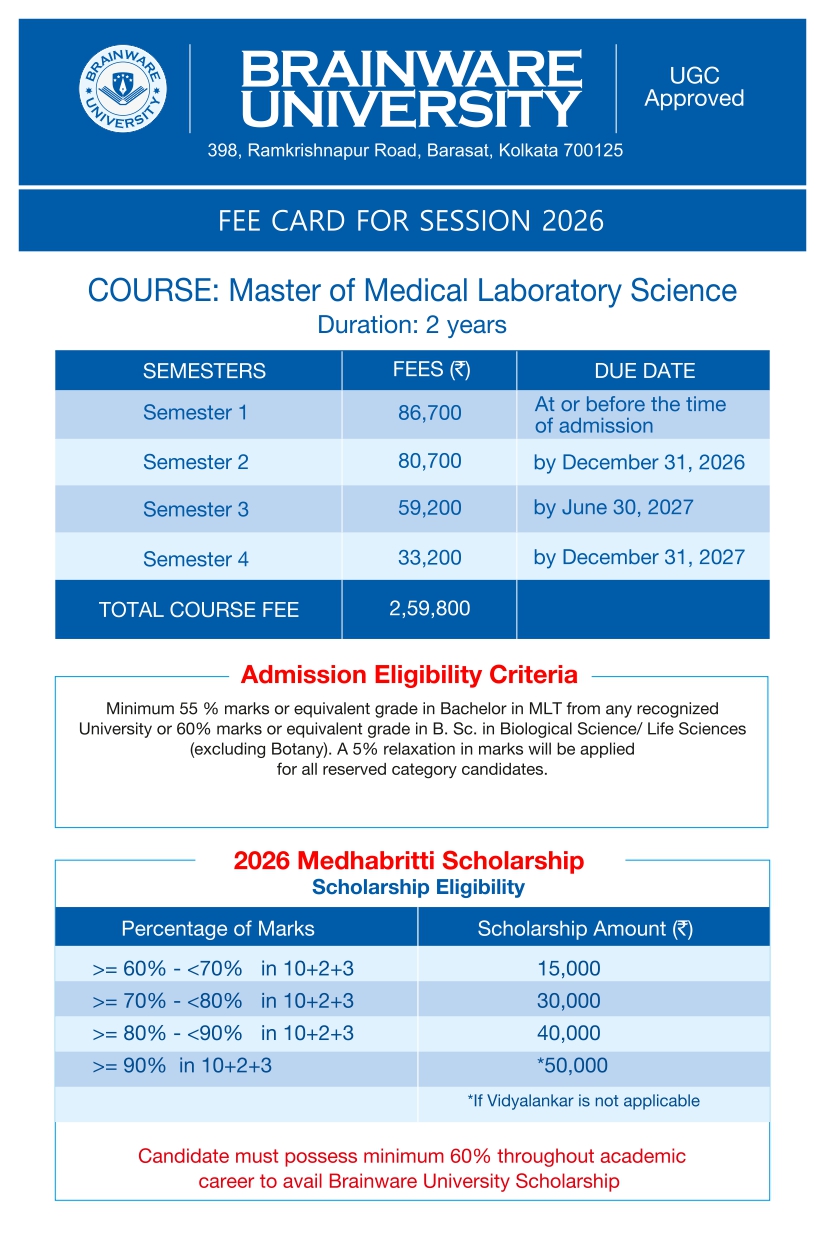
The Master of Medical Laboratory Science (MSc MLS) programme follows a transparent and student-centric fee structure designed to reflect the advanced nature of postgraduate laboratory training. The course fees cover classroom instruction, access to specialised diagnostic laboratories, advanced instruments, research facilities, practical training, internal assessments, and academic mentoring. This structured fee model ensures students receive high-quality education, hands-on exposure, and strong career value without hidden costs. Detailed semester-wise fees are provided in the table below for clarity and financial planning
| Semesters | Semester 1 | Semester 2 | Semester 3 | Semester 4 | Semester 5 | Semester 6 | Semester 7 | Semester 8 | Semester 9 | Semester 10 | Total |
|---|---|---|---|---|---|---|---|---|---|---|---|
| Fees (INR) | 86700 | 80700 | 59200 | 33200 | 0 | 0 | 0 | 0 | 0 | 0 | 259800 |
**Fees are subject to change, and the application fee of ₹5,000 is non-refundable under any circumstances. Please contact us for further details.
Scholarships(Fees): Brainware University offers merit-based scholarships for top performers and financial aid for deserving students. Scholarships are available for high scorers in entrance exams, board results, and outstanding achievements in innovation or research. Visit our scholarship page for more details.
**Please note that the Brainware Vidyalankar Scholarship is available only to students who passed their qualifying examination in the current admission year. Also, eligibility is strictly restricted to Indian nationals; international students are not eligible to apply.
Artificial Intelligence is changing the way modern diagnostic laboratories work. In the Master of Medical Laboratory Science programme, students gain exposure to how AI-supported systems assist in faster reporting, better sample analysis, digital pathology, disease screening, laboratory quality control, and clinical decision support.
AI in medical laboratory science is especially useful in areas such as haematology, microbiology, biochemistry, histopathology, molecular diagnostics, immunology, and cytology. It can help identify abnormal patterns in blood samples, support image-based analysis, reduce manual error, track laboratory workflow, and improve the accuracy of diagnostic interpretation when used under expert supervision.
The programme helps students understand how advanced laboratory science is becoming more data-driven, automated, and technology-enabled. Learners are introduced to the responsible use of AI, digital laboratory systems, automation, patient data security, quality assurance, and ethical reporting practices. This prepares them for future-ready roles in hospitals, diagnostic laboratories, research centres, healthcare technology companies, and advanced pathology units.

The AI learning spectrum in Master of Medical Laboratory Science connects core diagnostic knowledge with emerging digital and automated laboratory practices. Students learn how AI can support the full diagnostic workflow, from sample processing and analysis to reporting, quality checks, and clinical interpretation.
Key learning areas may include:
This learning spectrum helps students understand that AI is not a replacement for trained laboratory professionals. It is a support system that improves speed, consistency, and analytical depth when guided by qualified experts.



The allied health science programmes have established successful careers across diagnostic laboratories, hospital pathology departments, research institutes, and pharmaceutical companies. Alumni serve as Medical Laboratory Technologists, Blood Bank Officers, Quality Control Analysts, and Research Assistants in reputed healthcare institutions such as Apollo Diagnostics, SRL Diagnostics, Tata Medical Centre, and government health services.
Many alumni have progressed to higher studies, including Clinical Biochemistry, Molecular Diagnostics, and Biomedical Research, strengthening their expertise and leadership potential in the healthcare sector.
Their journeys reflect the university’s commitment to academic rigor, clinical excellence, and professional readiness in the field of diagnostic medicine.


Brainware University has earned an AA+ rating in India’s Best Engineering Institutes by Careers360. The recognition reflects the University’s strength in academic quality, faculty, infrastructure, research, and student outcomes, reinforcing its position as a trusted destination for industry-aligned engineering education.

Brainware University has been ranked No. 1 Engineering College under a Private University in West Bengal in the IIRF Rankings 2026. The recognition highlights the University’s strength in engineering education, industry-focused learning, research, emerging technologies, and placement outcomes.

Brainware University has been ranked No. 2 Private University in West Bengal by uniRank 2026, marking another recognition of the University's growing presence in the state's higher education landscape.

Brainware University's inclusion in the Times Higher Education (THE) Impact Rankings 2025 reflects its contribution to the UN Sustainable Development Goals (SDGs) through education, innovation, sustainability, community engagement, and responsible institutional practices.

Brainware University has been recognised as the Best Private University of West Bengal in Infrastructure & Placement at Times Now.in – Leaders of Excellence: East 2026, celebrating its commitment to world-class infrastructure and career-focused education.

Brainware University has been recognised by The Times Group for excellence across Engineering (Placement), Law, and MBA Studies. The honours reflect the University’s multidisciplinary strength and its focus on career-oriented, industry-relevant education.

Brainware University received the ABP Ananda Shiksha Samman 2026 for Excellence in Placement & AI-Integrated Academic Infrastructure, acknowledging its emphasis on placement opportunities alongside technology-enabled academic development.

Brainware University has been honoured with the Zee 24 Ghanta Education Excellence Award 2026 for Best Industry Placement & Academic Infrastructure, continuing its recognition in 2022, 2023, 2024, 2025, and 2026. The University was also recognised in 2017 and 2018 for its job-oriented academic initiatives.

Brainware University received the TV9 Uttaran Academic Excellence Honour for Excellence in Placement & AI-Integrated Academic Infrastructure, highlighting its focus on combining career opportunities with an AI-enabled academic and learning environment.

Brainware University was honoured with the R Bangla Sikkha Gourab Samman 2026, recognising its contribution to higher education and continued pursuit of academic excellence and career-focused learning.

Brainware University was honoured as the Best Private University in West Bengal at the Times Now in Business Excellence Awards (East) 2025, recognising its academic quality, modern infrastructure, industry engagement, and focus on student success.

Brainware University was recognised as the Leading University in Infrastructure, Academics & Placement at the Times Business Awards West Bengal 2025, highlighting its strong campus facilities, academic ecosystem, and placement performance across disciplines.

The students of MLS at Brainware University will have the following learning advantages.
The syllabus outline will be updated shortly.
*MOOC/Equivalent MOOC approved by BoS Chair (Evaluation scheme as per Blended Learning and MOOC Policy)Please note that the syllabus is subject to modification. Visit our Syllabus page for the elective subject details and updated syllabus.

Graduates work in private hospitals, diagnostic chains, research labs, biotech firms, and pharmaceutical companies as laboratory scientists, quality analysts, molecular technologists, research coordinators, and lab managers—supporting advanced diagnostics and healthcare innovation.
Opportunities exist in government hospitals, public health laboratories, forensic departments, blood banks, research institutions, and health missions as laboratory officers, scientific assistants, quality inspectors, and diagnostic specialists.
| Job Title | Core Function |
|---|---|
| Clinical Laboratory Scientist | Performs advanced diagnostic tests and analyzes complex biological samples to aid in disease diagnosis. |
| Research Scientist | Conducts laboratory-based experiments to develop new diagnostic tools, treatments, or medical procedures. |
| Laboratory Manager | Directs the overall operations of a medical lab, including budgeting, staffing, and regulatory compliance. |
| Quality Control/Assurance Analyst | Monitors and validates laboratory processes to ensure results are accurate, reliable, and meet industry standards. |
| Clinical Research Coordinator | Oversees the daily operations of clinical trials, ensuring data collection follows strict medical protocols. |
| Molecular Technologist | Specializes in analyzing DNA, RNA, and proteins to detect genetic disorders or infectious diseases. |
| Biomedical Scientist | Investigates the biological mechanisms of diseases to help doctors choose or develop effective treatments. |
| Pathologist's Assistant | Assists pathologists in examining surgical specimens and performing autopsies to determine causes of disease. |
| Consultant in Laboratory Medicine | Provides expert technical and operational advice to healthcare facilities on lab setup and specialized testing. |
| Academic Lecturer/Professor | Delivers lectures to undergraduate/graduate students and leads academic research in the field of MLT. |
| Regulatory Affairs Specialist | Ensures that diagnostic products and laboratory procedures comply with government health laws and safety codes. |
| Entrepreneur/Diagnostic Lab Owner | Operates a private diagnostic business, managing everything from clinical testing to commercial growth. |
With rapid growth in diagnostic technologies, molecular medicine, and AI-driven healthcare, MSc Medical Laboratory Science graduates enjoy stable, respected, and future-proof career opportunities in India and abroad.
The job market for MSc in Medical Lab Technology graduates from 2025 to 2032 is expected to grow with the expansion of diagnostic services, preventive healthcare, molecular testing, digital pathology, laboratory automation, and AI-supported diagnostic systems. India’s diagnostic laboratory market is projected to grow strongly up to 2030, supported by rising health awareness, chronic disease testing, hospital-based diagnostics, and wider access to testing services. (TechSci Research)
Medical laboratory professionals will remain important because doctors, hospitals, diagnostic centres, research laboratories, and public health systems depend on accurate test results for disease detection, treatment planning, monitoring, and prevention. WHO has also identified diagnostics capacity as a global health priority, including the need to strengthen laboratory systems, workforce capacity, and reliable access to diagnostic services. (World Health Organization)
Between 2025 and 2032, graduates with advanced laboratory skills, digital diagnostic awareness, quality assurance knowledge, and practical training in modern lab instruments will be better prepared for career growth. Students who build expertise in molecular diagnostics, automation, digital pathology, laboratory management, and AI-supported analysis can explore stronger opportunities across hospitals, diagnostic centres, healthcare technology companies, research institutions, and public health organisations.

Delve into the intricacies of medical laboratory technology with our Master of Science (MSc) program at Brainware University. Our MLS syllabus is carefully crafted to provide students with a comprehensive understanding of the field, covering a wide range of subjects essential for a successful career in medical diagnostics. From laboratory techniques and diagnostic procedures to quality assurance and research methodologies, our syllabus equips students with the knowledge and skills needed to excel in various healthcare settings.
Our MLS program covers a diverse range of subjects designed to prepare students for the challenges of the healthcare industry. Explore topics such as clinical chemistry, haematology, microbiology, immunology, and molecular diagnostics. Through a combination of theoretical lectures, practical laboratory sessions, and clinical rotations, students gain hands-on experience in performing diagnostic tests, analyzing samples, and interpreting results. Our goal is to ensure that graduates are well-equipped to meet the demands of the ever-evolving field of medical laboratory technology.

Brainware University maintains active collaborations with hospitals, diagnostic centres, research institutes, and healthcare organisations to provide internships, clinical training, expert lectures, and industry-aligned projects—bridging academic learning with real-world diagnostic practice.






Securing admission into our MLS program is your first step towards a successful career in medical laboratory technology. At Brainware University, we welcome students who have a passion for science and a desire to make a difference in healthcare. Our admission process is straightforward and transparent, ensuring that qualified candidates have the opportunity to join our esteemed program. With our experienced faculty, state-of-the-art facilities, and hands-on learning opportunities, Brainware University is the top choice for aspiring medical laboratory technologists.
Admission Criteria: Candidates must hold a Bachelor in MLT or BSc in Biological/Life Sciences with the required minimum marks as specified.
Application: Apply online by filling the enquiry form; counsellors assist with documentation and eligibility verification.
Entrance Exam: Admission is merit-based or through the Brainware Entrance Test (BET), where applicable.
Counselling: Shortlisted candidates attend counselling sessions covering curriculum, labs, fees, internships, and career pathways.
Direct Admission: Eligible candidates may receive direct admission based on merit and seat availability.
Please follow the Master of Medical Laboratory Science admission procedure at Brainware University:

The Department of Allied Health Sciences at Brainware University regularly conducts workshops, clinical training programmes, industry interactions, seminars, and diagnostic research initiatives—ensuring students gain strong academic, practical, and professional exposure.
https://www.brainwareuniversity.ac.in/departments/allied-health-sciences/activities.php
Master of Medical Laboratory Science is a postgraduate degree program that focuses on advanced knowledge and skills in laboratory diagnostics, medical testing, research methodologies, and quality assurance in the field of medical laboratory science. It prepares students to work as professionals in clinical laboratories, research institutions, or healthcare settings.
Students should choose Brainware University for Master of Medical Laboratory Science in 2026 because the programme offers advanced training in clinical pathology, haematology, microbiology, biochemistry, diagnostic techniques, laboratory management, and quality control. With practical laboratory exposure, hospital-linked learning, a 98% placement rate across courses, 1000+ recruiters, internships, and placement support, Brainware University prepares students for careers in diagnostic laboratories, hospitals, healthcare organisations, research labs, and medical technology sectors.
Prerequisites for applying to the program may vary depending on the university or institution offering the program. Generally, applicants are expected to have a bachelor's degree in Medical Laboratory Science, Biomedical Science, or a related field. Some programs may require relevant work experience, letters of recommendation, a statement of purpose, and specific undergraduate coursework.
The curriculum of the Master of Medical Laboratory Science program typically includes a combination of core courses and specialized electives. Core courses may cover subjects such as advanced laboratory techniques, clinical biochemistry, haematology, immunology, molecular diagnostics, quality control, research methods, and laboratory management. Electives allow students to focus on specific areas of interest within medical lab technology.
Graduates of the Master of Medical Laboratory Science program can pursue various career paths in the field of medical laboratory science. They may work as medical laboratory technologists, clinical laboratory scientists, laboratory managers, research scientists, or quality assurance officers in hospitals, diagnostic centers, research institutions, pharmaceutical companies, or public health agencies. They can also explore opportunities in academia or pursue further research or doctoral studies.
Many universities or institutions offering the Master of Medical Laboratory Science program provide opportunities for internships, clinical rotations, or practical training in affiliated laboratories or healthcare settings. These experiences allow students to apply their theoretical knowledge, develop practical skills, and gain hands-on experience in real-world laboratory settings. Internships or practical training can significantly enhance employment prospects and professional competence.
The availability of part-time or online options for the Master of Medical Laboratory Science program may vary depending on the institution. Some universities offer flexible study options, including part-time or online programs, to accommodate the needs of working professionals or individuals with other commitments. It is advisable to check with the specific institutions offering the program to determine their options for flexible study.
The duration of the Master of Medical Laboratory Science program typically ranges from one to two years, depending on whether it is a full-time or part-time program. Some universities may also offer accelerated or extended study options. The program structure and duration may vary, so it is important to review the specific details provided by the institution you are considering.
The Master of Medical Laboratory Science program helps students develop a range of skills required in medical laboratory practice. These skills include laboratory techniques and methodologies, proficiency in conducting medical tests and analysis, quality control and assurance, research skills, data analysis, laboratory management, and effective communication within a healthcare team.
While having a background in Medical Laboratory Science or a related field is commonly preferred, some universities may admit students from diverse academic backgrounds. However, additional coursework or prerequisites may be required to ensure a solid foundation in relevant scientific principles and laboratory techniques. It is important to review the specific admission requirements of the institutions you are interested in.
To obtain more information about the Master of Medical Laboratory Science program, you can visit the websites of universities or institutions offering the program. The websites typically provide detailed program descriptions, admission requirements, curriculum details, faculty profiles, and contact information. You can also reach out to the admissions office or program coordinators directly to address any specific inquiries you may have.
Brainware University offers state-of-the-art laboratories, experienced faculty, hands-on training, and strong industry collaborations, making it an excellent choice for M.Sc. in Master of Medical Laboratory Science.
You need a Bachelor’s degree in Medical Laboratory Technology (B.Sc. Master of Medical Laboratory Science) or a related field. Admission may be based on merit or entrance exams.
The curriculum includes Clinical Biochemistry, Hematology, Microbiology, Immunology, Pathology, Molecular Diagnostics, and Laboratory Management.
The program is 2 years long, divided into 4 semesters.
Graduates can work as Medical Lab Scientists, Pathologists, Clinical Researchers, Quality Control Analysts, Laboratory Managers, and Diagnostic Technologists.
Entry-level salaries start from ₹4-6 LPA, while experienced professionals can earn ₹8-12 LPA in hospitals, diagnostic labs, and research centers.
Top employers include hospitals, diagnostic labs, pharmaceutical companies, research institutions, and government health agencies.
Focus on laboratory techniques, quality control standards, pathology case studies, and problem-solving skills.
Yes, the demand for skilled lab technologists is growing due to advancements in healthcare and diagnostic technologies.
Key skills include analytical thinking, attention to detail, laboratory safety, microbiological techniques, and medical data interpretation.
Learn techniques like PCR (Polymerase Chain Reaction), ELISA, Spectrophotometry, Chromatography, and Microbial Culture.
Gain hands-on experience through lab work, attend workshops, and stay updated with new diagnostic technologies.
Certifications in Clinical Pathology, Molecular Diagnostics, Quality Control in Labs, and Blood Banking can enhance job prospects.
Include internships, laboratory skills, research experience, certifications, and expertise in diagnostic tools.
AI is helping in automated diagnostics, predictive analytics, and precision medicine for faster and more accurate results.
Emerging trends include genomic testing, liquid biopsy, point-of-care testing, and AI-powered lab automation.
Master of Medical Laboratory Science professionals play a crucial role in diagnostic testing, disease surveillance, and vaccine research.
It helps in genetic testing, biomarker analysis, and customized treatment plans for individual patients.
Forensic lab technologists work with law enforcement agencies, crime investigation labs, and forensic research centers.