98%
Placed
in 2025




Master of Arts in English is a 2-year postgraduate programme focused on English literature, language, literary criticism, cultural studies, research methodology, communication, and contemporary theoretical approaches. The programme is designed for graduates who want advanced academic training and careers in teaching, research, publishing, journalism, content development, media, public relations, communication, and civil services.
The MA English programme at Brainware University combines the study of major literary traditions with critical theory, language skills, research, digital content creation, and professional communication. Applicants will find complete information on this page about MA English admission, eligibility, fees, syllabus, course duration, career options, placement support, and learning benefits.
The applicants will find all admission-relevant information on this page including programme overview, syllabus outline, career options, as well as learning benefits. Details concerning course, eligibility and admission criteria are provided as well.
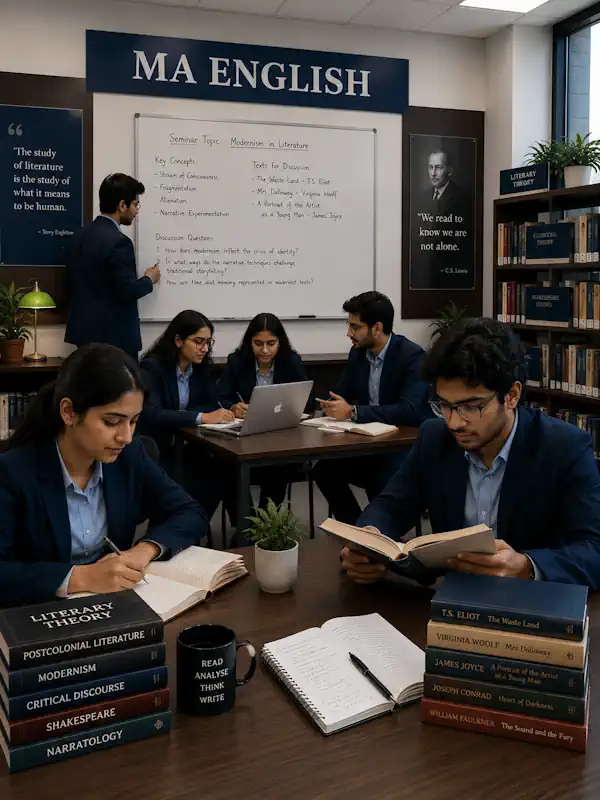

MA English at Brainware University is a 2-year postgraduate programme focused on English literature, literary theory, language studies, cultural criticism, research, writing, and communication. The programme prepares students for careers in academia, publishing, journalism, content development, media, public relations, corporate communication, research, and language-related professions.
| Programme | Master of Arts in English |
|---|---|
| Duration | 2 years |
| Focus Areas | British Literature, American Literature, Indian Writing in English, Postcolonial Literature, Literary Criticism, Cultural Studies, Linguistics, World Literature, Gender Studies, Digital Humanities, Research Methodology, Creative Writing, Academic Writing, Translation Studies, Communication, and Media Writing. |
| Salary | MA English graduates may explore entry-level salary packages commonly ranging from ₹3 LPA to ₹6 LPA, depending on writing ability, communication skills, portfolio quality, internship exposure, recruiter profile, and interview performance. Higher career growth may be available in publishing, academic research, corporate communication, editorial leadership, digital content, public relations, and specialised writing roles with experience. |
| Popular Job Types | Academician, Lecturer, Content Writer, Copywriter, Editor, Proofreader, Journalist, Public Relations Executive, Corporate Communication Executive, Publishing Assistant, Research Associate, Language Expert, Technical Writer, Script Writer, Digital Content Strategist, Translator, Blogger, and Creative Writer. |
| Hiring Industries | Universities, colleges, schools, publishing houses, newspapers, digital media companies, advertising agencies, public relations firms, corporate communication departments, EdTech companies, research organisations, cultural institutions, NGOs, content agencies, translation services, tourism, and government communication projects. |
| Top Recruiters | MA English graduates may find opportunities with publishing firms, media organisations, content companies, educational institutions, public relations agencies, digital marketing firms, research organisations, and corporate communication teams. |
| Specializations | British Literature, American Literature, Indian Writing in English, Postcolonial Studies, Literary Theory, Linguistics, Cultural Studies, Gender Studies, Comparative Literature, Digital Humanities, Creative Writing, Translation Studies, Media Writing, and English Language Studies. |
| Higher Studies | Graduates can pursue PhD programmes in English Literature, Comparative Literature, Linguistics, Cultural Studies, Translation Studies, Digital Humanities, Gender Studies, Communication, or related interdisciplinary areas. They may also prepare for NET, SET, civil services, teaching qualifications, publishing certifications, digital marketing, technical writing, journalism, and language training. |
| Benefits | The programme develops critical reading, academic writing, research, interpretation, communication, editorial judgment, cultural awareness, and advanced language skills. It is suitable for students seeking postgraduate English literature, a master’s degree in English, MA English literature, MA English language, or a university postgraduate degree in the humanities. |
| Internship and Placement | Students receive exposure to internships, content projects, publishing assignments, editorial work, digital writing, research activities, pre-placement training, resume support, interview preparation, and placement assistance. The programme aims to build career-ready skills for education, publishing, media, content, communication, public relations, and research roles. |
| Location | Brainware University, Barasat, Kolkata, West Bengal. |
| Approvals & Recognition | Brainware University is a UGC-recognised university. The MA English programme is offered under the university’s academic framework, with curriculum, assessment, and learning outcomes aligned with postgraduate humanities and language education standards. |
Key reasons to study MA English include:

Educational Qualification: Candidates must have completed graduation from a UGC-recognized university in any discipline.
Minimum Marks: Applicants should have secured a minimum of 50% marks or equivalent grade in graduation.
A relaxation of 5% in minimum marks is applicable for candidates belonging to reserved categories, as per university and government norms.
Entrance Examination: Admission to the Master of Arts (MA) in English programme is based on performance in the university’s Entrance Examination (BET) and/or merit, in accordance with the prescribed admission guidelines and applicable university norms.
The Master of Arts (MA) in English programme is designed for graduates who aspire to deepen their understanding of literature, language, and critical thought. Blending classical texts with contemporary theory, the programme nurtures analytical insight, research aptitude, and advanced communication skills.
With a curriculum covering British, American, and Postcolonial literature, along with literary criticism and cultural studies, MA English prepares students for careers in academia, research, publishing, content development, civil services, and corporate communication—ensuring meaningful academic and professional growth.
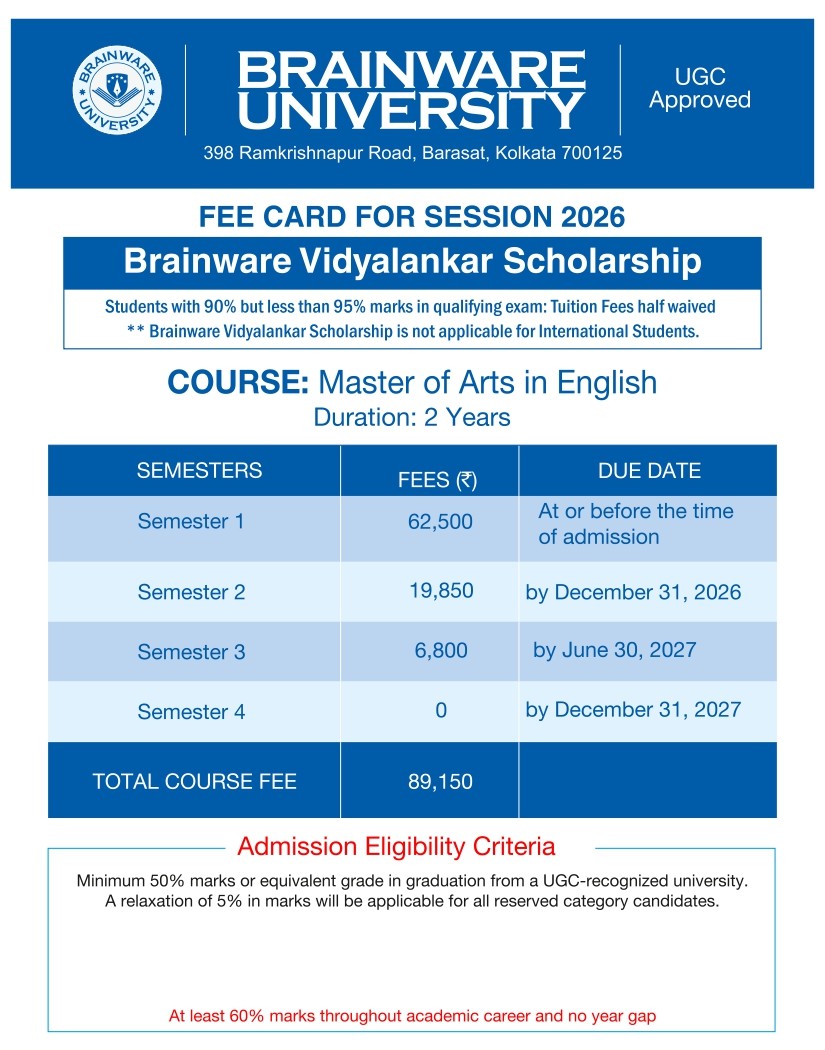
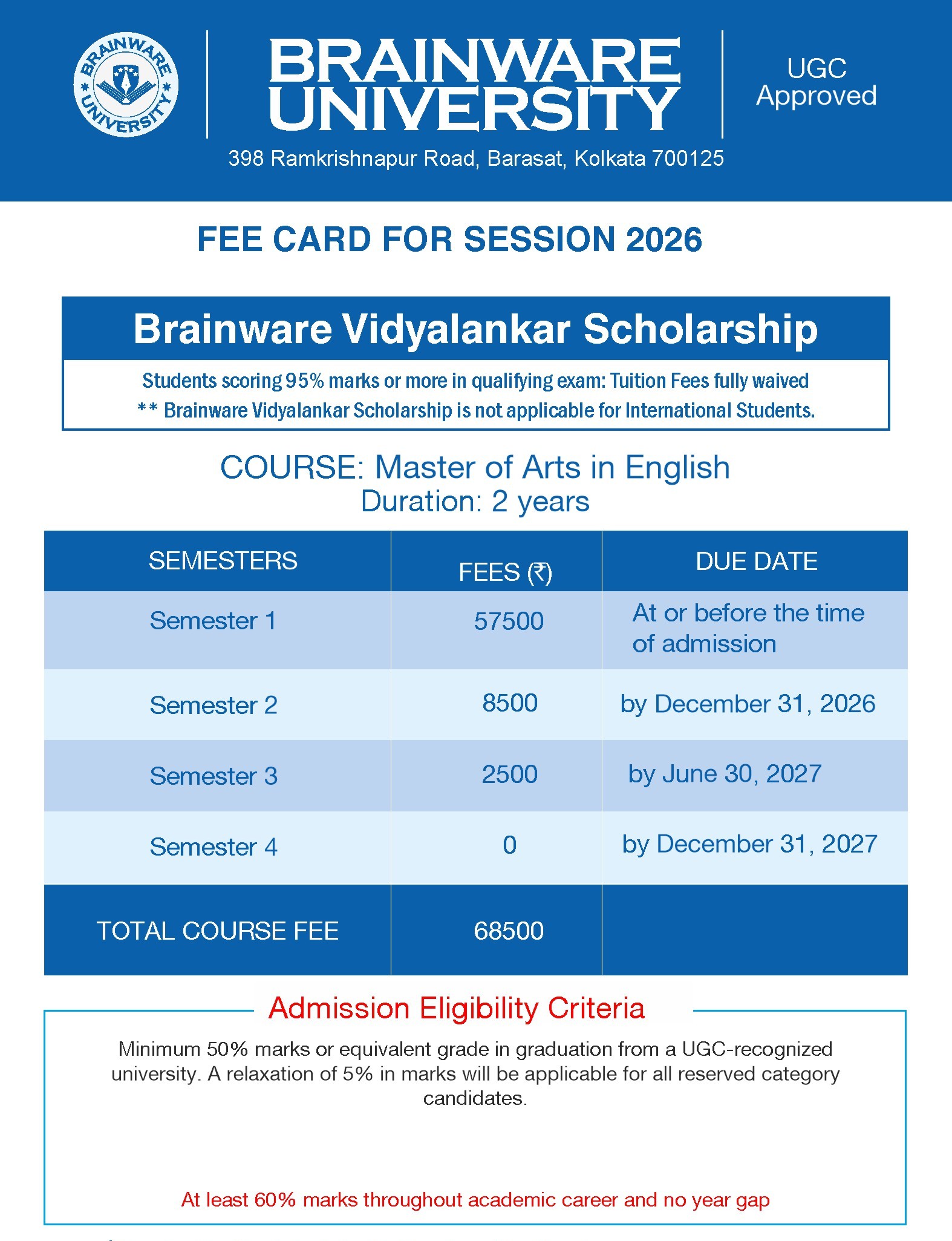
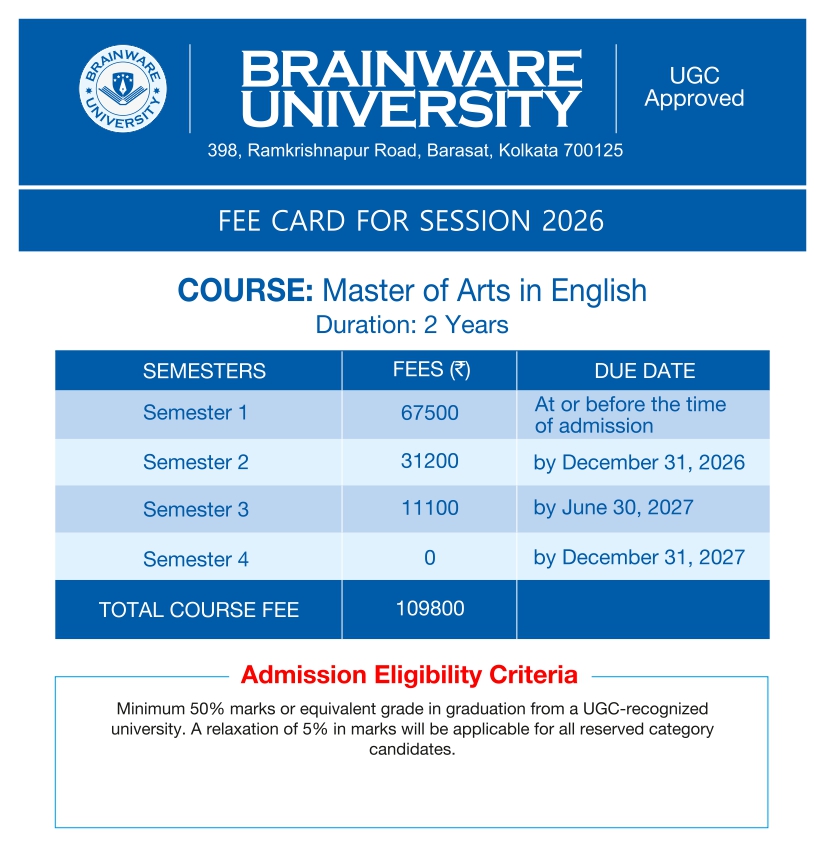
The MA English fee structure at Brainware University is designed to support postgraduate education in English literature, language, literary criticism, cultural studies, research, communication, and digital content creation. The fee generally covers academic instruction, language lab access, project work, research guidance, workshops, student support, and placement-oriented preparation as per university norms.
| Semesters | Semester 1 | Semester 2 | Semester 3 | Semester 4 | Semester 5 | Semester 6 | Semester 7 | Semester 8 | Semester 9 | Semester 10 | Total |
|---|---|---|---|---|---|---|---|---|---|---|---|
| Fees (INR) | 67500 | 31200 | 11100 | 0 | 1,09,800 |
**Fees are subject to change, and the application fee of ₹5,000 is non-refundable under any circumstances. Please contact us for further details.
Scholarships(Fees): Brainware University offers merit-based scholarships for top performers and financial aid for deserving students. Scholarships are available for high scorers in entrance exams, board results, and outstanding achievements in innovation or research. Visit our scholarship page for more details.
**Please note that the Brainware Vidyalankar Scholarship is available only to students who passed their qualifying examination in the current admission year. Also, eligibility is strictly restricted to Indian nationals; international students are not eligible to apply.
AI is changing how literature, language, publishing, research, media, and communication are studied and practised. MA English students need to understand how digital tools support textual analysis, academic research, editing, translation, content creation, language learning, and archival work while maintaining originality, critical judgment, ethical scholarship, and human interpretation.
The programme connects traditional literary study with emerging methods in digital humanities, corpus analysis, online archives, AI-assisted research, and multimedia communication. Students gain awareness of how technology can support scholarship without replacing close reading, argument, creativity, or academic responsibility.
AI and digital innovation are relevant in areas such as:

The end-to-end AI learning spectrum in MA English covers the complete academic and professional journey from text discovery and research to analysis, writing, editing, publication, and audience engagement. Students learn how digital tools can support literary research, language analysis, communication, and content production while preserving academic integrity.
This approach helps students understand the difference between tool-assisted work and original scholarship. AI may assist with organisation, language review, or data processing, but interpretation, argument, evidence, and intellectual responsibility must remain with the student.
Key learning areas include:



Key academic strengths include:
When comparing MA English colleges, students should check:
The MA English placement scoreboard reflects the programme’s career focus across education, publishing, content development, media, public relations, corporate communication, research, and language-based roles. Students are trained for writing tests, editorial tasks, interviews, communication rounds, portfolio presentation, and industry-specific recruitment processes.


MA English placement support at Brainware University helps students prepare for careers in education, publishing, editorial work, content creation, journalism, public relations, media services, research, and corporate communication. The programme encourages students to develop strong writing samples, research ability, communication confidence, and professional portfolios.
Alumni of M.A. English can build careers across education, publishing, journalism, digital media, content development, public relations, corporate communication, research, translation, and creative industries. Their professional journeys show how postgraduate training in literature, language, critical theory, research, and communication can support both academic and industry-oriented career paths.


Brainware University has earned an AA+ rating in India’s Best Engineering Institutes by Careers360. The recognition reflects the University’s strength in academic quality, faculty, infrastructure, research, and student outcomes, reinforcing its position as a trusted destination for industry-aligned engineering education.

Brainware University has been ranked No. 1 Engineering College under a Private University in West Bengal in the IIRF Rankings 2026. The recognition highlights the University’s strength in engineering education, industry-focused learning, research, emerging technologies, and placement outcomes.

Brainware University has been ranked No. 2 Private University in West Bengal by uniRank 2026, marking another recognition of the University's growing presence in the state's higher education landscape.
Brainware University's inclusion in the Times Higher Education (THE) Impact Rankings 2025 reflects its contribution to the UN Sustainable Development Goals (SDGs) through education, innovation, sustainability, community engagement, and responsible institutional practices.

Brainware University has been recognised as the Best Private University of West Bengal in Infrastructure & Placement at Times Now.in – Leaders of Excellence: East 2026, celebrating its commitment to world-class infrastructure and career-focused education.

Brainware University has been recognised by The Times Group for excellence across Engineering (Placement), Law, and MBA Studies. The honours reflect the University’s multidisciplinary strength and its focus on career-oriented, industry-relevant education.

Brainware University received the ABP Ananda Shiksha Samman 2026 for Excellence in Placement & AI-Integrated Academic Infrastructure, acknowledging its emphasis on placement opportunities alongside technology-enabled academic development.

Brainware University has been honoured with the Zee 24 Ghanta Education Excellence Award 2026 for Best Industry Placement & Academic Infrastructure, continuing its recognition in 2022, 2023, 2024, 2025, and 2026. The University was also recognised in 2017 and 2018 for its job-oriented academic initiatives.

Brainware University received the TV9 Uttaran Academic Excellence Honour for Excellence in Placement & AI-Integrated Academic Infrastructure, highlighting its focus on combining career opportunities with an AI-enabled academic and learning environment.

Brainware University was honoured with the R Bangla Sikkha Gourab Samman 2026, recognising its contribution to higher education and continued pursuit of academic excellence and career-focused learning.

Brainware University was honoured as the Best Private University in West Bengal at the Times Now in Business Excellence Awards (East) 2025, recognising its academic quality, modern infrastructure, industry engagement, and focus on student success.

Brainware University was recognised as the Leading University in Infrastructure, Academics & Placement at the Times Business Awards West Bengal 2025, highlighting its strong campus facilities, academic ecosystem, and placement performance across disciplines.

The MA English syllabus is designed to provide advanced knowledge of literature, language, criticism, cultural studies, research methodology, and communication. The curriculum combines the study of major literary periods and traditions with contemporary theories, interdisciplinary approaches, and practical writing skills.
The syllabus prepares students to analyse literary and cultural texts, conduct research, build academic arguments, understand language and society, and apply communication skills across education, publishing, media, research, and professional contexts.
The core foundation modules in MA English help students develop advanced knowledge of literary history, criticism, theory, language, research, and interpretation. These areas provide the academic base required for teaching, research, publishing, and further study.
Core learning areas include:
These foundation subjects help students understand literary texts within historical, cultural, political, and linguistic contexts.
The evolving and high-growth areas in MA English prepare students for contemporary careers in digital publishing, content strategy, media writing, translation, digital humanities, cultural research, technical writing, and communication. These areas are becoming increasingly important as language-based careers move across digital platforms and industries.
Advanced learning areas include:
These modules help students connect literary scholarship with emerging academic and professional opportunities.
| Semester | Course |
|---|---|
| Semester I | Research Methodology and Ethics |
| Approaches to Literature | |
| Indian Writing in English | |
| Discourse Analysis | |
| Semester II | World Literatures in English |
| Digital Humanities | |
| Language and Linguistics | |
| Emerging Trends of Research in Literary Studies | |
| Professional Communication, Collaboration, and Career Skills | |
| Semester III | Dissertation – 1 |
| Semester IV | Dissertation – 2 |
Please note that the syllabus is subject to modification. Visit our Syllabus page for the elective subject details and updated syllabus.

MA English graduates can work across publishing, media, advertising, public relations, digital marketing, education technology, corporate communication, research, translation, and content development. Career growth depends on writing ability, editing skill, communication confidence, digital awareness, subject knowledge, and portfolio quality.
Students with strong writing portfolios, research experience, editing skills, communication ability, and digital content knowledge are better positioned for private-sector language and communication careers.
MA English graduates may explore government and public-sector opportunities in education, information services, public communication, publishing, cultural institutions, archives, libraries, translation, research, and competitive examination pathways. These roles often require strong language skills, academic knowledge, communication, and success in relevant selection processes.
Candidates should review official recruitment notifications, eligibility requirements, examination patterns, and organisation-specific criteria.
MA English career prospects extend beyond teaching and traditional literary study. Graduates can work in publishing, content development, media, public relations, marketing communication, research, translation, digital platforms, corporate communication, and cultural organisations. The degree develops critical thinking, writing, research, interpretation, and communication skills that remain valuable across industries.
| Area of Opportunity | Why It’s in Demand |
|---|---|
| Academician | Higher Education Leadership: Essential for developing the next generation’s critical-thinking abilities. With the expansion of universities and higher education institutions, there is a continuing need for qualified professors and lecturers who can teach literature, language, criticism, and linguistics. |
| Public Relations & Advertising | The Art of Persuasion: Brands require professionals who can create compelling narratives, campaigns, and slogans. English postgraduates are well suited to these roles because they understand how language influences psychology, identity, and public perception. |
| Media Services | Cross-Platform Storytelling: Media organisations need professionals for scripting, programme conceptualisation, editorial planning, and digital content production, where the ability to structure stories across video, audio, and text is essential. |
| Marketing & Strategic Communication | Brand Voice Management: Organisations need communication professionals who can maintain a clear, consistent, and sophisticated brand voice across markets and ensure that corporate messaging is accurate, persuasive, and impactful. |
| English Language & Literature Researcher | Cultural Preservation & Analysis: Researchers are needed in universities, archives, museums, and cultural institutions to analyse literary and historical texts, conduct sociolinguistic research, and contribute to literary and cultural theory. |
| Editorial & Content Development | Quality Control in the AI Era: Although AI can generate text, skilled editors are required to assess accuracy, context, nuance, tone, coherence, originality, and audience suitability. English postgraduates can lead editorial and content-quality workflows. |
| Language Expert | Global Localisation: Language experts support corporate training, translation, localisation, communication, and linguistic services. They help organisations adapt content to specific cultural, regional, and audience requirements. |
| Journalism | Investigative Depth: English postgraduates are suited to feature writing, investigative reporting, opinion writing, editorial analysis, and long-form journalism that require research, interpretation, clarity, and critical judgement. |
| Publishing Careers | Gatekeepers of Literature: Traditional and digital publishing houses need acquisitions editors, copy editors, literary agents, proofreaders, and production professionals to select, develop, refine, and distribute written content. |
| Blogger / Digital Influencer | Niche Authority: In the creator economy, professionals with strong literary and writing backgrounds can build authoritative digital platforms by producing well-researched, original, and analytical long-form content for specialised audiences. |
The career scope after MA English depends on the student’s writing ability, research exposure, communication skills, portfolio, digital knowledge, and professional interests. Graduates who combine literary training with editing, content strategy, research, teaching, media, or technical writing skills can build progressive careers across academic and professional sectors.
The job market for MA English graduates from 2025 to 2032 will be shaped by digital publishing, online education, content strategy, localisation, AI-assisted editing, corporate communication, media production, and research. Demand will favour graduates who combine literary knowledge with digital writing, editorial judgment, research ability, audience awareness, and ethical communication.
Language-based work is changing rather than disappearing. Routine drafting may become more automated, but organisations will still need skilled professionals who can interpret context, verify facts, maintain tone, edit for clarity, build persuasive narratives, and communicate across cultural and professional settings.
Career growth will be driven by the expansion of digital content, e-learning, publishing, corporate communication, localisation, branded storytelling, technical documentation, and multimedia platforms. Employers will need professionals who can write accurately, adapt content for different audiences, evaluate AI-generated text, and preserve editorial quality.
Major growth drivers include:
High-growth roles for MA English graduates will include Content Strategist, Editor, Technical Writer, UX Writer, Digital Content Specialist, Corporate Communication Executive, Localisation Specialist, Research Associate, Instructional Content Developer, and Publishing Professional.
High-growth career roles include:
MA English graduates will find opportunities in industries that depend on language, storytelling, research, interpretation, communication, and editorial quality. Hiring will extend beyond publishing and education as technology, healthcare, finance, consulting, and consumer brands build specialised content teams.
Key hiring industries include:
The most valuable skills from 2025 to 2032 will include critical reading, research, editing, fact-checking, academic writing, digital content strategy, technical writing, communication, localisation, and responsible use of AI tools. Employers will prefer graduates who can combine strong language ability with digital and professional awareness.
Important skill areas include:
The outlook is positive for MA English graduates who develop professional skills beyond literary knowledge alone. Higher-value roles will require editorial judgment, audience understanding, research, digital fluency, and the ability to improve or verify machine-generated content.
Students should focus on building:
The future language and literature job market will reward graduates who can read deeply, write clearly, verify information, understand culture, and adapt communication for different audiences. These skills remain important even as AI changes content production.
For students choosing an English literature university or college for MA English, the focus should be on curriculum quality, faculty mentorship, research exposure, language development, digital content training, internships, and placement support. Brainware University’s MA English programme is structured to support these academic and career needs.


MA English admission 2026 at Brainware University is open to eligible graduates who want advanced postgraduate study in English literature, language, literary criticism, cultural studies, research, and communication. Applicants should review eligibility, entrance requirements, application steps, counselling, fees, scholarships, and document requirements before applying.
Admission Criteria: Admission to MA English is based on academic eligibility and university admission norms. Candidates must have completed graduation from a UGC-recognised university and secured the required minimum marks.
Application: Candidates can apply online through the enquiry or application form on the Brainware University website. Applicants must provide their name, programme preference, location, phone number, email address, and academic information. The admission counselling team will guide eligible candidates through the remaining steps.
Entrance Exam: Admission to the MA English programme is based on BET, the Brainware Entrance Test, and/or merit according to the prescribed university guidelines. Candidates should confirm the current entrance schedule, examination mode, syllabus, and selection requirements with the admission office.
Counselling: Eligible or shortlisted candidates receive counselling support from the university admission team. Counselling covers the programme structure, syllabus, fees, scholarships, career scope, placement support, required documents, and final admission formalities.
Direct Admission: Direct admission may be considered for eligible candidates according to university norms, merit, seat availability, and the applicable admission process. Students seeking MA English admission should contact the admission office for current requirements and document details.
Please follow the given MA English Admission Procedure in Brainware University:


During the pandemic, we received maximum support from our academic fraternity. The professors conducted regular online classes and uploaded learning materials and videos.
Srijonee SarkarMA English
I want to really appreciate and thank Brainware University for providing an uninterrupted learning experience. The way of teaching and interacting with students to make learning easier and interesting is indeed a commendable job.
Ayantika BanerjeeMA English
I am now a successful professional and started my career under the guidance of Brainware University with the precise training and placement support
Anushka Chaudhuri MA English

"Brainware students are professionally and technically well-informed as freshers. We are impressed with the level of confidence and positive attitude they demonstrated during their interviews."
Mr. Vaskar Bhattacharya Regional Head-East, Ginnisystems Ltd.
We always find competent and positive students who are almost ready to be professionals. We never get disappointed wherever we come for the recruitment. Well done Brainware University!
Ms. Srimoyee Mukherjee Manager HR Nature Technologies Pvt. Ltd.





The Department of English and Literary Studies at Brainware University supports academic and creative development through seminars, workshops, literary events, invited lectures, research activities, student presentations, cultural programmes, and interdisciplinary discussions. These activities connect classroom learning with contemporary debates in literature, language, media, society, and culture.
https://www.brainwareuniversity.ac.in/departments/english-literary/activities.php
The MA in English is a master's degree program that focuses on the advanced study of the English language, literature, and related disciplines. It provides students with a deeper understanding of various literary periods, genres, critical theories, and linguistic analysis.
Students should choose Brainware University for MA in English in 2026 because the programme offers advanced study in literature, literary theory, cultural studies, linguistics, communication, research writing, and critical interpretation. With academic guidance, research exposure, a 98% placement rate across courses, 1000+ recruiters, and placement support, Brainware University prepares students for careers in teaching, publishing, content writing, editing, communication, research, media, civil services preparation, and higher studies.
Prerequisites for applying to the program may vary depending on the university or institution offering the program. Generally, applicants are expected to have a bachelor's degree in English or a related field. Some programs may also require a strong academic record, letters of recommendation, a statement of purpose, and writing samples.
The curriculum of the MA in English program typically includes a combination of core courses and electives. Core courses often cover topics such as literary theory, research methods, and advanced literary analysis. Electives allow students to explore specific areas of interest, such as British literature, American literature, world literature, postcolonial literature, Shakespeare, linguistics, or creative writing.
Graduates of the MA in English program can pursue a variety of career paths. They may work as educators, teaching at the secondary or post-secondary level. They can also find employment in writing and editing, publishing, journalism, public relations, cultural organisations, libraries, and research institutions, or pursue further studies at the doctoral level.
Some universities or institutions offering the MA in English program may provide opportunities for internships, teaching assistantships, or teaching experience. These opportunities can enhance practical skills, offer valuable teaching experience, and contribute to a well-rounded academic profile. However, availability may vary depending on the specific institution and program.
The availability of part-time or online options for the MA in English program may vary depending on the institution. Some universities offer flexible study options, including part-time or online programs, to accommodate the needs of working professionals or individuals with other commitments. It is advisable to check with the specific institutions offering the program to determine their options for flexible study.
The duration of the MA in English program typically ranges from one to two years, depending on whether it is a full-time or part-time program. Some universities may also offer accelerated or extended study options. It is important to review the program structure and duration provided by the institution you are considering.
Brainware University's M.A. in English programme offers an advanced curriculum covering literature, literary theory, cultural studies, linguistics, and critical thinking. With experienced faculty, research-oriented learning, academic mentoring, and skill development opportunities, students gain a strong foundation for careers in teaching, research, content writing, publishing, media, and civil services. The programme is further supported by the university's 98% placement record across programmes, creating diverse career opportunities for graduates.
The MA in English program helps students develop a range of skills that are valuable in various professional fields. These skills include critical analysis and interpretation of texts, research and writing skills, effective communication, presentation skills, cultural literacy, and the ability to think critically and construct arguments.
While having an undergraduate degree in English or a related field is commonly preferred, some universities may admit students from diverse academic backgrounds. However, additional coursework or prerequisites may be required to ensure a solid foundation in English literature and language. It is important to review the specific admission requirements of the institutions you are interested in.
To obtain more information about the MA in English program, you can visit the websites of universities or institutions offering the program. The websites typically provide detailed program descriptions, admission requirements, curriculum details, faculty profiles, and contact information. You can also reach out to the admissions office or program coordinators directly to address any specific inquiries you may have.
The MA in English is a postgraduate degree that focuses on literary studies, linguistics, critical theory, and research in English literature.
Brainware University offers a comprehensive MA English program with a modern curriculum, expert faculty, and research-driven learning.
Admission is based on merit or entrance examinations, depending on the university's requirements.
The course duration is 2 years, divided into 4 semesters.
Core subjects include British Literature, American Literature, Indian Writing in English, Postcolonial Studies, Literary Criticism, and Linguistics.
Graduates can work as professors, editors, content writers, journalists, copywriters, translators, public relations officers, and creative writers.
The salary of an MA English graduate in India may range from ₹4 LPA to ₹12 LPA, depending on the job role, skills, industry, organisation, and professional experience.
Media houses, publishing firms, universities, corporate communication departments, digital marketing agencies, and content creation industries offer promising career opportunities for MA English graduates.
Focus on improving communication skills, developing a strong writing portfolio, highlighting research experience, and gaining industry-specific knowledge relevant to the job role.
Highlight research work, internships, publications, creative writing projects, academic achievements, technical skills, and digital content expertise.
Practise essay writing, research papers, creative storytelling, editing, proofreading, and academic writing techniques regularly.
MA English students can learn tools such as Grammarly, Hemingway Editor, Scrivener, Microsoft Word, and academic research databases such as JSTOR and Google Scholar.
Students can gain practical experience by participating in internships, publishing projects, freelance writing assignments, literary analysis projects, research activities, workshops, and academic conferences.
Editing, proofreading, content strategy, storytelling, research, communication, digital content creation, and SEO writing are among the most in-demand skills for MA English graduates.
Students can follow literary journals, attend literature festivals, enrol in online courses, participate in academic conferences, and engage with scholarly communities.
AI-powered tools support content creation, grammar checking, editing, research, idea generation, and SEO-optimised writing. However, human creativity, critical thinking, accuracy, and editorial judgement remain essential.
Digital humanities, ecocriticism, feminist literature, postcolonial studies, cultural studies, interdisciplinary research, and digital literary analysis are gaining importance in English literature studies.
Brands use storytelling and narrative techniques to engage audiences, communicate their values, build emotional connections, and promote products or services through blogs, social media, videos, and advertising.
An MA in English graduate can transition into UX writing by developing skills in user psychology, content structuring, digital writing, microcopy, user research, information architecture, and interface communication.
Certifications in Creative Writing, Digital Marketing, Journalism, Technical Writing, Content Marketing, Editing, Translation, and SEO can enhance the career prospects of an MA English graduate.