98%
Placed
in 2025






Brainware University transformed me, fostering confidence and capability for conquering the world.
The LLM Master of Laws programme at Brainware University is a 2-year postgraduate law degree for students who have completed LL.B. and want to build advanced legal knowledge, research ability, advocacy skills, and subject expertise. Students searching for an LLM course, master of law degree, master of laws, or LLM degree can use this page to understand the course structure, eligibility, fees, syllabus, specialisation options, admission process, and career scope.
The LLM course is suitable for law graduates who want to pursue careers in litigation, judicial services, corporate law, legal consultancy, academics, public policy, compliance, legal research, and rights-based organisations. At Brainware University, the programme combines legal theory with practical exposure through moot court training, court visits, legal aid camps, drafting exercises, legal research, workshops, and mentorship from experienced legal professionals.
For students looking for LLM in Kolkata, this page covers important information on LLM admission 2026, LLM eligibility criteria, LLM fees, LLM duration, LLM syllabus, practical training, career prospects, and admission procedure.


The LLM degree at Brainware University is a 2-year postgraduate law programme that helps LL.B. graduates build advanced legal knowledge, research skills, advocacy ability, drafting competence, and practical exposure for legal careers, higher studies, and judicial or academic pathways.
| Programme | Master of Law |
|---|---|
| Duration | 2 years |
| Focus Areas | Advanced Legal Research, Constitutional Law, Corporate Law, Human Rights Law, Criminal Law, Intellectual Property Rights, Labour and Industrial Law, Banking and Insurance Law, Arbitration, Legal Drafting, Advocacy, Court Procedures, Public Policy, Compliance, and Legal Ethics. |
| Salary | Salary after LLM depends on the student’s specialisation, legal skills, internships, professional experience, court practice, recruiter type, and chosen career path. Graduates may explore roles in law firms, corporate legal departments, courts, NGOs, research bodies, academic institutions, compliance teams, and policy organisations. |
| Popular Job Types | Advocate, Legal Advisor, Law Officer, Litigator, Corporate Lawyer, Legal Researcher, Compliance Executive, Policy Research Associate, Academic Associate, Legal Consultant, Judicial Services Aspirant, Arbitration Associate, Contract Analyst, and In-house Legal Executive. |
| Hiring Industries | Law Firms, Corporate Legal Departments, Banks, Insurance Companies, Consulting Firms, NGOs, Government Bodies, Courts, Tribunals, Research Institutions, Universities, Compliance Organisations, Human Rights Organisations, Legal Process Outsourcing Firms, and Public Policy Organisations. |
| Top Recruiters | LLM graduates may explore opportunities with law firms, corporate legal teams, litigation chambers, NGOs, compliance consultancies, banks, insurance companies, legal research organisations, government bodies, and academic institutions. |
| Specializations | Students may study advanced areas such as Constitutional Law, Corporate Law, Criminal Law, Human Rights Law, Intellectual Property Law, Banking and Insurance Law, Labour and Industrial Law, International Law, Arbitration, Commercial Law, Environmental Law, and Legal Research, subject to the latest curriculum and university norms. |
| Higher Studies | LLM graduates can pursue PhD in Law, legal research fellowships, judicial services preparation, UGC NET in Law, policy research programmes, advanced certifications in arbitration, intellectual property rights, cyber law, corporate governance, compliance, human rights, international law, and legal analytics. |
| Benefits | The programme offers advanced legal learning, legal research training, moot court exposure, court visits, drafting and pleading practice, legal aid camp participation, tutorial support for judicial examinations, workshops with legal professionals, and 360-degree placement training. |
| Internship and Placement | Students receive practical exposure through internships, court visits, legal aid activities, moot court training, drafting exercises, research assignments, workshops, and placement preparation. Training may include legal writing, communication, interview readiness, professional ethics, advocacy practice, and sector-specific legal career guidance. |
| Location | Brainware University, Barasat, Kolkata, West Bengal. |
| Approvals & Recognition | UGC Recognised. BCI Approved. |
Studying LLM is a strong choice for law graduates who want to move beyond foundational legal education and develop advanced subject knowledge. The programme helps students understand complex legal issues, improve legal research, strengthen drafting ability, develop advocacy skills, and gain deeper insight into specialised areas of law.
An LLM degree can support careers in litigation, corporate law, judicial services, legal consultancy, public policy, compliance, academia, research, arbitration, human rights, and international legal practice. It is also valuable for students who want to prepare for teaching, pursue PhD in Law, publish legal research, or build subject expertise in a chosen field.
The legal profession is changing rapidly with new developments in technology law, data protection, corporate governance, cyber law, intellectual property, arbitration, ESG compliance, financial regulation, and human rights. An LLM course helps students stay prepared for these shifts by combining advanced legal theory with practical exposure.
At Brainware University, students receive training through moot courts, legal aid camps, court visits, workshops, drafting practice, research guidance, and mentoring by legal professionals. This makes the programme suitable for students who want both academic depth and professional readiness.

Educational Qualification: Candidates must have completed a Bachelor of Laws (LL.B.) degree from a recognised university.
Minimum Marks: Applicants should have secured a minimum of 45% marks in LL.B. for the General category.
A relaxation in minimum marks is applicable for reserved categories, with 42% for OBC candidates and 40% for SC/ST candidates, as per university and government norms.
Entrance Examination: Admission to the Master of Laws (LLM) programme is based on performance in the university’s entrance examination [BET] and/or merit, in accordance with the prescribed admission guidelines and applicable university norms.
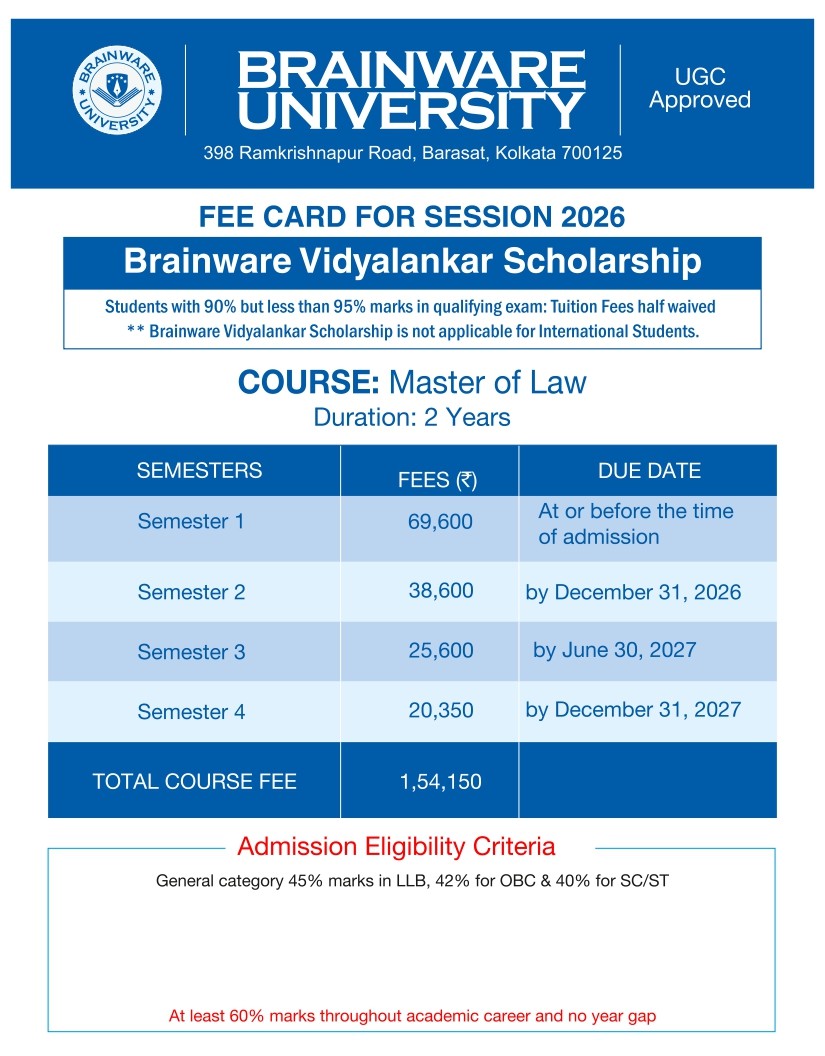
The Master of Laws (LLM) programme at Brainware University is offered at a competitive and affordable fee structure, making quality postgraduate legal education accessible without financial burden. Designed for law graduates aiming to specialise and advance their legal expertise, the programme combines advanced legal theory with research-driven learning.
With a curriculum covering key areas such as constitutional law, corporate law, human rights, and legal research, the LLM prepares students for careers in academia, legal practice, judicial services, and policy research—ensuring strong value for your educational investment.
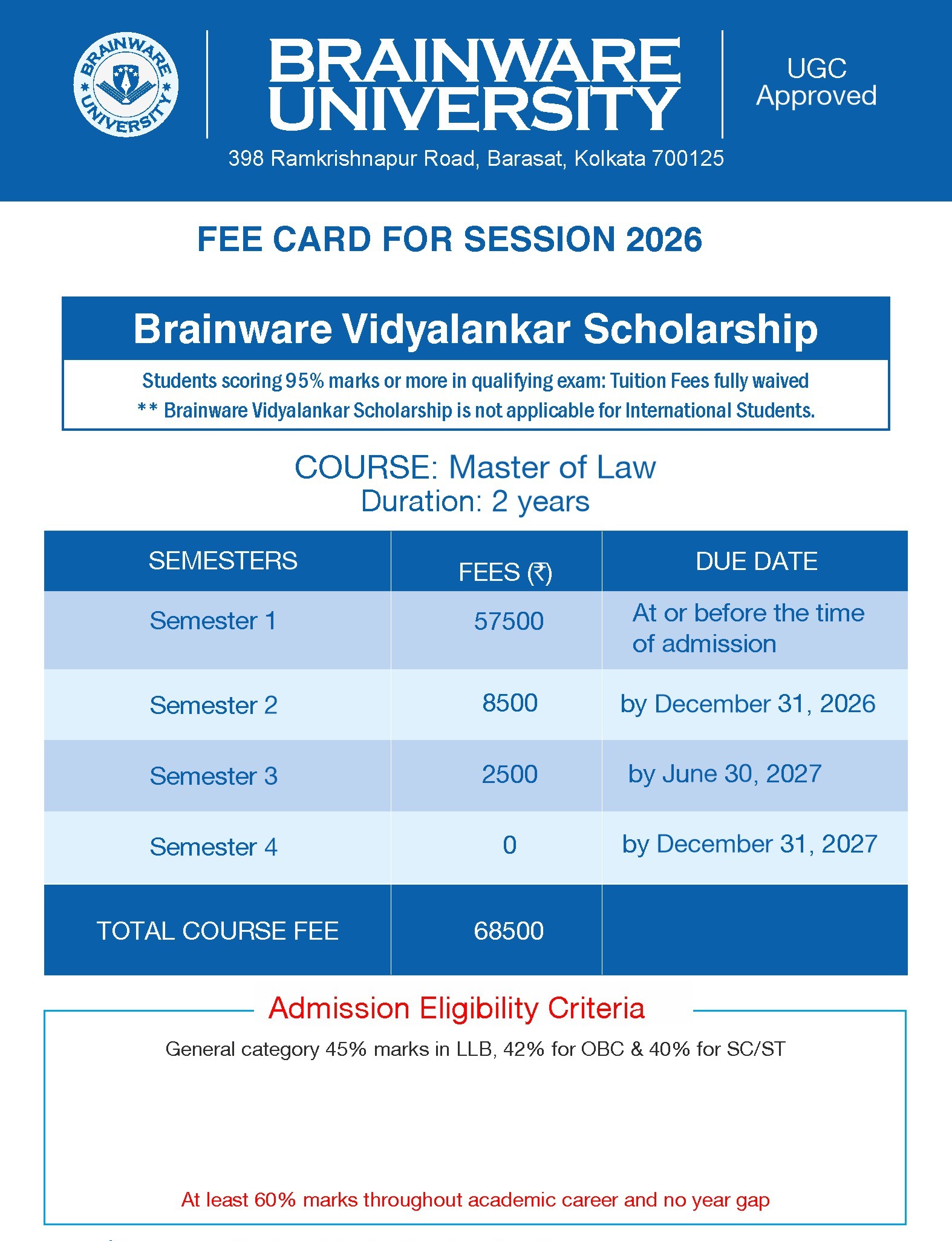
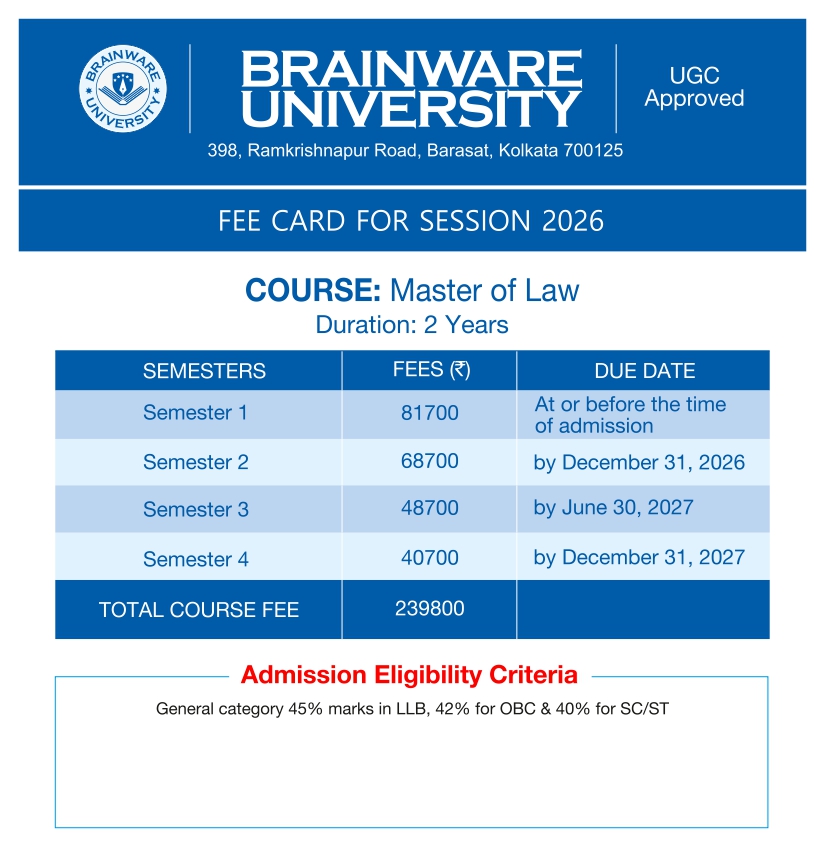
LLM fees at Brainware University are structured to make postgraduate legal education accessible while supporting advanced learning, research exposure, practical legal training, and career preparation. Students searching for LLM fees should check the latest semester-wise fee details from the official admission office before applying, as fees may be revised as per university policy.
| Semesters | Semester 1 | Semester 2 | Semester 3 | Semester 4 | Semester 5 | Semester 6 | Semester 7 | Semester 8 | Semester 9 | Semester 10 | Total |
|---|---|---|---|---|---|---|---|---|---|---|---|
| Fees (INR) | 81700 | 68700 | 48700 | 40700 | 2,39,800 |
**Fees are subject to change, and the application fee of ₹5,000 is non-refundable under any circumstances. Please contact us for further details.
Scholarships(Fees): Brainware University offers merit-based scholarships for top performers and financial aid for deserving students. Scholarships are available for high scorers in entrance exams, board results, and outstanding achievements in innovation or research. Visit our scholarship page for more details.
**Please note that the Brainware Vidyalankar Scholarship is available only to students who passed their qualifying examination in the current admission year. Also, eligibility is strictly restricted to Indian nationals; international students are not eligible to apply.
Artificial Intelligence is changing the way legal professionals conduct research, review contracts, study case law, manage compliance, analyse legal documents, and prepare legal opinions. The LLM programme at Brainware University introduces students to the growing role of technology in legal education and legal practice.
AI-driven learning helps law students understand how legal databases, research platforms, document review tools, legal analytics, and compliance systems are used in modern legal work. Students also learn why ethical judgment, legal reasoning, confidentiality, data privacy, and human supervision remain essential when technology is used in law.
This exposure is important for LLM students because courts, law firms, corporate legal departments, policy bodies, and research organisations increasingly use digital tools to improve speed, accuracy, documentation, and legal decision-making. The focus is to help students become legally sound, digitally aware, and professionally responsible.

The end-to-end AI learning spectrum in LLM focuses on the practical use of legal technology and AI-supported research while retaining the central importance of human legal judgement. Students are introduced to how technology can support legal study, case preparation, compliance, contract management, and policy research.
Key learning areas may include:
This learning spectrum helps students understand how AI can support legal work without replacing legal reasoning, professional ethics, or statutory interpretation.


LLM alumni can build diverse career journeys across litigation, corporate law, legal consultancy, compliance, judicial services preparation, legal research, policy work, academia, arbitration, and rights-based organisations. Their postgraduate legal training helps them approach legal problems with deeper subject understanding and stronger research ability.


Brainware University has earned an AA+ rating in India’s Best Engineering Institutes by Careers360. The recognition reflects the University’s strength in academic quality, faculty, infrastructure, research, and student outcomes, reinforcing its position as a trusted destination for industry-aligned engineering education.

Brainware University has been ranked No. 1 Engineering College under a Private University in West Bengal in the IIRF Rankings 2026. The recognition highlights the University’s strength in engineering education, industry-focused learning, research, emerging technologies, and placement outcomes.

Brainware University has been ranked No. 2 Private University in West Bengal by uniRank 2026, marking another recognition of the University's growing presence in the state's higher education landscape.

Brainware University's inclusion in the Times Higher Education (THE) Impact Rankings 2025 reflects its contribution to the UN Sustainable Development Goals (SDGs) through education, innovation, sustainability, community engagement, and responsible institutional practices.

Brainware University has been recognised as the Best Private University of West Bengal in Infrastructure & Placement at Times Now.in – Leaders of Excellence: East 2026, celebrating its commitment to world-class infrastructure and career-focused education.

Brainware University has been recognised by The Times Group for excellence across Engineering (Placement), Law, and MBA Studies. The honours reflect the University’s multidisciplinary strength and its focus on career-oriented, industry-relevant education.

Brainware University received the ABP Ananda Shiksha Samman 2026 for Excellence in Placement & AI-Integrated Academic Infrastructure, acknowledging its emphasis on placement opportunities alongside technology-enabled academic development.

Brainware University has been honoured with the Zee 24 Ghanta Education Excellence Award 2026 for Best Industry Placement & Academic Infrastructure, continuing its recognition in 2022, 2023, 2024, 2025, and 2026. The University was also recognised in 2017 and 2018 for its job-oriented academic initiatives.

Brainware University received the TV9 Uttaran Academic Excellence Honour for Excellence in Placement & AI-Integrated Academic Infrastructure, highlighting its focus on combining career opportunities with an AI-enabled academic and learning environment.

Brainware University was honoured with the R Bangla Sikkha Gourab Samman 2026, recognising its contribution to higher education and continued pursuit of academic excellence and career-focused learning.

Brainware University was honoured as the Best Private University in West Bengal at the Times Now in Business Excellence Awards (East) 2025, recognising its academic quality, modern infrastructure, industry engagement, and focus on student success.

Brainware University was recognised as the Leading University in Infrastructure, Academics & Placement at the Times Business Awards West Bengal 2025, highlighting its strong campus facilities, academic ecosystem, and placement performance across disciplines.

The LLM syllabus at Brainware University is designed to provide advanced knowledge of law, legal theory, research methodology, constitutional developments, corporate governance, arbitration, human rights, banking and insurance law, intellectual property, labour law, and dissertation-based learning. The course helps students move from basic legal understanding to deeper analysis of statutes, judicial decisions, policy issues, and social justice questions.
The syllabus combines classroom learning with legal research, case analysis, seminar presentations, drafting exercises, moot court exposure, and dissertation work. Students are trained to study law critically, write with precision, understand legal developments, and apply legal principles to real and emerging issues.
The core foundations of the LLM programme help students build advanced legal reasoning, research ability, and subject understanding. These areas are important for litigation, legal research, judicial preparation, academia, policy work, and corporate legal careers.
Core learning areas may include:
These subjects help students develop the ability to analyse legal systems, interpret judgments, conduct research, and present legal arguments with clarity.
The LLM syllabus also includes high-growth legal areas that are becoming increasingly important in courts, corporate offices, policy organisations, and international legal discussions. These areas help students respond to new legal challenges arising from technology, commerce, rights, governance, and globalisation.
Evolving and high-growth areas may include:
These areas prepare students for modern legal careers where specialisation, research, drafting, negotiation, and regulatory understanding are increasingly important.
| Semester | Course name |
|---|---|
| Semester I | Theories of Law and Justice |
| Law and Social Transformation in India | |
| Legal Education, Research Methodology and Design of Blueprint of Curriculum | |
| Quantitative Analysis | |
| Semester II | Research Methodology II |
| Business Law: Advanced Corporate Law and Governance | |
| Business Law: Commercial Arbitration | |
| Business Law: Investment and Competition Law | |
| Constitution and Public Law: Indian Constitutional Law and New Challenges - I | |
| Constitution and Public Law: Comparative Federalism | |
| Constitution and Public Law: Administrative Law | |
| Criminal Law: Principles of Criminal Law | |
| Criminal Law: Law of Torts | |
| Criminal Law: Crime and Criminology | |
| Semester III | Business Law: Banking and Insurance Law |
| Business Law: IPR: Jurisprudential Development and International Perspectives | |
| Business Law: Labour and Industrial Law - I | |
| Constitution and Public Law: Human Rights and Indian Constitution | |
| Constitution and Public Law: Women and Indian Constitution | |
| Constitution and Public Law: Indian Constitutional Law and New Challenges - II | |
| Criminal Law: Penology and Victimology | |
| Criminal Law: Juvenile Justice and Treatment of Offenders | |
| Criminal Law: Emergence of New Crimes | |
| Semester IV | Dissertation and Viva-voce |
| Class Teaching and Teaching Internship | |
| Business Law: Labour and Industrial Law - II | |
| Business Law: International Economic Law | |
| Constitution and Public Law: Child Law and Indian Constitution | |
| Constitution and Public Law: Vulnerable Groups and Indian Constitution | |
| Criminal Law: Administration of Criminal Justice | |
| Criminal Law: Crime and Legislation |
Please note that the syllabus is subject to modification. Visit our Syllabus page for the elective subject details and updated syllabus.

LLM graduates can explore corporate and private-sector opportunities in law firms, corporate legal departments, compliance teams, banks, insurance companies, consulting firms, legal process outsourcing firms, arbitration centres, NGOs, think tanks, and policy research organisations.
Popular corporate and private-sector jobs after LLM include:
Students with strong legal research, drafting ability, internship experience, moot court exposure, legal database skills, and specialisation knowledge can build stronger profiles for private-sector legal careers.
LLM graduates can also apply for government and public-sector roles that require legal interpretation, research, drafting, compliance, policy understanding, and regulatory knowledge. Opportunities may be available in judicial services, public sector units, government legal departments, law commissions, universities, public policy organisations, tribunals, statutory bodies, and legal aid institutions.
Possible government and public-sector career options include:
Students with strong legal research, drafting ability, internship experience, moot court exposure, legal database skills, and specialisation knowledge can build stronger profiles for private-sector legal careers.
Career prospects after LLM are broad because advanced legal knowledge is required across courts, corporate organisations, government institutions, academic bodies, policy organisations, and rights-based sectors. The degree helps law graduates develop specialised understanding, research discipline, drafting ability, and legal reasoning that can support both practice-based and academic careers.
Students can build careers in litigation, corporate legal practice, judicial services, legal advisory work, law officer roles, arbitration, compliance, legal research, policy work, teaching, and consultancy. The best outcomes usually come to students who combine postgraduate legal study with internships, court exposure, publications, moot court participation, and strong legal writing.
| Area of Opportunity | Why It’s in Demand |
|---|---|
| Advocate | Expert Courtroom Representation: LLM holders often specialize in specific fields, such as Taxation or Human Rights, making them valuable choices for complex cases where general legal knowledge may not be sufficient. |
| Judicial Services | The Backbone of Justice: A postgraduate degree provides the academic depth required to clear competitive examinations for Civil Judge or District Judge roles, where a profound understanding of legal theory is essential. |
| Legal Advisor | Preventive Legal Strategy: Companies and private individuals hire legal advisors to navigate the grey areas of the law, maintain compliance, and avoid expensive lawsuits before they arise. |
| Law Officer | Public and Banking Compliance: There is significant demand in public sector undertakings and banking institutions to manage internal legal affairs, interpret regulatory changes, and protect organisational legal interests. |
| Litigator | Specialized Dispute Resolution: There is high demand for specialists who can handle high-stakes litigation in the Supreme Court, High Courts, and international tribunals using advanced research and drafting skills. |
| Corporate Lawyer | Mergers, Acquisitions, and Regulatory Navigation: Corporate lawyers manage mergers, acquisitions, complex contracts, and regulatory requirements, ensuring that major business transactions remain legally compliant. |
Overall, an LLM degree can help law graduates move into more specialised, research-oriented, and responsible legal roles. As legal work becomes more complex across business, technology, rights, governance, and international affairs, graduates with strong subject knowledge, legal research skills, ethical judgement, and practical exposure will remain valuable in both private and public sectors.
The legal job market for LLM graduates from 2025 to 2032 is expected to be shaped by corporate governance, data protection, cyber law, intellectual property, arbitration, fintech regulation, ESG compliance, international trade, human rights, digital evidence, and technology-assisted legal research. Legal professionals will need both subject expertise and the ability to understand new legal questions arising from technology and social change.
Key future trends for LLM graduates include:
Students with strong legal research, drafting ability, internship experience, moot court exposure, legal database skills, and specialisation knowledge can build stronger profiles for private-sector legal careers.


The university maintains active collaborations with law firms, corporate legal departments, compliance consultancies, NGOs, and government bodies. These tie-ups facilitate internships, legal aid initiatives, workshops, court visits, and expert interactions—bridging academic learning with real-world legal practice.





LLM admission 2026 at Brainware University is open for eligible law graduates who want to pursue advanced postgraduate legal education. The admission process is designed for students who have completed LL.B. and want to specialise further in legal research, litigation, corporate law, constitutional law, human rights, compliance, policy, or academic pathways.
Applicants should review LLM eligibility, LLM course duration, LLM fees, LLM syllabus, available specialisation areas, practical exposure, scholarship options, and admission requirements before applying. The process may include application submission, eligibility checking, BET or merit-based evaluation, counselling, document verification, and final admission as per university norms.
Admission Criteria: Candidates applying for the LLM programme must have completed a Bachelor of Laws, or LL.B., degree from a recognised university.
Applicants should have secured at least 45% marks in LL.B. for the General category. The minimum marks requirement is 42% for OBC candidates and 40% for SC/ST candidates, as per university and government norms.
Admission is subject to eligibility fulfilment, entrance examination or merit-based evaluation where applicable, document verification, seat availability, and final approval under university admission guidelines.
Application: Students can apply for LLM admission 2026 by filling out the online enquiry or application form available on the Brainware University website. Applicants must enter their name, select LLM from the course drop-down menu, choose their location, and submit a valid phone number and email ID.
Entrance Exam: Admission to the Master of Laws programme at Brainware University is based on performance in the university entrance examination, BET, and/or merit, as per the prescribed admission guidelines and applicable university norms.
Counselling: After application submission, eligible candidates are guided through counselling by the university admission team. Counselling helps students understand LLM eligibility criteria, course structure, syllabus, fees, scholarship options, practical exposure, specialisation areas, career pathways, document requirements, and admission timelines.
Direct Admission: LLM direct admission may be available for eligible candidates as per university norms, subject to academic qualification, merit, BET requirement where applicable, seat availability, document verification, and admission guidelines.
Please follow the LLM admission procedure at Brainware University:

The Department of Law at Brainware University is committed to academic excellence, practical legal training, and social responsibility. Through a range of academic, professional, and community-oriented initiatives, the department ensures the holistic development of students while contributing meaningfully to society and the legal profession.
The Department of Law at Brainware University actively advances socially engaged legal education through impactful outreach initiatives. The programme “Towards Equity and Dignity: Understanding Legal Rights of Women and Transgender Persons” highlighted the department’s commitment to gender justice and inclusivity by addressing key issues related to women’s rights, criminal law, and transgender protection laws, thereby strengthening community legal awareness.
The department reinforced international and comparative legal understanding by hosting the International Seminar on “Migration, Human Rights and Social Justice in Contemporary Times”, featuring Dr. Richard L. Benkin. The seminar enabled students to engage with global human rights challenges and contemporary social justice issues, fostering critical thinking and global legal consciousness.
Emphasising experiential learning, the Intra-School Moot Court Competition 2025 provided students with hands-on exposure to courtroom procedures, advocacy, and legal research. By simulating real-life court proceedings, the initiative helped cultivate professionalism, analytical ability, and confidence among aspiring legal practitioners.

The LLM full form is Master of Laws. It is a postgraduate law degree for students who have already completed LL.B. or an equivalent law qualification and want to gain advanced legal knowledge in a specialised area of law.
Students should choose Brainware University for the Master of Laws in 2026 because the programme provides advanced legal education, research training, a critical understanding of legal systems, constitutional principles, corporate law, criminal law, human rights, and contemporary legal issues. With academic mentoring, research-focused learning, a 98% placement rate across courses, 1000+ recruiters, and career support, Brainware University helps students prepare for legal practice, teaching, research, policy work, corporate legal roles, and competitive examinations.
LLM stands for Master of Laws. It is a postgraduate degree program that allows individuals who already hold a law degree (LLB or equivalent) to specialize in a specific area of law or gain advanced legal knowledge and skills. The LLM program provides an opportunity for in-depth study and research in various legal disciplines.
The prerequisites for pursuing an LLM may vary among institutions. Typically, applicants are required to hold a bachelor's degree in law (LLB or equivalent) or a Juris Doctor (JD) degree. Some programs may also consider applicants who hold a degree in a related field, along with relevant professional experience. It is advisable to check the specific program requirements of the institution you are interested in.
LLM programs offer a wide range of subjects and specializations, allowing students to focus on specific areas of law. Some common specializations include international law, corporate law, intellectual property law, human rights law, environmental law, criminal law, commercial law, tax law, and constitutional law. Additionally, some programs may offer interdisciplinary specializations or allow students to design their own specializations based on their interests and career goals.
Completing an LLM can enhance career prospects in various legal fields. Graduates can pursue careers as legal practitioners, advocates, corporate lawyers, legal consultants, legal researchers, legal advisors, and in-house counsels, or pursue academic and teaching positions. The specific career opportunities depend on the specialization chosen, prior experience, and the legal system of the country where one intends to practice.
Generally, an LLM program is designed for individuals who already hold a law degree (LLB or equivalent) or have significant legal experience. However, some institutions may offer specialized LLM programs that admit students from non-law backgrounds, provided they have relevant professional experience or demonstrate a strong interest in the area of study. It is advisable to research and check with specific institutions for any alternative pathways for non-law graduates.
Yes, many institutions offer LLM programs online or through distance learning formats. These programs provide flexibility for students who may not be able to attend classes on campus. Online LLM programs often utilize virtual classrooms, online lectures, discussion forums, and assignments. It is important to ensure that the online LLM program you choose is accredited and provides the necessary resources and support for a comprehensive learning experience.
An LLM program helps students develop advanced legal skills and knowledge in their chosen specialization. These skills include legal research and writing, critical analysis of legal issues, understanding and interpretation of laws and legal documents, legal argumentation and advocacy, negotiation and dispute resolution, legal drafting, and a deeper understanding of the chosen area of law. LLM programs also emphasize analytical thinking, problem-solving, and effective communication skills.
The duration of an LLM program typically ranges from 1 to 2 years, depending on the institution and the program structure. Some programs may offer part-time options, which can extend the duration. The duration may also vary if the program includes a thesis or research component. It's essential to check the specific program requirements and consult the institution for accurate information regarding the duration of the program.
The LLM (Master of Law) is a postgraduate law degree that allows law graduates to specialize in various legal fields like Corporate Law, Criminal Law, Constitutional Law, and International Law.
Brainware University offers an industry-focused LLM program with expert faculty, case studies, and legal research exposure.
Admission is based on CLAT-PG, LSAT-India, or university entrance exams, followed by a personal interview.
The course duration is 1 year (full-time) or 2 years (part-time).
Popular specializations include Corporate Law, Criminal Law, Intellectual Property Rights, Human Rights Law, and International Law.
Graduates can work as Legal Consultants, Corporate Lawyers, Judges, Legal Advisors, Policy Analysts, and Law Professors.
The average salary ranges from ₹6-20 LPA, depending on specialization and experience.
Amarchand Mangaldas, AZB & Partners, Nishith Desai Associates, Cyril Amarchand Mangaldas, and Government Legal Departments.
Focus on legal research, case studies, advocacy skills, and corporate law compliance.
Highlight internships, legal publications, moot court experiences, and specialized certifications.
Practice case law analysis, legal drafting, and academic research in journals.
LexisNexis, Manupatra, Westlaw, SCC Online, and Bloomberg Law.
Participate in legal internships, moot courts, pro bono cases, and legal aid programs.
Legal research, contract drafting, dispute resolution, arbitration, and compliance management.
Follow Supreme Court judgments, law journals, legal blogs, and government policy updates.
AI is streamlining legal research, contract review, and case prediction using data analytics.
ESG compliance, fintech regulations, mergers & acquisitions, and blockchain in contracts.
Cybersecurity laws protect against data breaches, online fraud, and digital crimes.
By working in international trade law, human rights advocacy, and global arbitration.
Certifications in Arbitration, Intellectual Property Rights, Cyber Law, and Corporate Governance add value.