98%
Placed
in 2025





Diploma in Mechanical Engineering is a 3-year technical programme focused on mechanical systems, engineering drawing, thermodynamics, manufacturing processes, machine tools, materials, automobile technology, maintenance, quality control, and computer-aided design. The programme is designed for students who want practical engineering education after Class 10 and careers in manufacturing, automotive, production, maintenance, energy, construction, and heavy engineering.
The Diploma in ME programme at Brainware University combines classroom learning with workshop practice, laboratory training, technical projects, industrial exposure, and placement preparation. Applicants will find complete information on this page about mechanical engineering course duration, eligibility, fees, admission process, syllabus, subjects, career options, internships, placements, and higher-study pathways.
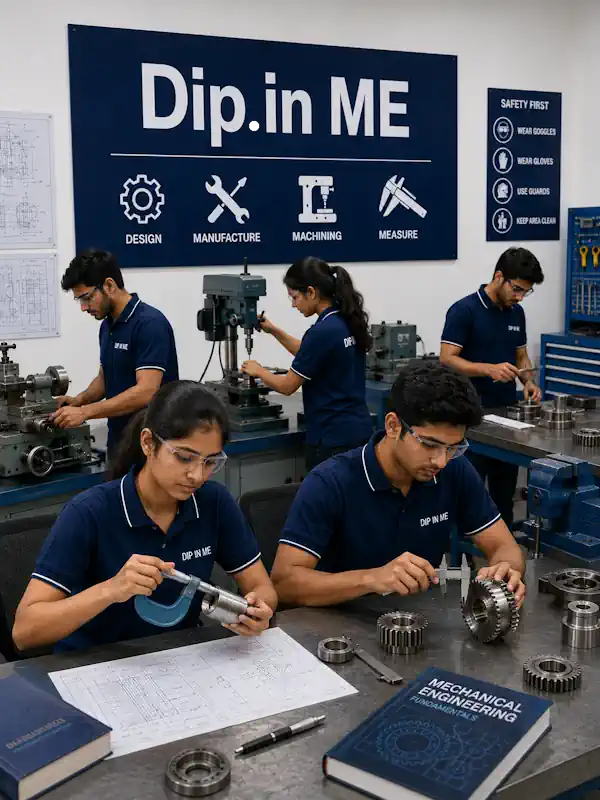

Diploma in Mechanical Engineering at Brainware University is a 3-year technical programme covering engineering mechanics, thermodynamics, manufacturing processes, machine design, production technology, CAD, CNC operations, maintenance, quality control, and automobile systems. The programme prepares students for entry-level technical roles and lateral-entry higher studies in mechanical and related engineering disciplines.
| Programme | Diploma in Mechanical Engineering |
|---|---|
| Duration | 3 years |
| Focus Areas | Engineering Mechanics, Thermodynamics, Fluid Mechanics, Manufacturing Processes, Machine Design, Engineering Materials, Production Technology, CAD, CNC Machining, Automobile Engineering, Industrial Maintenance, Quality Control, Welding, Metrology, Heat Transfer, and Workshop Practice. |
| Salary | Diploma in Mechanical Engineering graduates may explore entry-level salary packages commonly ranging from ₹2.5 LPA to ₹4 LPA, depending on technical skills, workshop exposure, internship experience, industry, location, recruiter profile, and interview performance. Career growth may improve with experience, software proficiency, specialised certifications, and higher qualifications. |
| Popular Job Types | Mechanical Technician, Production Technician, Maintenance Technician, Quality Control Inspector, CNC Machine Operator, CAD Design Technician, Automobile Service Technician, Manufacturing Technician, Plant Maintenance Technician, Junior Mechanical Engineer, Workshop Supervisor, Tool Room Technician, and Service Engineer. |
| Hiring Industries | Manufacturing, automotive, heavy engineering, machinery production, steel and metal processing, construction, energy, railways, aerospace support, industrial maintenance, engineering services, defence manufacturing, consumer durables, fabrication, and production plants. |
| Top Recruiters | Diploma in ME graduates may find opportunities with manufacturing companies, automotive firms, industrial plants, engineering contractors, machinery manufacturers, fabrication units, maintenance service providers, and production organisations. |
| Specializations | Production Engineering, Manufacturing Technology, Automobile Engineering, Industrial Maintenance, CAD and Drafting, CNC Technology, Quality Control, Machine Design, Welding Technology, Tool Engineering, Thermal Engineering, and Plant Operations. |
| Higher Studies | Graduates may pursue B.Tech or B.E. in Mechanical Engineering through lateral entry where applicable. They may also consider related programmes in Automobile Engineering, Production Engineering, Industrial Engineering, Mechatronics, Robotics, Manufacturing Engineering, or other technical fields according to eligibility rules. |
| Benefits | The programme develops practical knowledge of mechanical systems, workshop processes, machine tools, manufacturing, maintenance, technical drawing, materials, production, and quality control. It offers a suitable route for students seeking a mechanical engineering diploma, polytechnic mechanical engineering course, technical employment, or lateral entry into an engineering degree. |
| Internship and Placement | Students receive exposure to internships, workshop assignments, live projects, industry visits, technical training, pre-placement sessions, resume support, interview preparation, and placement assistance. The programme helps students develop practical readiness for manufacturing, automotive, production, maintenance, quality, and junior engineering roles. |
| Location | Brainware University, Barasat, Kolkata, West Bengal. |
| Approvals & Recognition | Brainware University is a UGC-recognised university. The Diploma in Mechanical Engineering programme is offered under the university’s academic framework and applicable technical education norms. Applicants should verify the latest recognition and approval details through official university sources before admission. |
Key reasons to study Diploma in Mechanical Engineering include:

Educational Qualification: Candidates must have passed the Madhyamik (Class 10) examination or an equivalent examination from any recognised board.
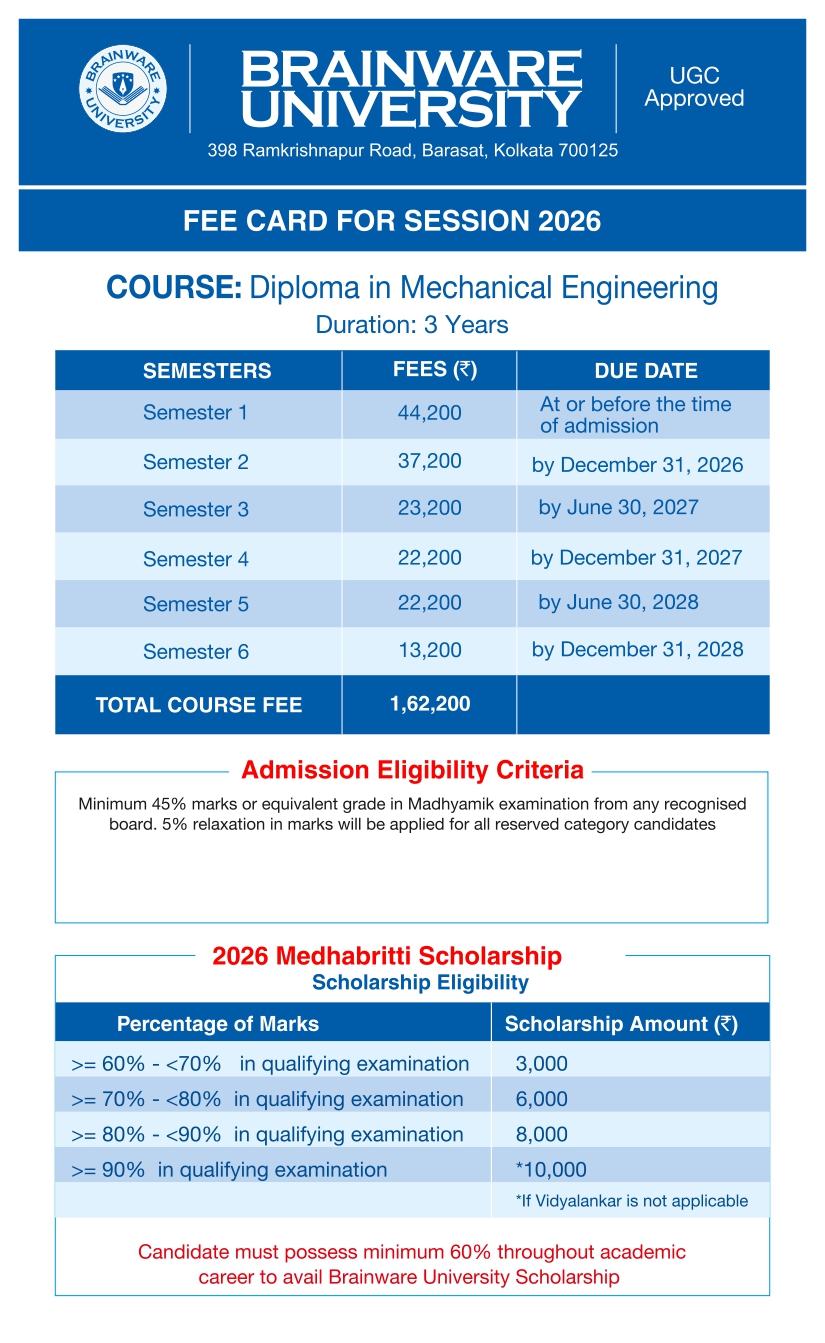
Minimum Marks: Applicants are required to secure a minimum of 45% marks or an equivalent grade in the qualifying examination. A relaxation of 5% in marks is applicable for candidates belonging to reserved categories, as per university norms.
Admission Process: Admission to the Diploma in Mechanical Engineering programme at Brainware University is conducted according to the university's admission guidelines and eligibility criteria.
Brainware University offers the Diploma in Mechanical Engineering programme at an affordable fee structure, making quality technical education accessible to aspiring engineers. Students benefit from modern workshops, advanced laboratories, practical training, industry exposure, and expert faculty guidance, ensuring excellent value for their investment in education.
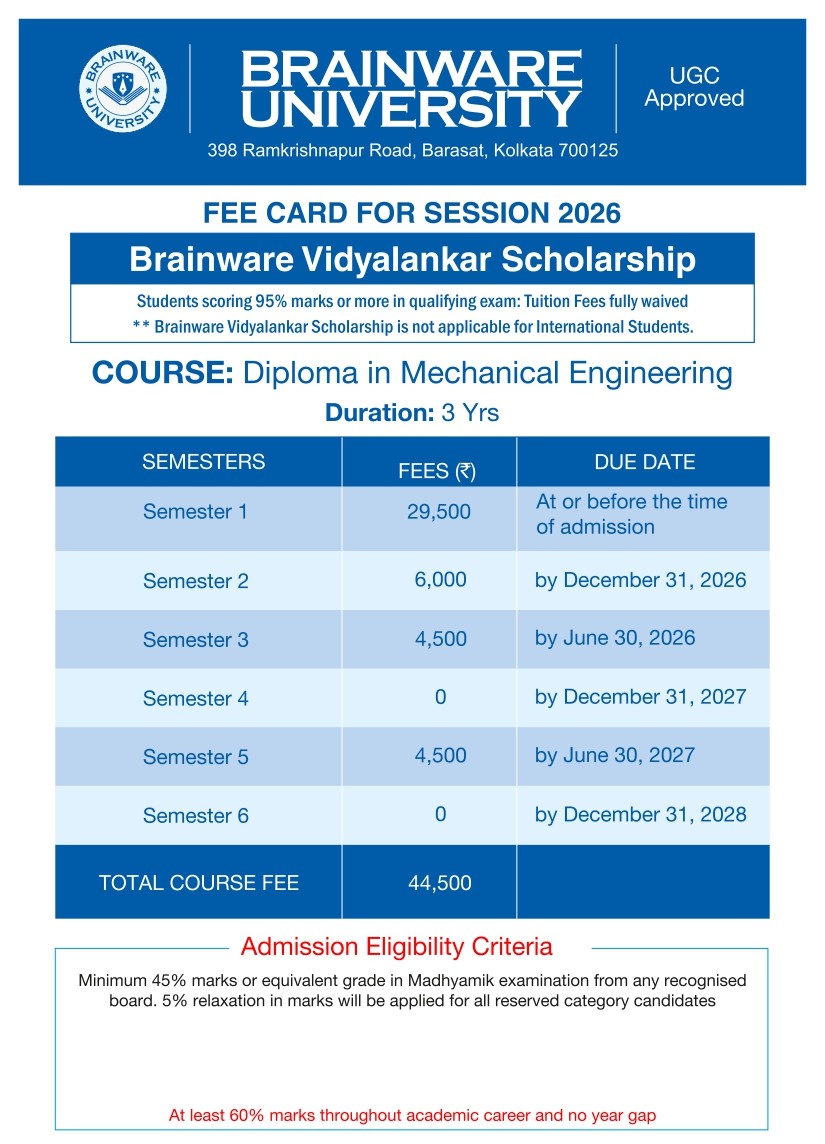
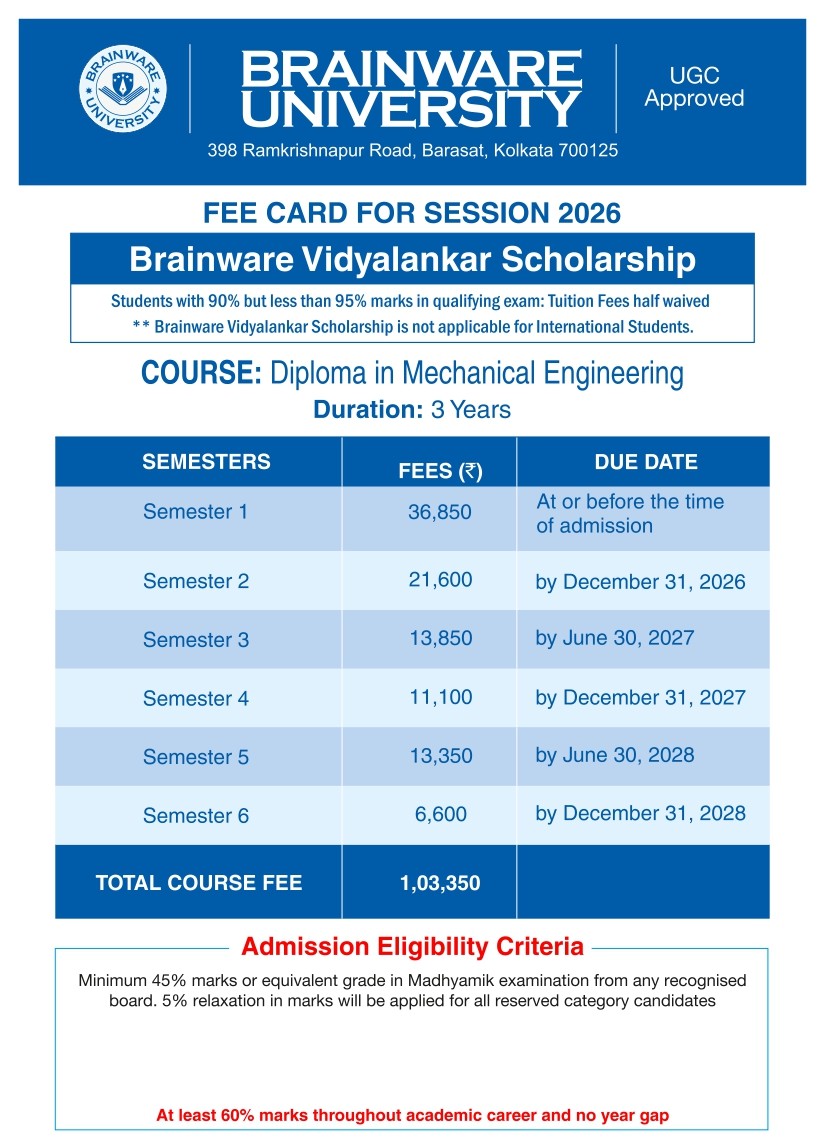
The Diploma in Mechanical Engineering fee structure at Brainware University is designed to support technical education in manufacturing, machine design, thermodynamics, workshop practice, CAD, CNC technology, maintenance, and quality control. The fee generally covers academic instruction, laboratory and workshop exposure, project work, technical training, student support, and placement preparation according to university norms.
| Semesters | Semester 1 | Semester 2 | Semester 3 | Semester 4 | Semester 5 | Semester 6 | Semester 7 | Semester 8 | Semester 9 | Semester 10 | Total |
|---|---|---|---|---|---|---|---|---|---|---|---|
| Fees (INR) | 44200 | 37200 | 23200 | 22200 | 22200 | 13200 | 1,62,200 |
**Fees are subject to change, and the application fee of ₹5,000 is non-refundable under any circumstances. Please contact us for further details.
Scholarships(Fees): Brainware University offers merit-based scholarships for top performers and financial aid for deserving students. Scholarships are available for high scorers in entrance exams, board results, and outstanding achievements in innovation or research. Visit our scholarship page for more details.
**Please note that the Brainware Vidyalankar Scholarship is available only to students who passed their qualifying examination in the current admission year. Also, eligibility is strictly restricted to Indian nationals; international students are not eligible to apply.
AI-driven mechanical engineering education helps students understand how automation, sensors, robotics, digital design, predictive maintenance, and smart manufacturing are changing production and maintenance systems. Diploma students gain foundational awareness of how mechanical equipment can be monitored, controlled, tested, and improved using digital tools.
AI does not replace mechanical fundamentals. Students still need strong knowledge of machines, materials, production, maintenance, thermodynamics, safety, and workshop practice. Digital systems support better fault detection, process control, quality inspection, energy efficiency, and production planning.
AI and digital innovation are relevant in areas such as:

The end-to-end AI learning spectrum in Mechanical Engineering begins with engineering fundamentals and progresses towards digital design, machine monitoring, automation, simulation, production data, and intelligent maintenance. Students learn how machines generate operational data and how that information supports safer, faster, and more reliable industrial systems.
The learning process connects workshop practice with modern manufacturing. Students gain awareness of how sensors collect information, software supports design, automated systems control machines, and technicians use data to diagnose faults or improve production quality.
Key learning areas include:



Key academic strengths include:
When comparing mechanical engineering colleges, students should check:
The Diploma in ME placement scoreboard reflects the programme’s career focus across manufacturing, automotive, production, maintenance, CNC operations, quality control, and junior mechanical roles. Students are prepared for technical interviews, aptitude tests, practical assessments, communication rounds, and role-specific recruitment processes.


Diploma in ME placement support at Brainware University helps students prepare for roles in manufacturing, production, maintenance, quality control, CNC machining, automotive service, fabrication, machine design support, and plant operations.
.webp)
JBMI

Kiswok Industries Pvt.Ltd
.webp)
JBMI

JBMI


Brainware University has earned an AA+ rating in India’s Best Engineering Institutes by Careers360. The recognition reflects the University’s strength in academic quality, faculty, infrastructure, research, and student outcomes, reinforcing its position as a trusted destination for industry-aligned engineering education.

Brainware University has been ranked No. 1 Engineering College under a Private University in West Bengal in the IIRF Rankings 2026. The recognition highlights the University’s strength in engineering education, industry-focused learning, research, emerging technologies, and placement outcomes.

Brainware University has been ranked No. 2 Private University in West Bengal by uniRank 2026, marking another recognition of the University's growing presence in the state's higher education landscape.

Brainware University's inclusion in the Times Higher Education (THE) Impact Rankings 2025 reflects its contribution to the UN Sustainable Development Goals (SDGs) through education, innovation, sustainability, community engagement, and responsible institutional practices.

Brainware University has been recognised as the Best Private University of West Bengal in Infrastructure & Placement at Times Now.in – Leaders of Excellence: East 2026, celebrating its commitment to world-class infrastructure and career-focused education.

Brainware University has been recognised by The Times Group for excellence across Engineering (Placement), Law, and MBA Studies. The honours reflect the University’s multidisciplinary strength and its focus on career-oriented, industry-relevant education.

Brainware University received the ABP Ananda Shiksha Samman 2026 for Excellence in Placement & AI-Integrated Academic Infrastructure, acknowledging its emphasis on placement opportunities alongside technology-enabled academic development.

Brainware University has been honoured with the Zee 24 Ghanta Education Excellence Award 2026 for Best Industry Placement & Academic Infrastructure, continuing its recognition in 2022, 2023, 2024, 2025, and 2026. The University was also recognised in 2017 and 2018 for its job-oriented academic initiatives.

Brainware University received the TV9 Uttaran Academic Excellence Honour for Excellence in Placement & AI-Integrated Academic Infrastructure, highlighting its focus on combining career opportunities with an AI-enabled academic and learning environment.

Brainware University was honoured with the R Bangla Sikkha Gourab Samman 2026, recognising its contribution to higher education and continued pursuit of academic excellence and career-focused learning.

Brainware University was honoured as the Best Private University in West Bengal at the Times Now in Business Excellence Awards (East) 2025, recognising its academic quality, modern infrastructure, industry engagement, and focus on student success.

Brainware University was recognised as the Leading University in Infrastructure, Academics & Placement at the Times Business Awards West Bengal 2025, highlighting its strong campus facilities, academic ecosystem, and placement performance across disciplines.

The Diploma in Mechanical Engineering syllabus is designed to build technical knowledge in mechanics, thermodynamics, fluid mechanics, manufacturing, machine design, materials, production, CAD, maintenance, metrology, and workshop practice. The curriculum combines classroom instruction with laboratory training, projects, workshops, and industrial exposure.
Students learn how machines are designed, manufactured, operated, tested, maintained, and improved in industrial and commercial environments.
The core foundation modules help students develop essential knowledge of mechanical science, engineering drawing, manufacturing, materials, thermodynamics, and machine systems.
Core learning areas include:
These subjects help students understand the principles behind machines, production systems, manufacturing operations, and maintenance practices.
The evolving and high-growth areas prepare Diploma in ME students for careers in automation, robotics, electric mobility, advanced manufacturing, 3D printing, smart factories, and sustainable engineering.
Advanced learning areas include:
These areas help students understand how mechanical engineering is adapting to automation, clean mobility, and digital production.
| Semester | Course |
|---|---|
| Semester I | Mathematics-I |
| Applied Physics-I | |
| Applied Chemistry | |
| Introduction to IT Systems | |
| Communication Skills in English | |
| Applied Physics-I Lab | |
| Applied Chemistry Lab | |
| Introduction to IT Systems Lab | |
| Engineering Graphics | |
| Engineering Workshop Practice | |
| Semester II | Mathematics-II |
| Applied Physics-II | |
| Fundamentals of Electrical and Electronics Engineering | |
| Engineering Mechanics | |
| Computer Programming | |
| Applied Physics-II Lab | |
| Fundamentals of Electrical and Electronics Engineering Lab | |
| Engineering Mechanics Lab | |
| Computer Programming Lab | |
| Communication Skills in English Lab | |
| Environmental Sciences | |
| Basic Communication and Thinking Skills | |
| Semester III | Design of Machine Elements |
| Manufacturing Engineering | |
| Thermal Engineering-1 | |
| Strength of Materials | |
| Materials Science and Engineering | |
| Theory of Machines and Mechanisms | |
| Manufacturing Engineering Lab | |
| Materials Science and Engineering Lab | |
| Semester IV | Fluid Mechanics and Machinery |
| Thermal Engineering - II | |
| Advanced Manufacturing Process | |
| Refrigeration and Air-conditioning / Industrial Robotics and Automation / Computer Aided Design and Manufacturing / Automobile Engineering | |
| Entrepreneurship and Start-ups | |
| Fluid Mechanics and Machinery Lab | |
| Thermal Engineering - II Lab | |
| Advanced Manufacturing Process Lab | |
| Essence of Indian Knowledge and Tradition | |
| Communication Skills and Workplace Basics | |
| Semester V | Metrology and Measurements |
| Heat Transfer / Power Plant Engineering / Mechatronics / Tool Engineering | |
| Material Handling Systems / Computer Integrated Manufacturing / Hybrid Vehicles / Total Quality Management | |
| Operations Research / Engineering Economics and Accountancy / Economic Policies in India | |
| Metrology and Measurements Lab | |
| Machine Drawing Lab | |
| Strength of Materials Lab | |
| Internship | |
| Minor Project | |
| Semester VI | Production Management |
| Renewable Energy / Artificial Intelligence and Machine Learning / Energy Conservation and Audit | |
| Additive Manufacturing / Virtual Reality / Internet of Things | |
| Product, Process and Design Analysis | |
| Major Project | |
| Grand Viva-Voce | |
| Indian Constitution |
Please note that the syllabus is subject to modification. Visit our Syllabus page for the elective subject details and updated syllabus.

Diploma in Mechanical Engineering graduates can work across manufacturing, automotive, heavy engineering, machinery, fabrication, construction, energy, industrial maintenance, production, and engineering service sectors.
Students with strong skills in machining, CAD, CNC, maintenance, quality control, materials, safety, and technical drawing are better positioned for private-sector roles.
Diploma in ME graduates may explore government and public-sector opportunities in railways, public works, defence establishments, public-sector manufacturing units, transport departments, energy organisations, municipal services, and technical institutions.
Candidates should check official recruitment notifications, examination requirements, age limits, trade requirements, and organisation-specific eligibility rules.
Diploma in ME career prospects extend across manufacturing, automotive, production, maintenance, quality control, construction, energy, heavy engineering, and machinery services. Graduates develop practical abilities in machining, fabrication, equipment operation, inspection, troubleshooting, and production support.
| Area of Opportunity | Why It’s in Demand |
|---|---|
| Mechanical Technician | Industries require skilled technicians to install, maintain, and troubleshoot mechanical systems and machinery. |
| Production Technician | Manufacturing companies need professionals to support efficient production processes and ensure operational productivity. |
| Maintenance Technician | Factories and industrial plants rely on maintenance personnel to minimize downtime and keep equipment functioning smoothly. |
| Quality Control Inspector | Organizations seek quality professionals to ensure products meet industry standards and customer expectations. |
| CNC Machine Operator | The increasing use of automated machining and precision manufacturing has created strong demand for CNC specialists. |
| CAD Design Technician | Engineering and manufacturing firms require technicians who can create and modify technical drawings using CAD software. |
| Automobile Service Technician | The expanding automotive sector needs trained professionals for vehicle maintenance, diagnostics, and repairs. |
| Manufacturing Technician | Modern manufacturing facilities depend on technicians who can operate, monitor, and optimize production equipment. |
| Plant Maintenance Technician | Industrial plants require skilled personnel to maintain machinery, utilities, and production systems for continuous operations. |
| Junior Mechanical Engineer | Companies hire junior engineers to assist with design, production, maintenance, testing, and project execution activities. |
The career scope after Diploma in Mechanical Engineering depends on technical skill, workshop practice, internship exposure, safety awareness, software knowledge, and higher qualifications. Graduates who add CAD, CNC, quality control, automation, or maintenance certifications can improve their prospects in modern manufacturing sectors.
The job market for Diploma in ME graduates is expected to remain active from 2025 to 2032 as manufacturing, automotive production, industrial automation, infrastructure, electric mobility, renewable energy equipment, and precision engineering continue to expand. Demand will favour technicians who combine mechanical fundamentals with CAD, CNC, automation, maintenance, and quality skills.
Mechanical careers are also changing with the adoption of robotics, smart factories, 3D printing, digital twins, and electric vehicles. Diploma holders who build practical skills in these areas will be better positioned for technical and supervisory roles.
Mechanical engineering career growth will be driven by manufacturing expansion, industrial automation, electric mobility, machinery production, infrastructure, renewable energy equipment, defence manufacturing, and advanced production systems.
Major growth drivers include:
High-growth technical roles are likely to include CNC Machine Operator, CAD Technician, Automation Technician, Maintenance Technician, Quality Control Inspector, EV Service Technician, Production Technician, and Additive Manufacturing Technician.
High-growth career roles include:
Diploma in Mechanical Engineering graduates will find opportunities across industries that depend on machines, production, maintenance, design, quality, and industrial operations.
Key hiring industries include:
The most valuable skills from 2025 to 2032 will include machining, CAD, CNC, maintenance, quality control, production planning, automation, technical drawing, measurement, safety, and problem-solving.
Important skill areas include:
The growth outlook is positive for diploma graduates who combine mechanical fundamentals with practical knowledge of CNC machining, CAD, maintenance, automation, quality control, and electric mobility. Routine manual work may reduce in some factories, but skilled technicians will remain important for machine setup, repair, inspection, monitoring, and production support.
Students should focus on building:
The future mechanical job market will reward technicians who can work with both traditional machinery and modern automated systems. Manufacturing plants, EV companies, smart factories, and engineering firms need workers who understand machines, digital design, production, maintenance, and quality.
For students choosing a Diploma in Mechanical Engineering college, the focus should be on workshop facilities, machine tools, CAD and CNC exposure, industry visits, internship support, technical faculty, higher-study pathways, and placement assistance.


The Diploma in Mechanical Engineering course provides students with a well-rounded education, combining theoretical knowledge with hands-on practical experience. Our cutting-edge labs and comprehensive curriculum ensure a dynamic learning journey, preparing you for success in the world of mechanical engineering. Elevate your skills with practical training and embark on a fulfilling career.

Diploma in Mechanical Engineering admission 2026 at Brainware University is open to eligible students who want technical education in machines, manufacturing, production, maintenance, CAD, CNC, quality control, and workshop practice. Applicants should review eligibility, fees, lateral-entry options, scholarships, counselling, and required documents before applying.
Admission Criteria:Admission is based on academic eligibility and Brainware University’s admission norms. Candidates must have passed Madhyamik, Class 10, or an equivalent examination from a recognised board and meet the prescribed minimum marks.
Application: Candidates can apply through the online enquiry or application form on the Brainware University website. Applicants must provide their name, programme preference, location, phone number, email address, and academic information.
Entrance Exam: Admission is conducted according to the university’s current eligibility and selection guidelines. Candidates should confirm whether any entrance test, merit assessment, counselling step, or additional requirement applies for the 2026 academic session.
Counselling: Eligible applicants receive counselling support from the university admission team. Counselling covers the course structure, Diploma ME subjects, duration, fees, scholarship options, lateral entry route, career scope, internship support, placement assistance, and required documents.
Direct Admission: Direct admission may be available according to eligibility, merit, seat availability, and university norms. Students seeking Polytechnic ME admission or mechanical engineering admission should contact the admission office for the latest procedure.
Please follow the given Diploma in Mechanical Engineering Admission Procedure in Brainware University:


If you are willing to work hard and trust the guidance you receive at Brainware, you cannot fail. The pre-placement training sessions right from the induction days, set us on the winning path.
Sourya Dey Dip ME

"Brainware students are professionally and technically well-informed as freshers. We are impressed with the level of confidence and positive attitude they demonstrated during their interviews."
Mr. Vaskar Bhattacharya Regional Head-East, Ginnisystems Ltd.
We always find competent and positive students who are almost ready to be professionals. We never get disappointed wherever we come for the recruitment. Well done Brainware University!
Ms. Srimoyee Mukherjee Manager HR Nature Technologies Pvt. Ltd.
The Department of Mechanical Engineering at Brainware University supports technical learning through workshops, seminars, laboratory activities, industrial visits, expert sessions, projects, innovation-based learning, and student participation in engineering events.
https://www.brainwareuniversity.ac.in/departments/mechanical-engineering/activities.php
A Diploma in Mechanical Engineering is a technical program that provides students with the necessary skills and knowledge to work in the field of mechanical engineering. It focuses on areas such as design, manufacturing, maintenance, and operation of machinery and mechanical systems.
The entry requirements may vary depending on the educational institution offering the program. However, typically, candidates need to have completed their secondary education or its equivalent. Some institutions may also require students to have a background in mathematics and physics.
The subjects covered in a Diploma in Mechanical Engineering may include engineering mathematics, engineering mechanics, thermodynamics, fluid mechanics, manufacturing processes, machine design, control systems, CAD/CAM, and project management, among others.
By completing a Diploma in Mechanical Engineering, you will develop skills such as technical drawing and drafting, problem-solving, critical thinking, project management, computer-aided design (CAD), manufacturing techniques, and practical hands-on skills in operating and maintaining machinery.
Graduates with a Diploma in Mechanical Engineering can find employment in various industries such as manufacturing, automotive, aerospace, energy, construction, and consulting firms. They may work as mechanical technicians, design engineers, maintenance engineers, production supervisors, quality control inspectors, or project coordinators, among other roles.
Yes, many educational institutions offer the option to further your studies after completing a Diploma in Mechanical Engineering. You can pursue a Bachelor's degree in Mechanical Engineering or a related field to enhance your knowledge and career prospects.
The duration of a Diploma in Mechanical Engineering can vary depending on the educational institution and the specific program. Typically, it takes around two to three years of full-time study to complete a diploma program.
A Diploma in Mechanical Engineering is a shorter, more focused program that provides a foundation of knowledge and practical skills in mechanical engineering. A Bachelor's degree, on the other hand, is a more comprehensive program that covers a wider range of subjects and provides a deeper understanding of the field. A Bachelor's degree may also offer more advanced career opportunities and eligibility for professional engineering licensure.
Financial aid options such as scholarships, grants, and loans may be available for students pursuing a Diploma in Mechanical Engineering. It is recommended to check with the educational institution or relevant financial aid organizations for specific details and eligibility criteria.
A Diploma in Mechanical Engineering is a 3-year program that focuses on mechanical systems, thermodynamics, materials science, and engineering design, preparing you for hands-on work in the mechanical engineering field.
Brainware University is a top choice for a Diploma in Mechanical Engineering, offering state-of-the-art labs, practical training, and industry exposure.
Brainware University combines practical workshop training, advanced laboratory facilities, industry-oriented learning, and expert faculty guidance. Supported by the university's 98% placement record across programmes, students gain valuable opportunities to pursue rewarding careers in manufacturing, automotive, production, and maintenance industries.
You must have completed 10th grade (SSC) with a minimum of 45% in relevant subjects such as Mathematics, Physics, and Chemistry.
The Diploma in Mechanical Engineering course is typically 3 years long, divided into 6 semesters.
Subjects include Mechanics, Thermodynamics, Machine Design, Fluid Mechanics, Manufacturing Processes, and Engineering Materials.
Graduates can work as Mechanical Technicians, Design Engineers, Production Engineers, or Maintenance Engineers in various industries such as automotive, aerospace, and manufacturing.
The starting salary for a Diploma in Mechanical Engineering graduate ranges from ₹2.5 to ₹4 LPA, depending on skills, experience, and industry.
Industries include automobile, construction, aerospace, power generation, and manufacturing.
Focus on your technical knowledge related to mechanical systems, machinery, thermodynamics, and problem-solving skills. Also, practice common interview questions and scenarios.
Leading companies include Tata Motors, L&T, Mahindra, Bosch, and General Electric.
Focus on hands-on practice, workshops, internships, and project work related to mechanical systems, CAD, and 3D modeling.
Learn software such as AutoCAD, CATIA, SolidWorks, and ANSYS for 3D modeling, simulation, and design.
Work on solving engineering problems related to mechanical systems, take part in projects, and engage in internships for real-world problem-solving experience.
Study topics like machine elements, materials selection, and manufacturing processes. Use CAD tools to design machines and systems.
Study the basics of energy systems, fluid dynamics, and heat transfer. Solve practical problems using simulation tools and real-world applications.
Automation involves the use of robotics, sensors, and programmable systems to improve production efficiency, reducing human intervention in mechanical processes.
Mechanical Engineers design wind turbines, solar thermal systems, and geothermal power plants, helping to harness clean energy for sustainable development.
After completing the diploma, you can pursue B.Tech/BE in Mechanical Engineering, Automobile Engineering, or Industrial Engineering to further advance your career.
Mechanical engineers are involved in the design, manufacturing, and testing of vehicles, including engines, chassis, and suspension systems.
Mechanical Engineers design and develop robotic systems, focusing on mechanical components, actuators, and motion control to enhance robotics applications in various industries.