98%
Placed
in 2025







Diploma in Computer Science and Engineering is a 3-year technical programme that builds foundational knowledge in programming, software development, computer hardware, networking, database management, web technologies, operating systems, and emerging digital tools. The course is designed for students who want an early entry into computer science, IT services, software support, and technology-linked careers after Class 10.
The Diploma in CSE programme at Brainware University helps students develop practical computing skills through classroom learning, laboratory exposure, coding practice, technical projects, and industry-oriented training. Applicants will find complete information on this page about diploma CSE admission 2026, eligibility, fees, syllabus, subjects, career options, placement support, internship scope, higher studies, and learning benefits.
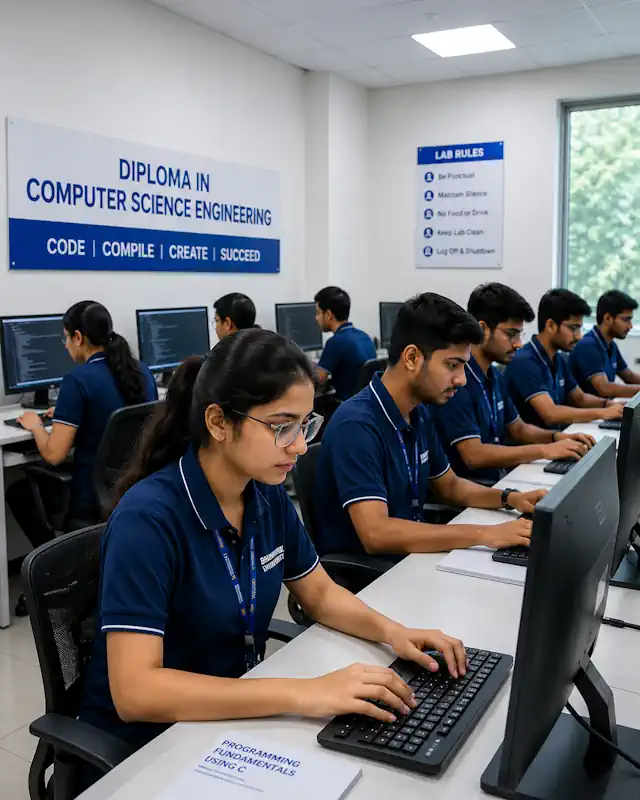

Diploma in CSE at Brainware University is a 3-year technical programme focused on computer programming, software development, database systems, networking, operating systems, computer hardware, web technologies, and emerging areas such as AI, cloud computing, cybersecurity, and data analytics. The programme prepares students for entry-level IT roles and higher studies in computer science and engineering.
| Programme | Diploma in Computer Science & Engineering |
|---|---|
| Duration | 3 years |
| Focus Areas | Programming, Computer Fundamentals, Software Development, Web Development, Database Management Systems, Computer Networks, Operating Systems, Computer Hardware, Digital Electronics, Software Engineering, Data Structures, Artificial Intelligence Basics, Cybersecurity Fundamentals, Cloud Computing Concepts, and IT Support. |
| Salary | Diploma in CSE graduates may explore entry-level salary packages commonly ranging from ₹2 LPA to ₹4 LPA, depending on programming ability, practical skills, internship exposure, project work, recruiter profile, and interview performance. Higher growth may be possible in software development, web development, cybersecurity, cloud support, database administration, and networking roles with experience and further qualifications. |
| Popular Job Types | Software Developer, Web Developer, Computer Programmer, Technical Support Engineer, Network Administrator, System Administrator, Database Administrator, IT Support Executive, Cybersecurity Technician, Mobile Application Developer, QA Tester, Cloud Support Associate, Hardware and Network Technician, Data Entry and Operations Executive, and Junior Software Engineer. |
| Hiring Industries | IT services, software development companies, web development firms, networking companies, cybersecurity firms, cloud service providers, e-commerce companies, telecom, EdTech, FinTech, digital agencies, manufacturing IT departments, healthcare IT, logistics companies, startups, public-sector IT projects, and technical support organisations. |
| Top Recruiters | Diploma in CSE graduates may find opportunities with IT companies, software firms, support service providers, web development agencies, networking firms, cloud support teams, technology startups, and business organisations with IT departments. Recruiter participation may vary by year, student profile, skill level, internship exposure, and placement cycle. |
| Specializations | Software Development, Web Technologies, Database Management, Computer Networking, IT Support, Cloud Computing Basics, Cybersecurity Fundamentals, Mobile Application Development, Data Handling, Computer Hardware, System Administration, and Emerging Digital Technologies. |
| Higher Studies | Diploma in CSE graduates can pursue B.Tech or B.E. in Computer Science and Engineering through lateral entry where applicable, BCA, B.Sc Computer Science, or other higher education routes as per eligibility norms. They may also take certifications in programming, web development, networking, cybersecurity, cloud computing, database management, Linux administration, and data analytics. |
| Benefits | The programme supports early technical learning through computer labs, programming practice, networking exposure, database training, hardware and software fundamentals, project-based assignments, industry interaction, and placement-oriented preparation. It is suitable for students seeking computer science diploma, computer engineering diploma, polytechnic computer science, or diploma courses in computer science. |
| Internship and Placement | Students receive exposure to internships, live projects, technical workshops, industry visits, skill training, pre-placement sessions, resume support, interview preparation, and placement assistance. The programme aims to build job-ready skills for IT support, software development, web development, networking, database administration, and technical service roles. |
| Location | Brainware University, Barasat, Kolkata, West Bengal. |
| Approvals & Recognition | Brainware University is a UGC-recognised university. The Diploma in Computer Science and Engineering programme is offered under the university’s academic framework, with curriculum, evaluation, and learning outcomes aligned with technical education and computer science learning standards. |
Key reasons to study Diploma in Computer Science and Engineering include:

Educational Qualification: Candidates must have passed the Madhyamik (Class 10) examination or an equivalent examination from any recognised board.
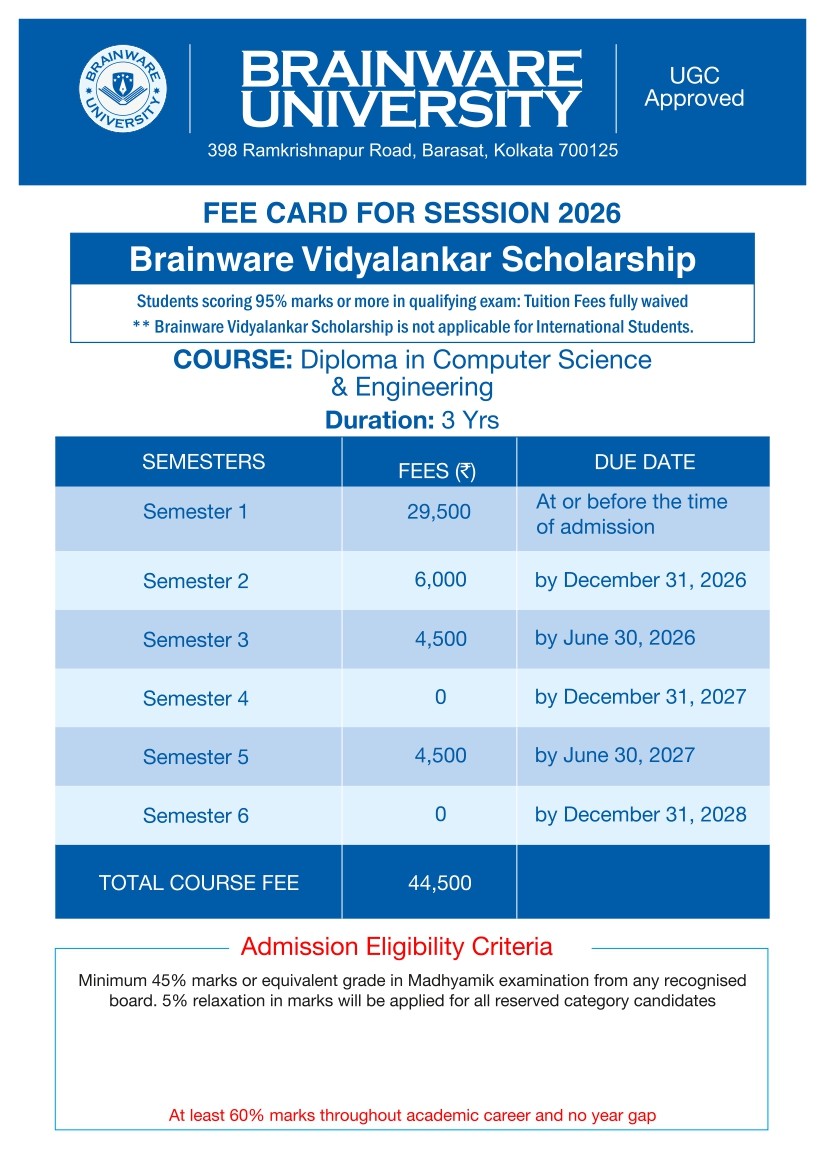
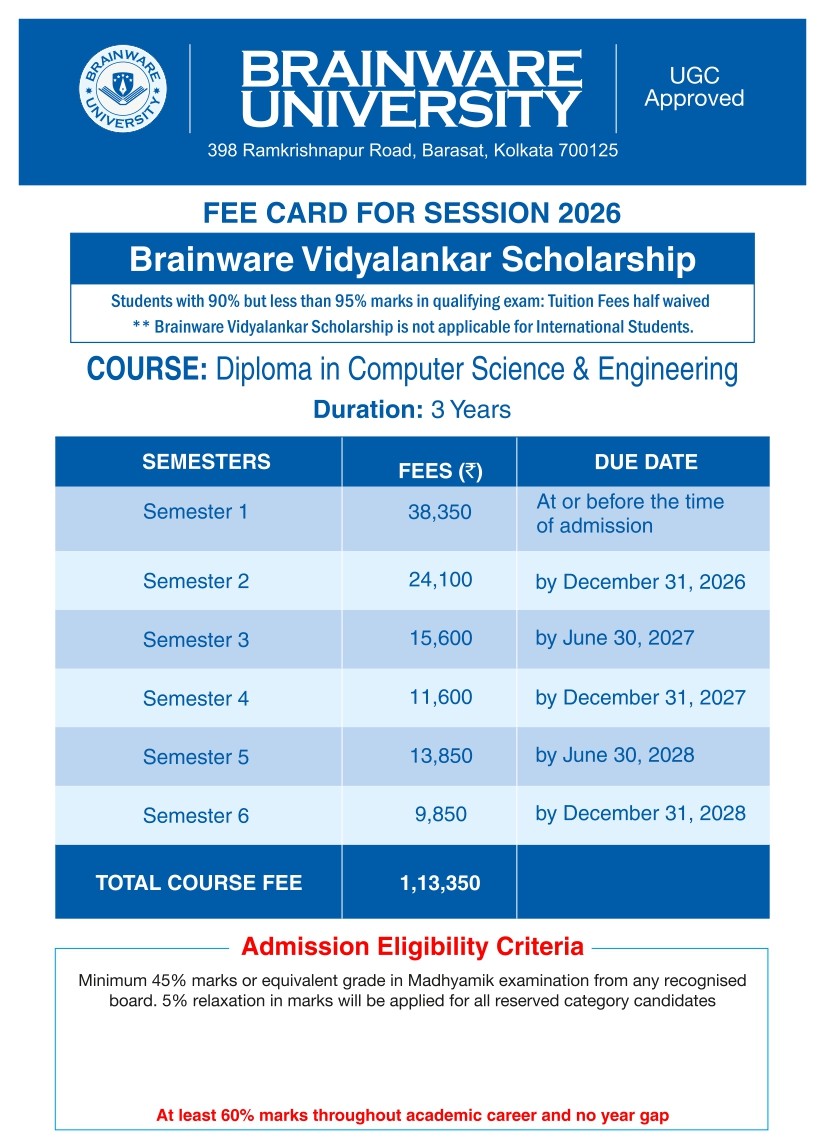
Minimum Marks: Applicants are required to secure a minimum of 45% marks or an equivalent grade in the qualifying examination. A relaxation of 5% in marks is applicable for candidates belonging to reserved categories, as per university norms.
Admission Process: Admission to the Diploma in Computer Science & Engineering programme at Brainware University is conducted according to the university's admission guidelines and eligibility criteria.
Interested in building a strong foundation in computer science and engineering? At Brainware University, we are committed to providing quality technical education that combines theoretical knowledge with practical skill development. The Diploma in Computer Science & Engineering programme is designed to equip students with the essential competencies required to thrive in today's technology-driven world.
The curriculum covers key areas such as programming, database management, computer hardware, networking, software development, web technologies, and emerging digital solutions. With access to modern laboratories, experienced faculty, industry-oriented training, and hands-on projects, students gain the technical expertise and problem-solving abilities needed for successful careers in the IT and technology sectors or for pursuing higher studies in engineering.
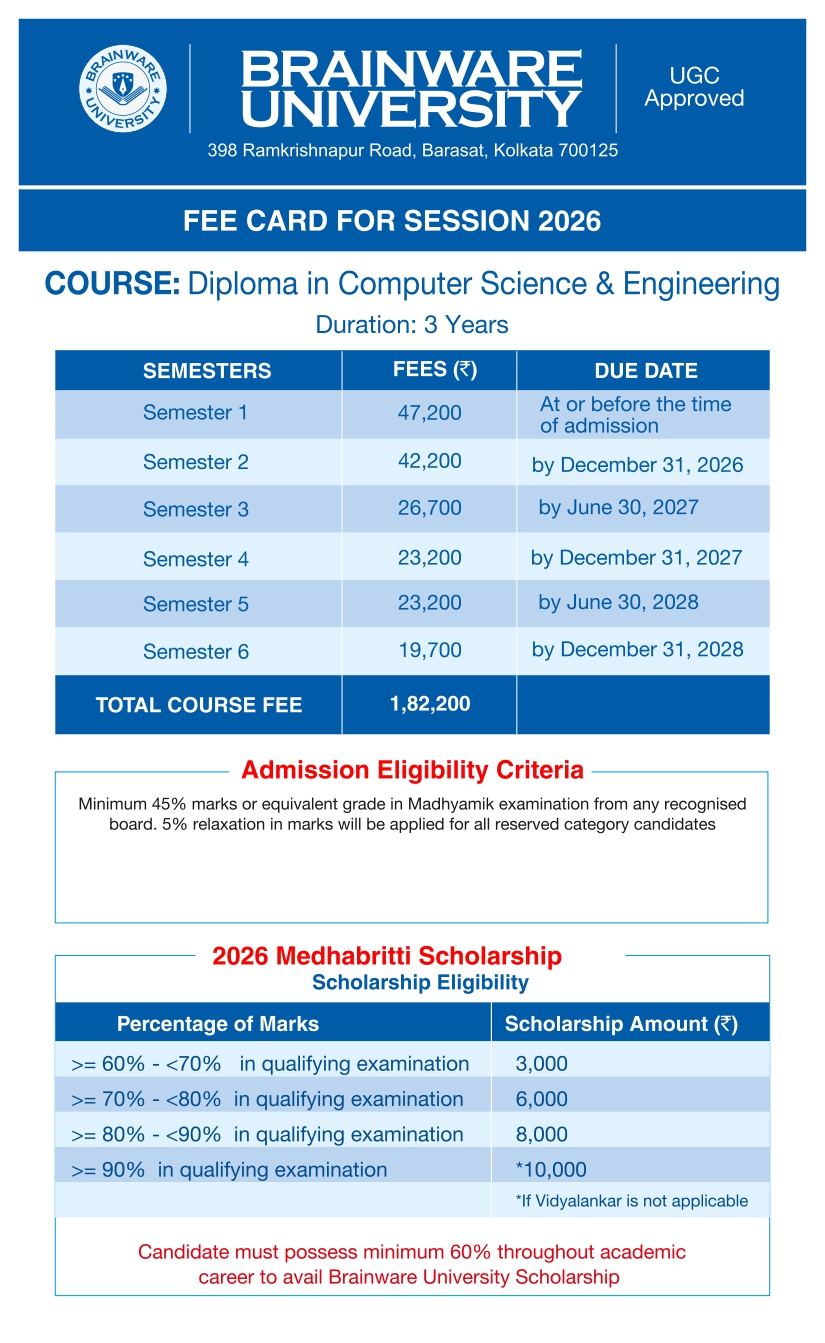
The Diploma in CSE fee structure at Brainware University is designed to support quality technical education in programming, computer networks, database systems, software development, web technologies, hardware, and emerging IT skills. The fee generally covers academic instruction, laboratory exposure, project work, technical training, student support, and placement-oriented preparation as per university norms.
| Semesters | Semester 1 | Semester 2 | Semester 3 | Semester 4 | Semester 5 | Semester 6 | Semester 7 | Semester 8 | Semester 9 | Semester 10 | Total |
|---|---|---|---|---|---|---|---|---|---|---|---|
| Fees (INR) | 47200 | 42200 | 26700 | 23200 | 23200 | 19700 | 1,82,200 |
**Fees are subject to change, and the application fee of ₹5,000 is non-refundable under any circumstances. Please contact us for further details.
Scholarships(Fees): Brainware University offers merit-based scholarships for top performers and financial aid for deserving students. Scholarships are available for high scorers in entrance exams, board results, and outstanding achievements in innovation or research. Visit our scholarship page for more details.
**Please note that the Brainware Vidyalankar Scholarship is available only to students who passed their qualifying examination in the current admission year. Also, eligibility is strictly restricted to Indian nationals; international students are not eligible to apply.
AI-driven technology education helps Diploma in CSE students understand how artificial intelligence, automation, data analytics, cloud computing, cybersecurity, and smart applications are changing the computer science field. Students build foundational knowledge that supports future learning in software development, AI tools, data handling, web systems, and digital infrastructure.
The programme helps students connect basic computing concepts with current industry practices. While the diploma focuses on fundamentals, it also introduces students to the technologies shaping modern IT careers, including AI-enabled applications, cloud platforms, data systems, and cybersecurity awareness.
AI and digital innovation are relevant in areas such as:

The end-to-end AI learning spectrum in Diploma in CSE begins with core computer science foundations and gradually connects them to modern digital applications. Students learn how programming, data, algorithms, databases, networks, and software systems support AI-enabled tools and automation in real-world settings.
This learning approach helps students understand that AI is not a standalone topic. It depends on strong fundamentals in coding, logic, mathematics, database management, computer systems, and problem-solving.
Key learning areas include:





Key academic strengths include:
When comparing Diploma CSE colleges, students should check:
The placement scoreboard for Diploma in CSE reflects the programme’s career focus across IT support, software development, web development, networking, database management, technical services, and junior engineering roles. Students are trained for technical interviews, coding tasks, communication rounds, aptitude tests, and role-specific placement processes.

Alumni from Diploma in CSE can build careers across IT support, software development, web development, networking, database management, cloud support, cybersecurity support, technical operations, and higher education pathways. Their career journeys show how diploma-level computer science training can support both employment and future academic growth.


Brainware University has earned an AA+ rating in India’s Best Engineering Institutes by Careers360. The recognition reflects the University’s strength in academic quality, faculty, infrastructure, research, and student outcomes, reinforcing its position as a trusted destination for industry-aligned engineering education.

Brainware University has been ranked No. 1 Engineering College under a Private University in West Bengal in the IIRF Rankings 2026. The recognition highlights the University’s strength in engineering education, industry-focused learning, research, emerging technologies, and placement outcomes.

Brainware University has been ranked No. 2 Private University in West Bengal by uniRank 2026, marking another recognition of the University's growing presence in the state's higher education landscape.
Brainware University's inclusion in the Times Higher Education (THE) Impact Rankings 2025 reflects its contribution to the UN Sustainable Development Goals (SDGs) through education, innovation, sustainability, community engagement, and responsible institutional practices.

Brainware University has been recognised as the Best Private University of West Bengal in Infrastructure & Placement at Times Now.in – Leaders of Excellence: East 2026, celebrating its commitment to world-class infrastructure and career-focused education.

Brainware University has been recognised by The Times Group for excellence across Engineering (Placement), Law, and MBA Studies. The honours reflect the University’s multidisciplinary strength and its focus on career-oriented, industry-relevant education.

Brainware University received the ABP Ananda Shiksha Samman 2026 for Excellence in Placement & AI-Integrated Academic Infrastructure, acknowledging its emphasis on placement opportunities alongside technology-enabled academic development.

Brainware University has been honoured with the Zee 24 Ghanta Education Excellence Award 2026 for Best Industry Placement & Academic Infrastructure, continuing its recognition in 2022, 2023, 2024, 2025, and 2026. The University was also recognised in 2017 and 2018 for its job-oriented academic initiatives.

Brainware University received the TV9 Uttaran Academic Excellence Honour for Excellence in Placement & AI-Integrated Academic Infrastructure, highlighting its focus on combining career opportunities with an AI-enabled academic and learning environment.

Brainware University was honoured with the R Bangla Sikkha Gourab Samman 2026, recognising its contribution to higher education and continued pursuit of academic excellence and career-focused learning.

Brainware University was honoured as the Best Private University in West Bengal at the Times Now in Business Excellence Awards (East) 2025, recognising its academic quality, modern infrastructure, industry engagement, and focus on student success.

Brainware University was recognised as the Leading University in Infrastructure, Academics & Placement at the Times Business Awards West Bengal 2025, highlighting its strong campus facilities, academic ecosystem, and placement performance across disciplines.

The Diploma CSE syllabus is designed to build strong technical foundations in computer programming, software development, computer hardware, database systems, operating systems, networking, web technologies, and emerging digital technologies. The curriculum combines classroom learning with laboratory practice, projects, and skill-based assignments.
The syllabus prepares students to understand how computer systems work, how software is developed, how networks are managed, and how databases and applications support modern digital businesses.
The core foundation modules in Diploma in Computer Science and Engineering help students develop basic technical knowledge in computing, programming, mathematics, hardware, software, networks, and databases. These subjects build the base required for entry-level IT roles and higher studies in computer science.
Core learning areas include:
These foundation areas help students understand both the software and hardware sides of computer science engineering.
The evolving and high-growth areas in Diploma CSE prepare students for future opportunities in AI, cybersecurity, cloud computing, web development, mobile applications, data analytics, and digital infrastructure. These areas are becoming increasingly important as industries adopt technology-led operations.
Advanced learning areas include:
These modules help students build practical readiness for IT careers and higher studies in computer science and engineering.
| Semester | Course |
|---|---|
| Semester I | Communication Skills in English |
| Applied Chemistry | |
| Applied Physics - I | |
| Mathematics - I | |
| Introduction to IT Systems | |
| Engineering Mechanics | |
| Applied Physics - I Lab | |
| Applied Chemistry Lab | |
| Introduction to IT Systems Lab | |
| Engineering Mechanics Lab | |
| Engineering Workshop Practice | |
| Semester II | Applied Physics - II |
| Mathematics - II | |
| Fundamentals of Electrical and Electronics Engineering | |
| Computer Programming | |
| Applied Physics - II Lab | |
| Fundamentals of Electrical and Electronics Engineering Lab | |
| Computer Programming Lab | |
| Engineering Graphics | |
| Communication Skills in English Lab | |
| Environmental Sciences | |
| Basic Communication and Thinking Skills | |
| Semester III | Data Structures |
| Operating Systems | |
| Software Engineering | |
| OOP with C++ | |
| Digital Electronics | |
| Data Structures Lab | |
| Operating Systems Lab | |
| Scripting Languages Lab | |
| OOP with C++ Lab | |
| Semester IV | Computer Organization |
| Design and Analysis of Algorithm | |
| Introduction to DBMS | |
| Web Technologies | |
| Computer Networks | |
| Computer Organization Lab | |
| Design and Analysis of Algorithm Lab | |
| Database Management System Lab | |
| Web Technologies Lab | |
| Computer Networks Lab | |
| Essence of Indian Knowledge and Tradition | |
| Communication Skills and Workplace Basics | |
| Semester V | Entrepreneurship and Start-ups |
| Internet of Things | |
| Elective: Mobile Computing / Multimedia Technologies / Fundamentals of AI | |
| Elective: Information Security / Network Forensics / Cloud Computing | |
| Elective: Renewable Energy Technologies / Operations Research / Corporate Social Responsibility | |
| Industrial Training | |
| Project-I | |
| Semester VI | E-Commerce |
| Microprocessor | |
| Elective: FOSS (Free and Open Source Software) / Software Testing / Machine Learning | |
| Elective: Game Theory / Organisational Behaviour / Fundamentals of Engineering Economics | |
| Elective: Cyber Law and Security / Project Management / Marketing and Sales | |
| Project-II | |
| Grand Viva | |
| Indian Constitution |
Please note that the syllabus is subject to modification. Visit our Syllabus page for the elective subject details and updated syllabus.

Diploma in CSE graduates can work in private-sector roles across IT services, software development firms, web development agencies, networking companies, cloud support teams, cybersecurity support units, e-commerce companies, digital agencies, startups, and business organisations with IT departments. Career growth depends on programming ability, practical skills, certifications, internship exposure, and communication confidence.
Students with strong skills in programming, SQL, web development, networking, Linux, troubleshooting, and project work are better positioned for entry-level technology roles.
Diploma in CSE graduates may explore government and public-sector opportunities in IT support, data operations, technical assistance, computer operations, network maintenance, public-sector projects, and technical service roles. These roles often require computer knowledge, documentation ability, troubleshooting skills, and awareness of basic IT systems.
Candidates should check official recruitment notifications, eligibility rules, examination patterns, and organisation-specific requirements.
Diploma in CSE career prospects are strong for students who want early technical careers in software development, web development, IT support, networking, database management, cybersecurity support, cloud support, and digital operations. A Diploma in Computer Science and Engineering provides practical computing skills and creates a pathway for both employment and higher studies.
| Area of Opportunity | Why It’s in Demand |
|---|---|
| Software Developer | Businesses across industries require software solutions, creating strong demand for professionals who can design, develop, and maintain applications. |
| Web Developer | The rapid growth of online businesses and digital platforms has increased the need for skilled web development professionals. |
| Computer Programmer | Organisations seek programmers who can write, test, and optimise code for various software and technology applications. |
| Technical Support Engineer | Companies rely on technical support specialists to troubleshoot issues, maintain systems, and ensure smooth IT operations. |
| Network Administrator | Expanding digital infrastructure has created demand for professionals who can manage and secure computer networks. |
| System Administrator | Organisations require system administrators to oversee servers, operating systems, and enterprise IT environments. |
| Database Administrator | Growing volumes of business data have increased the need for professionals who can manage, secure, and optimise databases. |
| IT Support Executive | Businesses depend on IT support personnel to maintain technology resources and assist users with technical challenges. |
| Cybersecurity Technician | Rising cybersecurity threats have created opportunities for professionals who can protect networks, systems, and sensitive information. |
| Mobile Application Developer | The increasing use of smartphones and mobile technologies continues to drive demand for app development specialists. |
| Quality Assurance (QA) Tester | Software companies require QA professionals to test applications, identify defects, and ensure product quality. |
| Cloud Support Associate | As organisations adopt cloud technologies, the need for cloud support and infrastructure professionals continues to grow. |
| Hardware and Network Technician | Companies require technicians to install, maintain, and troubleshoot computer hardware and networking equipment. |
| Data Entry and Operations Executive | Businesses need professionals to manage digital records, process information, and support operational workflows. |
| Junior Software Engineer | Technology companies actively recruit entry-level software engineers to support application development and innovation projects. |
The career scope after Diploma in CSE depends on the student’s programming ability, practical lab exposure, internship experience, project portfolio, communication skill, and willingness to keep learning new technologies. Graduates who combine diploma-level foundations with certifications, coding practice, and higher studies can build stable careers in the technology sector.
The job market for Diploma in CSE graduates is expected to remain active from 2025 to 2032 as industries expand their use of software systems, web platforms, cloud services, cybersecurity tools, databases, digital operations, and AI-enabled applications. Entry-level opportunities will favour students with practical skills, project experience, and strong technical fundamentals.
Technology-related roles are among the fastest-changing career areas. WEF’s Future of Jobs Report 2025 identifies Big Data Specialists, FinTech Engineers, and AI and Machine Learning Specialists among the fastest-growing job categories, while Nasscom’s 2025 technology outlook highlights stronger AI-led digital spending by enterprises.
Diploma CSE career growth will be driven by digital transformation, software adoption, cloud migration, cybersecurity needs, mobile applications, e-commerce, IT support demand, and AI-enabled business tools. Organisations will need entry-level professionals who can assist with coding, support systems, maintain networks, handle databases, and troubleshoot technical issues.
Major growth drivers include:
The fastest-growing roles for Diploma in CSE graduates will include Web Developer, IT Support Executive, Junior Software Engineer, QA Tester, Cloud Support Associate, Network Support Technician, Database Support Executive, Cybersecurity Technician, and Technical Support Engineer. These roles require practical knowledge, troubleshooting ability, communication, and willingness to learn continuously.
High-growth career roles include:
Diploma in CSE graduates will find opportunities in industries that depend on IT systems, software tools, technical support, digital records, networks, databases, and web platforms. Hiring is expected across technology companies as well as non-technology organisations that need IT support.
Key hiring industries include:
The most valuable Diploma CSE skills from 2025 to 2032 will include programming, web development, SQL, networking, Linux basics, troubleshooting, cybersecurity awareness, cloud fundamentals, software testing, and communication. Employers will prefer students who can show hands-on ability through projects, internships, and practical assignments.
Important skill areas include:
The growth outlook for Diploma in CSE graduates is positive for students who build practical capability beyond classroom learning. BLS projects 15% employment growth for software developers, quality assurance analysts, and testers from 2024 to 2034, much faster than the average for all occupations. By 2032, the strongest opportunities will favour diploma holders who add coding practice, certifications, internships, and higher education to their foundation.
Students should focus on building:
The future computer science job market will reward students who can learn continuously and apply technical concepts in real settings. Employers will seek entry-level professionals who can code, troubleshoot, support users, manage systems, handle data, and adapt to emerging technologies.
For students choosing a Diploma in Computer Science and Engineering, the focus should be on practical labs, projects, internships, programming skill, networking exposure, industry guidance, and higher-study pathways. Brainware University’s Diploma in CSE programme is structured to support these academic and career needs for students aiming at technology careers from 2025 onwards.





Brainware University's Department of Computer Science and Engineering is excited to announce the formalization of a strategic partnership with Code Clouds IT Solutions Pvt. Ltd. Through this Memorandum of Understanding (MOU), both entities aim to foster a collaborative environment for innovative research, knowledge exchange, and industry-oriented training programs. The MOU establishes a platform for joint research projects, technical workshops, and internships, empowering students and faculty to engage in real-world problem-solving and technological advancements. This partnership solidifies our commitment to nurturing technological excellence and ensuring our students are well-equipped with practical skills and knowledge to excel in the ever-evolving tech landscape.
Brainware University's Department of Computer Science and Engineering proudly announces the signing of an MOU with Consilio Intelligence Research Lab, marking a significant step toward the enhancement of research and academic collaboration. This collaboration aims to promote joint initiatives, including research projects, knowledge sharing, and training programs that align with the latest industry trends and technological advancements. By fostering an environment of innovation and academic synergy, this MOU endeavours to provide students and faculty with invaluable opportunities for skill development, collaborative research, and exposure to cutting-edge technologies, further enriching the academic experience and preparing individuals for the demands of a dynamic tech-driven world.
The Department of CSE is delighted to formalize a strategic partnership with DCPL Tech through the signing of a Memorandum of Understanding (MOU). This collaboration marks the beginning of an enriching relationship focused on promoting mutual cooperation in research, training, and technological innovation. The MOU aims to establish joint research projects, seminars, and skill development initiatives, creating an environment that fosters innovation and academic excellence. Through this partnership, students and faculty will have access to practical experiences, industry insights, and opportunities to engage with emerging technologies, empowering them to thrive in the competitive landscape of the tech industry.
Brainware University's Department of CSE proudly announces the signing of an MOU with Tata Consultancy Pvt. Ltd., a significant milestone in fostering a collaborative and mutually beneficial relationship. This partnership sets the stage for joint initiatives focusing on research, development, and industry-aligned education. The MOU facilitates collaborative projects, training programs, and knowledge exchange to bridge the gap between academia and industry. This alliance will provide students and faculty with exposure to real-world challenges, technological expertise, and valuable insights from industry leaders, ensuring a comprehensive and practical learning experience in the field of computer science and engineering.
Brainware University's Department of Computer Science and Engineering is pleased to formalize an alliance with Webskitters Technology Solutions Pvt. Ltd. through the signing of a Memorandum of Understanding (MOU). This partnership symbolizes a commitment to foster an environment of collaboration, innovation, and knowledge-sharing. The MOU outlines joint research initiatives, workshops, and internship opportunities aimed at providing students and faculty with exposure to real-world industry practices and cutting-edge technological advancements. Through this collaboration, both entities strive to bridge the gap between academia and industry, equipping students with the skills and expertise necessary to excel in the ever-evolving landscape of technology and software development.

Diploma CSE admission 2026 at Brainware University is open to eligible students who want early technical education in computer science, programming, software development, networking, databases, and IT systems. Applicants should review eligibility, application steps, counselling process, fees, scholarships, lateral entry options, and required documents before applying.
Admission Criteria: Admission to Diploma in Computer Science and Engineering is based on academic eligibility and university admission norms. Candidates must have passed the Madhyamik or Class 10 examination, or an equivalent examination from a recognised board. Applicants must meet the required minimum marks mentioned in the eligibility criteria.
Application: Candidates can apply online by filling up the enquiry or application form on the Brainware University website. Applicants need to provide their name, course preference, location, phone number, email ID, and academic details. After submission, the admission counselling team will guide them through the next steps.
Entrance Exam: Admission is conducted according to Brainware University admission guidelines and eligibility criteria. Candidates should confirm whether any entrance test, counselling step, or document verification process applies for the current academic session by contacting the admission office.
Counselling: After application and eligibility review, shortlisted candidates receive counselling support from the university admission team. Counselling helps students understand the Diploma in CSE course, eligibility, fees, syllabus, subjects, lateral entry route, placement scope, scholarships, and final admission steps.
Direct Admission: Direct admission may be available for eligible candidates as per university norms, seat availability, and admission criteria. Students seeking Diploma CSE admission 2026, Diploma CSE admission process, or admission to diploma courses in computer science should contact the admission counsellor to confirm eligibility, documents, fee details, and the latest admission procedure.
Please follow the given Diploma in CSE Admission Procedure in Brainware University:


If you are willing to work hard and trust the guidance you receive at Brainware, you cannot fail. The pre-placement training sessions right from the induction days, set us on the winning path.
Amit Kumar Bharti CSE
I made the right decision in choosing the university. Apart from the technical knowledge, they focused on the non-technical skills from the beginning of our programme which helped me to get the placement. Thank you Brainware University.
Debankojit RoyCSE

"Brainware students are professionally and technically well-informed as freshers. We are impressed with the level of confidence and positive attitude they demonstrated during their interviews."
Mr. Vaskar Bhattacharya Regional Head-East, Ginnisystems Ltd.
We always find competent and positive students who are almost ready to be professionals. We never get disappointed wherever we come for the recruitment. Well done Brainware University!
Ms. Srimoyee Mukherjee Manager HR Nature Technologies Pvt. Ltd.








Brainware University's Department of Computer Science and Engineering (CSE) stands at the forefront of technological innovation and academic excellence. Here's a glimpse into the department's remarkable achievements and contributions:
The 4th International Conference on Current Research in Engineering and Technology (ICCRET-2025), hosted by Brainware University, Kolkata, is a premier global forum uniting innovators, researchers, and industry leaders to explore “Innovation in Engineering and Technology for Sustainable Development.” Scheduled on February 21–22, 2025, the hybrid conference invites papers on AI, IoT, smart cities, green computing, blockchain, cybersecurity, and sustainable software systems. With distinguished keynote speakers like Padma Shri Dr. Bimal Kumar Roy and global academicians from IIT Kharagpur, ISI Kolkata, and international universities, ICCRET-2025 promotes interdisciplinary collaboration, publication in Scopus-indexed journals, and networking opportunities for scholars worldwide.
The department organized a comprehensive 10-day Faculty Development Programme (FDP) for its faculty members. The FDP aimed to equip faculty with knowledge about current technologies and the latest research work, ensuring that they stay abreast of industry advancements. This initiative reflects Brainware University's commitment to providing high-quality education through skilled and updated faculty.
Recognising the importance of practical skills, CSE students had the opportunity to visit Euphoria Genx for hands-on training on web development using PHP and MySql. These practical sessions bridge the gap between theoretical knowledge and industry requirements, preparing students for successful careers in the dynamic field of technology.
The department organised the prestigious ICACDS - 2023, bringing together experts from academia and industry. Notable speakers included Dr. Dipti Prasad Mukherjee (Deputy Director, Indian Statistical Institute), Welmoed Spahr (Vice President of Publishing, Springer Nature Books), and Vipin Tyagi (Jaypee University of Engineering). This conference showcased Brainware University's commitment to advancing research and fostering collaboration on a global scale.
The department invited esteemed guests from CodeClouds to share valuable insights on executing business strategies with CSE students. The speakers, Mr. Subhojit Ganguly (COO, CodeClouds) and Mr. Biplab Pal (VP and R&D CodeClouds) provided students with real-world perspectives, aligning academic learning with industry practices.
Brainware University's Department of Computer Science and Engineering continues to elevate the standards of education and industry readiness. Through pioneering events, hands-on training, and collaborations with industry leaders, the department ensures that its students are well-prepared to excel in the dynamic and ever-evolving field of computer science and engineering.

A Diploma in CSE refers to a Diploma program in Computer Science and Engineering. It is an undergraduate-level course that provides students with a strong foundation in the field of computer science, software development, programming, and engineering.
The duration of a Diploma in a CSE program may vary depending on the educational institution and the specific curriculum. Typically, it is a three-year program.
The eligibility criteria may vary from institution to institution. However, generally, candidates who have completed their 10th grade or equivalent from a recognized board are eligible to apply for a Diploma in the CSE program.
A Diploma in CSE program covers a wide range of subjects related to computer science and engineering. Some of the common subjects include programming languages, data structures, algorithms, computer networks, database management systems, software engineering, operating systems, and computer architecture.
After completing a Diploma in CSE, graduates can pursue various career paths. They can work as software engineers, web developers, system analysts, network administrators, database administrators, and IT support specialists or pursue higher education such as a Bachelor's degree in Computer Science or related fields.
Yes, you can pursue higher studies after completing a Diploma in CSE. Many universities and colleges offer lateral entry or credit transfer programs where diploma holders can directly enter the second or third year of a Bachelor's degree program in Computer Science or related fields.
Brainware University offers a career-focused Diploma in Computer Science & Engineering programme with practical learning in programming, database management, web technologies, operating systems, computer networks, computer hardware, software engineering and emerging digital tools. Students benefit from computer labs, project-based assignments, industry visits, internships, technical workshops, faculty mentoring and placement support. The programme prepares students for entry-level IT roles and higher studies such as BTech CSE lateral entry, BCA, B.Sc. Computer Science or related pathways.
No, a Diploma in CSE is not equivalent to a Bachelor's degree. While both are undergraduate programs, a Bachelor's degree typically requires a longer duration of study and covers a broader range of subjects compared to a diploma program.
Yes, after completing a Diploma in CSE, you can find employment opportunities in various sectors of the IT industry. However, it's important to note that a Bachelor's degree or higher qualifications may provide you with more career options and higher-level positions in the long run.
A Diploma in CSE program helps you develop a strong foundation in programming, problem-solving, software development, database management, networking, and other essential skills required in the field of computer science and engineering.
The level of specialization may vary depending on the institution and the program curriculum. Some diploma programs may offer elective courses or specializations in areas such as web development, mobile app development, cybersecurity, data science, or artificial intelligence.
A Diploma in Computer Science & Engineering is a 3-year undergraduate program that provides foundational knowledge and practical skills in computer programming, hardware, software development, and IT infrastructure.
Brainware University offers a top-rated diploma program in Computer Science & Engineering, focusing on hands-on experience, practical skills, and industry integration.
Candidates should have completed 10th grade (SSC) with a minimum required percentage in relevant subjects like Mathematics and Science.
The Diploma in Computer Science & Engineering is typically 3 years.
Subjects include Programming Languages, Computer Architecture, Data Structures, Operating Systems, Database Management, Networking, and Web Technologies.
Graduates can work as Software Developers, Network Engineers, System Analysts, Web Developers, IT Support Technicians, and Database Administrators.
The starting salary of a Diploma in CSE graduate typically ranges from ₹2.5 - 4 LPA depending on skills, location, and experience.
You can work in industries like IT services, software development, network security, telecommunications, e-commerce, and data management.
Focus on technical skills, including programming languages, networking concepts, system design, and problem-solving abilities. Practice common interview questions and prepare your portfolio.
Leading recruiters include Infosys, TCS, Wipro, IBM, Accenture, and tech startups.
Practice coding on platforms like LeetCode, HackerRank, CodeChef, and participate in coding competitions to sharpen your problem-solving abilities.
C, C++, Java, Python, and JavaScript are essential languages for a career in computer science and engineering.
Work on personal projects, internships, and practical assignments to gain hands-on experience with software development, networking, and database management.
Study network protocols, network architecture, and security concepts, and participate in hands-on labs and network simulation tools like Cisco Packet Tracer.
Understand the fundamentals of SQL, database design, normalization, and indexing. Work on real-life projects that involve database creation and management.
AI is applied in areas like data analysis, automation, machine learning, and smart applications, and CSE students can specialize in these areas.
With a background in CSE, you can venture into Data Science by learning data analysis, machine learning, and statistical modeling.
Yes, you can pursue a B.Tech/BE in Computer Science, BCA, or MCA after completing the Diploma in CSE.
Cloud Computing enables remote data storage, scalable software, and infrastructure solutions. It's a rapidly growing field within CSE.
Blockchain, IoT (Internet of Things), Artificial Intelligence (AI), Cybersecurity, Cloud Computing, and Data Analytics are leading technological trends in Computer Science Engineering.