98%
Placed
in 2025







LLB full form is Bachelor of Legislative Law, a professional degree that provides in-depth knowledge of the legal system and its various branches. If you’re wondering LLB how many years, the program generally takes 3 years to complete after graduation. However, students can also pursue an integrated 5-year LLB course directly after Class 12.
During the course, students study a wide range of subjects including Contract Law, Criminal Law, Civil Law, Property Law, Corporate Law, and Constitutional Law. With a balance of theoretical learning and case-based practical training, LLB prepares students for careers as lawyers, legal advisors, judges, or corporate legal consultants.
Candidates of the LLB programme also find placement and professional opportunities with reputed legal organisations such as Srivastava & Company, Lex Resolutio, Vidhikarya Legal Services LLP, and Prime Legal, among others.
The applicants seeking llb 2026 admission will find all admission relevant information on this page including llb course overview, llb course syllabus outline, llb career options, as well as learning benefits.


The LLB programme at Brainware University is a three-year professional law degree designed for graduates who aspire to build careers in legal practice, corporate law, public service, and judiciary preparation. The programme provides rigorous legal training combined with practical exposure, ethical grounding, and advocacy skills essential for modern legal professionals.
| Programme | Bachelor of Law |
|---|---|
| Duration | 3 years |
| Focus Areas |
|
| Salary | LLB graduates typically begin their careers with salaries ranging from ₹3–6 LPA, depending on role and organisation. With courtroom experience, corporate exposure, or specialisation, earnings increase significantly. Corporate lawyers, legal advisors, and compliance professionals can earn ₹8–15 LPA, while senior practitioners and consultants may earn substantially more. |
| Popular Job Types |
|
| Hiring Industries |
|
| Top Recruiters | Khaitan & Co. • Luthra & Luthra • Corporate Legal Departments • Government Legal Offices • Compliance & Advisory Firms |
| Specializations |
|
| Higher Studies |
|
| Benefits |
|
| Internship and Placement | LLB students undergo internships with courts, law firms, NGOs, corporate legal departments, and government offices. The university facilitates structured legal exposure, drafting practice, advocacy training, and placement mentoring to ensure professional readiness. |
| Location | The programme is offered at Brainware University’s Barasat campus, with access to district courts, Calcutta High Court exposure, and legal institutions across Kolkata. |
| Approvals & Recognition |
|
LLB is a foundational professional degree that prepares students to understand, interpret, and apply the law across diverse social, corporate, and governance contexts. As legal systems grow more complex with expanding regulations, rights-based frameworks, and technological advancements, trained legal professionals continue to play a critical role across sectors.

Educational Qualification:
Candidates must have completed their graduation (any discipline) from a recognised university.
Minimum Marks:
Applicants must secure 45% marks or an equivalent grade in their graduation. Relaxation applies: 42% for OBC candidates and 40% for SC/ST candidates.
Entrance Exams:
Admission is generally merit-based as per institutional guidelines. (If applicable, candidates may appear for the BET – Brainware Entrance Test.)
Pursue your passion for law with the LLB programme designed to offer high-quality legal education at an affordable cost. The course provides access to modern moot courts, legal research labs, expert faculty mentorship, and practical exposure through internships, legal aid activities, and court visits. With a balanced investment in academic learning and hands-on legal training, this programme prepares students for successful careers in litigation, legal consultancy, judiciary preparation, corporate compliance, and various legal service sectors.
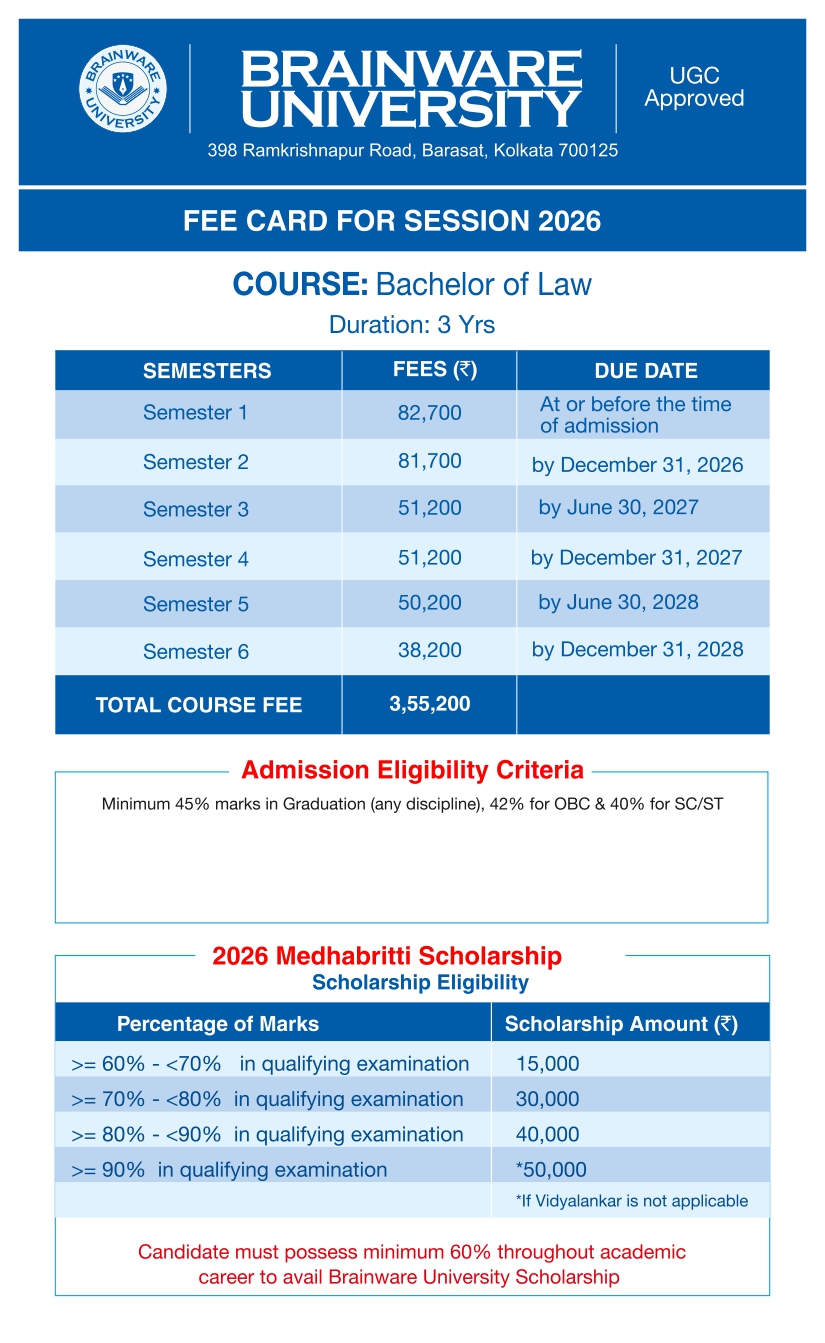
The LLB programme follows a transparent and affordable fee structure covering academic instruction, moot court facilities, legal research resources, internships, court visits, and expert mentorship. The fee model ensures high-quality legal education while remaining accessible to aspiring legal professionals.
| Semesters | Semester 1 | Semester 2 | Semester 3 | Semester 4 | Semester 5 | Semester 6 | Semester 7 | Semester 8 | Semester 9 | Semester 10 | Total |
|---|---|---|---|---|---|---|---|---|---|---|---|
| Fees (INR) | 82700 | 81700 | 51200 | 51200 | 50200 | 38200 | 0 | 0 | 355200 |
**Fees are subject to change, and the application fee of ₹5,000 is non-refundable under any circumstances. Please contact us for further details.
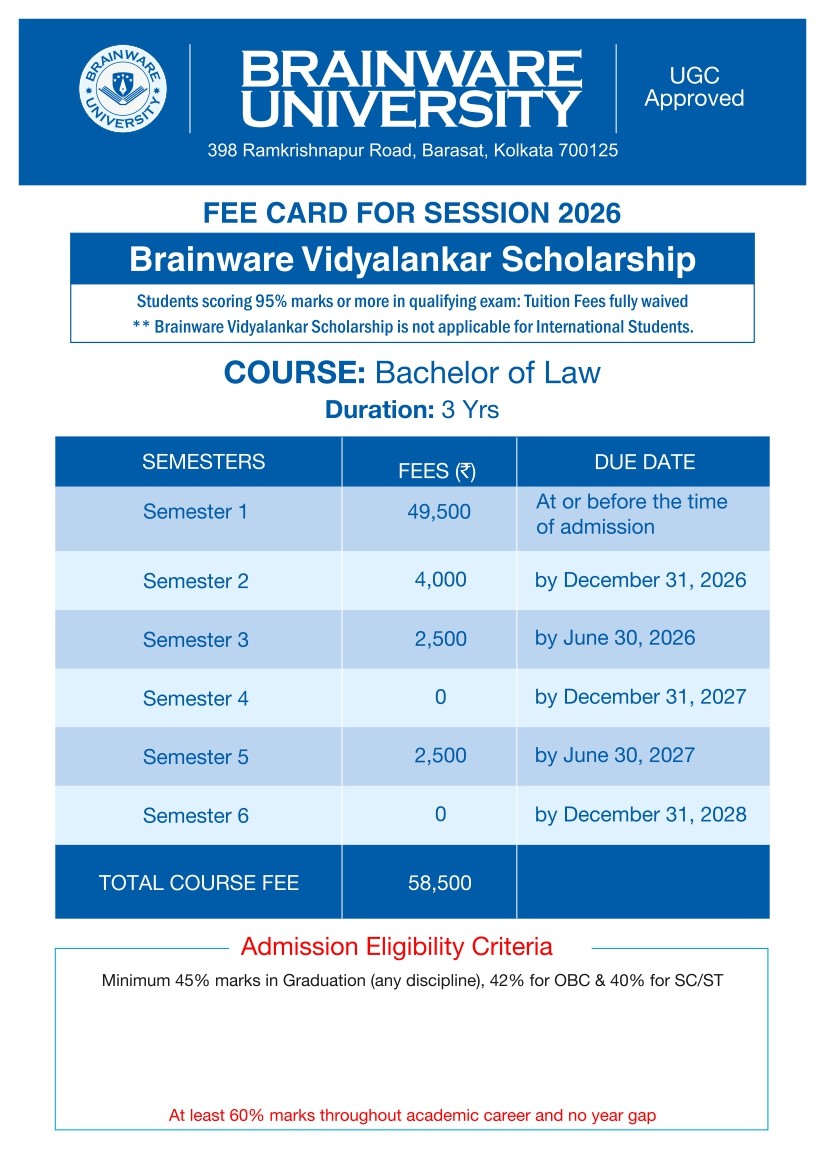
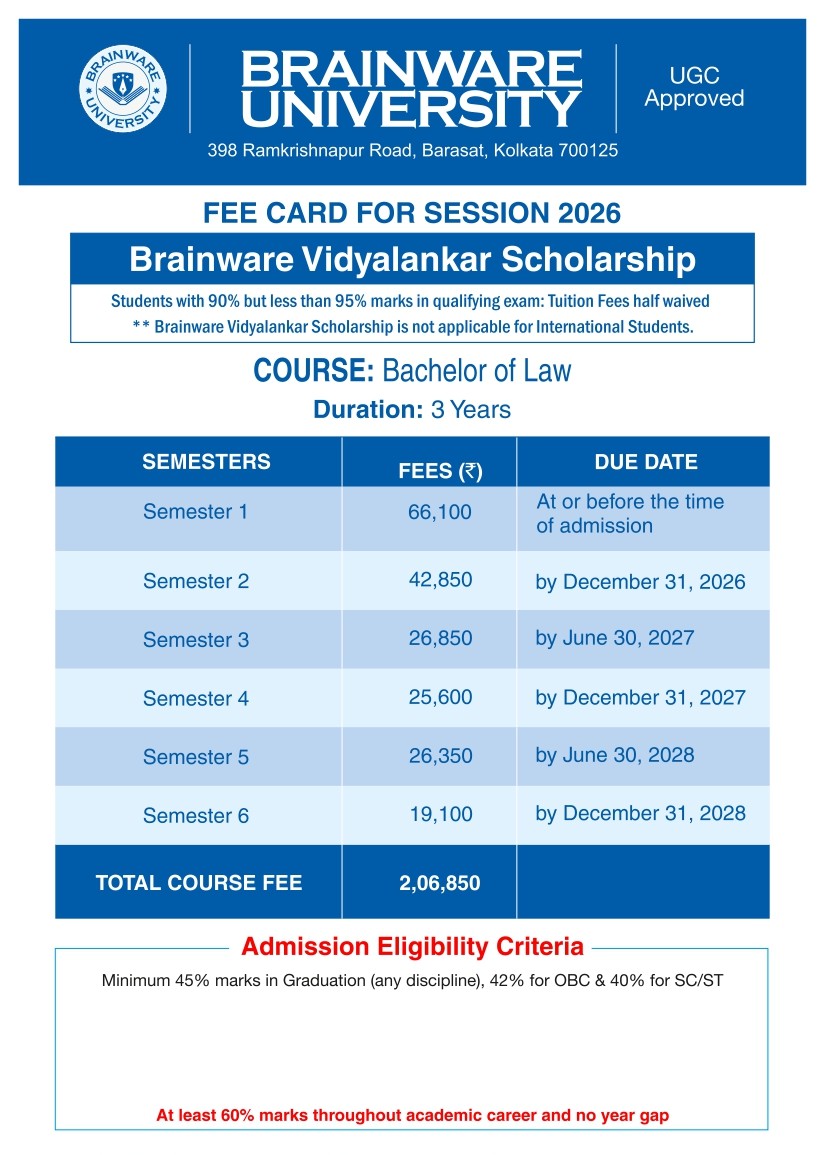
Scholarships(Fees): Brainware University offers merit-based scholarships for top performers and financial aid for deserving students. Scholarships are available for high scorers in entrance exams, board results, and outstanding achievements in innovation or research. Visit our scholarship page for more details.
**Please note that the Brainware Vidyalankar Scholarship is available only to students who passed their qualifying examination in the current admission year. Also, eligibility is strictly restricted to Indian nationals; international students are not eligible to apply.
Legal practice is undergoing a major transformation as artificial intelligence, data analytics, and digital research platforms reshape how legal professionals interpret laws, analyse cases, and manage legal documentation. The LLB programme at Brainware University integrates legal technology and AI-supported research methods into the curriculum to prepare students for the modern legal ecosystem.
Students learn how technology supports legal reasoning, case research, compliance monitoring, and dispute resolution. Through technology-enabled legal training, learners gain exposure to digital case databases, automated legal research platforms, and analytics tools that help identify precedents, analyse judgments, and understand evolving legal frameworks.
This AI-enabled academic model encourages students to combine traditional legal knowledge with technological competence, preparing them for emerging areas such as cyber law, digital governance, AI regulation, data protection, and technology-driven legal consulting. By blending legal theory, research methodology, and digital tools, the programme prepares graduates to operate effectively in both courtroom practice and corporate legal environments.

The LLB programme introduces legal technology and artificial intelligence concepts progressively so that students develop both legal reasoning and digital research capabilities.


The LLB programme at Brainware University demonstrates strong career outcomes supported by structured internships, moot court training, legal drafting workshops, and exposure to law firms and corporate legal departments.
Students receive career guidance through the university’s placement and internship cell, which facilitates professional mentoring, legal research training, and networking opportunities with practicing lawyers and legal organisations.


With strong legal training and industry exposure, our law graduates secure positions in law firms, corporate legal departments, and judiciary services. Recruiters include Khaitan & Co., Luthra & Luthra, and government legal departments.
Graduates of the LLB programme at Brainware University have built successful careers across litigation practice, corporate legal services, regulatory compliance, and public service.
Many alumni have joined law firms, corporate legal departments, and litigation chambers, where they work on case research, contract drafting, dispute resolution, and legal advisory functions.


Brainware University has earned an AA+ rating in India’s Best Engineering Institutes by Careers360. The recognition reflects the University’s strength in academic quality, faculty, infrastructure, research, and student outcomes, reinforcing its position as a trusted destination for industry-aligned engineering education.

Brainware University has been ranked No. 1 Engineering College under a Private University in West Bengal in the IIRF Rankings 2026. The recognition highlights the University’s strength in engineering education, industry-focused learning, research, emerging technologies, and placement outcomes.

Brainware University has been ranked No. 2 Private University in West Bengal by uniRank 2026, marking another recognition of the University's growing presence in the state's higher education landscape.

Brainware University's inclusion in the Times Higher Education (THE) Impact Rankings 2025 reflects its contribution to the UN Sustainable Development Goals (SDGs) through education, innovation, sustainability, community engagement, and responsible institutional practices.

Brainware University has been recognised as the Best Private University of West Bengal in Infrastructure & Placement at Times Now.in – Leaders of Excellence: East 2026, celebrating its commitment to world-class infrastructure and career-focused education.

Brainware University has been recognised by The Times Group for excellence across Engineering (Placement), Law, and MBA Studies. The honours reflect the University’s multidisciplinary strength and its focus on career-oriented, industry-relevant education.

Brainware University received the ABP Ananda Shiksha Samman 2026 for Excellence in Placement & AI-Integrated Academic Infrastructure, acknowledging its emphasis on placement opportunities alongside technology-enabled academic development.

Brainware University has been honoured with the Zee 24 Ghanta Education Excellence Award 2026 for Best Industry Placement & Academic Infrastructure, continuing its recognition in 2022, 2023, 2024, 2025, and 2026. The University was also recognised in 2017 and 2018 for its job-oriented academic initiatives.

Brainware University received the TV9 Uttaran Academic Excellence Honour for Excellence in Placement & AI-Integrated Academic Infrastructure, highlighting its focus on combining career opportunities with an AI-enabled academic and learning environment.

Brainware University was honoured with the R Bangla Sikkha Gourab Samman 2026, recognising its contribution to higher education and continued pursuit of academic excellence and career-focused learning.

Brainware University was honoured as the Best Private University in West Bengal at the Times Now in Business Excellence Awards (East) 2025, recognising its academic quality, modern infrastructure, industry engagement, and focus on student success.

Brainware University was recognised as the Leading University in Infrastructure, Academics & Placement at the Times Business Awards West Bengal 2025, highlighting its strong campus facilities, academic ecosystem, and placement performance across disciplines.

Embark on a transformative academic journey through a diverse array of LLB subjects curated at Brainware University. Delve into the fundamentals of law, encompassing criminal law, constitutional law, administrative law, and much more. Our structured curriculum ensures a well-rounded education, covering essential subjects and specialized areas vital for legal practice.
| Semester | Course name |
|---|---|
| Semester I | Family Law I |
| Law of Contract I | |
| Law of Torts including CP & MV Act | |
| Constitutional Law of India I | |
| Law of Crimes I | |
| Environmental Studies | |
| Semester II | Administrative Law |
| Constitutional Law of India II | |
| Law of Crimes II | |
| Family Law II | |
| Law of Contract II | |
| Computer Application in Law | |
| Semester III | Law of Evidence |
| Code of Civil Procedure | |
| Jurisprudence | |
| Property Law | |
| Company Law | |
| Environmental Law | |
| Artificial Intelligence & Law | |
| Semester IV | Labour Law I |
| Taxation Law | |
| Banking Law / Gender Justice including Feminist Jurisprudence | |
| Insurance Law / Media Law | |
| Corporate Governance / Human Rights Law | |
| Intellectual Property Law | |
| Semester V | Mediation Law |
| Law & Economics / Interpretation of Statute & Principles of Legislation | |
| Law on Corporate Finance / Law on Education | |
| Cyber Law / Health Law | |
| Labour Law II | |
| Public International Law | |
| Semester VI | Land Laws |
| Alternate Dispute Resolution | |
| Professional Ethics & Professional Accounting System | |
| Drafting, Pleading & Conveyancing | |
| Indian Language Course (Hindi) | |
| Moot Court Exercise & Internship | |
| Court Visit, Report Preparation and Comprehensive Viva Voce |
Please note that the syllabus is subject to modification. Visit our Syllabus page for the elective subject details and updated syllabus.

Graduates work as advocates, corporate lawyers, legal advisors, compliance officers, and consultants in law firms, corporates, banks, and private organisations—supporting legal risk management and governance.
LLB graduates can pursue careers in judicial services, public prosecution, government legal departments, PSUs, and regulatory bodies as legal officers, prosecutors, magistrates, and advisors after qualifying relevant examinations.
The legal profession continues to expand across litigation, governance, corporate regulation, and emerging technology-driven domains. The following roles highlight why LLB graduates remain essential to justice delivery and institutional governance.
| Area of Opportunity | Why It's In Demand |
|---|---|
| Criminal Lawyer | Upholding Legal Rights: Essential role in the justice system, defending individuals accused of crimes or representing the state (as a prosecutor). Demand is constant due to the continuous need for legal counsel in criminal proceedings. |
| Corporate Lawyer | Business and Regulatory Compliance: High demand to advise corporations on contracts, mergers, acquisitions, and regulatory filings. Critical for minimizing legal risks associated with complex business transactions and governance. |
| Judicial Services (e.g., Magistrate, Judge) | Dispensing Justice and Rule of Law: Represents the apex of the legal profession. Highly sought-after (via competitive exams) to preside over courts, interpret laws, and ensure the orderly functioning of the judiciary. |
| Legal Journalist | Informing the Public: Needed by media houses and legal publications to simplify and report on complex court rulings, legislative changes, and major legal events, playing a key role in legal awareness. |
| Legal Analyst | Research and Strategy: Works for law firms, corporations, or research tanks to examine large amounts of data, case law, and regulations to develop legal strategies, forecasts, and policy recommendations. |
| Civil Lawyer | Resolving Non-Criminal Disputes: Specializes in disputes between individuals or organizations (e.g., property, family, contracts, torts). Demand is constant as these matters form the majority of cases filed in courts. |
| Legal Advisor | Proactive Risk Management: Provides strategic legal counsel directly to a business or organization on day-to-day operations, ensuring compliance and drafting documentation, helping the organization avoid future litigation. |
With rising legal complexity, regulatory expansion, and demand for ethical legal professionals, LLB graduates enjoy respected, stable, and long-term career opportunities across legal, corporate, and public sectors.
The demand for LLB graduates is expected to remain strong between 2025 and 2032, driven by expanding legal services, increasing regulatory complexity, corporate compliance requirements, and the growing need for specialised legal expertise. Law continues to be a foundational profession across governance, business, technology, and social justice, ensuring consistent career relevance.
The global legal services industry continues to grow steadily, supported by rising litigation, corporate advisory work, cross-border transactions, and regulatory compliance. Legal services contribute significantly to national economies in major markets such as the US, UK, and emerging economies, reflecting sustained long-term demand.
India’s legal sector is expanding due to corporate growth, foreign investment, digital economy regulations, and judicial reforms. Increasing demand for corporate lawyers, compliance professionals, and legal advisors positions India as a growing legal services hub.
Employment of lawyers is projected to grow at a stable rate through 2032, with consistent openings created by new demand and workforce replacement. In India, opportunities are expanding across litigation, corporate law firms, in-house legal teams, government services, and regulatory bodies.
Every sector—finance, healthcare, technology, real estate, telecom, and manufacturing—requires legal expertise for contracts, compliance, dispute resolution, and risk management.
Evolving laws related to data protection, corporate governance, ESG compliance, and financial regulation are driving demand for legally trained professionals with specialised knowledge.
Emerging areas such as cyber law, data privacy, AI regulation, and legal technology are creating new roles for law graduates beyond traditional courtroom practice.
Government departments, courts, tribunals, and public institutions continue to recruit legal professionals for advisory, drafting, and enforcement roles.


The LL.B. programme at Brainware University strengthens practical legal learning through industry-institute interaction, legal exposure, court visits, moot court activities, internships, legal aid initiatives, and expert sessions. Students gain opportunities to interact with legal professionals, corporate experts, advocates, academicians, and industry representatives, helping them understand the practical application of law in courts, law firms, corporate legal departments, compliance teams, and business organisations.





Admission Criteria: Candidates must have completed graduation in any discipline from a recognised university, securing at least 45% marks. A relaxation is applicable as per norms: 42% for OBC candidates and 40% for SC/ST candidates. Admission is based on university guidelines, including BET where applicable.
Application: Apply online by filling out the enquiry form; admission counsellors assist throughout the process.
Entrance Exam: Admission is primarily merit-based. Where applicable, candidates may appear for the Brainware Entrance Test (BET).
Counselling: Shortlisted candidates attend counselling sessions covering curriculum, fees, internships, and career pathways.
Direct Admission: Eligible candidates may receive direct admission based on merit and seat availability.
Please follow the LLB admission procedure at Brainware University:


"Brainware students are professionally and technically well-informed as freshers. We are impressed with the level of confidence and positive attitude they demonstrated during their interviews."
Mr. Vaskar Bhattacharya Regional Head-East, Ginnisystems Ltd.
We always find competent and positive students who are almost ready to be professionals. We never get disappointed wherever we come for the recruitment. Well done Brainware University!
Ms. Srimoyee Mukherjee Manager HR Nature Technologies Pvt. Ltd.





The Department of Law at Brainware University is committed to academic excellence, practical legal training, and social responsibility. Through a range of academic, professional, and community-oriented initiatives, the department ensures holistic development of students while contributing meaningfully to society and the legal profession.
The Department of Law at Brainware University actively advances socially engaged legal education through impactful outreach initiatives. The programme “Towards Equity and Dignity: Understanding Legal Rights of Women and Transgender Persons” highlighted the department’s commitment to gender justice and inclusivity by addressing key issues related to women’s rights, criminal law, and transgender protection laws, thereby strengthening community legal awareness.
The department reinforced international and comparative legal understanding by hosting the International Seminar on “Migration, Human Rights and Social Justice in Contemporary Times”, featuring Dr. Richard L. Benkin. The seminar enabled students to engage with global human rights challenges and contemporary social justice issues, fostering critical thinking and global legal consciousness.
Emphasising experiential learning, the Intra-School Moot Court Competition 2025 provided students with hands-on exposure to courtroom procedures, advocacy, and legal research. By simulating real-life court proceedings, the initiative helped cultivate professionalism, analytical ability, and confidence among aspiring legal practitioners.

The chances of getting hired for BA LLB, BBA LLB, and LLB graduates may depend on various factors such as their skills, knowledge, experience, and the job market scenario. It's important for students to explore their interests and strengths and choose a career path that aligns with their goals and aspirations.
LLB stands for Bachelor of Law. The course focuses on core areas of law such as constitutional law, criminal law, civil law, contract law, and legal procedures. It trains students in legal reasoning, case analysis, advocacy, and professional ethics, preparing them for careers in litigation, legal consultancy, corporate law, and judiciary preparation.
In India, the salary package offered to LLB, BBA LLB, and BA LLB freshers may vary depending on various factors such as the industry, job profile, location, experience, and skills. However, here are some general observations: LLB graduates can expect a starting salary of around Rs. 3-6 lakhs per annum, depending on the industry and job profile. With experience and specialization, the salary can increase significantly. BBA LLB graduates may have an advantage in pursuing careers related to business and management in addition to legal professions. They can expect a starting salary of around Rs. 4-8 lakhs per annum, depending on the industry and job profile. BA LLB graduates may have a broader range of knowledge as compared to LLB graduates, and this can make them suitable for a variety of roles that require a combination of skills from both fields. They can expect a starting salary of around Rs. 3-6 lakhs per annum, depending on the industry and job profile.
Brainware University offers a comprehensive LLB program that covers essential legal concepts and prepares students for various legal careers. The university combines theoretical knowledge with practical exposure, making it an excellent choice for aspiring lawyers.
Candidates must have completed graduation in any discipline from a recognised university, securing at least 45% marks. A relaxation is applicable as per norms: 42% for OBC candidates and 40% for SC/ST candidates. Admission is based on university guidelines, including BET where applicable.
After completing an LLB, you can become a practicing lawyer, legal advisor, corporate lawyer, judge, public prosecutor, or legal consultant. Other career options include working in law firms, government agencies, multinational companies, or the public sector.
Yes, LLB is a great career choice for those interested in law and justice. The program opens up multiple career opportunities, both in legal practice and in the corporate world. It allows individuals to make a meaningful impact on society through legal work.
Common subjects include Constitutional Law, Criminal Law, Contract Law, Family Law, Civil Law, Taxation Law, International Law, Labour Law, Environmental Law, Legal Writing, and more. Some universities also offer electives based on your area of interest.
Brainware University offers a career-focused LL.B. programme with practical learning in constitutional law, criminal law, contract law, family law, property law, administrative law, corporate law, cyber law, legal research, legal drafting and professional ethics. Students gain exposure to moot court practice, court visits, legal aid activities, internships, case analysis and advocacy training. With experienced faculty, legal industry exposure, professional training and placement support, the programme helps students prepare for careers in litigation, law firms, corporate legal departments, compliance, public service, legal research and judiciary preparation.
After completing LLB, you can work as an Advocate, Corporate Lawyer, Legal Advisor, Public Prosecutor, Legal Researcher, Judge (after clearing judicial exams), Legal Consultant, or in government organizations. You can also join law firms or corporate legal departments.
The starting salary for an LLB graduate can range from ₹4 LPA to ₹6 LPA, depending on the role, industry, and location. With experience, salaries can increase, especially for those working in top law firms or in corporate law.
Focus on showcasing your legal knowledge, critical thinking, and problem-solving skills. Be prepared to discuss your internships, moot court participation, and practical legal work. Highlight your ability to communicate complex legal matters clearly and confidently.
Top law firms, multinational corporations, public sector undertakings, and government organizations hire LLB graduates. Companies like TCS, Infosys, and top law firms like Luthra & Luthra, and Cyril Amarchand Mangaldas regularly recruit law graduates.
Highlight internships, legal research experience, participation in moot courts, and any other relevant experiences. Include academic achievements, any specialization areas (e.g., corporate law or criminal law), and skills like legal writing, public speaking, and negotiation.
Develop your research skills by reading case laws, legal journals, and online legal databases such as Westlaw and LexisNexis. Practice analyzing judgments and writing research papers on legal topics to improve your ability to interpret and apply the law.
Essential skills for LLB students include legal writing, research, contract drafting, negotiation, and communication. Understanding how to interpret statutes, case laws, and legal principles is also important. Additionally, public speaking and presentation skills are valuable.
Participate in moot courts, debates, and mock trials to practice presenting arguments clearly and persuasively. You can also join public speaking clubs or take part in legal seminars and conferences to gain more confidence and experience.
To prepare for exams like the Judicial Services exam or CLAT (for higher education), focus on strengthening your legal knowledge, logical reasoning, general awareness, and current affairs. Practice mock tests, previous years’ papers, and enroll in coaching classes if needed.