98%
Placed
in 2025






The BSc Agriculture (Hons) is a four-year undergraduate degree programme that focuses on the scientific study of agriculture and modern farming practices. The programme offers an in-depth understanding of key domains such as plant science, soil science, crop production, plant breeding, animal husbandry, pest management, and agricultural economics. Students receive extensive hands-on training through field visits, agricultural research plots, soil and crop laboratories, rural immersion programmes, internships, and project-based learning.
Graduates with a BSc Agriculture (Hons) are equipped for diverse career opportunities in agricultural research organisations, government departments, agri-tech companies, seed and fertiliser industries, food processing units, rural development agencies, and NGOs. They may also pursue roles in farm consultancy, crop production management, sustainable agriculture planning, or continue higher studies in specialised areas of agriculture.
Applicants will find complete admission-related information for BSc Agriculture (Honours), including the programme overview, eligibility criteria, fee structure, syllabus outline, career opportunities, and learning benefits. The section also presents key details about the BSc Agriculture programme and admission requirements in a clear and concise manner.
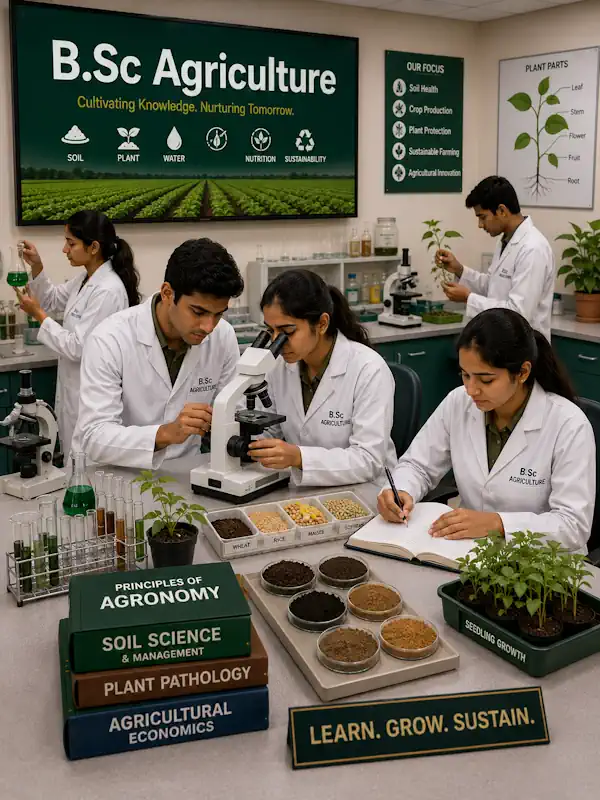

The BSc Agriculture (Hons) programme at Brainware University trains students in scientific farming, crop improvement, soil and water management, agri-technology, and sustainable agriculture through an ICAR-aligned curriculum and extensive field-based learning.
| Programme | Bachelor of Science (Honours) in Agriculture |
|---|---|
| Duration | 4 years |
| Focus Areas |
|
| Salary | Fresh BSc Agriculture graduates earn ₹3–6 LPA, with rapid growth in agri-tech firms, seed and fertilizer companies, government departments, and consulting roles. Advanced positions in research, agronomy, food systems, and agri-business management offer salaries of ₹7–12 LPA+. |
| Popular Job Types |
|
| Hiring Industries |
|
| Top Recruiters |
|
| Specializations |
|
| Higher Studies |
|
| Benefits |
|
| Internship and Placement | Students undergo internships in farms, agribusiness companies, research stations, seed and fertilizer industries, and government agencies. Placement support includes domain-specific training, agri-industry mock interviews, and connections with top recruiters. |
| Location | The BSc Agriculture programme is conducted on Brainware University’s eco-friendly campus in Barasat, featuring agricultural research plots, crop demonstration units, soil science labs, and modern teaching facilities. |
| Approvals & Recognition |
|

Educational Qualification:
Minimum Marks: Applicants must secure 60% marks or an equivalent grade in their 10+2 examination.
Entrance Exams: Admission is generally merit-based as per institutional guidelines. If applicable, candidates may appear for the BET – Brainware Entrance Test.
Pursue your passion for farming science, crop production, and sustainable agriculture with the BSc Agriculture programme designed to offer high-quality agricultural education at an affordable cost. The course provides access to modern agriculture labs, experimental farms, expert faculty mentorship, and real-world exposure through field training, research activities, and agri-industry visits. With a balanced investment in academic learning and hands-on agricultural practice, this programme prepares students for successful careers in agronomy, horticulture, farm management, agri-business, and the rapidly evolving agricultural sector.
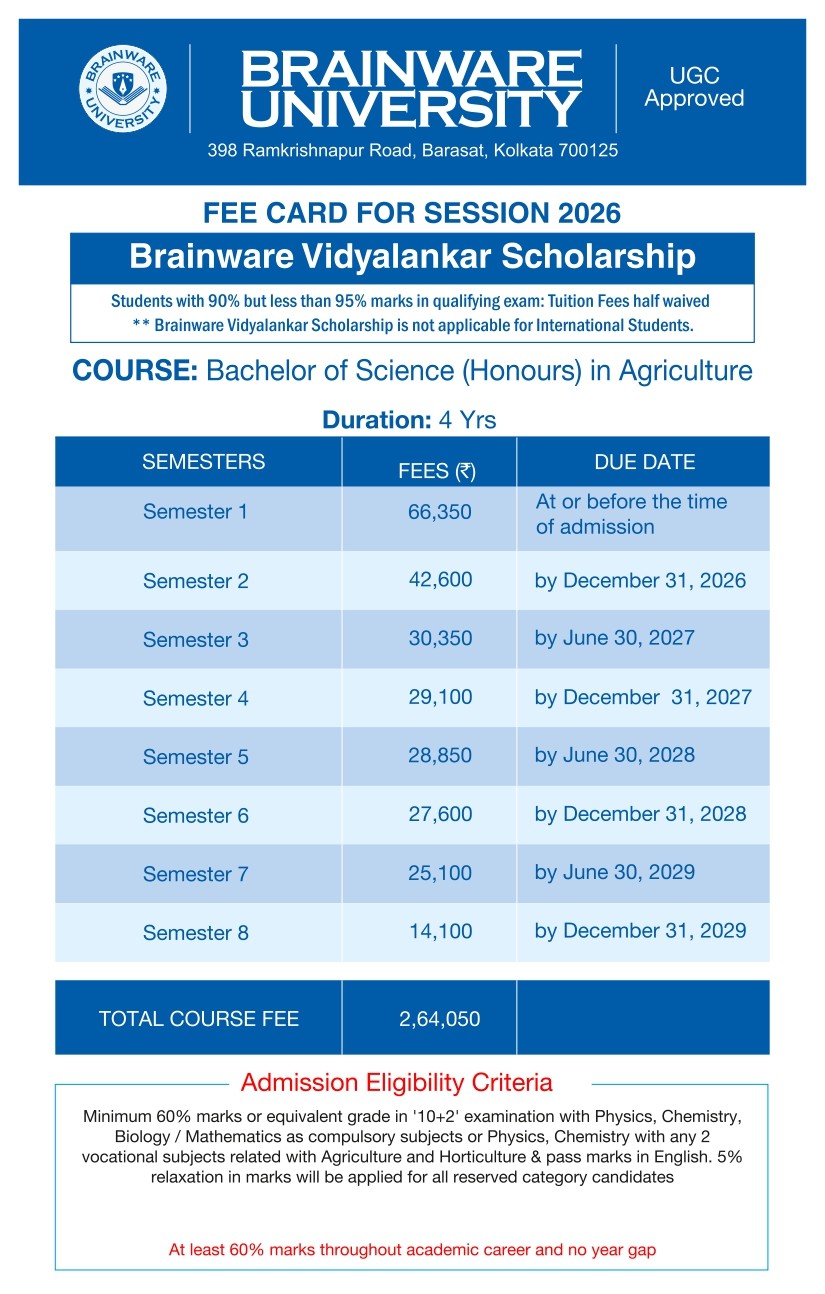
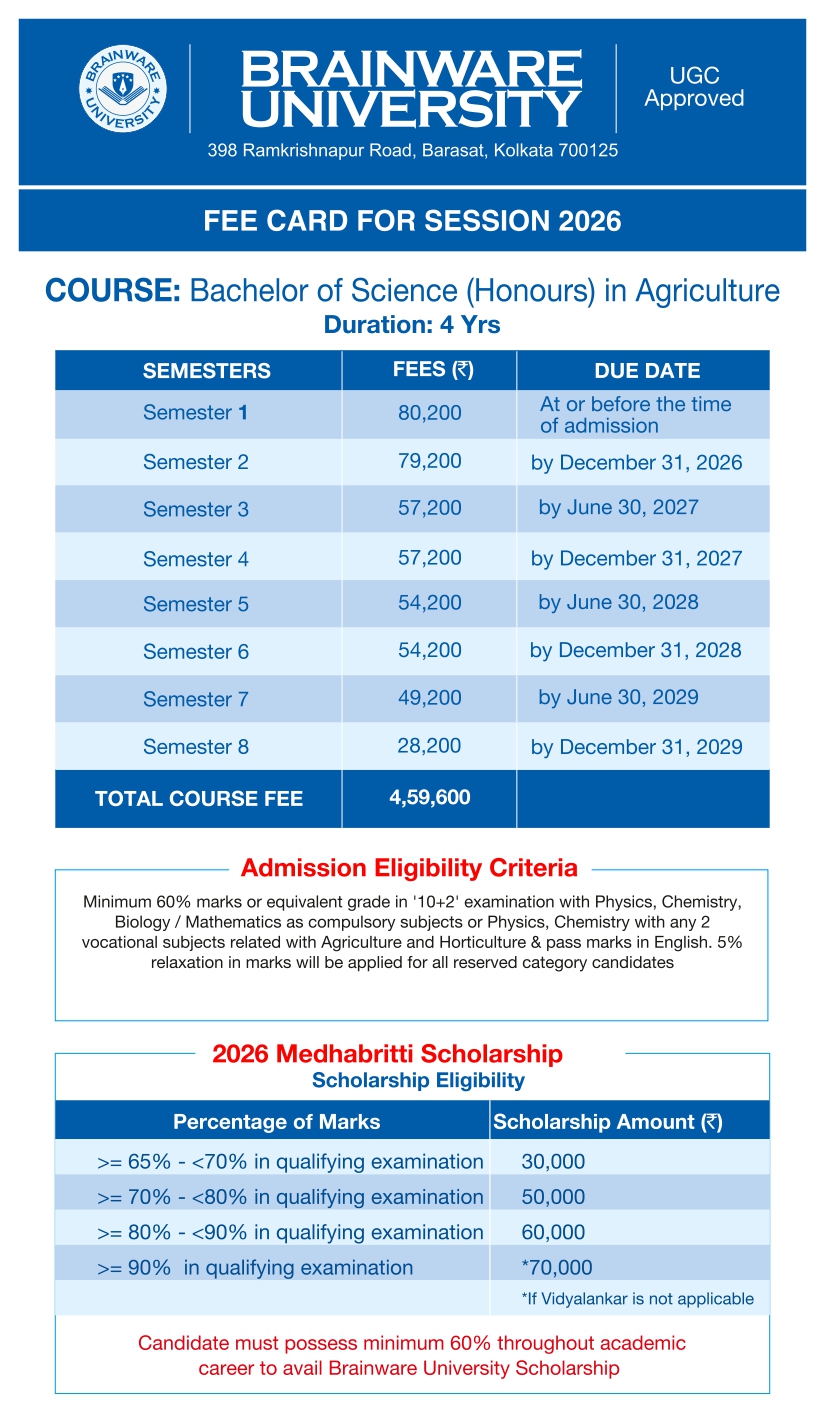
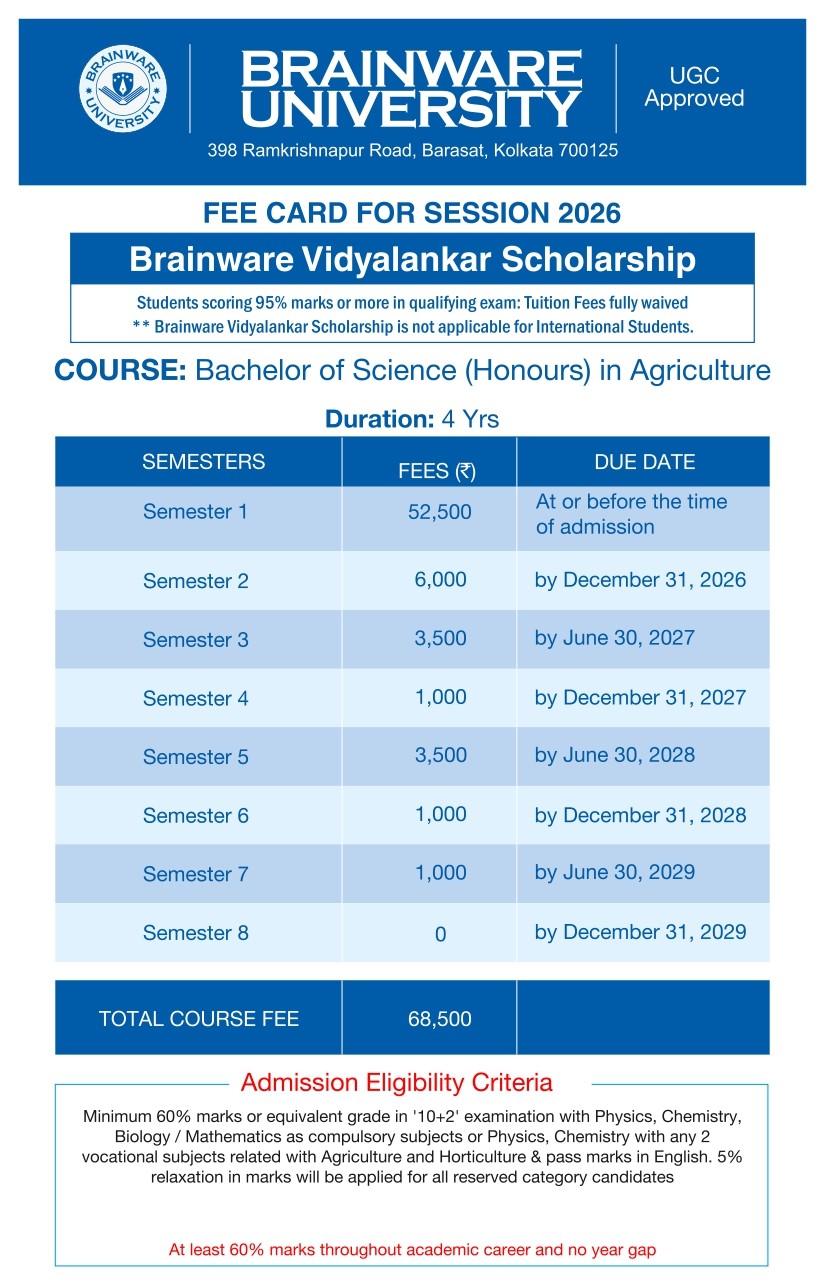
The BSc Agriculture programme follows an affordable and transparent fee structure, covering academic training, laboratory access, field-based practicals, research farm usage, and industry exposure. Students receive excellent value through hands-on learning, modern infrastructure, and mentorship from expert faculty.
| Semesters | Semester 1 | Semester 2 | Semester 3 | Semester 4 | Semester 5 | Semester 6 | Semester 7 | Semester 8 | Semester 9 | Semester 10 | Total |
|---|---|---|---|---|---|---|---|---|---|---|---|
| Fees (INR) | 80200 | 79200 | 57200 | 57200 | 54200 | 54200 | 49200 | 28200 | 459600 |
**Fees are subject to change, and the application fee of ₹5,000 is non-refundable under any circumstances. Please contact us for further details.
Scholarships(Fees): Brainware University offers merit-based scholarships for top performers and financial aid for deserving students. Scholarships are available for high scorers in entrance exams, board results, and outstanding achievements in innovation or research. Visit our scholarship page for more details.
**Please note that the Brainware Vidyalankar Scholarship is available only to students who passed their qualifying examination in the current admission year. Also, eligibility is strictly restricted to Indian nationals; international students are not eligible to apply.
Modern agriculture is undergoing a technological transformation driven by artificial intelligence, data analytics, and smart farming systems. The BSc Agriculture programme at Brainware University integrates AI-enabled tools and digital agriculture practices into the academic framework so that students understand both traditional agricultural science and emerging agri-technology innovations.
Students learn how advanced technologies such as precision agriculture, remote sensing, crop analytics, and climate modelling can improve crop productivity, resource efficiency, and sustainable farming outcomes. The programme combines field-based agricultural training with digital tools used in modern farming systems, allowing students to analyse soil conditions, monitor crop health, predict pest outbreaks, and optimise irrigation through data-driven decision making.
Through laboratory training, field experiments, research projects, and industry interactions, students explore how AI supports yield forecasting, plant disease detection, farm automation, and agricultural supply chain management. This technology-integrated approach ensures graduates are prepared to work in modern agritech companies, agricultural research institutions, smart farming enterprises, and sustainable food production systems.






Graduates of the BSc Agriculture programme at Brainware University benefit from strong industry connections across agribusiness companies, food processing organisations, agricultural research institutions, and agritech startups. Through structured placement training, industry visits, internships, and professional skill development programmes, students are prepared for diverse roles in agriculture, agri-technology, and rural development sectors.


With growing demand in agribusiness, research, and sustainable farming, B.Sc. Agriculture graduates from Brainware University secure jobs in government agencies, agritech firms, and agricultural research institutions. Companies such as ITC Agri Business and Bayer CropScience actively recruit from our university.
Internships form a key component of the programme, including fieldwork in agricultural departments, agri-business companies, ICAR-affiliated institutes, seed and fertilizer firms, and food processing units. Students apply classroom knowledge to real farm situations, gain exposure to modern equipment, and participate in crop trials, diagnostics, and soil and water management projects.


Brainware University has earned an AA+ rating in India’s Best Engineering Institutes by Careers360. The recognition reflects the University’s strength in academic quality, faculty, infrastructure, research, and student outcomes, reinforcing its position as a trusted destination for industry-aligned engineering education.

Brainware University has been ranked No. 1 Engineering College under a Private University in West Bengal in the IIRF Rankings 2026. The recognition highlights the University’s strength in engineering education, industry-focused learning, research, emerging technologies, and placement outcomes.

Brainware University has been ranked No. 2 Private University in West Bengal by uniRank 2026, marking another recognition of the University's growing presence in the state's higher education landscape.

Brainware University's inclusion in the Times Higher Education (THE) Impact Rankings 2025 reflects its contribution to the UN Sustainable Development Goals (SDGs) through education, innovation, sustainability, community engagement, and responsible institutional practices.

Brainware University has been recognised as the Best Private University of West Bengal in Infrastructure & Placement at Times Now.in – Leaders of Excellence: East 2026, celebrating its commitment to world-class infrastructure and career-focused education.

Brainware University has been recognised by The Times Group for excellence across Engineering (Placement), Law, and MBA Studies. The honours reflect the University’s multidisciplinary strength and its focus on career-oriented, industry-relevant education.

Brainware University received the ABP Ananda Shiksha Samman 2026 for Excellence in Placement & AI-Integrated Academic Infrastructure, acknowledging its emphasis on placement opportunities alongside technology-enabled academic development.

Brainware University has been honoured with the Zee 24 Ghanta Education Excellence Award 2026 for Best Industry Placement & Academic Infrastructure, continuing its recognition in 2022, 2023, 2024, 2025, and 2026. The University was also recognised in 2017 and 2018 for its job-oriented academic initiatives.

Brainware University received the TV9 Uttaran Academic Excellence Honour for Excellence in Placement & AI-Integrated Academic Infrastructure, highlighting its focus on combining career opportunities with an AI-enabled academic and learning environment.

Brainware University was honoured with the R Bangla Sikkha Gourab Samman 2026, recognising its contribution to higher education and continued pursuit of academic excellence and career-focused learning.

Brainware University was honoured as the Best Private University in West Bengal at the Times Now in Business Excellence Awards (East) 2025, recognising its academic quality, modern infrastructure, industry engagement, and focus on student success.

Brainware University was recognised as the Leading University in Infrastructure, Academics & Placement at the Times Business Awards West Bengal 2025, highlighting its strong campus facilities, academic ecosystem, and placement performance across disciplines.

The BSc Agriculture syllabus is structured to provide a well-rounded education encompassing essential subjects such as Crop Science, Soil Science, Agricultural Economics, Plant Pathology, and Agricultural Engineering. Students delve into both theoretical knowledge and hands-on practical experiences, ensuring a holistic learning approach.
| Semester | Course |
|---|---|
| Semester I | Rural Sociology & Educational Psychology |
| Fundamentals of Agronomy | |
| Fundamentals of Soil Science | |
| Fundamentals of Plant Biochemistry and Biotechnology | |
| Introduction to Forestry | |
| Fundamentals of Horticulture | |
| Agricultural Heritage | |
| Introductory Biology / Elementary Mathematics | |
| Human Values & Ethics | |
| NSS / NCC / Physical Education & Yoga Practices | |
| Comprehension & Communication Skills in English | |
| Semester II | Fundamentals of Agricultural Economics |
| Fundamentals of Plant Pathology | |
| Fundamentals of Entomology | |
| Communication Skills and Personality Development | |
| Fundamentals of Genetics | |
| Agricultural Microbiology | |
| Soil and Water Conservation Engineering | |
| Fundamentals of Crop Physiology | |
| Fundamentals of Agricultural Extension Education | |
| Semester III | Crop Production Technology – I (Kharif Crops) |
| Fundamentals of Plant Breeding | |
| Agricultural Finance and Cooperation | |
| Agri-Informatics | |
| Farm Machinery and Power | |
| Production Technology for Vegetables and Spices | |
| Environmental Studies and Disaster Management | |
| Statistical Methods | |
| Livestock and Poultry Management | |
| Semester IV | Problematic Soils and their Management |
| Farming System & Sustainable Agriculture | |
| Crop Production Technology – II (Rabi Crops) | |
| Production Technology for Ornamental Crops, MAP and Landscaping | |
| Renewable Energy and Green Technology | |
| Production Technology for Fruit and Plantation Crops | |
| Principles of Seed Technology | |
| Agricultural Marketing, Trade & Prices | |
| Introductory Agro-meteorology & Climate Change | |
| Agribusiness Management / Agrochemicals / Commercial Plant Breeding / Landscaping | |
| Semester V | Intellectual Property Rights |
| Principles of Integrated Pest and Disease Management | |
| Manures, Fertilizers and Soil Fertility Management | |
| Pests of Crops and Stored Grain and their Management | |
| Diseases of Field and Horticultural Crops and their Management – I | |
| Crop Improvement – I (Kharif Crops) | |
| Entrepreneurship Development and Business Communication | |
| Geoinformatics and Nano-technology and Precision Farming | |
| Practical Crop Production – I (Kharif Crops) | |
| Weed Management / Biopesticides & Biofertilizers / Protected Cultivation / Micro-propagation Technologies | |
| Semester VI | Principles of Food Science and Nutrition |
| Rainfed Agriculture & Watershed Management | |
| Protected Cultivation and Secondary Agriculture | |
| Diseases of Field and Horticultural Crops and their Management – II | |
| Post-harvest Management and Value Addition of Fruits and Vegetables | |
| Management of Beneficial Insects | |
| Crop Improvement – II (Rabi Crops) | |
| Principles of Organic Farming | |
| Farm Management, Production & Resource Economics | |
| Practical Crop Production – II (Rabi Crops) | |
| Hi-tech Horticulture / System Simulation and Agro-advisory / Food Safety and Standards / Agricultural Journalism | |
| Semester VII | Rural Agricultural Work Experience (RAWE) and Agro-industrial Attachment (AIA) |
| Semester VIII | Mushroom Cultivation Technology |
| Poultry Production Technology | |
| Agriculture Waste Management | |
| Seed Production and Technology | |
| Production Technology for Bioagents and Biofertilizer | |
| Floriculture and Landscaping | |
| Soil, Plant, Water and Seed Testing | |
| Commercial Beekeeping | |
| Commercial Horticulture | |
| Food Processing | |
| Organic Production Technology | |
| Commercial Sericulture |
Please note that the syllabus is subject to modification. Visit our Syllabus page for the elective subject details and updated syllabus.

BSc Agriculture graduates are employed in agritech companies, seed and fertilizer firms, food processing units, crop consultancy agencies, agri-input sales and marketing, precision farming companies, plantations, and research laboratories. Their expertise in crop production, soil health, and agri-business makes them valuable assets across the private sector.
Graduates can pursue roles in government agriculture departments, Krishi Bhavans, State Agriculture Services, FCI, NABARD, ICAR research centres, Agri-Marketing Boards, and rural development missions. Positions such as Agriculture Officer, Extension Officer, Field Inspector, and Horticulture Assistant offer strong job security and growth.
Agriculture professionals play a crucial role in food security, sustainable farming, rural development, and agri-economy growth. The opportunities listed below highlight the diverse career pathways available to BSc Agriculture graduates and explain why these roles remain in high demand across India’s expanding agricultural sector.
| Area of Opportunity | Why It’s in Demand |
|---|---|
| Agriculture Officer (Government/Bank) | Policy implementation and rural credit management, including execution of government agricultural schemes, farmer extension services, and handling agricultural loan portfolios in banks. |
| Agricultural Research Analyst | Development of sustainable agricultural practices, yield improvement strategies, new crop varieties, soil health enhancement, and climate-resilient solutions. |
| Management Executive | Enhancing agribusiness efficiency through logistics coordination, supply chain management, and operational planning in seed, fertilizer, and food processing industries. |
| Horticulture Assistant | Management of high-value crops such as fruits, vegetables, flowers, and ornamental plants using specialized cultivation and quality control techniques. |
| Agro-Meteorology Observer | Providing accurate weather data and forecasts to support climate-resilient farming decisions related to sowing, irrigation, and harvesting. |
| Junior Scientific Officer | Conducting laboratory and field analyses of soil, water, and plant health to support research, diagnostics, and quality assurance. |
| Food Inspector | Ensuring compliance with food safety, quality, and regulatory standards for agricultural produce and processed food products. |
| Farm Manager | Overseeing farm operations, labor management, implementation of best practices, and financial planning to maximize productivity and profitability. |
| Agriculture Inspector | Monitoring agricultural practices, enforcing input quality standards, and ensuring compliance with environmental and trade regulations. |
BSc Agriculture graduates enjoy abundant opportunities across government, private, research, and entrepreneurial domains. With rising emphasis on sustainability, agri-innovation, and food quality, skilled agricultural professionals continue to be highly valued across the nation.
The job market for BSc Agriculture graduates is undergoing a transformation as traditional farming intersects with digital technologies, sustainability demands, and global food security imperatives. With the agriculture sector adopting advanced tools and diversified value chains, opportunities are expanding beyond conventional roles—offering both challenges and growth potential through 2032.


The B.Sc. Agriculture programme is strengthened through a strategic industry–institute tie-up with Annadhatri Agritech Private Limited, aimed at bridging classroom learning with real-world agricultural practices. This collaboration ensures that students gain hands-on exposure to contemporary agribusiness models, precision farming techniques, and sustainable agricultural innovations that are shaping the future of Indian agriculture.


Brainware University collaborates with agricultural research institutes, agritech companies, agro-processing units, and rural development organisations to provide field-based training, demonstrations, internships, and expert-led sessions. These partnerships ensure students gain practical insights and industry-aligned competencies.
Admission Criteria:
Application: Candidates may apply online by completing the enquiry or application form. After submission, the admission team assists with eligibility verification, documentation, counselling, and the enrolment process.
Entrance Exam: BET evaluates scientific aptitude, analytical skills, and agricultural interest. Strong performers may qualify for scholarships or fee reductions.
Counselling: Shortlisted applicants participate in counselling sessions to understand curriculum details, learning pathways, scholarship options, fees, internship opportunities, and career outcomes.
Direct Admission: Eligible students with strong academic performance may receive direct admission depending on seat availability, making the enrolment process swift and convenient.
Please follow the given BSc Agriculture Admission Procedure in Brainware University:


At Brainware University's Agriculture Department, the top-notch facilities, including advanced laboratories and greenhouses, have provided me with invaluable hands-on learning experiences. The guidance from expert faculty and access to extensive library resources have enriched my educational journey
Rudra Bhunia BSc Agriculture
Studying at Brainware University's Agriculture Department has been exceptional, thanks to its outstanding facilities. From farm land to modern technology, the department offers a conducive environment for practical learning and research, supported by experienced faculty members
Sujan JanaBSc Agriculture

"Brainware students are professionally and technically well-informed as freshers. We are impressed with the level of confidence and positive attitude they demonstrated during their interviews."
Mr. Vaskar Bhattacharya Regional Head-East, Ginnisystems Ltd.
We always find competent and positive students who are almost ready to be professionals. We never get disappointed wherever we come for the recruitment. Well done Brainware University!
Ms. Srimoyee Mukherjee Manager HR Nature Technologies Pvt. Ltd.





In a world where the importance of sustainable living and healthy food choices is increasingly recognized, Brainware University's Department of Agriculture stands out for its impressive achievements, led by the dynamic Dr. Sourav Roy, Assistant Professor.
Dr. Sourav Roy, Assistant Professor, has embarked on a commendable journey to revive the rich tradition of green leafy vegetables, including water spinach and spinach, that have gradually disappeared from our plates. His significant contribution lies in the form of insightful lifestyle articles featured in the agriculture section of the popular Bengali daily 'Sangbad Pratidin.' Through these articles, Dr. Roy shares his expertise, encouraging the present generation to adopt healthier food habits.
The department takes pride in hosting distinguished speakers like Dr. Tapati Banerjee, Principal Scientist at ICAR-National Bureau of Soil Survey and Land Use Planning (NBSS&LUP), Govt. of India. Dr. Banerjee's enlightening session on the application of geospatial techniques in land resource inventory for developing optimum agricultural land use plans showcases Brainware University's commitment to staying at the forefront of cutting-edge technologies and practices.
The Department of Agriculture at Brainware University is not just focused on theoretical knowledge but also on practical skills. Offering a 30-hour value-added course on 'Micro-propagation of Gerbera Plant' is a testament to this commitment. Renowned speaker Prof. S. Dutta Gupta, Former Professor of Agricultural Biotechnology at IIT Kharagpur, imparts valuable insights, ensuring that students are equipped with hands-on expertise in micro-propagation techniques.
Understanding the importance of preparing students for the real world, Brainware University's Department of Agriculture organizes insightful sessions on job prospects and opportunities in Agricultural Science. Dr. Pradeep Kumar Patel, Scientist 'C' at the Tocklai Tea Research Institute, Tea Research Association, Jorhat, Assam, shares his extensive knowledge of plant physiology and breeding. These sessions empower students with a comprehensive understanding of the diverse career paths available in the field.
Brainware University's Department of Agriculture is not merely an academic institution; it is a hub of innovation, knowledge dissemination, and practical skill development. Through the efforts of dedicated faculty members and collaborations with industry experts, the department continues to make significant strides in shaping the future of agriculture and contributing positively to society and its stakeholders.

BSc Agriculture stands for Bachelor of Science in Agriculture. The course covers crop production, soil science, horticulture, agronomy, plant breeding, and modern farming technologies. It prepares students for careers in farm management, agribusiness, research, and agricultural development.
BSc Food and Nutrition and BSc Agriculture are undergraduate programmes that lead to different career paths. BSc Food and Nutrition focuses on food processing, food quality control, nutrition, dietetics, food chemistry, microbiology, preservation, and packaging. BSc Agriculture, on the other hand, focuses on agricultural sciences such as crop production, horticulture, soil science, agronomy, plant pathology, agricultural economics, and marketing. Career options for Food and Nutrition graduates include food analyst, dietician, food technologist, and quality control manager, while BSc Agriculture graduates may specialise in plant breeding, seed technology, organic farming, and agricultural biotechnology.
Yes, BSc Agriculture is a good career option for students interested in agriculture. The programme offers diverse career opportunities and addresses the growing demand for food security, sustainable farming, and agricultural innovation.
After completing BSc Agriculture, graduates can work as Agricultural Officers, Agronomists, Horticulturists, Plant Breeders, Soil Scientists, Food Technologists, and in various other roles across the agriculture and allied sectors.
BSc Agriculture provides a strong foundation in agricultural science and technology, preparing students for careers in farming, agricultural research, agribusiness, and allied industries. BSc Biotechnology focuses on biotechnology applications in pharmaceuticals, medical research, agriculture, and environmental science. Both degrees offer excellent career prospects, and the choice depends on individual interests and career goals.
Brainware University is a leading choice for B.Sc. (Hons.) Agriculture, offering an advanced curriculum, extensive practical exposure, modern laboratories, and strong placement opportunities in agri-tech and farming sectors.
Brainware University offers a field-oriented B.Sc. (Hons.) Agriculture programme with hands-on training, agricultural research plots, soil and crop laboratories, rural immersion, internships, agri-industry exposure, and placement support. With experienced faculty, an ICAR-aligned syllabus, and a 98% placement record, the university helps students prepare for careers in agribusiness, research, farm management, seed and fertiliser industries, food processing, and government agriculture services.
Candidates must have passed Class 12 with Science subjects including Physics, Chemistry, and Biology or Mathematics. Interested students can apply by visiting the Brainware University website and completing the admission process.
Graduates can pursue careers as Agricultural Officers, Agronomists, Farm Managers, Soil Scientists, Agricultural Consultants, or explore entrepreneurial opportunities in agriculture and agri-business.
Yes, agriculture is a rapidly evolving sector with expanding opportunities in modern farming, agri-technology, research, and sustainable development, making it a promising long-term career option.
The curriculum includes Agronomy, Soil Science, Plant Pathology, Horticulture, Agricultural Economics, Farm Machinery, and other core and applied agricultural subjects.
Graduates can work as Agricultural Officers, Crop Production Specialists, Agribusiness Managers, Horticulturists, and Research Scientists in both government and private organisations.
The starting salary typically ranges between ₹3 to ₹5 LPA, with higher growth potential based on experience, specialisation, and sector.
Students should focus on core concepts such as crop management, soil fertility, pest control, and sustainable practices, and be prepared to discuss internships, fieldwork, and practical projects.
Top recruiters include ICAR, NABARD, FCI, Krishi Vigyan Kendras, agri-tech startups, multinational agricultural companies, and government departments.
A strong resume should highlight academic achievements, internships, field training, certifications in modern farming techniques, and project work related to sustainable agriculture.
Students can build practical skills through field training, internships, live projects, crop production activities, soil analysis, and hands-on experience with farm machinery.
Certifications in Organic Farming, Precision Agriculture, Agri-Business Management, Soil Testing, and Climate-Smart Agriculture can significantly enhance career prospects.
Students should follow agricultural research publications, attend agri-expos and seminars, and take online courses on emerging areas such as drone farming, AI, and IoT in agriculture.
Specialisation can be achieved through higher studies such as M.Sc. in Agronomy, Horticulture, Soil Science, or Agricultural Economics, along with professional certifications in chosen domains.